Solutions Desk

Transforming perspectives on trauma through paintings of hope

The Solutions Desk looks beyond Alaska’s problems and reports on its solutions — the people and programs working to make Alaska communities stronger. Listen to more solutions journalism stories and conversations, and share your own ideas here.

Tarah Hargrove stands before a massive painting. One side is dominated by gray cinder blocks and stencils of guns, the other by a yellow sky filled with birds. And in the center is a giant portrait of Hargrove herself. Her chin is lifted, and she looks defiantly at the viewer, magenta radiating from her hair.

“So my inner narcissist was like, ‘Yay! My face!” Hargrove said, laughing about her first impression of the four-panel mural painted by University of Alaska Anchorage students. Though she’s lighthearted, she knows that sharing her story — her truth — through the artwork is essential.

Last fall she was invited by a professor, Steve Gordon, to tell a group of beginning art students about her life. She started with her unstable childhood: Her abusive stepfather had substance misuse problems, she was raped and she attempted suicide. Despite that, as a young adult she did well in school, started her own business and helped raise her younger sister.

Tarah Hargrove poses in front of the mural depicting her story created by students at University of Alaska Anchorage.
Tarah Hargrove poses in front of the mural depicting her story created by students at the University of Alaska Anchorage. (Photo by Joey Mendolia/Alaska Public Media)

Things got rocky again in her early 20s, and eventually she started using and selling street drugs and ended up in prison. Hargrove said she feels like being open and honest about her decisions, both good and bad, has ripple effects.

“When we’re being honest, and we’re being vulnerable, and we’re being intimate — intimacy is the key to having connection,” she said. And through those connections, people are more likely to care about others and take time to stop and help people. To engage with them.

Hargrove wasn’t always so willing to engage with others or with herself. She said her turning point is illustrated on the mural with the overlapping, seemingly endless images of guns. Before going to prison, she was violently beaten by her ex-boyfriend.

“Like, I got my ass beat so bad it changed my life,” she explained. “And my gun was involved. It was my gun that they used on me, on my head. So it was, I mean, it’s kind of pinnacle (for me).”

She permanently lost hearing in one ear and realized she needed a dramatic change in her life. When she went to prison, she participated in different programs that helped her deconstruct the way she looked at the world and start her path to recovery. She said she started removing the layers of dishonesty and bitterness she used to justify her actions. She wanted to be candid and straightforward.

A mural created by students at University of Alaska Anchorage about Adverse Childhood Experiences.
A mural created by students at the University of Alaska Anchorage about adverse childhood experiences. (Photo by Joey Mendolia/Alaska Public Media)

And those are some of the traits that struck Arlitia Jones when the two women first met for the mural project. Jones is a playwright who took the nighttime art class at UAA because she wanted to learn to paint. She thought she’d be painting flowers and still lifes, not someone’s intimate story of trauma. It made her nervous because she wasn’t sure someone could be truly open about their difficult past.

Jones said Hargrove was not what she expected. “My first reaction to Tarah was when she walked in and I saw this woman, I was like, ‘Wow. That woman doesn’t look like she’s had anything happen. She’s very physically beautiful, and so strong.’”

And then Hargrove opened up about her story and laid out all of the details.

Meeting Hargrove made Jones re-evaluate some of the assumptions she makes about people and their life experiences.

“Now walking around, I’m not going to say that, ‘Oh, I never judge people anymore,’ because I do. Every day,” Jones said. “But just there’s this little voice in the back like, ‘Wait a minute, you know, you don’t know that whole story and how we cover up.’”

Jones said she hopes that when people see the mural, they’ll see Hargrove’s strength and determination. That she has to work hard every day to keep her relationships strong and to care for her daughter, but that she’s doing it. Her story, like the painting, has moved from dark to light.

A mural created by students at the University of Alaska Anchorage about adverse childhood experiences.
A mural created by students at the University of Alaska Anchorage about adverse childhood experiences. (Photo by Joey Mendolia/Alaska Public Media)

Hargrove wants people who see the piece to think about all of the young people they meet.

“So you’re going to Christmas and there’s like that one kid who acts like an a˗˗˗˗˗˗, and you’re like, ‘What’s wrong with you?’ There’s probably something really wrong with them,” Hargrove said.

She asks that people don’t just write the kid off — like adults did with her.

Hargrove never says her life was hard. She likens her experiences to special access to extra information about the world that helps her connect with others.

“I’m not trying to be like, ‘The quality of my life is better than other people’s,’ but the quality of my life is better than other people’s,” she said matter-of-factly. “Because I’m aware, and I get to love people for real. I have no qualms about that.” She said she’ll take extra steps to help people, even if others judge her for it.

The two women hope this mural and the six others that will be on display around town will change perceptions about the effects of childhood trauma. Because if people receive love and support, their stories don’t have to end with more pain. They can begin again — with hope.

The murals will be on display from Feb. 8 to March 8 by the Downtown Transit Center in Anchorage. In April, they’ll be at the Loussac Library before moving to the Mat-Su Health Foundation in May.

When a step back into prison is really a jump forward on the road to recovery

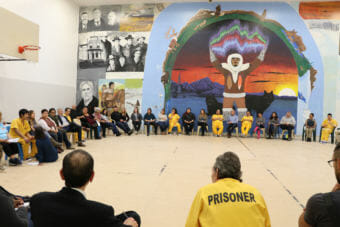
Community members gathered for a conversation at Anvil Mountain Correctional Center.
Community members gathered for a conversation at Anvil Mountain Correctional Center. (Photo courtesy of Danielle Slingsby)

Alexandria Niksik has been in and out of prison for seven years. Her most recent return home only lasted 16 days. But what might look like failure from the outside is actually a key step toward success and recovery from alcohol misuse.

When Niksik was a kid in St. Michael, a village in western Alaska, she learned some lessons pretty quickly.

“With just violence being a part of growing up in my childhood, it was always my first instinct to react violently,” she said during an interview at Anvil Mountain Correctional Center in Nome in the late summer. “Because I never knew any other way to express my emotions properly.”

Niksik saw some of the adults in her life using alcohol as a way to cope with their trauma from childhood, she said, so she started doing the same thing.

“Either numbing or enhancing my emotions, whether they were negative or positive, I’d always turned to alcohol to express my emotions,” she explained.

By 18, Niksik was involved with the criminal justice system. For a few years, she moved between Anvil Mountain Correctional Center and her village where she stayed with her family and her children. Eventually, she was sent to Hiland Mountain Correctional Center, the women’s prison in Eagle River — a huge change for her. There she received intensive outpatient treatment for alcohol misuse.

“I learned things that my parents didn’t have a chance to learn, and it played a role with how I should be a better person,” Niksik reflected.

She learned things like coping skills and ways to deal with her emotions. And then she was released. Niksik went back to St. Michael, back to her old friends and her old life. She said she was OK when she was with her children because they motivated her to stay sober. But when they left to stay with other family members, “When they weren’t with me, I felt lost completely.”

“I didn’t know what to do with myself when I didn’t have my children around,” Niksik said.

Niksik said she starting hanging out with the same people as before, and she gave in to peer pressure to start drinking again.

“It’s hard to change when you’re the only one who knows the steps to change and want to change,” she said. “Because those guys in St. Michael, they don’t have the opportunity that I did. And I was very overwhelmed with the step-up of showing them how to be there for them in the proper way that people were for me.”

After 16 days, state troopers took her back to Anvil Mountain.

David Patterson Silver Wolf, a professor of social work at Washington University in St. Louis, said Niksik’s situation is common. He has worked as a treatment provider and a researcher.

“Behavior changes is hard, right?” Patterson Silver Wolf said. “And it’s really hard to do when you have people who are convincing you that you don’t need a change.”

Patterson Silver Wolf is also a person in long-term recovery. He said having a support system of people who understand the changes you are trying to make is essential.

“I had these routines of using alcohol and drugs and doing those things,” Patterson Silver Wolf said. “I had to reinvent my whole self, which required that I had to make new friends and go to another community and oftentimes avoid the community where I gave in, where it was easy to give in.”

He said he also needed hope and motivation for change, just as Niksik needed the motivation of supporting her children.

Finding new people to hang out with is easier said than done in a village of 400, but Niksik said that her brief trip back to her village this summer actually gave her hope that she could do that.

“With the time that I was home, I learned who to avoid and who I was most vulnerable against when it came to questioning on whether I wanted to party with them or not,” Niksik said.

The experience was a reality check about what she needs to do in the future.

“I not only hurt myself or my parents, but I hurt my son. That hurts me the most because the look in his eyes when the troopers came to pick me up again. It’s still tearing at my heart,” Niksik said, her voice catching. “He still questions on why I had to come back to jail.”

Now, Niksik is heading to a long-term residential treatment program where she can live with her son. She said she’s ready to focus on her sobriety and prepare herself to return home.

She has plans for her future in St. Michael. She’s going to care for her parents and open a restaurant. And she’s going to be a supportive mother for her children.

Site notifications
Update notification options
Subscribe to notifications