Talking Trash

Talking Trash: Composting startup tackles Juneau’s green waste

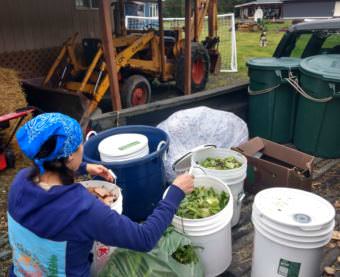
Lisa Daugherty, owner of Juneau’s sole composting service, empties residential green waste into her truck on Aug. 25. (Photo by Jacob Resneck/KTOO)

Compostable waste makes up nearly a quarter of the waste that ends up in Juneau’s landfill. Yet the food scraps, green waste and other organic material could be put to better use.

As part of CoastAlaska’s series, Talking Trash, a small Juneau venture is already demonstrating how it can be done.

Juneau Composts! is a woman-and-her-truck kind of operation: Lisa Daugherty and a green Chevy pickup.

Each Friday the commercial fisherman and small business owner drives from one end of Juneau’s road system to the other collecting compost bins set out by her customers.

This is her first year in business. Households and businesses separate their compostables and pay a monthly fee for her to haul it away.

“Community composting is something that goes on all over the country,” Daugherty said. “It’s actually shocking that it hasn’t happened here yet.”

Juneau’s landfill accepts conventional recyclables such as aluminum cans and plastics. But stuff like food waste otherwise gets lumped in with the rest of the trash.

Most of her clients already pay for curbside trash and recycling pickup — so why pay for another service?

For one, it’s keeping material out of the landfill.

Juneau’s privately run dump is projected to fill up in the next 20 years. That may seem like a long time away but finding another site won’t be easy.

Juneau has even talked about shipping its waste south, as five other Southeast cities do.

The city is working on a diversion strategy to extend the landfill’s lifespan, which could one day include a city-run composting operation on a large scale.

The City and Borough of Juneau’s solid waste official says composting food, paper scraps and green waste makes sense — on a number of levels.

“Diverting that waste stream from going into a landfill, that’s a huge benefit,” said Jim Penor, the city’s solid waste coordinator. “Another benefit is to actually compost it into a marketable product or a usable, beneficial use product, namely being a good topsoil.”

Juneau Composts! is already working the topsoil-production angle.

At an 8-acre property in an area north of town, Daugherty unloads the day’s pickups.

Under a tarp, there’s a compost heap she’s been tending since her operation started in April.

“Your compost pile is alive, it’s full of billions of organisms per gram — it’s crazy,” Daugherty said as she turns the pile with a pitchfork. “Basically when you create the right sort of environment, all those bacteria are colonizing and they’re working and they’re producing heat.”

She produces something that resembles an oversized meat thermometer to take its temperature.

She’s checks to make sure it reaches 131 degrees, to kill pathogens and making it safe to handle.

Eventually the bacteria breaks down the food waste, old paper and green matter into a dark mealy material called humus. It takes months to mature and smells faintly sweet — plants love it.

“It looks like soil, it’s high in organic matter, it’s full of nutrients and it’s definitely a good nitrogen boost,” she explained. “You can use it as a growing medium. When I make new raspberry beds, I mix in compost, sand and seaweed and that’s it – I don’t buy topsoil or get bagged topsoil or anything.”

Juneau Composts! owner Lisa Daugherty unloads residential food scraps on Aug. 25. (Photo by Jacob Resneck/KTOO)

Daugherty keeps track of how much compost is collected from each client. The tally will eventually be a credit towards buying the nutrient-rich mix she’ll sell for home gardening.

Her operation doesn’t approach the scale envisioned by the city’s municipal planners, but it demonstrates that it can work in Juneau, and that’s already earning praise.

“I think it’s wonderful what Juneau Composts! is doing,” said Darren Snyder, agriculture agent with the University of Alaska Fairbanks’s Cooperative Extension Service in Juneau. “Lisa has provided, essentially a truth-in-concept that people will participate and people will pay to participate. She’s able to successfully compost moderate quantities of waste and it certainly is doable, there’s no question that we can compost our waste here.”

It’s still small scale; Juneau’s privately run landfill takes in about 32,000 tons of garbage annually.

During the past six months, Lisa Daugherty’s personally diverted about 10 tons. But for Snyder there’s a moral imperative, especially when it can be put to good use.

“We can turn this stuff into something that’s beneficial and it just should be done – I don’t know how else to put it,” he said.

Talking Trash: You bought it. You tossed it. Now rural towns struggle to ship it out

Juneau's hazardous waste facility (Photo by Elizabeth Jenkins/Alaska's Energy Desk)
Juneau’s Hazbin program diverts about 2,000 pounds of hazardous waste a month from having to be shipped to the Lower 48. (Photo by Elizabeth Jenkins/Alaska’s Energy Desk)

When a household cleaner or a box of batteries is barged to one of Alaska’s remote communities and sold in a store, it’s commerce.

But many of those items aren’t destined for a one-way transaction.

A lot of hazardous waste shouldn’t be tossed in a landfill: radioactive smoke detectors, flares that can explode, chemicals that can poison you. 

At great expense, small municipalities are stuck trying to fix the problem: How do you get the potentially dangerous trash back out of town?

“This is where we put all the waste in containers when we’re offloading cars,” Aaron Widmyer said.

He’s leading me around a bulky Sony TV, a spray can of Raid and grease from a high-end restaurant.

We’re at Juneau’s hazardous waste facility, where people drop off their stuff that shouldn’t go in the dump.

Widmyer works for a company that contracts with the City and Borough of Juneau. He makes sure the trash is safely packaged, so it can be shipped out.

And he says the job comes with a few perks.

“The amount of free of stuff that I get,” he said with a laugh. “I haven’t had to pay for anything for the past two years. Household cleaning supplies, laundry, soap, car oil for my oil changes.”

It’s not just Widmyer who picks up the schwag.

Anyone in Juneau can stop by and look for a half-used bottle of their favorite cleaner or bug spray.

But what isn’t scavenged has to go somewhere else.

Alaska doesn’t have any permitted hazardous waste treatment or disposal plants. So regulated hazardous waste has to be shipped back down to the Lower 48.

Around the corner, in a city office occupied by one man, is where the negotiations for that happen.

Jim Penor is Juneau’s solid waste coordinator, and he knows this business inside and out. He got his start in Washington state.

“I grew up as a landfill kid rat,” Penor said. “I’d go around and have fun in the landfill and it wasn’t a landfill. It was a burn pit operation.”

Penor has been in Juneau for close to a decade, trying to make the math of shipping the city’s hazardous waste pencil out.

If you ask him, it doesn’t.

But during his time, he’s been able to make it more affordable. He saved the city about  $120,000 a year — just by figuring out a way to treat latex paint so it can safely go in the landfill.

And the capital city is one of only two communities in Southeast with a weekly drop-off site, which Penor says makes the whole operation run a lot more smooth.

“We have time to work the waste stream,” Penor said. “Before, at a one time even per month, you don’t have time to work the waste stream.”

Literally, a stream. It’s a term that’s used to describe the lifeflow of garbage from beginning to end.

Still, there’s some trash that’s so risky to transport, the cost makes it nearly impossible to barge.

Old smoke detectors and exit signs are radioactive, so Juneau has to shell out extra to ship those. Then, there are out-of-date boat flares, which are considered highly flammable. Right now, there’s no way to get those out of town.

This creates a giant paradox, Penor said.

Commercial products wind up on store shelves with relative ease. But once it becomes hazardous waste, it’s a lot harder to transport out.

“I mean, even Juneau here. We’re the capital city. We’re the biggest city in Southeast and we’re 32,000 people,” Penor said. “We struggle with it.”

Jim Penor -- Juneau's solid waste coordinator (Photo by Elizabeth Jenkins/Alaska's Energy Desk)
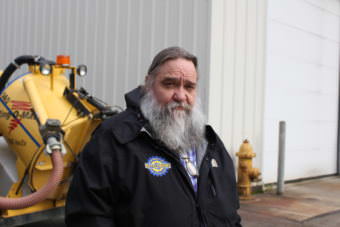
Jim Penor said after he retires this spring, he’ll travel on his yacht to small Southeast communities to discuss trash. (Photo by Elizabeth Jenkins/Alaska’s Energy Desk)

In rural parts of the state, the struggle is even worse and the stakes can be much higher.

The state’s Department of Environmental Conservation used to have a program that helped barge out hazardous waste, but it was cut in 2004. And since then, it’s been up to the communities to figure out their own method.

Sandra Woods, who inspects landfills for the state, says a lot of small municipalities are just trying to do their best. But the funds are limited and money is usually needed for other things, like clean drinking water.

“By the time you get to solid waste, the money is usually gone,” Woods said.

A federal program helps Alaska Native villages barge out hazardous wasteBut it’s being discontinued in 2020.

Lynn Zender, an Anchorage doctor who specializes in solid waste management and health risks, calls it an impending catastrophe.

“It’s very worrisome from a public health perspective,” Zender said.

She helps run an environmental nonprofit and is a member of the Solid Waste Alaska Taskforce, a group that’s trying to help villages prepare for the change.

Zender worries, as more hazardous waste goes into the ground, it could leach into the environment and contaminate subsistence foods.

“Those landfills will expand out to rivers. They can expand out to town,” Zender said. “The access can be so horrendous that people start just keeping their garbage in town.”

Penor thinks the state needs to step up and help more communities get rid of their hazardous waste.

He acknowledges it’s an unlikely scenario, given the state’s current budget deficit. But he envisions a fund that could earn interest — designed specifically for trash.

In the meantime, he said consumers should view that half-empty bottle of nail polish or antifreeze differently. There’s a branding issue.

“I don’t like the term hazardous waste,” Penor said. “Because you went to the store and purchased it.”

Penor said he’s never used a jug of Drano to unclog his sink. Even after it’s tossed, someone’s going to pay for it.

Talking Trash: In Ketchikan, you can salvage stuff from the landfill

Ketchikan artist Halli Kenoyerleft, uses recycled trash to build a set piece for a community theater production. Ketchikan issues permits for locals who want to salvage metal, bowling balls and whatever else they find at the landfill. (Photo by Leila Kheiry/KRBD)
Artist Halli Kenoyer, left, uses recycled trash to build a set piece for a community theater production. Ketchikan issues permits for locals who want to salvage metal, bowling balls and whatever else they find at the landfill. (Photo by Leila Kheiry/KRBD)

Southeast communities are always looking at ways to reduce the amount of trash that ends up in their landfills or that they have to ship south. In Ketchikan, people can come up to the landfill and take what they want. In this report, part of CoastAlaska’s series, Talking Trash, we learn how that program saves the city time, space and money.

“I love the dump! I go to the dump for all of my wearable art needs. That’s where I go first,” said Ketchikan artist Halli Kenoyer.

She said the local landfill is a great place to gather material for the large, complicated pieces she makes for Ketchikan’s popular Wearable Art Show.

Kenoyer also goes there when helping to build sets for First City Players, the city’s community theater.

“We’re making trees right now for “Shrek Jr.,” the children’s musical and we need tall things that will not break. The dump is a great place to go find things for free,” she said in an interview this summer.

Nissa Dash is another Ketchikan artist who loves the landfill. She’s helping Kenoyer with sets for “Shrek Jr.,” but she also gathers material for her own art. Dash has a penchant for the patina of rusty metal.

“I have to be careful, because I will go to the dump and — I have to sneak it,” Dash said, laughing. “I have stuff in the garage and in little places tucked away. And God forbid we have to move.”

“‘Honey, I need to bring my rust collection!’” Kenoyer joked.

“Exactly!” said Dash.

Those two aren’t alone in their scavenging.

Up at the landfill, surrounded by opportunistic ravens, Solid Waste Supervisor Lenny Neely said about 40 people are signed up for the city’s salvage permit program. He said they take more than 100 tons of stuff out of the landfill every year.

That’s 200,000 pounds.

“And in some way, shape or form, all that material is getting reused,” he said. “That’s the nice part.”

That saves the city money in a variety of ways. It reduces the work load, cuts back on space taken up by trash, and reduces the volume of items the city has to barge south.

Ketchikan’s landfill offers a permit program that allows people to come up to the fill and take anything that strikes their fancy. It saves the City of Ketchikan money, and recycles items that otherwise would take up space in the fill. (KRBD photo by Leila Kheiry)
Ketchikan’s landfill offers a permit program that allows people to come up to the fill and take anything that strikes their fancy. It saves the City of Ketchikan money, and recycles items that otherwise would take up space in the fill. (Photo by Leila Kheiry, KRBD)

Neely said it’s tough to know exactly how much money the city saves a year. For some context, the city pays almost $60 per ton to ship household garbage south.

Beyond art material, Neely said salvagers collect for commercial use. Popular material includes metal pipes and wooden boards, often discarded after a home remodel project.

Neely points to a tangle of copper pipe sitting on the ground next to the fill.

“This piece laying here. Whoever came up and dumped laid that there because they know a salvager will grab that,” he said.

And the person who picks it up likely is after metal they can sell for scrap. But, there’s other salvageable stuff in the fill.

“The possibility, I guess, is the foosball table,” Neely said, pointing. “I see some metal over there that somebody will grab. Bicycles are a big item. We get a lot of bicycles for whatever reason. A little bit of everything.”

Some people come for spare parts, others for specific collectable items. Landfill employee Tim Morgan said bowling balls are one example.

“There’s two bowling ball ladies,” he said. “They just collect them for decoration in their gardens and yards.”

Staffers don’t see as many bowling balls now as they did back when Ketchikan had a bowling alley.

Neely said he was surprised by Ketchikan’s salvage permit program when he first came to work at the landfill years ago, mostly because of the liability.

City of Ketchikan Solid Waste Superintendent Lenny Neely stands at the local landfill. He says discarded metal, construction material, bicycles and more are taken out of the dump through the city's salvage permit program. (Photo by Leila Kheiry, KRBD)
City of Ketchikan Solid Waste Superintendent Lenny Neely said discarded metal, construction material, bicycles and more are salvaged from the landfill. (Photo by Leila Kheiry, KRBD)

“But, the reality is here, it’s worked really well,” he said. “That’s recycling at its finest. When I first got here, I couldn’t believe. I was like, ‘We do what?’ We may be one of the very few places in the state that does that.”

Liability is one concern cited by other regional facilities, although Wrangell used to have a salvage program before it capped its landfill years ago.

Petersburg has something similar to Ketchikan’s salvage program. The fill there is open for salvagers just twice a week, though, and the permit fee is quite a bit higher: $10 per day versus $5 a month in Ketchikan.

Ketchikan’s landfill requires permit holders to sign a waiver, wear a safety vest and stay out of the fill when equipment is running.

Back at the First City Players building, Kenoyer leads a set-building workshop for kids participating in the “Shrek Jr.” production. She said when she’s on the hunt for supplies, she goes to the landfill daily.

She showed off some of her recently salvaged items: discarded Christmas decorations, metal tomato-plant cages and a big bag of fabric leaves.

“We have two long bamboo sticks that are 12-footers from the dump,” she said. “You don’t find that very often anymore, so it’s a real treasure to find that. Tied that sucker on top of my truck and I hit the road.”

That’s salvage success.

Talking Trash: Follow the garbage Southeast ships south

Household garbage from Sitka, Ketchikan and three other Southeast Alaska cities ends up in the Roosevelt Regional Landfill in Klickitat County, Washington. (Tom Banse/Northwest News Network)
Household garbage from Sitka, Ketchikan and three other Southeast Alaska cities ends up in the Roosevelt Regional Landfill in Klickitat County, Washington. (Photo by Tom Banse/Northwest News Network)

When you toss a candy wrapper in the trash, you’re sending it on a thousand-mile journey to a Lower 48 landfill. That’s the case if you live in one of five Southeast Alaska communities that send their garbage south via barge, truck and train.

We’ll take you on that trip, beginning in Sitka, as part of the CoastAlaska News series, Talking Trash.

Sitkan Megan Pasternak stands in her kitchen, holding a bag of garbage. So, what’s inside?

“Not much. There’s a couple used paper towels, I hate to admit,” she said. “And some stuff that could be composted because it’s vegetable stuff, but we don’t do that anymore because of the bears around here. And some plastics that I couldn’t recycle and a few odds and ends.”

And does she ever wonder what happens to it after it gets picked up by the trash truck?

“Not really, but I always like garbage day because it goes away from my house and just disappears,” she said, laughing.

Of course, it doesn’t. A garbage truck picks up her trash can, dumps the contents inside and hauls it to a solid-waste transfer station across town.

Jim Walters, with Waste Connections, operates a front-end loader to push trash aboard a container van, staged on the lower level of the Sitka Waste Transfer Station. (Robert Woolsey/KCAW)
Jim Walters with Waste Connections operates a front-end loader to push trash aboard a container van, staged on the lower level of the Sitka Waste Transfer Station. The containers are barged to Seattle. (Photo by Robert Woolsey/KCAW)

There, it and most other Sitka trash is unloaded, shoved into shipping containers and trucked back across town to a barge dock. There, it joins more containers from Sitka and other Southeast towns.

Sitka’s trash has taken that trip since the year 2000, when officials realized they were running out of space.

“The landfill was reaching a level to where it needed a new location. It was becoming a mountain,” said former Sitka City Administrator Hugh Bevan.

He said officials considered building a new dump. But more stringent environmental regulations would have made it extremely expensive.

New landfills have to virtually eliminate polluted runoff. And that’s hard to do in Southeast, where it rains up to 12 feet a year.

“And the idea of shipping waste to an off-island landfill rose to the top as being the most cost-effective over the long term,” Bevan said.

Trash from Southeast Alaska and the Pacific Northwest travel by train from Seattle to the Roosevelt Regional Landfill, near the Columbia River. (Tom Banse/Northwest News Network)
Trash from Southeast Alaska and the Pacific Northwest travel by train from Seattle to the Roosevelt Regional Landfill near the Columbia River. (Photo by Tom Banse/Northwest News Network)

Sitka now barges approximately 8,000 tons of garbage a year south. When added to trash from four other Southeast cities, it totals about 22,000 tons. Another 1,300 tons of regional recycling is shipped the same way.

The approximately 800-mile Alaska Marine Lines barge trip covers long stretches of open water and sometimes rough seas. It takes about 10 days.

After arriving at the barge dock, the containers are loaded onto trucks for a short ride to the Republic Services rail yard, just south of downtown Seattle. Once loaded onto rail cars, they head about 300 miles east to the Roosevelt Regional Landfill in southcentral Washington.

The final destination

That’s where the long journey of southeast Alaska’s trash comes to an end.

The landfill is in a wide bowl a few miles above the Columbia River. It’s bone dry and there’s not a neighbor in sight, which are two key reasons why it’s been so successful in getting contracts with cities near and far.

“It’s under the radar and that’s really the way we like it,” said Don Tibbetts, a Washington state-based manager for Republic Services, which owns the landfill.

“People like the garbage ferries to just take care of the garbage,” he said. “They don’t want to know where it goes. They just want to make sure it is being handled responsibly.”

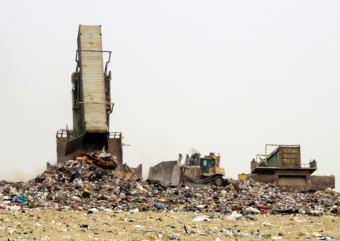
Don Tibbets looks over piles of garbage at the Roosevelt Regional Landfill, where he served as general manager. The landfill takes in about 22,000 tons of Southeast Alaska garbage each year (Photo by Tom Banse/Northwest News Network)
Republic Services’ Don Tibbets looks over piles of garbage at the Roosevelt Regional Landfill, where he served as general manager. The landfill takes in about 22,000 tons of Southeast Alaska garbage each year. (Photo by Tom Banse/Northwest News Network)

Tibbets said the regional landfill business took off when the U.S. Environmental Protection Agency cracked down on polluted runoff from garbage dumps. He said this landfill is “highly engineered” with liners and collection systems to capture and treat whatever harmful liquid does percolate through.

Southeast Alaska’s garbage is not alone. Much of Western Washington’s trash also heads here on trains often stretching more than a mile long.

“More than likely, about 10 percent of the containers you see on the train in front of you has Alaska waste on it,” Tibbets said.

One last truck ride shuttles the garbage containers a short distance uphill to the landfill, where the trash is finally tipped out, compacted and buried.

The decomposing garbage generates landfill gas, or methane. A network of pipes and wells collects that gas and sends it next door to a small power plant to be burned to make electricity. So in a small way, the banana peels and hamburger wrappers Alaskans throw away indirectly light homes in the small towns of southcentral Washington state.

Three other regional landfills are also located along the Columbia River.

Other options

Before Southeast communities started shipping garbage to the Lower 48, they considered a similar option — not so far away.

A group of cities called the Southeast Alaska Solid Waste Authority looked at a chunk of land in Thorne Bay, a former logging camp on Prince of Wales Island’s eastern shore.

City Administrator Wayne Benner heads up the authority’s board.

“That actually was a serious prospect,” he said. “When they first started out they were looking at a regional landfill facility. But when the study was done to look at it, it did not pencil out.”

So Petersburg, Wrangell and Klawock joined Sitka and Ketchikan by hiring Republic Services to haul its garbage south. Benner said Thorne Bay will be next.

It’s always possible that new technology and attitudes will change how the region’s garbage is handled. But ‘til then, Sitka’s Hugh Bevan thinks barging it south is the best solution.

“The thing to keep in mind with solid waste is that you’re responsible for it forever,” he said. “So if you build a landfill in your town, the responsibility for it flows to the next generation, along with all the capital costs associated with it.”

Not every Southeast community ships out its trash. Juneau, with about half of the region’s population, still uses a local landfill. So does Haines.

In both cases, garbage collection and disposal is done by a private company.

Most of Juneau's garbage ends up in the local landfill, operated by Waste Management. A municipal study estimates it will fill up in about 20 years. (Ed Schoenfeld/CoastAlaskaNews)
Most of Juneau’s garbage ends up in the local landfill, operated by Waste Management. A municipal study estimates it will fill up in about 20 years. (Photo by Ed Schoenfeld/CoastAlaskaNews)
Site notifications
Update notification options
Subscribe to notifications