Alaska Native Arts & Culture

Alaskans Mourn Katie John

Photo by Sara Bernard, APRN Anchorage

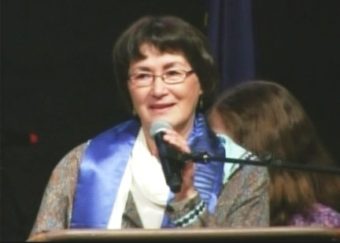
A public memorial service for Ahtna elder Katie John drew a crowd Wednesday in Anchorage. John inspired Alaska Natives, and at least one Alaska governor, with her unyielding stand on Alaska Native subsistence rights.

Photo by Sara Bernard, APRN Anchorage

Yvonne Echohawk, a pastor and an adopted daughter of Katie John, officiated. Echohawk likened John to Biblical heroines. She said her mother never bowed to bitterness in her fight for Native rights.

“Miss Katie John walked up before lawyers, and judges and tv cameras and people, and she said ‘give me my land, give me my water, give me my fish, I want justice for my people.’ And she didn’t rest until she had it. A woman of God, called of God, knew what she had to do and did it. She knew she had a destiny. She knew she had a purpose. And she did it and she did it well,” Echohawk said.

Photo by Sara Bernard, APRN Anchorage

Former state legislator Georgiana Lincoln read the eulogy, remembering John’s sense of humor, and thanked her for the “blessing to all of us” that followed John’s insistence in 1984 that her fish camp be opened for subsistence fishing.

“Our beloved leader, elder, loved one, Katie John, we mourn your passing. But we smile your contagious smile, knowing you are at last with those loved ones who waited for you, to dance longer, laugh louder, and play harder.  Job well done,” she said.

The legal wrangling that followed John’s lawsuit went on for a decade, until Alaska Governor Tony Knowles decided not to fight the case any longer. Knowles could not be present at today’s memorial, but he sent a letter, read by Echohawk, about meeting John at her fish camp face to face.

“I leaned more that day about rights and values than all the boxes of legal briefs and opinions of a 10-year old divisive lawsuit could ever say. I thank Katie John for being a teacher, I thank Katie John for being a protector of her family, I thank Katie John for being a great Alaskan, fighting for the rights of the people of the Great Land,” Knowles’ letter read.

Friends and relatives of Katie John filled the Anchorage Baptist Temple for the service. Many called her Chook-tay, or Grandma.

[box]
Photo by Sara Bernard, APRN Anchorage

Bob Anderson: “I was Katie’s Lawyer when we started the famous Katie John Case in 1985. She’s an important figure for the upper Ahtna people but she’s really a part of the Alaska Civil Rights Movement, not just Native Right, but Civil Rights – and she’s a sweet kind person too.

Donna Pennington: “I grew up in the village of Mentasta. She adopted me in 1969 in the Village of Mentasta and taught her language in the school during my generation. So we were very fortunate that we got to get the language directly from her.”

Eruera Kawe: “My mother in law was adopted by grandma Katie. So I’m originally from New Zealand. Grandma Katie was an inspiration to us. And not only was she a mother, grandmother, a great grandmother to Athabascan people, but to many other nations around the world.”

David Harrison: “She was my relative. You know when she gave you a hug, you knew things were gonna be okay.”

[/box]

John’s legacy lives on with her over 250 grandchildren, great grandchildren and great-great grandchildren. She will be buried in her home village of Mentasta on Saturday.

Yakutat’s tern festival in sound and pictures

A group of birdwatchers looks for seabirds from Sandy Beach during the Yakutat Tern Festival. Click for a slideshow of festival images. Photo by Ed Schoenfeld, CoastAlaska News.

Birders, biologists, carvers and kids gathered in Yakutat May 30th to June 2nd for the northern Southeast community’s annual tern festival.

The event included lectures, field trips, art classes for kids, a live raptor show, fund-raising meals, Tlingit oratory and a performance from the Mount Saint Elias Dancers.

Here’s an audio post card of the event, which celebrates the return of one variety, the Aleutian tern.

Five Aleutian terns sit on a protected beach on Yakutat’s Black Sand Spit, a nesting area. Photo by Ed Schoenfeld, CoastAlaska News.


Athabascan Elder Katie John was ‘a role model for Alaska Natives’

Katie John
Katie John. (Photo by Chris Arend. Photo is owned by Ahtna, Incorporated.)

The Athabascan elder who was the lead plaintiff in a lawsuit that strengthened Native subsistence fishing rights in Alaska has died.

Katie John passed away early Friday morning at the Alaska Native Medical Center in Anchorage. She was 97-years-old.

The Athabascan elder who was the lead plaintiff in a lawsuit that strengthened Native subsistence fishing rights in Alaska has died.  Katie John passed away early Friday  morning at the Alaska Native Medical Center in Anchorage. She was 97 years old.

 John and the Mentasta Village Council sued the U.S. government in Federal Court in 1985 when the Alaska Board of Fisheries did not allow them to fish at an abandoned fish camp in an area which is now part of Wrangell-Saint Elias National Park.

 The suit claimed the federal government had unlawfully excluded subsistence fishing from the protections of the Alaska National Interest Lands Conservation Act. The judge ruled in John’s favor in 1994. The state of Alaska battled that ruling, but in early 2001, the 9th Circuit Court of Appeals upheld the ruling.

Later that year, then governor of Alaska Tony Knowles announced he would not fight the 9th Circuit decision before the US Supreme Court.  A delighted Katie John said the governor told her of his decision in person

“This morning he called me he said no more. You got everything. So I was so happy, I was pretty sick, too, this morning and the last couple of days I’ve been sick, I got a cold. So when he talked to me about the case, I was jumping around. [laughs] I forgot my sickness.”

 At the time, Knowles told the Alaska Public Radio Network that  he made his decision because the litigation was only widening the gap between urban and rural Alaskans

“I think anyone that would talk to Katie John and to look at what she does would believe that what she does is right. It’s not wrong, to provide for her family in the best way that she knows how is right for her, for her family and for thousands of other families from Metlakatla to Bethel to Noorvik. This is something the state must support. You know, we have to stop that losing legal strategy that we have pursued for ten years, and stop the permanent divide that it has threatened to cause among Alaskans.”

 Native American Rights Fund attorney Heather Kendall Miller, who represented John in court, says John continues to be a role model for Alaska Natives.

“She represents the Alaska Native determination to hold onto their way of life, that is intimately connected to the land and is a very rich and rewarding life that has become known as subsistence way of life. And she wanted to pass on the customs and traditions to her family and her children and her community. And that is what she spent her life doing.”

John received an honorary doctor of laws degree from the University of Alaska Fairbanks in 2011 for her advocacy of indigenous rights and her ongoing efforts as a teacher of culture and language. Dr. Jim Kari with the Alaska Native Language Center in Fairbanks, worked with Katie John on efforts to preserve Alaska Native languages by developing an alphabet of the Athna Athabascan dialect.

 “One memorable statement by Katie John is ‘everything I know, I keep in my head.’ Just this morning I spoke briefly with Chief Fred Ewan, who said this, ‘we lost the best woman we ever had.’ “

 John raised 14 children and six adopted children with her husband Mentasta Traditional Chief Fred John.

Family members have not released plans for a funeral yet.

Update:

A funeral service has been scheduled for late Athabascan elder Katie John.

John’s funeral will be held at 1 p.m. Saturday at her home village of Mentasta.

A visitation service is set for 2 p.m. Wednesday at the Anchorage Baptist Temple.

This story has been updated to include comments from people who knew Katie John.

Planning Commission OKs Soboleff Center permit

The Walter Soboleff Heritage Center will be built on this lot on the corner of Seward and Front streets, across from Sealaska Corp. Photo by Justin Heard/KTOO.

The Juneau Planning Commission has approved a Conditional Use Permit for the downtown Walter Soboleff Heritage Center.

It smooths the way for the 29-thousand square foot, three-story building, which will house Sealaska Heritage Institute offices and cultural, artistic and ceremonial spaces.  Sealaska still needs to get a city building permit.

The commission granted the Conditional Use Permit on Tuesday, placing conditions on lighting and fuel deliveries.  The proposed building will be heated by a pellet furnace, and commissioners said pellet deliveries must be limited to weekdays before 8 a.m., or Saturdays.

The Sealaska parking lot across Seward Street will be used as construction staging area.  The 46-space lot is reserved for Sealaska employees and other businesses during the day, but is open to the public at night.  CBJ Community Development Planner Beth McKibben says 18 parking spaces will be available during construction.

When the cultural center is complete, Sealaska plans to reconfigure the parking lot for 50 spaces to be used for the Soboleff Center.

Sealaska Heritage officials hope to break ground for the project this year.

Fishermen found guilty, although court agrees subsistence salmon fishing is religious

Napaskiak elder, Noah Okoviak, was one of several fishermen to be sentenced May 20. Photo by Lillian Michael.

Nearly 50 fishermen were cited for illegal salmon fishing last June. Half of them pled not guilty and have been fighting it in court ever since.

In recent weeks, the fishermen had been waiting to hear a decision on whether they have the religious right to subsistence fish, even during state closures.

The trial resumed May 20 in Bethel and the fishermen packed into the courtroom with some people left standing in the hallway. It was a trial by judge and Judge Bruce Ward, in a gentle voice, said the court found that the state’s need to restrict King salmon supersedes the fishermen’s right to religious practice.

“The court wants all parties to know that this was a very difficult decision to make,” Ward said. “This was not easy.”

The fishermen were challenging the state based on a free exercise clause of the Alaska constitution, arguing that subsistence fishing is a religious practice and that when they fished last summer during closures, they were practicing their religion.

Judge Ward said he did a lot of research, including looking at an older case, Frank vs. the State, which was decided by the Alaska Supreme Court in 1979. That case shows that the free exercise clause may work when three things are met: 1) religion is involved; 2) the conduct is religiously based; 3) the person is sincere.

The judge found the defendants met the first two, no problem. It was obvious from the expert testimony the court heard on Yup’ik culture. The sincerity question would be addressed later by each individual trials.

The sticking point came when Western science entered into the argument. Based on the testimony given by state and federal fish biologists last month, the court decided that there is a compelling need to restrict the Kuskokwim King run based on recent data. Where in the Frank case, it was about the need to take one moose for a ceremonial potlatch, which wouldn’t have affected the population of moose, in this case the fishing could have had an adverse affect.

“Therefore, this court finds the need to police the Chinook run to ensure its continuity for future generations of Yup’ik fishermen and families overcomes the argued for free exercise exemption which would otherwise apply,” Ward said.

Although each case must be heard separately for the court to determine the fishermen’s sincerity, Judge Ward said those finding won’t sway his guilty verdicts.

That held true in the first trials against fishermen Felix Flynn and Peter Heinz. Both had their nets seized last summer and both got emotional on the stand. Felix Flynn wiped tears away saying that it had been hard answering questions from his young grandson:

“He asked me, when are we going to check the net. I couldn’t say nothing…because we didn’t have no net out there…because he witnessed me when we set the net. And that’s really painful.”

So far, the court is finding that all the fishermen were sincere in their religious beliefs but is finding them guilty anyway. Most are being sentenced $500 dollars with half of it suspended and put on probation for one year.

The defense, led by James Davis Jr. with the Northern Justice Project, plans to appeal, and the judge says the Alaska Supreme Court should review the Frank case.

“I think the Alaska Supreme Court needs to address some of the parameters that was outlined in Frank 40 years ago. It’s been a long time and the situation in this case is very different for a number of reasons.”

At some point during the proceeding, the courtroom was infused with the smell of dry fish as someone in the gallery passed around a gallon baggie full of it, sharing it with everyone.

The individual trials will continue at the Bethel Court House until all remaining fishermen are heard.

Site notifications
Update notification options
Subscribe to notifications