Alaska Native Arts & Culture

Museums, attractions gear up for more ships, passengers (+ slideshow)

Four armed, armored figures display Tlingit war gear created by Sitka’s Tommy Joseph as part of the Alaska State Museum’s “Rainforest Warriors” exhibit. It’s one of three Alaska shows tourists will see this season. Click here to watch a slideshow from the exhibit and Kay Field Parker’s “Playing with Lightning.”

Alaska State Museum Exhibit Curator Jackie Manning is confronted by some imposing figures every time she enters its main gallery.

They’re well-armed, well-armored mannequins, displaying years of carving by Sitka Tlingit artist Tommy Joseph.

“And when you first walk in, you’re met by all six of them and they‘re up and they have this presence that I think really gives you the sense of what it would be like to encounter these warriors in life,” she says.

She points to one of the figures, with an abalone-eyed helmet, shelled, protective neck gear and the historic equivalent of a kevlar vest.

“Every time I see it, it leaves quite the impression because it’s fully dressed with the slat armor and the collar and the tunic and the bow and the arrow as well as the dagger. It’s just such a beautiful example of all of the armor on one figure,” she says.

The museum is a popular Juneau tourist destination, catering to cruise-ship passengers and independent travelers, as well as locals.

It, and other parts of the tourist industry, will likely see more people visit the state this year. Larger cruise ships are on their way, bringing visitors through Southeast and across the Gulf of Alaska. Many tourists continue north, riding and flying to the Railbelt and on to places north and west.

This season’s visitors to the state museum will also view Juneau’s Kay Field Parker’s Ravenstail weaving and Sitka’s Nicholas Galanin’s contemporary Tlingit-Aleut art.

“I think the three shows really work together very well and are going to give our all of our visitors a great impression of the kind of artwork that’s done in Alaska,” she says.

The Marten Helmet, part of the “Rainforest Warriors” exhibit. Click here watch a slideshow from the exhibit, as well as Kay Field Parker’s “Playing with Lightning.”

The museum is but one of hundreds of attractions and excursions ready for Alaska’s 2013 tourist season.

“It looks excellent,” says John Binkley, president of the Alaska Cruise Association, which represents Princess, Holland America and other large-ship lines sailing Alaska waters.

“It looks like this will be the first time since 2009 that we’ll get back above the 1 million mark for cruise visitors coming to Alaska.”

He says the ships will bring nearly 70,000 more visitors north this season.

They’ll come aboard 28 large ships, one more than last year. And three lines will send larger vessels than last year, making close to 500 separate voyages.

“The indications that we’ve gotten are that the prices are holding steady, which means that there’s less discounting and usually people who are a little more affluent are coming to Alaska. That should be good news for retail merchants as well as those who have shore excursions that hopefully people purchase when they get off the ship,” Binkley says.

“The industry is cautiously optimistic that it will be a great summer and total visitor season,” adds Sarah Leonard, president of the Alaska Travel Industry Association, a statewide tour-business group.

“Last summer we know that visitors reached 1.8 million in Alaska. And that was the first increase we saw in over four years. And then with some new … airline service and new cruise-ship berths, we see positive growth,” Leonard says.

Back at the Alaska State Museum, dozens of Kay Field Parker’s ravenstail weavings are on exhibit, in a summer show called “Playing with Lightning.”

Leggings from the “Playing with Lightning” exhibit.

“Lightning is one of the patterns, a triangle pattern that repeats, but it reverses,” says Manning, the museum curator.

She describes ravenstail as highly geometric. The technique was rediscovered in the 1980s after being out of use for about two centuries. Manning says Parker’s work follows the old ways, with some variations.

“The traditional colors were white and black and yellow. And the majority of Kay’s work reflects those traditional colors. And based on materials, because they’re so hard to come by for weavers that do this kind of work, she also has some other colors she’s introduced,” she says.

This is the final summer exhibits will be on display in this aging museum. It will be torn down next year and eventually replaced with a modern structure including the state library and archives.

Meanwhile, the cruise-and-tourist season continues through late September. In addition to large-ship lines, the number of smaller tour vessels is increasing this year.

Spring whaling begins in Arctic

Beluga Whale
Beluga Whale (Photo by Ansgar Walk)

Despite the lingering effects of winter, spring whaling has begun in Arctic Alaska and seal hunters are also heading to the coast from Chevak in the Southwest part of the state. Grace Levettte with the Alaska Eskimo Whaling Commission in Barrow confirmed that whaling crews on St Lawrence Island have landed a total of three bowheads so far – two for Gambell and one for Savoonga.

Farther south on the mainland, seal hunters from the Cu’pik community of Chevak are hauling their boats to the coast for spring seal hunts. John Atchak lives in Chevak and is a long time hunter. He’s been watching hunters head to favorite coastal spots toward Hopper Bay and Nelson Island.

He says harbor, spotted and bearded seals are an important part of Cu’pik dinners.

“That’s our mainstay diet in our area and it provides a lot of iron for our bodies, required iron, and it’s a real healthy food,” Atchak said.

Atchak says local hunters haul their boats behind snowmachines on homemade wooden sleds, traveling from eight to 30 miles. He says crews with at least 10 boats have left over the past two days. Sometime in May, when they see the right signs, they will hunt belugas.

“When the herring arrive, that’s when the beluga arrive, along with the fish,” Atchak said.

Atchak says they will hunt until mid May.

Anchorage kids’ kayak co-op kickstarts fundraising

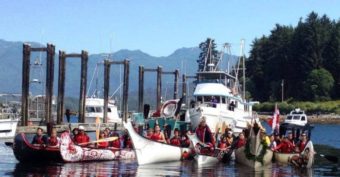
In Juneau on Tuesday, canoes were launched for an 8-day trip to Wrangell for the rededication of the Chief Shakes Clan House.
In Juneau on Tuesday, canoes were launched for an 8-day trip to Wrangell for the rededication of the Chief Shakes Clan House. (Photo by Megan Ahleman)

An Anchorage-based co-op is raising money to begin after-school training that combines ancient techniques of kayak design with education.

Kayaks were invented by people of the north. Unangan, Supiat, Yup’ik, Inupiaq, and Inuit hunters used them to hunt seals and other marine mammals. Co-founder David Karabelnikoff says the Kayak Co-op was inspired by a movement in southeast Alaska to revitalize canoe building and paddling… and with the goal of encouraging youth to learn science, technology, engineering, and math:

“We’re blending the revitalization of traditional kayak, and ikiak, and umiaq building with the modern technology of maker space, digital fabrication. So that would look like LED scanners, laser scanners, laser cutters, CNC machines, 3-D printers and things of those type.”

Traditionally every aspect of the kayak was fitted to the owner’s body to make a watertight, stable yet maneuverable boat they could use in stormy Arctic waters. Karabelnikoff says the kayak coop will replicate those techniques to manufacture custom-fitted kayaks. He says the project will preserve kayak design techniques and communicate the role of kayaks in traditional life:

“It’s really something that both Alaska Natives can understand and get inspired by, but also that non-Native and folks that around the world will understand what we’re trying to do and the deep significance of the kayak into the Inuit life, and what this cultural revitalization means for our people, and not just us but also for them.”

In Juneau on Tuesday, canoes were launched for an 8-day trip to Wrangell for the rededication of the Chief Shakes Clan House there. Karabelnikoff says the co-op’s project will teach youth how to create, build and paddle their own kayak… and he’d like to see kayak trips, races, and other activities become part of modern life… all with the goal of setting at-risk youth on a healthy path:

“I hope this project will help to solve the suicide epidemic that we have in the Alaska Native community and that Alaska Natives will be looked at in a positive light for the things that we have contributed to humanity, and the kayak being one of those technological marvels that few other, and other people in the Arctic have developed but is really something that we can claim as our own and claim as something that makes us feel good, and the larger community respect our abilities and capabilities for what we’ve done.”

The co-op spells kayak with q’s instead of k’s. It’s using the internet fundraising site, Kickstarter.com to launch the project.

Congress looking at Sealaska Lands Bill

The latest Sealaska land conveyance bill had its first public showing in Congress on Thursday.

The public lands panel of the Senate Energy and Natural Resources Committee heard from two federal agencies about transferring 70,000 acres of the Tongass National Forest to the Sealaska Corporation.

While the bill’s supporters are optimistic it will pass, there are still a couple of major hurdles.

Every regional corporation formed by the Alaska Native Claims Settlement Act is entitled to land. Sealaska is the lone corporation yet to finalize its land transfer.

The corporation is entitled to about seventy thousand more acres.  Problem is, it’s been difficult finding agreement on where the remaining land should come from.

“Nearly every acre, I would venture that every acre of the 16.9 million acre Tongass, is precious to someone,” Senator Lisa Murkowski said.

She says there have been more than 175 revisions to the land transfer bill since it was first introduced more than five years ago. The bill would amendment ANCSA.

Murkowski, who spent part of her childhood in Ketchikan, calls this version the most fair to all involved.

Not everyone will be satisfied. Some environmental groups worry this legislation would set a precedent that would allow other Native corporations to choose new land.

Sealaska selected its acreage, but it wants to pick different sites with more valuable timber prospects. Officials also say they dropped some selections because they were too environmentally sensitive.

Jim Pena is the associate deputy chief of the National Forest System.

“We believe the circumstances around this bill are unique, and no such precedent would be created,” Pena said.

And as Pena said this, a satisfied Murkowski nodded in agreement.

“We went around and contacted all the Native corporation heads, gained assurance that they understood the unique situation that Sealaska faces, and that they do not consider this some kind of precedent,” Pena said.

So that issue should be cut and dry. But it’s not.

Sitting at the table next Pena was Jamie Connell, from the Bureau of Land Management. Both the BLM and Forest Service have stake in the Tongass.

“We can’t give an absolute on some of the issues that were brought up; an absolute that another corporation wouldn’t come in and ask for similar treatment,” Connell said.

Even though Connell hedges, BLM is closer to certainty than it’s been before.

There’s still one major issue though. What kind of trees Sealaska will be able to cut.

The Forest Service worries that the land conveyance will affect the transition from old-growth harvest to new growth.

Murkowski styles the transition as a lifeline to the struggling timber industry.

“These existing timber businesses need some time. They need sufficient timber. And they need economic certainty in order to survive and to have any chance of this transition succeeding,” Murkowski said.

She says she’s willing to compromise on the issue. The Forest Service says the transition is a 10-15 year process. But most new growth is far more decades away from being ready to harvest.

Some conservationists welcomed the changes to this version, such as Joe Mehrkens.

“There are improvements,” Mehrkens said. “The first versions were absolute wish lists for Sealaska.”

Mehrkens, a retired Forest Service employee, sits on the board of the Greater Southeast Alaska Conservation Community.

He says this plan saves prime land on Prince of Wales Island, but it’s still too degrading to the environment to support.

Chris McNeil is the president of Sealaska. He says the company met with every interested stakeholder.

Nine small communities on or near Prince of Wales Island oppose the transfer. McNeil dismisses them saying most of Southeast supports the transfer.

“Naturally you can’t have 100 percent of the constituency in favor of it. They’ve taken a position. But we’ve worked all the parties nonetheless,” he said.

McNeil says he’s optimistic this version can pass because it’s been tweaked to try and meet everyone’s needs.

The previous version stalled in the Senate last year. A similar measure passed the House, but went no further.

There is one indication a public lands bill could move this Congress: Senate Majority Leader Harry Reid testified before the committee. He needs Senate action on a Nevada lands bill.

And Reid controls the legislative calendar of the chamber.

AFN lobbies for protection of subsistence rights

Alaska Federation of Natives logo

At its annual convention last October, Alaska Federation of Natives delegates adopted a proclamation that Alaska Natives would use every political and legal means to achieve full and lasting federal protection of the Native hunting, fishing, and gathering way of life, and co-management of subsistence resources. Here’s what AFN’s doing to address the issue.

Nelson Angapak is Senior Vice President for the Alaska Federation of Natives. He says AFN lobbied U.S. Sen. Lisa Murkowski to hold oversight hearings on subsistence. Murkowski held a hearing in Bethel earlier this month and has another scheduled in Copper Center in May. Angapak says the goal is changes to federal law that will strengthen protections for subsistence:

“Our hope is Congress will recognize hunting and fishing of Alaska Natives is the life of our folks, and enact legislation would allow us to pursue fish and game for subsistence in such a manner folks in rural Alaska will benefit.”

Anthropologist Rosita Worl is president and CEO of the Sealaska Heritage Institute. She’s been the chair of AFN’s subsistence committee for ten years. She says Alaska Native needs for subsistence goes beyond food security:

“The way scientists look at it, they see three different components of subsistence, the economic dimensions, and we know that today we both have cash and subsistence, so we have duel economies in the villages. And then we have the social aspect of subsistence and here we usually have kin-based groups that go out and harvest and utilize the resources. And the cultural dimensions involve the special, the spiritual interrelationship that Native people have with their environment and with the wildlife or animals.”

She says one Native belief is that animals will come to a person who lives according to Native values, who lives the “right way:”

“One of the right ways is sharing. When you harvest resources, it creates an obligation for you to share those resources. And there are different laws, or protocols that different societies have. For example, the first harvest, and this applies to a young person when they take their first seal, when they take their first deer, they’re obligated, or even first whale, they’re obligated to share all of those resources with others. And it usually starts at a very young age. So very early, they’re imbued, or taught the right way of utilizing and sharing the resources with community members.”

Worl says Congress recognized the importance of subsistence to Native and non-Native people who live in rural Alaska, in the Alaska National Interest Lands Act, or ANILCA. It provides a rural preference for the subsistence harvest of traditional resources of fish and game. However, that conflicts with the state Constitution, which calls for equal access to resources by all citizens. To carry out ANILCA, federal agencies took over management of fish and game on federal lands from the state in the 1990s. But Worl says myriad agency decisions chip away at subsistence rights:

“I know the law says in a time of shortage, subsistence should be taken care of, but what happens is, it seems preference is always given to other kinds of uses over subsistence. And subsistence people, I mean just a continuous struggle to be able to maintain that subsistence.”

Last week, 22 Yup’ik fishermen were on trial in Bethel for fishing during the second of two closures of subsistence fishing for Chinook, or king, salmon. Their attorneys are arguing the fishermen were exercising constitutionally protected religious and cultural practices. For years, western Alaskans have said federally managed Pollock fisheries in the north Pacific are damaging salmon runs. Earlier this month, NOAA’s Alaska Fisheries Science Center released a genetic analysis showing 68% of the Chinook caught as bycatch in the Bering Sea and Aleutian waters originate in western Alaska rivers.

Sealaska holds “First Tree Ceremony” to launch 2013 timber harvest

Sealaska Corp. kicked off its 2013 timber harvest program with a First Tree Ceremony.

The Juneau-based regional Native corporation says in a press release that the event is like a Blessing of the Fleet at the beginning of fishing season.

The company says the ceremony was held April 13 on Prince of Wales Island near Big Salt, just north of Klawock.

Site notifications
Update notification options
Subscribe to notifications