Alaska Native Arts & Culture

Celebration begins with arts campus opening and totem pole dedication in Juneau

The Sealaska Cultural Values Pole was dedicated at the Arts Campus opening during Celebration. June 8 2022, Juneau AK (Photo by Yvonne Krumrey, KTOO)

The Sealaska Heritage Institute’s new arts campus was formally opened and dedicated on Wednesday afternoon.

Its name was announced at the ceremony — Antnané Hít, or House of Art.

Ricardo Worl, communications director for SHI, said the project was funded by over 2,000 individual donors, mostly in Southeast Alaska. 

“To us, that indicates there’s a lot of support for Lingít art or our culture: a recognition of, you know, that we’ve been here,” Worl said. 

The Sealaska Cultural Values Pole was dedicated at the Sealaska Heritage Institute’s  arts campus opening during Celebration on June 8, 2022 in Juneau. (Photo by Yvonne Krumrey/KTOO)

Classes have already been happening while the building was under construction. So far, there have been classes to learn how to make Tinaa,  small copper shield pendants, and how to weave cedar hats. 

“The way the building is designed, you know, we have a metals studio, we have a textile studio, we have a wood carving studio,” Worl said.

Upcoming art courses may be halibut hooks and bracelet making. Worl also said that SHI is looking into revitalizing other endangered art forms, too.

It’s not just the material arts that SHI had in mind when designing this campus. The covered outdoor pavilion is designed for musicians and dancers to perform.

“This is just the beginning of making Juneau the Northwest Coast art capital,” Worl said. 

One theme of the opening was unity among Lingít, Haida and Tsimshian people. The totem pole that now looks over the plaza is carved on all sides, which is a first in Alaska. It’s been named the Sealaska Cultural Values Pole. 

The carver, TJ Young, is Haida and he worked with guest carvers Rob Mills, who is Lingít, and David R. Boxley, who is Tsimshian, making the pole a collaborative piece that features all three Southeast Alaska Native groups. 

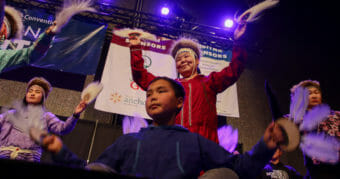
The opening ended with a carver’s dance, featuring Young, his brother, and apprentices Greg Frisby and Andrea Cook who also worked on the pole. Then, the Aagóon Yátx’i, or Angoon Children Dance, closed out the ceremonies.

Disclosure: KTOO is under contract with Sealaska Heritage Institute to produce video coverage of Celebration.

Celebration set to kick off in Juneau

Naawéiyaa Tagaban, Lingít from Juneau, dances during a processional and grand entrance on Wednesday, June 8, 2016, near Juneau, Alaska. Celebration is a biennial festival of Lingít, Haida and Tsimshian tribal members put on by the Sealaska Heritage Institute. (Photo by Rashah McChesney/KTOO)

Celebration — the every-other-year gathering of Indigenous people in Southeast Alaska — kicks off Wednesday in Juneau.

Through Saturday, Lingít, Haida and Tsimshian people will participate in dances, arts markets, cultural demonstrations and the ever-popular toddler regalia review.

This year’s theme is “Celebrating 10,000 years of cultural survival.” Sealaska Heritage Institute President Rosita Worl says the theme recognizes the many environmental, colonial, and pandemic-related challenges their people have overcome.

“We knew that we were going to survive that. I know our people suffered highly from it, but we still had the strong belief that we were going to survive and sure enough, here we are 10,001 years later and prospering,” Worl said

Indigenous people were disproportionately affected by COVID-19 in Alaska, accounting for nearly a third of the deaths from the virus. That included many elders and some of the last remaining Native speakers for several languages.

X̱’unei Lance Twitchell says more action is needed at the state level to help preserve Native languages.

“There’s probably 19 languages that are still going right now. And I think in about 10 years it will be down to maybe 10 unless we do something,” Twitchell said.

Official events begin with the dedication of SHI’s new Arts Campus. Worl says the facility will host classes aimed at preserving cultural practices and serve as the capital of Northwest Coast Arts.

“We’ve already had basket training classes there, we’ve had tin’aa training classes there, we’ve also had the box drum training,” Worl said. “So it’s not even formally open but our people are so anxious to use it that they’ve run in there, pushed things aside. And that’s just the beginning.”

A new 360-degree totem pole will also be unveiled Wednesday. Worl says it’s the first of its kind in Alaska and represents the cultural values of the three main Alaska Native groups of Southeast Alaska.

Disclosure: KTOO is under contract with Sealaska Heritage Institute to produce video coverage of Celebration.

All-Alaska Native reality series shows ‘we’re here, we’re strong,’ cast member says

Jody Potts-Joseph and her family appear in “Life Below: First Alaskans,” which features an all-Indigenous cast. (National Geographic)

A popular Alaska-based reality show has a new series out that features an all-Indigenous cast.

“Life Below Zero: First Alaskans” follows several Alaska Native families in different parts of the state as they pursue traditional ways of living off the land.

Jody Potts-Joseph and her family are on the show. Potts-Joseph is Han Gwich’in from the Native Village of Eagle and a former village public safety officer sergeant. She now does wilderness guiding, advocates for protecting the Arctic National Wildlife Refuge and works to get more Native youth involved in outdoor recreation.

Potts-Joseph also hunts and fishes near her family fish camp on the Yukon River, and those subsistence activities have been featured recently on TV screens around the world.

Potts-Joseph says she’s glad to be part of a show representing Indigenous people in mainstream media.

Listen:

The following transcript has been lightly edited for clarity.

Jody Potts-Joseph: They film pretty much most of our day, cutting wood, setting up our wall tent and our camp, hiking and traveling on the Yukon River, getting to our fish camp and things of that nature. So they’ve done quite a bit, and it really is very realistic. None of it’s made up. It’s really just exactly what we do on a daily and regular basis.

Casey Grove: Yeah, that’s one thing I’ve heard about that show in particular, is that it is pretty true to life. And I wondered, were you concerned about that going into it, that they would show things really as they are? And what made you interested in doing that?

Jody Potts-Joseph: Going into this, when we were first approached by Life Below Zero and BBC Productions, I was really very hesitant. I told them right off of the get-go that, you know, Native people have not been represented fairly or accurately in media historically, and that I definitely don’t want to participate in something that is going to not be accurate or authentic, but also something that is not going to make our people be represented well or look well. And so I had some very strong conversations with the production crew and the executives. And I felt really good after really hearing them say, “We want this to represent Indigenous people of Alaska, we really feel like, largely, your people have not had a voice.”

And they also have a strong understanding that, in a lot of ways, the Alaska Native way of life has been threatened by a variety of things, from climate change, to industry, to, really, the state regulations on fishing and hunting and some of the impacts there. Once I felt really confident in their intentions, and it being our story, you know, it’s never them telling us, “Well, we want you to do this.” It’s literally every day filming exactly what we’re doing, day in and day out.

Casey Grove: Part of Episode 1, aside from the excitement of the moose hunt, there’s this part where you guys are just getting water out of the river. Does it seem funny to see the tension that exists in that, even though it’s sort of an everyday thing for you?

Jody Potts-Joseph: Yeah, I mean, it’s not an easy way of life. And there are definitely some risks. And, also, one of the risks is that, you know, we live so far from help or assistance. We do have to be really careful and thoughtful in the way we approach things and just some simple tasks. Certain times of the year, like freeze-up and breakup, are both very challenging times of the year. And so, yeah, it’s can be a little nerve-racking, doing certain things that we have to do. But I guess we just always try to err on the side of caution and take all of the safety precautions and really help each other in everything that we do as a family. So I think that that definitely helps.

Casey Grove: In that scene in particular, you had tied a rope to your husband Jamey’s overalls, and I think you said, “This rope represents love,” which, I think you’re only like half-joking, that it really did represent your connection to each other.

Jody Potts-Joseph: Yeah, you know, I was really insistent, of course, on the rope. We really are watchful over each other and making sure that we get to enjoy this life together for years to come. And we joke around and tease each other about a lot and stuff. But there’s also half truths, as far as like, this rope really does represent love. Like it is pretty true and accurate, because I don’t want to lose my husband. Who wants to lose their husband? We can even go further and say I’m his ball and chain! No, we’re always very protective of each other and helping each other in everything that we do.

Casey Grove: So you talked about this already a little bit, but I thought I’d ask you again: What does it mean to you that they produced this show with an all Indigenous cast?

Jody Potts-Joseph: Oh man, I’m just, I’m really proud about that. And I just, sometimes I just can’t even quite find the words, but I’m just extremely proud of the show. And the families, and the people, and our way of life being shared with the world in this way, is really special. And I’m just so glad it’s done so well. And, you know, the folks that are on the show, they all capture a little bit of everything about Native people, one of which being our humor, Native humor, but also our understanding of the world around us and our connection to each other and to the land. So I’m just very proud to be a part of this and just super thankful.

Casey Grove: What do you want folks from outside of Alaska to take away from watching the show?

Jody Potts-Joseph: Definitely, as Native people, we’re here, we’re strong, we’re really trying to maintain our way of life, this life that we love and this life that we have maintained, as our ancestors have for thousands of years. And that there’s like a deep connection to the land. That really is, I guess, super valuable in everything that we do. One of the things I discussed with the production company is that Native people have either been depicted in the media with harmful stereotypes, or, you know, really largely in American culture, Indigenous peoples have been invisible-ized. Or else Native people have largely been kind of thought of as a people of the past, even in my son’s history books, referring to Native people in the past tense. So I just really want the world to see that Native people are alive and well, living our culture, and really maintain a strong connection to the land, and that we are really guardians and protectors of this land as well.

First 360-degree totem pole in Alaska was recently installed in Juneau

The Sealaska Cultural Values Totem Pole represents all three tribes of Southeast Alaska — Lingít, Haida and Tsimshian. (Photo by Lisa Phu/Alaska Beacon)

A new totem pole in Juneau is 22 feet tall, almost 4 feet wide at the base and about 7 to 8 feet wide where Raven and Eagle are. You have to walk around it completely to see all of the elements. Unlike most poles that are carved on one side, the Sealaska Cultural Values totem pole is carved all the way around, a full 360 degrees. According to Sealaska Heritage Institute, there are only three others like it, all in Canada. Now, there’s one in Alaska.

“It’s the fourth one that I know of on the whole Northwest Coast. They’re pretty rare, done within decades of each other. It was the biggest challenge of our career. There’s just so much that goes into the actual carving, the moving, the rolling back and forth. It was a lot more work than I anticipated,” Haida artist Sgwaayaans (TJ Young) said during an interview on Friday.

He and his brother Gidaawaan (Joe Young) carved the Sealaska Cultural Values pole, which was erected May 26, at the entrance of the plaza at Sealaska Heritage Institute’s arts campus in the middle of Downtown Juneau.

It’s made from a red cedar tree that Sgwaayaans estimates was 600 years old. “We counted the rings,” he said. “We had someone sit there and count the rings and use a tack; every 10 years you put a tack. This one was around 600 years old.”

The log from Prince of Wales Island was wide, straight, and had no knots for the first 20 feet; knots can slow the carving process down. “It was a beautiful log. We kind of got spoiled on that one because not all logs are like that,” Sgwaayaans said.

Haida artist Sgwaayaans (TJ Young) stands in front of the Sealaska Cultural Values Totem Pole on May 27, 2022. He and his brother Gidaawaan (Joe Young) carved the pole with the assistance of others. (Photo by Lisa Phu/Alaska Beacon)

Originally from Hydaburg and now living in Anchorage, Sgwaayaans has been carving for more than 20 years. In that time, he and his brother have carved 15 to 20 full-size totem poles. Most take about three to four months. The Sealaska Cultural Values Pole took close to nine months. With design and all the other work, the project was about a year and a half in the making. When the pole was erected and put together on Thursday, Sgwaayaans felt tremendous relief. “We were able to exhale,” he said.

The idea to make a 360-degree totem pole came from Sealaska Heritage Institute. “When we looked at where we were going to put it, it became really clear that there was no front and no back,” Sealaska Heritage Institute President Rosita Worl said.

No matter where a person stood, Worl didn’t want anyone to see the back of the pole.

“The only logical thing that we could do was to have it carved all the way around. At that time, I didn’t even know how rare it was. It’s a whole different ballgame for us.”

Lingít, Haida and Tsimshian unity

The Sealaska Cultural Values totem pole is different in other ways as well. It represents all three tribes of Southeast Alaska — Lingít, Haida and Tsimshian — and depicts Sealaska’s core cultural values. The values run across all three groups and “contributed to our survival as Native people,” Worl said.

In the Lingít language, those values are Haa Latseení, which stands for “Our Strength: Strength of Body, Mind, and Spirit;” Haa Aaní, “Our Land: Honoring & Utilizing our Land;” Haa Shuká, “Past, Present, and Future Generations: Honoring our Ancestors and Future Generations;” and Wooch Yáx, which means, “Balance: Social and Spiritual Balance.”

“Even though we are three separate tribes and we speak different languages, we have a common culture. And I keep saying that our cultural similarities are greater than our differences, and that’s because of the wide interaction that we had among our groups,” Worl said.

The three figures at the top of the pole represent the Lingít, Haida and Tsimshian, and the face of each was carved by a different carver. Tsimshian artist David R. Boxley carved the Tsimshian face, Lingít artist Rob Mills carved the Lingít face, and Sgwaayaans carved the Haida face.

Sgwaayaans wants to see more collaboration among Lingít, Haida and Tsimshian carvers in the future. That’ll help sustain the art and get younger people interested.

“There aren’t as many carvers as there were 100 years ago. That master [artist] apprenticeship got broken somewhere down the line in the early 1900s. Those were kind of the dark ages where everything was getting dismantled. Our culture, the language, the art, the dancing – it was forbidden. And we’re trying to get back to that old master standard as far as the art goes,” Sgwaayaans said.

Sgwaayaans previously spent four years as apprentice under master artist Robert Davidson, who Sgwaayaans consulted with throughout the process of making the pole. And Sgwaayaans and his brother had two apprentices for the Cultural Values pole — Greg Frisby and Andrea Cook, who are both Haida.

The art, he said, is “so beautiful. It’s worth preserving, it’s worth saving, and that’s kind of our mission.”

Atnané Hít: House of Art

Sgwaayaans and his brother did most of the carving in Hydaburg before the pole was moved to Juneau in late January. The final three months of carving was done at the Sealaska Heritage Arts Campus. It was the first work done in the new building, which is named Atnané Hít: House of art.

Sealaska Heritage Institute’s art campus building Atnané Hít: House of Art as seen on May 27, 2022. (Photo by Lisa Phu/Alaska Beacon)

The campus, which encompasses approximately 6,000 square feet, houses indoor and outdoor space for artists to make Northwest Coast art pieces, such as totem poles and canoes; classrooms for art programming and instruction in areas such as basketry, textiles and print making; an art library; and space for artists-in-residence and faculty. The covered outdoor area will be used for performances, art markets and public gatherings.

Sealaska Heritage Institute will hold a grand opening for the Sealaska Heritage Arts Campus on June 8 at noon in the plaza, during its biennial dance-and-culture festival Celebration. The grand opening will include dedications for the new building and the totem pole.

The arts campus is phase two of Sealaska Heritage Institute’s vision to make Juneau the Northwest Coast arts capital; the construction of the adjacent Walter Soboleff Building in 2015 was phase one. Phase three will be Kootéeyaa Deiyí (Totem Pole Trail) along the downtown Juneau waterfront. Sealaska Heritage has secured funding for 10 totem poles — Sgwaayaans and his brother will be carving two of them.

Strict COVID protection measures planned for Celebration with Juneau cases on the rise

Celebration 2018 grand processional June 6, 2018, Juneau. (Photo by Adelyn Baxter)
Celebration 2018 grand processional June 6, 2018, Juneau. Celebration hasn’t been celebrated in person since then due to the COVID-19 pandemic. (Photo by Adelyn Baxter/KTOO)

It has been 40 years since the first Celebration, which was hosted to celebrate the survival of Lingit, Haida and Tsimshian cultures.

This year, the theme is Celebration 2022: Celebrating 10,000 Years of Cultural Survival. This will be the first time the event has been in person since 2018, and after two years in a pandemic, the term “survival” is even more meaningful. 

Sealaska Heritage Institute President Rosita Worl said that, especially before the vaccine, the organization was committed to keeping the community as safe as possible. 

“We saw how [the pandemic] was affecting our elders,” Worl said. “And so the elders became kind of a symbol, a critical symbol for us of the survival of our culture.”

Juneau’s COVID-19 case count has risen in the last two weeks, and the City and Borough of Juneau no longer manages health risks after closing down its emergency operations center last month. 

Worl said that this is something they’ve anticipated and planned for since the official decision back in January to host Celebration in person. 

“We’re monitoring those numbers very closely,” Worl said. 

The gathering has become a vital time for Southeast Alaska Native communities to connect, she said.

“Over 40 years, it is now significant for us to gather together to celebrate our culture,” Worl said. “You put that on top of all of these other events where we were not able to gather, and it becomes really important.”

Around 1,200 dancers are registered to perform, and Worl is expecting around 3,000 people to attend. This is smaller than the usual crowd of 5,000, but higher transportation costs and tight lodging options have prevented some from coming. 

To limit spread during the events, all staff will be tested daily, temperatures will be taken at the door of each event, and masks will be required. Moderators will enforce the mask requirement. 

Haines artist and community leader pursues rare apprenticeship in Northwest Coast formline art

James Hart paints in his studio in Haines. (Photo by Corinne Smith/KHNS)

Bathed in afternoon spring sunlight and a sweeping view of Mount Ripinsky, Haines formline artist James Hart sits in his studio overlooking Main Street. Northwest Coast formline paintings and paddles hang on the walls, and a split board leans against one wall, all painted by his brother, cousin and Hart himself.

He puts the finishing touches on a new formline painting, outlining a bold, black design, highlighted by red forms and a yellow background.

Hart will apprentice with several master Lingít and Haida artists beginning this summer. The young artist says he’s excited to take his skills to the next level in glass and carving.

He began focusing on Northwest Coast formline art just a few years ago.

“It’s been a very long road from the start, which was a paddle-making class with Wayne Price here in Haines, at the woodshop at the school,” he said. “And from there, I was able to apprentice with him on two 40-foot dugouts, and kind of wasn’t sure if that was the direction I wanted to keep going. But it just kept calling me back.”

James Hart puts the finishing touches on a painting. (Photo by Corinne Smith/KHNS)

From there, he began taking formline design classes with Tsimshian artist David Robert Boxley of Metlakatla. Then, the COVID-19 pandemic hit.

“So, I spent a lot of time just working on designs. My design work has gotten a lot better. And I felt like I was in a place where I’m comfortable designing and now I want to start learning how to carve these designs,” Hart said.

During that time, in 2020, he also founded a screen printing company, 3-Mile Designs, and created original formline designs on clothing.

Up next, is something totally new for Hart — working in glass. He was selected to attend a workshop at the Pilchuck Glass School in Washington state, working with renowned Lingít glass artist Preston Singletary and master carver Joe David.

“We’re encouraged to show up with different designs. So I believe we’re going to be blowing glass and then sandblasting our designs onto these different pieces. So super excited to check it out and see what’s going on,” he said.

Then, Hart will apprentice with revered master Haida artist Robert Davidson.

“If you’re unfamiliar with Robert Davidson, he’s your favorite Northwest Coast artist’s favorite artist,” Hart said.

Davidson is a pivotal figure in the Northwest Coast art renaissance starting in 1969, and is an internationally known carver of totem poles and masks, printmaker, painter and jeweler.

Hart approached Davidson last winter, and they discussed his work and agreed Hart would apprentice with him at his British Columbia studio for the next few years.

“I’ll be honest, I got done, I jumped around and like, fist-pumped a few times and then probably cried a little bit too,” Hart said. “It was all the emotions wrapped up in one.”

Hart says Northwest Coast art is a difficult art form to learn and says he feels extremely fortunate to get to work with Davidson.

Hart tears up a bit and grabs a paintbrush again.

“He does a lot for Haida Gwaii and Haida people. He’s also a little bit Lingít so that’s also fun to put in,” he said with a laugh. “But he holds his culture extremely highly. And it seems like that’s been his driving force is the culture, and to be able to kind of learn from somebody and learn how to create a career that’s culturally based, is really what I’m looking for.”

Community members may know Hart from a number of leadership roles in Haines; he’s the president of the Chilkoot Indian Association and is involved in tribal and regional public affairs. He’s also Coach Hart to young basketball players at Haines High, or Little League players during the summer.

James Hart holds up two paintings in his Haines studio. (Photo by Corinne Smith/KHNS)

Hart plans to travel back and forth between Haines and British Columbia and continue participating in those areas, particularly mentoring and sharing traditional arts with youth.

“It’s a place that I’m always going to be coming back to; it’s home,” he said.

Hart says he hopes to take what he learns from other places back to the community.

“So that’s an aspiration, is to learn how to do bigger things and bring the next generation along with me,” he said.

And, Hart says, it’s important for those young artists to not be afraid to ask questions and find mentors who can help bring their skills to the next level.

“We can’t do these things by ourselves. Everybody’s had help along the way,” he said.

Hart will be part of a group show of contemporary Native American artists next month at the Washington State History Museum in Tacoma called “In the Spirit” opening July 15. See his work on Instagram.

Site notifications
Update notification options
Subscribe to notifications