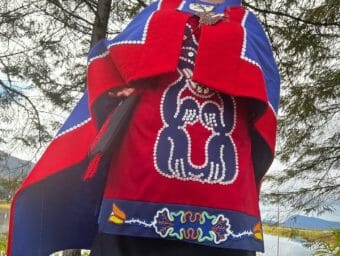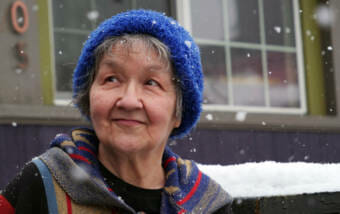
Culture Bearer Daaljíni Cruise tells Juneau second-graders a traditional Alaskan Native story during an excursion to the Walter Sobeloff Building on Nov. 16, 2017. (Photo by Adelyn Baxter/KTOO)
On Monday afternoon for Indigenous Peoples’ Day, the University of Alaska Southeast is hosting a panel on language revitalization efforts for three Southeast Alaska Native languages.
“One of the most Indigenous things is the language that was born on this land,” said UAS Lingít professor X’unei Lance Twitchell. “And that was maintained and allowed ancestors to survive, and was a gift to us to give to future generations.”
Often, the discussion of language serves as both a celebration of Indigenous identity and a reflection on harm done to Native languages, he said.
“As we talked about language revitalization,we’re also looking at some of the most damaging elements of colonization, and attempted genocide,” Twitchell said.
The featured speakers are Jaskwaan from the Haida language community, Daaljíni from the Lingít language community and Alex Roehl from the Juneau Sm’algyax learners group.
“What’s exciting as these are growing language movements, and so there’s multiple people to pick from,” Twitchell said. “They’ll just share their perspectives on what’s happening and what’s shifting.”
The speakers will give updates on the current status of language revitalization for all three languages, as well as what they think the future of the languages looks like.
The discussion can be joined at 3:00 p.m. via Zoom here.
Also on Monday, Sealaska Heritage Institute is offering free admission to the Shuká Hít clan house and Juried Art Show exhibit for Indigenous Peoples’ Day
In 2015, Alaska was the second state to designate Indigenous People’s Day on the second Monday of October to replace Columbus Day, after South Dakota. In 2021, the day was recognized nationwide by the Biden administration.
Eechdaa Dave Ketah, originally from Ketchikan, is a teacher and artist in Portland, Oregon. He’s taking Lingít language classes at the University of Alaska Southeast. “Having the opportunity to learn the language has been so powerful in my journey,” he says. (Photo provided by Eechdaa Dave Ketah)
The class assignment was to write a letter to anyone they wanted. In Lingít. Eechdaa Dave Ketah chose his late grandmother, the person who spoke Lingít to him when he was growing up in Ketchikan.
“And I was telling her that it’s hard learning the language at this point in my life, and one thing that makes it even harder is that I have to pay for it,” Ketah said, describing what he wrote. “White people took the language from us and now they’re charging us to get it back.”
Or: “Sgóon ḵaa sháade náḵx’i dleitx kaa sitee. Tlél has ushk’é ka Lingít yoo x̱ʼatángi has aawatáw. Yeedát Lingít x̱ʼatángi natoo.eich,” he wrote in the letter.
Ketah is a high school teacher in Portland, Oregon. He’s been taking online Lingít language classes at the University of Alaska Southeast since 2020. He started out as a beginner and is now in advanced Lingít learning the language his family spoke for thousands of years, but that he didn’t grow up speaking.
Ketah initially wanted to learn the language as a way to connect with his culture; he had felt detached from it living outside Southeast Alaska for so long. But it’s turned into so much more. Learning to speak Lingít is a way to connect to his ancestors, including his late grandmother, who had been taught to hide her culture and her language.
“Having the opportunity to learn the language has been so powerful in my journey,” Ketah said.
School, which forbade his grandmother from speaking Lingít, is now a place that’s making this type of personal journey even more accessible. A few months after that letter writing assignment, UAS announced over the summer it would be offering Alaska Native language classes tuition-free. It’s an effort that had been in the works for a few years. Funding from Sealaska Heritage Institute is making it possible.
Students currently taking non-credit classes in Lingít, Xaat Kíl or Smʼalgya̱x – traditional languages of Southeast Alaska – are no longer required to pay any tuition or fees.
“The University of Alaska Southeast is committed to recognizing and acknowledging historical wrongs endured by Alaska Native Communities. We are making sure Indigenous people don’t have to pay to learn their own language. It’s so important in the work towards language revitalization and overall healing,” UAS Dean of the School of Arts and Sciences Carin Silkaitis said in the announcement.
X̱’unei Lance Twitchell, professor of Alaska Native languages at UAS, has been part of the multi-year effort to make the language classes tuition-free. In finding a way to make it happen, he said the conversations would “come back to historical accountability on the part of governments and education as a system for playing a role in the attempted elimination of Indigenous languages.”
When it comes to endangered languages, Twitchell said, it’s not equitable to get money out of the population of people who have been oppressed.
“There’s so much trauma involved with language learning and recovery as Indigenous peoples that it just didn’t make sense to look at things from this sort of financial perspective,” he said.
Taking down the barrier of cost is working. UAS language professors say enrollment has gone up for both non-credit classes and for-credit classes. UAS still charges tuition and fees for for-credit classes. When Twitchell first joined UAS in 2011, enrollment was in the 30s or 40s. They were happy when it reached 70. “And I remember when we got up to 100,” he said.
Éedaa Heather Burge teaches a beginning Lingít class at the University of Alaska Southeast on Sept. 20, 2022. (Photo by Lisa Phu/Alaska Beacon)
Now, enrollment is nearing 300. More than 130 language students are taking for-credit classes and about 150 are taking the non-credit option.
Éedaa Heather Burge, assistant professor of Alaska Native languages at UAS, said classes usually capped at 30 students in previous semesters. This semester, one of her beginning Lingít classes has 70 students. Higher demand and bigger classes come with its own challenges, but it’s a fantastic problem to have, she said.
“To have your classes be in such high demand that we’re struggling to keep up, it’s an exciting problem,” she said. “I do think long term, we need to hire more people to be able to teach these classes if the demand continues to be this high.”
Ketah, who’s seeing this growth and revitalization from outside Alaska, is amazed.
“It might be being a little bit hyperbolic, but it’s like everybody wants to learn, whereas back in my youth, it just wasn’t something that people were excited about,” Ketah said.
‘Trained to do that’
As a kid in Ketchikan, Ketah used to visit his grandmother, Eva Ketah, a couple times a week.
“I spent an awful lot of time with my grandmother. I loved going over to her house. Every time I would visit with her it felt like she was trying to immerse me in the culture,” he said.
When the two of them were together, “we picked berries, she would feed me traditional foods and speak Lingít to me,” he described. “It would be all of this stuff that was about her youth, where she came from.”
But Ketah remembers a peculiar thing that his grandmother would do.
“Things would abruptly change. Food would be put away, she’d go back to speaking English, and then there’d be a knock at the door. It didn’t matter who it was. It could be another Lingít person. It could be a family friend, an acquaintance, whoever, but as soon as somebody else would come, it was hidden,” he said.
Ketah’s grandmother lived on a hillside that was accessible by a long staircase, which allowed her to see someone coming from a long distance.
The peculiar thing happened a few more times before Ketah asked his grandmother about it.
“I asked her, ‘Grandma, when other people come by, why do you stop doing anything that’s Lingít?’” Ketah said, thinking back 40 years.
“She said, ‘Because we were trained to do that.’”
Ketah, 10 years old at the time, was bewildered by her answer, but he didn’t know how to ask what she meant. Decades later, though, he’s been able to piece that memory with other memories and stories his grandmother told him.
“‘Trained to do that’ was a euphemism for: It was beaten out of her.” Ketah said.
His grandmother’s home
Ketah said his grandmother’s family is originally from Sʼeek Heení, Warm Chuck Inlet on Heceta Island on the northwestern side of Prince of Wales Island, before they moved to Klawock.
“The reason why she left Warm Chuck Inlet to go to Klawock was because government agents came and told her mother and all of the other mothers of children, ‘You need to put your kids in school,’” he recounted. “They would say, ‘If you don’t put your kids in school, we’ll put you in jail. And then after you’re in jail, we’ll put your kids in school anyway.’ And so, there was no choice in the matter.”
The school in Klawock, Ketah said, had a mix of kids who stayed there all the time and kids who had family in the community and went home on the weekends, like his grandmother.
“Teachers would say, ‘Now, when you kids go home, if anybody is breaking the rules – and that’s the school rules – if they’re speaking the Lingít language, or wearing Lingít clothes, or participating in the any of these cultural things, then you tell us when you come back to school,’” he said.
The kids were taught to inform on each other. Even a kid who had not broken the rules but failed to turn in another kid who had would get punished.
“And the penalties were physical beatings. So that happened to my grandma and all of her contemporaries,” he said.
Ketah said those wounds echoed into his dad’s childhood and into his own.
In addition to learning the language as an adult, Ketah has also been establishing himself as a Lingít carver and Alaska Native artist. This past summer, he did a residency at the Sheldon Jackson Museum in Sitka and his work was recently part of an exhibit at the Washington State History Museum.
Within the past couple of years, as Ketah has embarked in this expanded learning of his culture, he asked his dad, “‘Why didn’t you ever teach me any of this stuff?’”
His dad said, “‘Because my parents never taught us. We asked, but they wouldn’t.’”
Ketah knows now that by not teaching about their language or their culture, his grandparents were trying to protect their children.
“They were convinced that the way forward was to completely adopt the white way.”
‘I can speak my language in my school’
When Ketah learned enough Lingít, he went into the high school in Portland where he teaches and started his class saying yakʼéi tsʼootaat, or good morning.
“I was able to speak the Lingít language in, what my grandmother would call, a white man school and I’m not punished. As a matter of fact, they can’t touch me for anything that I do that’s related to my culture. And that’s incredible to me that we are able to overcome all that dark history and I can speak my language in my school,” Ketah said.
Each time he speaks Lingít in a school setting, he feels like he’s redeeming what his grandmother and other relatives endured. Despite everything they went through, Ketah said, the language lives on and he gets to be a part of it.
“I don’t think of it only as a privilege, I think of it as a responsibility because I have that freedom,” he said. “My ancestors didn’t do it because they couldn’t. And that’s why I should do it. Because I can.”
When Ketah was a kid and his grandmother spoke Lingít to him, he could only understand a few words, which is “heartbreaking” to him. He was never able to speak to her in their language.
But there are a couple video recordings from the 1990s that his uncle made of his grandmother and grandfather. “There is an awful lot of Lingít being spoken,” Ketah said, “that I understand completely now.”
Stevi Frets and Max Pyles joke as they do the dishes at the Sun’aq Tribe’s language house in Kodiak on Sept. 15, 2022. (Photo by Claire Stremple/KTOO)
Half of the first language speakers of Kodiak Alutiiq died between 2020 and 2022. But that’s not stopping new speakers from learning the language and passing along a distinct culture and worldview to the next generations.
At the Sun’aq Tribe’s language house, everything is a lesson—catching up on gossip, making a grocery list or washing the dishes.
No one lives here full time, but the Sun’aq Tribe uses a federal grant to pay a group of language apprentices and mentors to master the language.
“To really get the language down, you gotta use it in practice,” said Dehrich Chya, a mentor at the language house. “The point of a language house is it’s a place where you can just get together and use the language in your day to day life.”
“Heritage languages are so important,” said mentor Stevi Frets. “And when you learn them, it’s like, ‘Okay, I’m part of the crew saving it now.’ There’s no like, ‘Yeah, I learn a little Alutiiq on weekends, when I can.’ All of a sudden, you’re like, ‘Oh, my gosh, my language, I have to save it, I have to do everything I can’.”
Kodiak is home to a powerful movement to bring the Alutiiq language back into daily use. For about 100 years, American schools and governments suppressed the language and punished children for speaking it. Now the last Elders who speak it fluently are almost gone.
Frets says there are a few Elders in town she can speak with, and a lot of folks who have gone through some basic language classes at the University.
“But there’s not a lot of people you can like have a conversation with around. Like, I think they’re mostly in this room right now,” she said with a laugh.
In some ways, Frets says she feels like she missed out. The tribe estimates there are now only about 17 Elders who are fluent Alutiiq speakers left. They lost about that many during the pandemic. It’s a turning point.
But the language movement isn’t giving up, it’s moving forward.
Hailey Thompson administers the grant. She says part of the Sun’aq Tribe’s goal is to train fluent speakers who can in turn teach the language.
“We have a lot of motivation to learn Alutiiq. People want Alutiiq preschools, and Alutiiq language classes at the high school, and Alutiiq language class at the college,” she said. “But the problem is we don’t have the teachers to teach those classes and workshops.”
Hailey Thompson manages the Sun’aq Tribe’s language grant. “It’s not a job you can just clock out of,” she said. “If we don’t build more Alutiiq fluent people… then there’s not going to be anyone for my kids to learn from. So that’s what probably keeps me going.” In Kodiak on Sept. 15, 2022. (Photo by Claire Stremple/KTOO)
A solid foundation of language revitalization already exists in Kodiak. But Thompson says it’s different now—there were a lot more elders before.
“The next wave of what it looks like is building resources, archiving things that we know we’re going to need, spending the time that we know we can get with elders,” she said. “That’s what it looks like right now. Just cherishing all the things, that all the resources we can get… before we know that they’re gone.”
The stakes are high, but the rewards are immense. Frets and the others are building fluency to be able to teach the next generation of Alutiiq speakers.
At the Alutiingcut Childcare Center about a dozen preschoolers learn numbers in Alutiiq and Alutiiq versions of popular kids songs. There probably won’t be any birth speakers left by the time they’re older, but the language movement is working to ensure they’ll have teachers.
An Alutiiq language program exists at the Kodiak college and courses at the high school. And the tribe hopes to put 18 people through its program at the Language House over the course of its 3-year grant.
Learners meet up with Elders at the museum once a week. Three of the Elders that used to be at those sessions died during the pandemic, but the museum records them so new learners and descendants of the speakers can hear their stories.
Dehrich Chya, the Alutiiq Museum’s Language and Living Culture director, sits with Elders at a weekly session in Kodiak on Sept. 16, 2022. (Photo by Valerie Kern/AKPM)
Florence Pestrikoff didn’t grow up speaking Alutiiq, even though most people in her village did. But for the last couple of decades she has been an active speaker and teacher–she learned in the first wave of language revitalization about 20 years ago.
“I love speaking my language,” she said. “In the past it was — people were ashamed of the language. It’s sad. Really sad.”
American missionaries and schools enforced strict English-only policies for years. Parents like hers encouraged English to protect their children. The result was a swift decline in speaker numbers.
Pestrikoff answers her cell phone in Alutiiq and says she speaks it with her husband. And that’s the vision of the language movement—to have the language be in use. At home, in the grocery store, on the street.
And to carry the values that are embedded in the words.
“We never say goodbye. There is no goodbye in Alutiiq,” Pestrikoff said. “You say ‘Tang’rciqamken. I will see you later.’ I like that.”
Just like the language in Kodiak schools and homes — quiet for a while, but coming back.
University of Alaska Southeast professor X̱ʼunei Lance Twitchell in Juneau. (Photo by Paige Sparks/KTOO)
X̱ʼunei Lance Twitchell teaches Alaska Native languages at the University of Alaska Southeast. He started listening to podcasts years ago — long before he ever considered creating one of his own.
“And then I started to think, ‘Well, where are the Indigenous voices?’” he said.
He says he found podcasts about almost everything, from true crime to decolonization and anti-racism. But he says he didn’t hear anything about his life’s work: language revitalization.
Twitchell’s name is practically synonymous with a growing Indigenous language movement in Southeast Alaska. He teaches students that Indigenous language is fundamentally connected to culture and identity — things that colonization has tried to extinguish.
He’s taught all over the region. He’s writing Lingít language textbooks and a dictionary. And he’s been pushing the state to incorporate Indigenous languages into curriculum and daily life as a member of the Alaska Native Language Preservation & Advisory Council.
Now he’s the host of a new podcast called Tlél Wudakʼóodzi Ḵaa Lʼóotʼ — or Tongue Unbroken, if you don’t speak Lingít yet. The first season launched in August. It’s a platform for people who are doing language revitalization and decolonization work across North America.
Listeners will hear from a Lakota language teacher who’s fighting for data sovereignty in Standing Rock, a Nanticoke tribal member in Delaware who is bringing their language back from dormancy and a member of the Cherokee Nation about blood quantum and identity.
He and his guests take on serious conversations — Indigenous languages in Canada and the United States are endangered after years of colonialism and government policies aimed at erasing Indigenous culture. His approach highlights successes in language revitalization work without ignoring the challenges.
“Doing this work, you engage with a lot of people who are resisting you, and who are active in resistance,” he said. “When you’re resisting decolonization, if you’re resisting language revitalization, then you’re on the side of genocide and of white supremacy and racism. And now I have a platform to sort of share some of that stuff.”
He says he’s felt resistance as a language advocate in front of the legislature and even in academia. But he’s made a lot of headway. Just this year, UAS began offering Alaska Native language courses for free. He says when he arrived, a lot of language programs were shrinking. Now, he says so many people want to take courses that the university may have to hire more instructors.
Twitchell was supported by iHeart media’s Next Up Initiative, which is aimed at training creators from underrepresented groups in the art of podcasting. He says the podcast gives him an opportunity to speak frankly about how language revitalization is linked to decolonization.
“There’s all these terms that are out there, like ‘cancel culture’ and ‘wokeness’ and stuff. But I think those terms are employed to get people to stop talking about equity. And we’re not going to,” he said.
Twitchell says he hopes it’s another step towards normalizing the use of Indigenous languages in mass media.
“We’re just part of the things that everyone else is,” he said. “Because y’all are on our land. So you can’t just pretend that we’re not here.”
The guests vary, but the podcast is also personal. Twitchell shares stories from his life and stories that have been passed down to him. He interviews his own kids, who understand Lingít.
Those links are the point. Twitchell says the podcast name, Tongue Unbroken, uses the Lingít verb that refers to how a rope might break. But in this context, he says, it means an unbroken chain of communication.
Nathan Jackson and his son Stephen Jackson, who uses the artist name Jackson Polys, stand in the carving shed in Saxman earlier this month. (Photo by Eric Stone/KRBD)
The Sealaska Heritage Institute sees Juneau as the Northwest Coast art capital of the world. And they hope the Totem Pole Trail will help visitors see it the same way.
The institute has invited master carvers from around Southeast to create 10 totem poles representing Lingít, Haida and Tsimshian cultures, which should start going up along Juneau’s waterfront next year. The trail will eventually have 30 poles, with storyboards and plaques for each.
“Our traditional poles historically dominated the shorelines of our ancestral homelands and told the world who we were,” SHI President Rosita Worl said in a news release. “It’s fitting that our totems will be one of the first things people see while sailing into Juneau.”
A graphic from Sealaska Heritage Institute shows where poles might be placed as part of the Totem Pole Trail in Juneau. (Image courtesy of Sealaska Heritage Institute).
KRBD spoke with seven of the artists working on the trail, from Sitka, Ketchikan, Prince of Wales Island and Metlakatla.
Sitka
Tommy Joseph was just finishing up carving a canoe when Worl reached out, asking if he’d be interested in carving a pole for the trail.
“They wanted me to do a pole representing all of the eagle clans, all the eagle moiety,” Joseph said.
Joseph got to work, sketching out his vision for the pole.
“I had given them, I think, overall, four different renditions, because I had it way too complicated at first and needed to loosen up a bit,” Joseph explained. “After the fourth rendition, they agreed on it, and so made them their model.”
Tlingit carver Tommy Joseph sets a fist and feather he carved out of wood on top of a yellow cedar log. Joseph, who was born in Ketchikan, has carved nearly twenty totem poles in Sitka. (Photo by Erin McKinstry/KCAW)
He’s been working with two apprentices on the project. He said it’s coming along on schedule.
Joseph said he thinks SHI’s vision for the project is ambitious. He doesn’t remember anything like it being done before.
“So that’s a lot of a lot of different styles, interpretations, and, and whomever the person is behind keeping all this organized in track with all 10 carvers and all that is — I wouldn’t want their job, but I think it’s quite amazing what’s happening now,” he said.
Meanwhile, Nicholas Galanin is at work on a pole representing the Kaagwaantaan clan. He has more than 20 years experience in customary arts and carving.
Yéil Ya-Tseen Nicholas Galanin of Sitka uses an adze to carve the 40 foot T’aaku Kwáan Yanyeidí Healing kootéeyaa totem pole at Harborview Elementary School on 29, 2018. (Photo by Annie Bartholomew/KTOO)
He said the trail is probably the first time in more than 40 years that there’s been so much carving going on in Southeast.
“I think it’s going to be really important to all of these communities,” Galanin said. “I think it would be amazing for these artists that are apprenticing and getting to work on the project.”
Galanin is working with two apprentices — his cousin, Lee Burkhart, and Will Burkhart.
“So hopefully, some of these apprentices on these projects will be able to lead you know, their own totem poles on this down the line,” Galanin said.
Ketchikan
Two of the poles will come from the carving sheds of Ketchikan artists, renowned Lingít master carver Nathan Jackson and his son Stephen Jackson, who uses the artist name Jackson Polys. They’re working with four apprentices.
It won’t be the first time the family’s work makes it to Juneau. Polys created one of the bronze house posts standing in front of the Sealaska Heritage Institute’s building. Jackson has poles standing outside Juneau-Douglas High School: Yadaa.at Kalé. His work has been featured in exhibits and magazines in Alaska and nationwide.
Took, one of Jackson and Polys’s apprentices, works on a pole that will be raised for Sealaska Heritage Institute’s Totem Pole Trail. (Photo by Eric Stone/KRBD)
Polys’ pole, which focuses on the Shangukeidi clan, is topped by the figure of a Thunderbird.
“Another story on this pole is the house lowered from the sun crest,” Polys said. “There were wars with Tsimshian people that Shangukeidi were decimated.”
Norman Natkong works in the carving shed earlier this month. He is one of four apprentices working with Nathan Jackson and Jackson Polys. (Photo by Eric Stone/KRBD)
That tells the story of a mother and daughter who are the last of their clan. To save the clan, the mother marries the sun.
There’s also a spirit bear on the pole, who Polys said “led Ḵaax̱’aatee, Shangukeidi shaman and leader down a glacier path during the Little Ice Age, which is like 1550 to 1900.”
The lower figure on the pole takes inspiration from the history of a military leader named Fredrick Schwatka, who led explorations into the Yukon area. Polys said the man did not pay a debt he owed, so the clan took his name and military uniform.
Polys says carving poles that record important stories and are also exemplars of Northwest Coast Native art isn’t a job to be taken lightly.
“There’s a lot of back and forth between the artist, the carvers and the oral historians — (who) are caretakers of the culture — to ensure that it’s a piece of art, ultimately, that is respectful of both those aspirations,” Polys said.
Christian Dalton, a carving apprentice working with Nathan Jackson and Jackson Polys, stands on top of the pole in progress. (Photo by Eric Stone/KRBD)
Jackson’s pole symbolizes the Wooshkeetaan clan. The first figure on the pole is an eagle, and the second, a mountain. He said he wasn’t quite sure at first why the mountain was to be on the pole until he learned the clan would put a pole in the ground over a cache of frozen meat.
“And so that was the reason why they actually did a totem pole and put it right there, to lay claim to that place where they put the meat — so nobody would bother it and so it was a freezer,” Jackson said.
Below the mountain is a shark. Jackson said he thought maybe it was a salmon shark, but it was actually a great white that was said to have gone after people in canoes.
Both Jackson’s and his son’s pole should be done by the end of the year. He said it’s been easy working alongside his son.
“We can understand each other,” Jackson said. “We’ve done it before.”
Prince of Wales Island and Metlakatla
David R. Boxley from Metlakatla, Jon Rowan from Klawock, and TJ Young from Haida are also working on poles for the trail.
Boxley gets excited when he thinks about traditional carvings being the first look of Juneau that tourists get.
“The word that a lot of Westerners use is ‘primitive’ — and we were not,” he said. “The northwest coast was a thriving, ancient civilization, here on the northwest coast.”
David R. Boxley (right) and father David A. Boxley collaborated on the Tsimshian clan house front. (Photo by Brian Wallace/Sealaska Heritage Institute)
The Metlakatla carver is creating a pole representing the Tsimshian people.
He started carving at the age of six, guided by his father, David A. Boxley. Since then, he’s finished more than 25 poles. Together, the Boxleys carved the house front inside the Walter Soboleff building.
Boxley’s pole for Juneau will feature the crests of the Eagle, Raven, Wolf and Killer Whale moieties.
“And so they’re going to go in order of their origin in our history,” Boxley said. “At the top is the killer whale and grizzly bear for the Killer Whale clan, and then a raven and frog for the Raven clan. And a beaver and eagle for the Eagle clan, and the bottom of wolf and crane for the Wolf clan.”
Klawock carver Jon Rowan is one of three carvers working on the trail from Prince of Wales Island.
“It’s a pole for the Ishkahittaan people, they’re out of the Taku River, and it’s a raven, frog and sea lion that’s being represented on that (pole),” Rowan said.
Veteran and Klawock elder Aaron Isaacs looks at David Rowan’s Veterans’ Pole at the Klawock carving shed. (KRBD photo by Leila Kheiry)
Rowan credited his father and many POW teachers with sparking his love for carving.
“It seems like I’ve always been involved in it,” he said. “My dad used to do it back in the 60s. And that’s where I probably got hooked.”
Rowan teaches carving and Native arts at Klawock’s school.
Haida carver TJ Young was born and raised in Hydaburg. He’s working on two poles for the Juneau project. One will feature a Haida Raven crest, and the other a Lingít Raven crest.
“I’m doing Raven crest on this Lingít pole,” Young explained. “I’m doing Raven crest on the Haida totem pole. And I’m Haida myself. And that was kind of a traditional thing, you do the opposite of your clan. You carve the opposite. Eagle would never carve Eagle, Raven would never carve Raven.”
Haida carver TJ Young chips at a log that later became the totem pole facing Seward Street at the Sealaska Heritage Institute’s Arts Campus in downtown Juneau. (Photo by Lyndsey Brollini/KTOO)
Young said he takes a lot of inspiration from his grandfather, whose generation was discouraged from sharing traditional knowledge like carving. He feels lucky he was able to learn.
“It was literally outlawed, the potlatch, and the culture and the language,” Young said. “They had to adapt, they had to. They had to change without — without changing — if that makes any sense.”
His brother Joe Young also is carving a pole for the trail. TJ said it made his grandfather proud to watch him and his brother carve.
He said he’s looking forward to seeing the differences between all the poles when the project is complete.
“It’s going to be really interesting to notice the differences between styles and colors,” he said. “And even though it’s Lingít, Haida and Tsimshian, I think there’s gonna be a nice little variety of totem poles to look at and to enjoy. So that’s kind of exciting.”
Young said he has a December deadline to finish his carving.
Carver Wayne Hewson works on a Killer Whale Clan pole for a potlatch in 1994 in Metlakatla. (Photo courtesy of Lawrence Migdale)
When things were good, they were groovy. When something was cool, it was far out.
Wayne Hewson’s friends and family chuckle recalling how he held onto his 70’s slang over the years. Hewson died unexpectedly last week. He’s remembered as a mentor, a culture bearer and a fixture of life in Metlakatla.
The 69-year-old father of two was a respected carver who lived in Metlakatla with his wife Toni and two sons, David and Daniel. He was in a rock-and-roll band in high school. Later, he was a longtime member of the Fourth Generation dance group.
Wayne Hewson dressed in regalia ahead of dancing at Celebration in Juneau. (Photo courtesy of David R. Boxley)
“He was a really open and kind man,” David A. Boxley said. “He was soft spoken. He was really dedicated to his family.”
Boxley is a Tsimshian master artist and close friend and mentor of Hewson.
Hewson’s Tsimshian name was Sm Xsgyiik. He was Gisbutwada, Killer Whale clan. He also was Laxsgyiik, Eagle clan, because Boxley adopted him as his brother at a potlatch years ago.
Boxley worked on six poles with Hewson — including Hewson’s first pole, raised in 1994 at Metlakatla’s senior center.
He remembers Hewson as humble, talented and proud of the cultural revival work he did through the Fourth Generation group.
Wayne Hewson, center, watches as his first totem pole is raised in Metlakatla in 1994. (Photo courtesy of Lawrence Migdale)
Boxley remembered that when the dance group was getting started, there weren’t many men who took part. He encouraged Hewson, who showed up to watch with his two young sons, to try it out. Boxley said Hewson hesitated at first, but eventually jumped in and later became one of the group’s leaders.
“You know, people don’t realize how much of an effect they have on their families and their friends and just the world around them, their immediate world,” he said. “I think that was the kind of guy he was, too.”
He was also an inspiration for Boxley’s son, David R. Boxley.
“To me, he was Uncle Wayne,” David R. said.
The younger Boxley remembers how Hewson loved to play music — he was well-known for his affinity for rock-and-roll. His instruments of choice were the drums and guitar.
“But also, you know what surprises you when you pick up a guitar and just play some beautiful — pick, you know, just something really pretty,” he recalled. “He had a beautiful singing voice.”
He said Hewson was a man devoted to his family.
“Boy, he loved his wife,” David R. Boxley said. “And they were very close. And she was with him on a lot of his pole projects, she helped him paint and they were together, I think 45 years.”
Some of the poles that Hewson carved, with his wife Toni’s help, for Ketchikan’s Rainforest Sanctuary. (Photo courtesy of David R. Boxley)
William Bolton met Hewson through the Fourth Generation group. Chuckling, he joked that he always thought Hewson was a little odd.
“He was odd in the way, I guess, that he was friendly, and he didn’t tease like most people do here in Metlakatla,” Bolton said.
Bolton worked with Hewson on a few projects over the years. He said he remembers Hewson as a mentor who was always generous with his time and expertise.
“I think the biggest thing is that he was always willing to give people advice,” Bolton said. “And, he never did it in a way that could be taken as mean or attacking anybody. Just that he was willing to share his knowledge that he had, and didn’t judge anybody for not knowing something.”
Hewson designed and painted Metlakatla’s Longhouse. (Photo courtesy of David R. Boxley)
In the days since Hewson’s death, Bolton said he’s been reflecting on what the man taught him about carving.
“He showed me that other carvers aren’t my competition — that, you know, you could always learn something from somebody,” he said.
Bolton is a teacher now.
“And I think it’s one of the things that he is probably pretty proud that I’m doing now,” he said.
Wayne Hewson (photo courtesy of Lawrence Migdale)
Clifton Guthrie said that Hewson was someone he looked up to growing up in Metlakatla.
Guthrie said if it wasn’t for Hewson, he might never have completed his first solo pole. He recalled how Hewson calmed his nerves ahead of the pole raising.
“As a carver, I was worried about, like, you’re having guys lift it, carry it, raise it with ropes, and, and he’s the one in charge,” Guthrie said. “And he made a point to put his hand on my shoulder and say, ‘Your job is done now.’”
He said Hewson oversaw the whole event and attended the celebration held afterward. Guthrie decided that as payment, he would give Hewson fresh deer and fish whenever he had it. Guthrie noted he’s keeping up that deal, with Hewson’s wife Toni.
Most of all, Guthrie remembered Hewson as a generous man who always made time for those close to him.
“He made me feel like we had been friends forever,” he said.
A viewing was held in Ketchikan on Monday. A public celebration of life is set for Sept. 5 at Metlakatla Presbyterian Church. Hewson’s remains will be interred in a bentwood box carved by David A. Boxley.
Close
Update notification options
Subscribe to notifications
Subscribe
Get notifications about news related to the topics you care about. You can unsubscribe anytime.