The contractor is headquartered in Bellingham, Washington, with an extensive history of work in Alaska.
Institute Project Manager Lee Kadinger says the bid process began with about a half-dozen contractors.
“We scored each of those proposals and selected the top three to move on to develop a full bid proposal. I guess you have the cream of the crop by doing it in that fashion,” Kadinger says.
Dawson’s contract is for $14 million.
The Soboleff center is estimated to cost $20 million, including land, design, artwork and furnishings. Officials say they’ve raised about three-quarters of that amount.
The center will be a 29,000-square-foot, three-story building in downtown Juneau, across the street from Sealaska regional Native corporation’s headquarters.
Kadinger says Dawson must follow Alaska-preference rules, since some of the funding comes from the state.
He also says the contractor must try to hire Alaska Natives.
“There’s not a requirement to use (a certain) number. However, there is language in there encouraging Native hire on the project,” he says.
Ground-breaking is scheduled for later this month.
The center is named after the Rev. Dr. Walter Soboleff, a Tlingit cultural, political and spiritual leader who died about two years ago.
It will house education, arts and language programs, as well as the institute’s archives and collections, and heritage institute offices.
Dawson Construction’s many regional projects include a shop for Ketchikan’s shipyard, veterans’ housing in Haines and a cultural heritage center for Klukwan.
Governor Sean Parnell has reappointed two Juneau residents to state boards.
Zachary Jones will continue serving on the State Historical Records Advisory Board; and Ben Brown has been reappointed to the Alaska State Council on the Arts.
Jones is the archivist and collections manager for the Sealaska Heritage Institute and an adjunct instructor at the University of Alaska Southeast. He holds a master’s degree in comparative history from the College of William & Mary, and a certificate of advanced studies in archives and records administration from the University of Wisconsin Milwaukee. He’s currently pursuing a Ph.D. in Native American history from the University of Alaska Fairbanks. Jones was reappointed to a seat representing Native American record-keeping.
Brown is an attorney and member of the Alaska Commercial Fisheries Entry Commission. He’s a company member at Perseverance Theatre and has more than three decades of theatrical experience. He’s on the board of directors for the National Assembly of State Art Agencies and Alaska Public Media. Brown was reappointed to a public seat.
Leonard Nimoy is a passenger aboard the Silver Shadow cruise ship.
From the final frontier to the last frontier, Leonard Nimoy paid his first visit to Alaska since 1972 this week, with stops in Anchorage, Seward, Sitka, Juneau, Skagway and Ketchikan.
Alaska. First time here since 1972. Great people. Amazing state. LLAP
He tweeted Tuesday announcing his cruise, and that inspired some fans in Ketchikan to wander around town in hopes of a sighting. KRBD was lucky to get a brief encounter with the actor, best known for his portrayal of Mr. Spock, a beloved and very logical character on the original Star Trek series.
Anchorage, Seward, Sitka, Juneau, Skagway, Ketchikan. One beautiful trip. LLAP
Most states that had been covered under the Voting Rights Act won’t feel the full impact of the Supreme Court’s ruling until 2020, when the next redistricting cycle starts up. But Alaska, along with Texas, will experience the effects straight away. Here, political lines still haven’t been finalized, and today’s decision could shape the way boundaries are drawn.
Under federal law, Alaska was required to have five House and three Senate districts with large Native populations. The point was to guarantee Alaska Natives a voice in the legislature. With the Supreme Court striking down part of the Voting Rights Act, that requirement is gone.
“What we fear is that it’s going to be a net loss,” says Alice Ruby.
Ruby is the mayor of Dillingham, where Alaska Natives make up over half the population. She says that even with the Voting Rights Act’s requirements, communities like hers have seen their power diluted in recent years. As the population of cities along the Railbelt has gone up, rural Alaska has seen its representation shrink. The number of Alaska Natives in office has also dropped, going from seven to five in the last election cycle.
“I don’t know if you define that as discrimination, but I do know that it has affected certainly my community because we ended up being part of a district that was split in an odd way or that the district was so large that our legislator really couldn’t adequately represent us,” says Ruby.
Ruby is nervous that things may get worse for her region. As a city official, she says the Supreme Court’s ruling that all Alaska voting policies — whether they involve state or local elections — go through the Department of Justice before they get cleared relieves some regulatory burdens on a municipality like hers. But she says that wasn’t much of an inconvenience, and that Section 5 of the Voting Rights Act largely benefitted her region. With the Alaska Redistricting Board currently reviewing nearly a dozen political maps, she’s worried that communities off the road system won’t be adequately represented.
“So, why wouldn’t we be afraid? The maps have been released and hearings have been scheduled in the large urban areas, and here we are, still wondering what the impact will be on us.”
Bob Brodie is a member of the redistricting board, and he says he understands those concerns.
“I think in the future it’s going to be very difficult for rural areas to perhaps be represented,” say Brodie.
A number of the plans being reviewed by the board have a lot in common with the current map, which was drawn to meet Department of Justice standards. Michael White, the board’s attorney, says that they’re still keeping Native influence in mind. But when it comes to a decline in population, there’s not much the board can do.
Brodie says this isn’t just an Alaska problem.
“I don’t know so much if we could label it a Native thing, but it’s certainly a rural thing that’s common across the country.”
In addition to affecting redistricting, the Supreme Court’s ruling could also have implications for future voting laws. A controversial bill that would require voters to display photo ID at polling places was introduced in the legislature earlier this year, and had it passed this session, the Department of Justice would have had to okay it before it would go into effect. Should the bill move forward next session, it would no longer have to go through that review process.
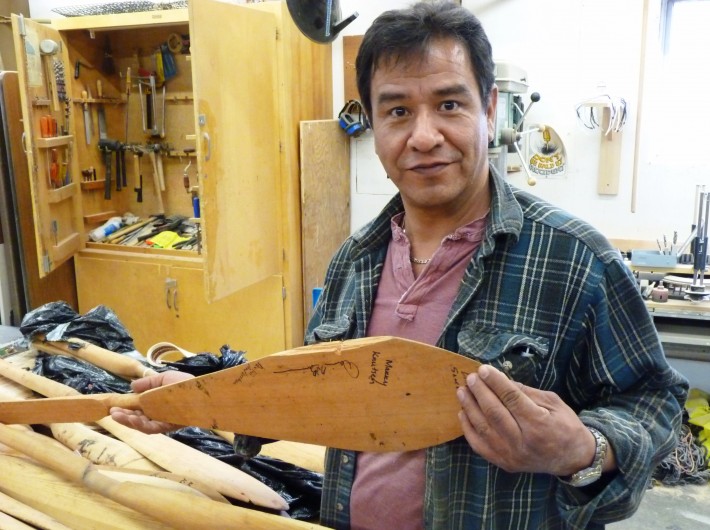
Carver Doug Chilton holds a lost canoe paddle that was chewed on by a bear before it could be recovered. Photos by Ed Schoenfeld, CoastAlaska News.
Remember the Tlingit and Haida paddlers who lost their canoes on a recent journey through Southeast? High winds and rough seas capsized the watercraft, dumping hand-carved, red cedar paddles into the ocean.
The canoes were found, and later, some of the paddles. They had a homecoming of sorts a few weeks ago in Yakutat, where they were made. The northern Southeast town is on the eastern edge of the Gulf of Alaska.
A half-dozen students sit and stand around a workbench in the Yakutat High School shop. They’re in a youth arts program that’s part of the community’s annual tern festival.
From left, Jasmine Long, Sarah Newlun and Kayla Drumm sand down ceremonial dance paddles during an arts workshop during the Yakutat Tern Festival. Photos by Ed Schoenfeld, CoastAlaska News.
Each holds an angled cedar plank rough-cut into the shape of a ceremonial dance paddle. A pile of raw boards sits on the bench, surrounded by dark, dusty pieces of crumpled sandpaper.
While an adult volunteer uses a power tool to remove the roughest edges, the teens smooth and shape each piece by hand.
Ninth-grader Jasmine Long, working with sandpaper, already has some experience.
“They had a canoe trip recently over to Wrangell and I helped them with those paddles. And I enjoyed it so much I thought I’d come back and do this one,” she says.
“I was thinking of (painting on) an eagle, since that’s my moiety, and a bear,” she adds.
Watching the work is Doug Chilton, who led the paddle-carving effort for the Wrangell journey.
“This is an introduction stage for the next generation,” he says.
The Juneau-based master carver, who’s also the tern festival’s featured artist, moves in to advise the students. Then he steps back, letting them get a feel for the wood on their own.
“These ones are little miniature dance paddles. And we’ll introduce them to the actual usable paddles that we use. Then I can get them into a canoe. And that’s where I’m at. That’s what I love doing,” he says.
Chilton is president of the One People Canoe Society, which promotes the traditional mode of travel, along with cultural awareness and community-building.
Some of the once-lost Yakutat cedar canoe paddles sit on a workbench in the town’s high school shop.
The recent canoe convoy from Juneau to Wrangell helped celebrate the rededication of the community’s Chief Shakes Tribal House.
That put Chilton – and some others – in the midst of some very rough seas.
“Bad weather’s bad weather. We got inside the safety boat, try to make sure everybody’s inside where it’s safe and we just kind of kept an eye on it through the window,” he says.
Two canoes and a couple dozen paddles were lost to the wind and waves.
“There’s not really a lot you can do other than just be sad. It was pretty quiet there for a while after the canoe broke loose. Once it went over we knew the paddles were gone,” he says.
“It was heartbreaking. Our spirits got lowered quite a bit,” says Cynthia Petersen, business manager for Yak-Tat Kwaan, the Native corporation that cosponsors tern festival events.
She watches over the sanding students as she talks about being on board the ill-fated Yakutat canoe.
“A lot of us thought that our ancestors gave us so much to begin with, that they were just taking our paddles as part of it. And for eight of them to get returned, when we had eight paddlers on the journey from Yakutat, was amazing,” Petersen says.
Doug Chilton works with Yakutat students in a paddle-carving class.
And there the paddles are, one broken and others battered – laid out on a nearby shop workbench.
Chilton walks over to the pile.
“This is one of the paddles that was returned to us. And you can see how the edge is busted off. The Fish and Game officer that brought these to us said they had to wait for this one because there was a bear chewing on it,” he says.
More than a dozen Yakutat paddles are still missing. But those recovered have some time in the water.
Chilton and others in the One People Canoe Society head to Washington’s Olympic Peninsula later this summer for what’s called the Intertribal Canoe Journey and Potlatch.
After that, the paddles return to Yakutat, and the sponsors who helped fund the Wrangell trip.
“It’s interesting. They went on their own journey and they came back,” Chilton says.
Back in the high school shop, Jasmine Long continues smoothing the edges of her ceremonial dance paddle. She’s been involved in dance groups in the past and is working on returning.
“I’ve been going to the practices and I’ve been trying to get back into it.”
She says it feels good to create a paddle she’ll use.
John Smith the 3rd dances with protest signs at the Idle No More rally at Marine Park. (Photo by Heather Bryant/KTOO)
An assortment of signs used at the rally and march. (Photo by Heather Bryant/KTOO)
Approximately 30 people participated in the rally and dozens of passersby stopped to watch the event. (Photo by Heather Bryant/KTOO)
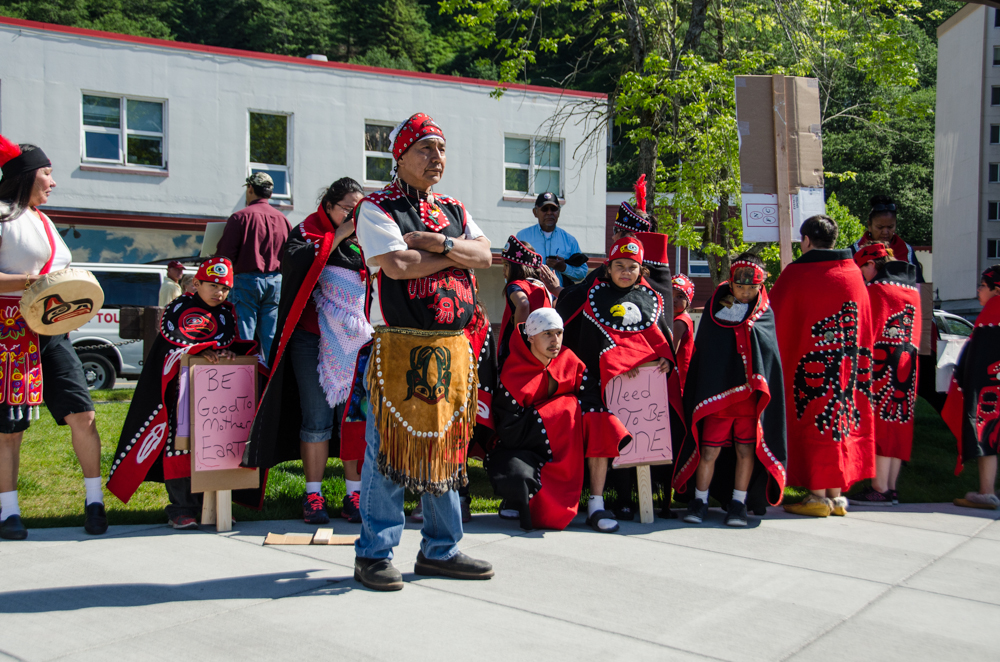
Dancers hold signs while watch a speech at the rally. (Photo by Heather Bryant/KTOO)
(Photo by Heather Bryant/KTOO)
One of the speakers spoke on the recent legislation that relaxed the regulations on where cruise ships could dump waste water. (Photo by Heather Bryant/KTOO)
John Smith the 3rd kneels during a dance. (Photo by Heather Bryant/KTOO)
Smith holds up a sign he says was made by children. (Photo by Heather Bryant/KTOO)
The drawing depicts native fisherman being arrested on one side and a trawler making money on the other side. (Photo by Heather Bryant/KTOO)
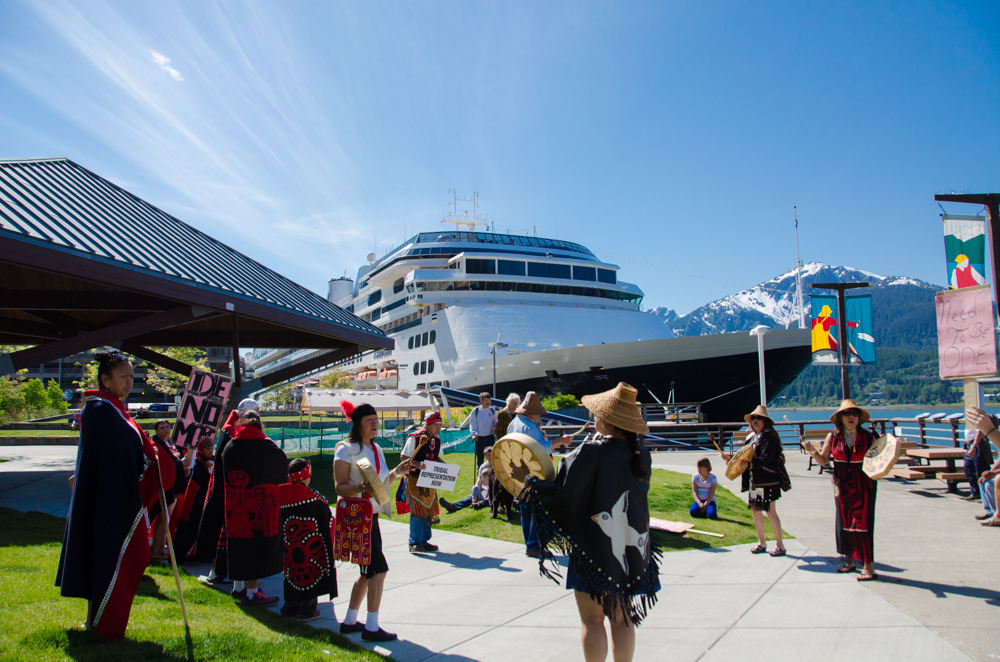
The crowd of nearly thirty, marched around downtown and up Franklin Street ending at Centennial Hall. (Photo by Heather Bryant/KTOO)
About 30 adults and children called for equality and greater subsistence fishery protection Wednesday morning in the ‘Idle No More’ rally in downtown Juneau. Several wore Native regalia, chanted songs, and danced as people took turns talking over a megaphone.
“The Pollock industry is coming into our water and has been for several years taking the fish away from our children and from our elders and our fish are dwindling in great numbers now and our people are struggling to try and get the fish to feed their children and to survive,” George Pletnikoff says through the megaphone.
Pletnikoff is with Greenpeace and Alaska Inter-tribal Council. He wants to spread awareness of the importance of subsistence which entails the spiritual lives of Native Alaskans, their customs and tradition. Pletnikoff highlights the Bering Sea Pollock fishery which results in high numbers of chinook salmon by-catch.
Rally participants cited ongoing subsistence fishing problems in western Alaska due to recent restrictions placed on the Yukon River by state and federal agencies, and last year’s closure on the Kuskokwim River. Susettna King is a Juneau resident and member of ANS Camp 70.
“I think it’s time they leave the land to us. We’re not going to go in there and slaughter thousands and thousands of fish. We’re going to take what we need and leave the rest so nature comes back and we’ve done that for years. And they should let us better regulate what is leaving our land and what is coming back.”
Other rally concerns include tribal representation, decline of salmon stocks, environmental stewardship, and cruise ship waste water.
Pletnikoff said the rally was organized by the AVCP, ANB Camp 70, Kawerak Inc in Nome, and supported by Green Peace. Rally organizers were in Juneau to attend parts of the week-long North Pacific Fishery Management Council meeting, which concluded yesterday.
Cruise ship tourists stopped to take photos of the march through downtown Juneau. The ‘Idle No More’ rally ended in front of Centennial Hall where a joint meeting was held yesterday between the North Pacific Fishery Management Council and Alaska Board of Fish.
Editor’s Note: In a previous version of this story we mistakenly identified George Pletnikoff as Timothy Andrew. The story has been amended to correct this error. We’re sorry for the confusion.
Close
Update notification options
Subscribe to notifications
Subscribe
Get notifications about news related to the topics you care about. You can unsubscribe anytime.