Community

Tongass Voices: Sakoon Donedin Jackson on re-indigenizing her life

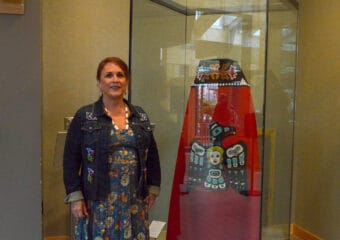
Sakoon Donedin Jackson at Wooshkindein Da.áat Lily Hope Weaver studio, where she worked on the Emergence Robe for SEARHC on June 4, 2024. (Tasha Elizarde/KTOO)

This is Tongass Voices, a series from KTOO sharing weekly perspectives from the homelands of the Áak’w Kwáan and beyond. 

Sakoon Donedin Jackson is a Chilkat weaver from Alberta, Canada who began her practice during the COVID-19 pandemic when she took classes online with Juneau’s Lily Hope. Now, Jackson is the featured resident artist at Wooshkindein Da.áat Lily Hope Weaver studio, where she has been working on a woolen button robe and teaching weaving classes for the first time. 

KTOO caught up with Jackson before she finished teaching her first weaving class the day before Celebration 2024 began.

Listen:

This transcript has been lightly edited for clarity.

My name is Sakoon. In English, I’m known as Donedin Jackson, and I am a child of the eagle moiety. And my father’s mother is Kukhittan from inland Deisleen, and my mother’s father is German. 

So, we are at Wooshkindein Da.áat Lily Hope Weaver studio, and I am currently the featured resident artist in the studio, for the time being. And I have been honored with the opportunity to work on a button robe, which is a very rare opportunity, since Lily doesn’t specialize in our woolen button robe. 

So this is the Emergence Robe, and it was commissioned first by the SEARHC medical organization 30 years ago from Lily’s mother, Clarissa Rizal. So, SEARHC organization uses this robe for patients who are transitioning from this world to the next. And so the families can request the use of this robe up to a week before they expect their family to pass, and it gets laid on their bed to aid with their transition. I am lucky enough to be here in the studio as Lily’s apprentice and working on getting that completed. 

I actually, this is my very first opportunity to work on a full size button robe for Lily, and so I get to really do some true apprentice work. But I actually came to the weaving through Lily when she went online during the pandemic. I got laid off from my government job due to said pandemic and I decided to re-indigenize my life. And I began learning Lingít, our traditional language. And the language led me to the weaving, and I have been doing nothing else ever since.

So the Goldbelt Heritage Foundation and CCHITA, Tlingit and Haida Council, has partnered together to bring me to the traditional territories to offer some weaving workshops. Because two years ago, Lily decided I was going to teach, even though I was like, “I’m not ready!” She said, “Yes, you are.” And she gave me the boot.

And so this is now, officially, I have been teaching workshops starting this last year. And so we are going to be completing my very first weaving workshop with Goldbelt. And we’re weaving the side border of a child-sized Chilkat robe to be turned into a piece of regalia for a headdress. 

Oh, it has been just absolutely delightful. And it’s been really quite a teaching experience, or a learning experience, doing the teaching, just identifying people’s understanding, who has taught them before, where they’re at and how to meet them there and bring them all together forward, collectively. And so it’s been a wonderful reconnecting opportunity to be here in Lingít Aaní and Áak’w Kwáan territory.

“Ship-Free Saturday” initiative secures enough signatures for Juneau’s October ballot

Karla Hart (left) helps a resident sign the “Ship-Free Saturday” ballot initiative at the Maritime Festival in downtown Juneau on May, 4, 2024. (Clarise Larson/KTOO)

An initiative asking voters whether Juneau should ban large cruise ships on Saturdays starting next year has qualified for the local ballot this fall.

The City and Borough of Juneau clerk’s office announced on Monday that the group leading the “Ship-Free Saturday” ballot initiative had secured enough certified signatures to get a spot on Juneau’s Oct. 1 ballot, unless the Juneau Assembly decides to take action on the issue before then.

Karla Hart is one of the activists who led the effort this spring. She said the support the initiative has seen so far goes to show how much people in Juneau want change. 

“I think it says that Juneau really seriously wants some hard stops on cruise industry impacts in their lives, and that they haven’t received that from the city Assembly,” she said. “And that they don’t think that those hard stops are coming unless citizens take action.”

If the initiative is passed by voters, it would ban all cruise ships that carry 250 or more passengers from visiting Juneau on Saturdays and on the Fourth of July. But before it appears on the ballot, the Juneau Assembly has until Aug. 15 to decide whether to take its own action on the issue. 

Though the initiative gained more than 2,300 signatures in support, plenty of people and businesses in the community oppose it, including Laura Martinson McDonnell. 

She owns a gift shop downtown and is on the steering committee for a local advocacy group called Protect Juneau’s Future. The group is behind the orange signs hanging around town that discouraged people from signing the initiative. 

“I’m absolutely voting against this initiative,” she said. “That’s because I would like to maintain the right to control my own business and have a say in how my business is operating.”

Martinson McDonnell said she believes the initiative is being led by a small minority of the community. And, she doesn’t think it actually has the support needed to pass in October.  

Juneau Visitor Industry Director Alix Pierce said the city will likely share information on its website that explains what the initiative seeks to do and the facts surrounding it. But, she said the city does not plan to take a formal stance on the issue. 

“People are always welcome to provide their own interpretation, but our duty as a local government is to provide accurate and factual information to our citizens,” she said. 

Local initiatives similar to this one have popped up in recent years in other parts of Southeast and at other ports across the U.S., but many have failed to make it across the finish line because of legal barriers.

Late last month, a group of residents in Sitka submitted a ballot measure to city officials there. It would limit the number of cruise ship passengers that visit there each season. That initiative is currently undergoing legal review. Last season, Sitka city officials there denied a petition seeking a similar goal, saying the proposed legislation would be unenforceable under the Alaska Constitution. 

Tongass Voices: Juneau Bike Doctor’s Ken Hill wants to get everybody on a bike

Juneau Bike Doctor owner Ken Hill with a bike that will be donated to a student in need of a bike at Dzantik’i Heeni Middle School. Artist Chloey Cavanaugh and school librarian Luke Fortier painted herrings on the sides in support of the Herring Protectors movement. June 21, 2024. (Photo by Yvonne Krumrey/KTOO)

This is Tongass Voices, a series from KTOO sharing weekly perspectives from the homelands of the Áak’w Kwáan and beyond.

Ken Hill opened Juneau Bike Doctor in 2018, but he’s been part of Juneau’s cycling scene for much longer. Hill wants to get as many people on bikes as possible and values giving back to the community. That includes supporting his favorite local performers from Juneau Drag as much as he can.

Listen:


This transcript has been lightly edited for clarity.

Ken Hill: I’ve been involved in bike stuff, starting back in the late 80s when I moved to town and was just part of the bike community. Started out sweeping floors and changing tires.

Biking here, in general, it’s almost like the community is perfectly made for someone to be a cyclist or to use a bike for transportation. You know, from one point to the next is typically not very far. 

One thing that we’ve been fortunate to have the opportunity to do is we do trade-ins with bikes where somebody has an old bike that they’re not going to do anything with. We may not necessarily put the bike back on the floor. We’ve taken a number of those types of bikes that, during the fall, we have time to kind of refurbish and get them up and running, and we’ve used those to get people on bikes that maybe don’t have the wherewithal to find a bike. 

We had a teacher from [Dzantik’i Heeni Middle School] who wanted to do something to help kids get back engaged with education. She’s a bike person, and we’re certainly bike people, and so we thought that we would do a special bike for them.

And then I thought, it’s cool to have one bike, but there’s a lot of need. There’s a lot of kids in schools that need a bike. So we kind of reached out to our audience and got a bunch of bikes that people donated to us.

And we were able to do — I think it was 17 bikes, is what we got, built up and donated through that program.

One girl received a bike, but, turns out she already had a bike. But she wanted to ride her bike with her mom, and mom didn’t have a bike, so that bike was, you know, transferred over to her mom. And so now we’ve got a family riding bikes together. 

Then we had another young man who had a bike, but his best friend didn’t have a bike. And so now he’s got a riding buddy. 

We work with groups like that — we work with the Juneau Drag crew, and do a lot with that group. NAMI does a Pride Outside event that we’ve been doing for, gosh, since the beginning.

This is where I get emotional. That group when — so when my wife and I started dating, it was totally not something that I was involved in at all. I mean, I had queer friends, I had friends that were performers, but I just didn’t feel like it was a place where I was welcome. And not that any of them wouldn’t be welcoming to me. It was just my own perception. 

And I went to a show with a couple friends, and had just the time of my life. And I told my wife, I’m like, “Now, what do I do? I don’t want to just sit in the crowd,” because I’m not going to, you know — not everybody has a group that wants to go to every show, but I wanted to be in every show. 

So I worked the door there for five or six years, every show. And then when we did the big Glitz programs, I gave myself a title: the head of VIP transportation and security. So when we have out of town guests come. And I just met the most amazing people. 

They’ve been super welcoming to me, and there is kind of a non-traditional family, in a sense, with that group. And so I love them to death.

Tongass Voices: The Evening Star on creating spaces for queer Indigenous people

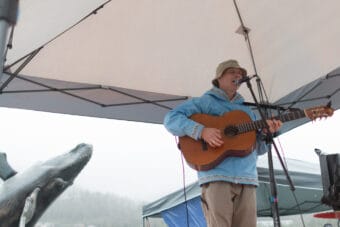
The Evening Star performs at the Crystal Saloon in Juneau on June 11, 2024. (Ḵaachgóon Rochelle Smallwood/Raven’s Tail Studio)

This is Tongass Voices, a series from KTOO sharing weekly perspectives from the homelands of the Áak’w Kwáan and beyond.

The Evening Star is a Pawnee and adopted Athabascan performer who’s known for storytelling, comedy, making music, and DJing. She came to Juneau during Celebration on her Indigequeer  tour. 

She says she wants her shows to be a space for people who often don’t feel like they can be themselves elsewhere. 

A warning: this story contains mentions of violence against transgender people.

Listen:

This transcript has been lightly edited for clarity.

The Evening Star:

Hi everybody. My name is the Evening Star. If you’re at home, you can say, “Hello, Evening Star.” I hope that you did it. Also known as Howie Echo-Hawk.  I’m on the Indigequeer Tour. It’s this thing that I’m doing where I’m going all over the place and just having as good a time as I possibly can with all the people that I like.

Being Native means that at one point, my identity wasn’t put in a little box and separated and kept in a neat little container over here. Before I knew I was Native, I just was. And before I knew I was queer, I just was. And before oppression, that’s what we were.

Nex Benedict was a young trans Choctaw person in Oklahoma who died because of bullying and not being able to be trans. You know, well, being trans and having the world say that that was not okay.

The Evening Star performs at the Crystal Saloon in Juneau on June 11, 2024. (Ḵaachgóon Rochelle Smallwood/Raven’s Tail Studio)

I am from the interior of Alaska. It was a really — and continues to be — a very racist place for Native people. And I left when I was 17, in large part due to being so closeted and had to go somewhere else to find my find out who I was, which was sad, but also a blessing, that I was able to do it. Because people like Nex Benedict — and many, many, many others who we will never know the names of also — don’t get a chance to leave. They don’t make it.

It’s hard to explain, because it’s not — I could say, like, “Yeah, I DJ, I play live music.” I have guest performers. There’s drag. There’s like, burlesque moments, there’s a lot. But I think at the core of it, it’s community. It’s like being able to let go.

It became very clear to me that it wasn’t just a dance party, because people would just often come to me crying, after dancing really hard to Bad Bunny.

Young people of many different ethnicities would come to me and just say, like, “Oh, this is so amazing. This is a place where I feel very normal.”

And that meant a lot. But I also had a boarding school survivor come to all my events and tell me that he literally never thought it’d be possible to be in a room like that. And, you know, this always gets me, because it’s just such an honor, and it still is such an honor to be able to provide something for people who feel like they don’t ever get that chance.

Because I am that person. You know, I grew up extremely conservative in Alaska and didn’t dream that I could ever come back and do anything like this. This was not even close to my wildest dreams. Like my wildest dreams was like, “I hope I get a good job and I don’t die when I’m 30.”

And that’s why when I say, “Go make your own version.” I mean it like, go, do, have fun.  Go enjoy yourself. Go play some music. Why are we out here doing anything? But that every moment that we are talking and worrying about whatever we could be making music. Why do any of this? What is this all for? If we can’t hang out, you know?

New cultural ambassadors deepen tourists’ experience of Juneau’s Mendenhall Glacier

Jinkasee.ee Rose Willard explains a náxw, or halibut hook to visitors. She is one of 10 cultural ambassadors at the Mendenhall Glacier Visitor Center on June 13, 2024. (Photo by Yvonne Krumrey/KTOO)

When tourists come to Juneau, the Mendenhall Glacier is usually near the top of their sightseeing list. It gets hundreds of thousands of visitors each summer.

And now, those visitors will have the chance to learn more about Indigenous connections to the glacier through cultural ambassadors.  

For the first time this year, tribal members were hired as ambassadors to share their own experiences and culture with visitors. 

Jinkasee.ee Rose Willard sat at a table inside the Mendenhall Glacier Visitor Center Thursday, while tourists milled around her. They peered at the spread in front of her: books about Lingít culture, small button blankets and pieces of beadwork, and a piece of wood the size of her hand carved in the style of a kootéeyaa, or totem pole. 

A young girl visiting the glacier with her family pointed to a deerskin drum.

“What’s this?” she asked. 

“This is a drum. We call it a gaaw. Can you say gaaw?” Willard said.

Willard handed her the drum, and she beat it a few times before saying it was cool.

Willard is one of 10 cultural ambassadors from the Central Council of the Tlingit and Haida Indian Tribes of Alaska that will spend their summer teaching visitors about Lingít culture — and about how Lingít people are connected to the glacier. It’s part of the new co-management strategy between the U.S. Forest Service and the tribe.

“That’s the first question people ask: Are you Lingít? Are you of this area? Are you a local? People want to know: are you a representation?” she said. “So I think it’s really important for them to know that they are speaking to a person who is from this area.” 

The rest of the year, Willard is a Lingít language teacher at Sítʼ Eetí Shaanáx̱ Glacier Valley Elementary School. So she likes to share pieces of language with visitors, like teaching them to say gaaw for a drum, or náxw for a halibut hook. 

She said when she first introduces herself, people are sometimes confused about why she’s there, and what the connection between Lingít culture and the glacier is

“But a lot of times people don’t know that our history — our Lingít people are here because of the glaciers, and our histories are all tied to the mini-glacier period. So when they receded, our people were able to travel over and under the glaciers to reside on these coastal areas,” Willard said. “Then they’re like, ‘Oh, wow.’ Then they make a connection between Lingít people and this amazing glacier.”

And, she said, it still feels like these interactions are authentic, not superficial or theatrical glimpses into her heritage. 

“I love that we are not selling the culture out here. We are simply sharing the culture about this amazing place,” Willard said. 

Jinkasee.ee Rose Willard is one of 10 cultural ambassadors at the Mendenhall Glacier Visitor Center. June 13, 2024. Photo by Yvonne Krumrey/KTOO.

Sarah Strand has been working for the Forest Service for three years now, and she said Lingít representation at the glacier used to be mostly limited to the short film shown to visitors.

“I think that’s very important to not only talk about the importance of our environment around here,” Strand said. “But the importance of the culture around it as well.”

Cultural Ambassador Supervisor Aankadax̱steen Jeremy Timothy said the Forest Service staff who they work with daily have made it easy for the ambassadors to experiment with the new program. 

He said this first summer is only the beginning. They hope to fill more of the space in the visitor center with even more cultural items and information.

“We’re looking at pop-up artists, maybe having a Chilkat robe, maybe tunics, hats. We’re looking at a kootéeyaa that’s coming back, that used to be out here,” Timothy said. “So we’re looking at possibly doing a ceremony for that, just kind of bringing more of our traditions to light here, and letting the visitors engage with us.”

But for now, Willard and the cultural ambassadors are set up and eager for your questions. 

Juneau Animal Rescue seeks foster homes after removing 50 cats from single residence

Kittens cuddle together at Juneau Animal Rescue on Wednesday, June 12, 2024. (Clarise Larson/KTOO)

Animal Control Officer Karen Wood opens the door to a small room swimming with tiny kittens. 

“So this is probably our biggest room,” Wood said. “We’ve got 16 kittens and three moms, so it’s going to stink in here.”  

That’s just one room that is housing an influx of cats. 

“We’re down to three empty kennels and I’m a little concerned because we’ve got to go out and get some more today,” she said. Later, she opens another room to a wall of quarantined adult cats, waiting to get better and get adopted. 

Juneau Animal Rescue removed more than 50 cats from a Juneau residence this month and still has more to bring in. Many are young kittens and many are sick. 

A kitten sits on a blanket at Juneau Animal Rescue on Wednesday, June 12, 2024. (Clarise Larson/KTOO)

They have severe respiratory illnesses and parasites, but she’s optimistic they will all recover. Since the rescue, none of the animals have died. 

Wood said an extreme number of cats like this can start with just two unaltered adults. Cats in the same litter can breed with each other, and it can snowball from there. The cost to spay and neuter — and care — for that many cats would quickly become unmanageable. 

“It’s just so important, spaying and neutering — if two cats had been spayed and neutered, then we would have 52 less cats in one household,” she said.

She said this is the largest number of cats she’s seen in a rescue situation in her 10 years of working there. And this influx of cats means the rescue won’t be able to take more for a while, so people hoping to surrender a cat may have to wait longer than usual. 

She said she’s worried about moving all of these animals into homes, but that the kittens will likely be adopted quickly, and they can send cats to other parts of Alaska if they don’t get adopted here. 

“We work with Paws and Claws in Skagway and HARK (Haines Animal Rescue Kennel) in Haines, and even have sent cats up to Fairbanks,” Wood said. “So if we get to that point, we can talk to them about that. You know, if they’re here for months, obviously other places will take some.”

A cat looks through the bars of its kennel at Juneau Animal Rescue on Wednesday, June 12, 2024. (Clarise Larson/KTOO)

They’ve had to shuffle cats around to make room to isolate the sick animals, but the undersized ventilation system means the other cats in the building aren’t fully protected, according to Rick Driscoll, the executive director at the rescue. 

“It’s really just some doors. That’s all we have,” he said. “From a best practices perspective we’d like to have multiple ventilation systems.” 

Juneau Animal Rescue is raising money to move to a bigger space. Driscoll said their current space is half the size recommended for an organization that serves so many animals. 

When the organization first posted about these cats, Driscoll said the community donated nearly $10,000 to help fund spay and neuter operations at a lower cost, and for the new building fund. 

“It was really overwhelming how many people chose to — within like a 12-hour period — donate money to help us with this particular situation,” he said.

More information about fostering animals can be found at juneauanimalrescue.org. It’s also offering highly reduced rabies vaccines for existing pets that live in homes where owners want to foster.

Correction: an earlier version of this story had an inaccurate count of cats in a room. 

Site notifications
Update notification options
Subscribe to notifications