Community

Alaska’s Little Norway keeps old culinary traditions alive

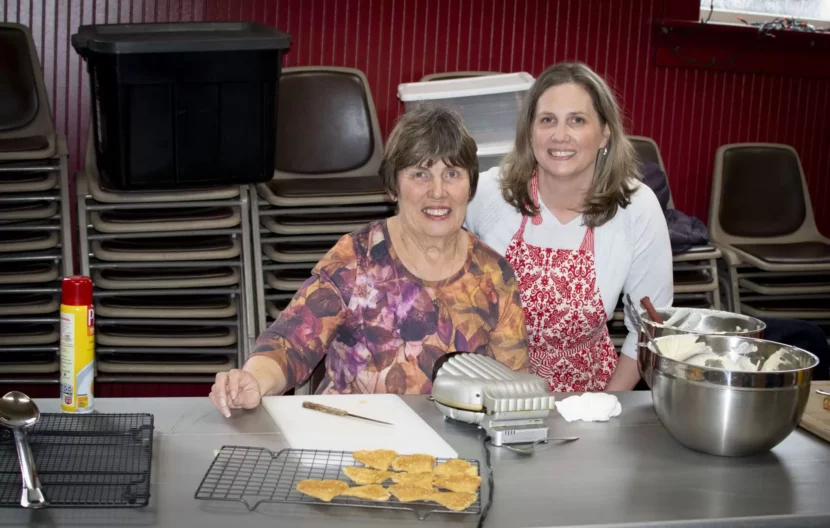
Sharon Wikan and her daughter, Katrina Miller, make waffler for Petersburg’s Little Norway Festival on May 13, 2024.
(Shelby Herbert/KFSK)

Alaska’s Little Norway celebrated Norwegian Constitution Day in mid-May with a week-long festival. For some families in the community, that meant many hours spent cooking heaps of treats from the Old Country, often using recipes that have been passed down for generations.

The air inside Petersburg’s Sons of Norway Hall was thick with the smell of cardamom, vanilla, and melted butter. Volunteers labored over portable stoves and bowls of batter. Sally Dwyer is the director of Petersburg’s Sons of Norway chapter, and she’s the mastermind behind the cooking operation.

After directing the volunteers to their stations, Dwyer fired up her griddle and, a few moments later, handed this reporter a delicate, cone-shaped waffle cookie — something called a krumkake. It melts in your mouth just as fast as it disintegrates in your hands.

As the crumbs fell away, Dwyer demonstrated her krumkake system.

“I am pouring approximately a tablespoon of krumkake batter into the krumkake iron, which has beautiful imprints of flowers and scroll-ey thingies,” she said. “I want it to spread out and be crispy, then I’ll put them on my roller and roll them into the cone shape, and then set them here to rest while making the next one.”

She would repeat that process hundreds of times that day. All the volunteers were making heaps of traditional treats to raise money for Petersburg’s Sons of Norway chapter at an annual buffet-style bake sale, called “Kaffehus.”
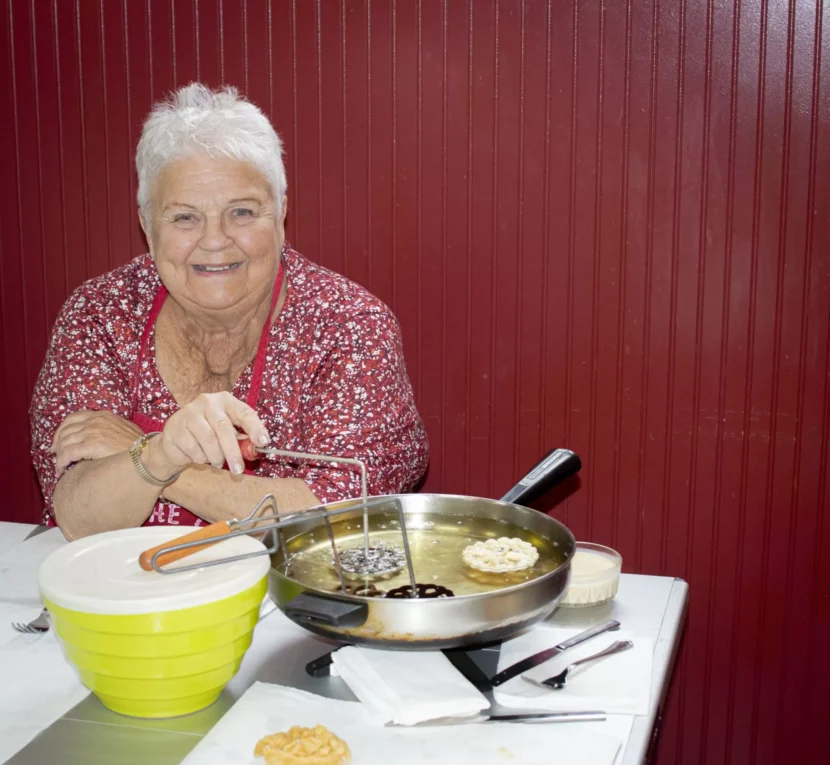
Vava Wikan fries up rosettes in Petersburg’s Sons of Norway Hall on May 13, 2024. (Shelby Herbert/KFSK)

In another corner of the room, Margaret Newlun was making rosettes. That’s a little more involved — and dangerous. Newlun wielded a long, thin metal rod with a flower-shaped cookie cutter at the end. She dipped the cookie cutter into a bowl of batter, and then turned around to face a ripping hot pan of oil.

“It just takes a while to make ‘em,” Newlun said. “You gotta fry ‘em in oil and you can’t set [the rod] down in the oil, because it’ll ruin the cookie!”

At another table, Katrina Miller was making waffler with her mom — that’s basically a tiny waffle sandwich. Miller’s grandmother taught her how to make it. Miller said waffler is an all-occasion thing that the next generation of her family has bonded over.

“It’s just kind of always been our thing and it brings us all together,” Miller said. “And it’s fun! We do it for Christmas, we do weddings, funerals… And then, sometimes, just because we want waffler.”

Miller’s mom, Sharon Wikan, offered a piece of waffler smeared with a type of caramelized goat cheese, called gjetost. She thinks that’s the best way to eat waffler, but not everybody in her family agrees.

“These are my grandkids’ favorite,” Wikan said. “But they don’t like the goat cheese. My kids don’t like the goat cheese. Just grandma — nobody else does.”
A line of customers outside Petersburg’s Sons of Norway Hall on May 18, 2024.
(Shelby Herbert/KFSK)

After hours of work, the volunteers’ tables were piled high with dozens upon dozens of pastries, which they started squirreling away for Kaffehus.

Days later, the dainty desserts reappeared in the Sons of Norway Hall, arranged on long buffet tables. A line of hungry festival-goers stretched around the outside the building, in the rain. But Bob Martin, who had been standing there for around 45 minutes, said it was all worth it.

“Lefse! It’s hard to find these days,” Martin said. “The ladies wearing bunads — they know the secrets!”

Lefse was one of the big draws — it’s a soft flatbread often filled with butter, sugar, and spices. It’s classic Scandinavian fare, but there’s been some drift over the years. Here, it’s taken on some American flavor.

A line of customers outside Petersburg’s Sons of Norway Hall on May 18, 2024.
(Shelby Herbert/KFSK)

Dwyer said her family’s lefse is a great example of how the town’s Norwegian forebears came up with new ideas after they started their lives in Petersburg.

“According to [our] family legend, Grandma Tora put sugar in her lefse after she buttered it, she used powdered sugar for the first time in Petersburg,” Dwyer said. “The granulated sugar — most of us think it’s like sand! So, most of us here use powdered sugar. Women were innovators back then!”

But the day’s visitors weren’t there to quibble over authenticity. They were there for the sugar rush. Plates of lefse — filled with both granulated and powdered sugar — got wolfed down, along with all the other fruits of the volunteers’ labor — another successful Kaffehus in the books.

This story has been updated to correct Vav Wikan’s identity in a photo caption.
Tongass Voices: Nick Alan Foote on coming home for Celebration

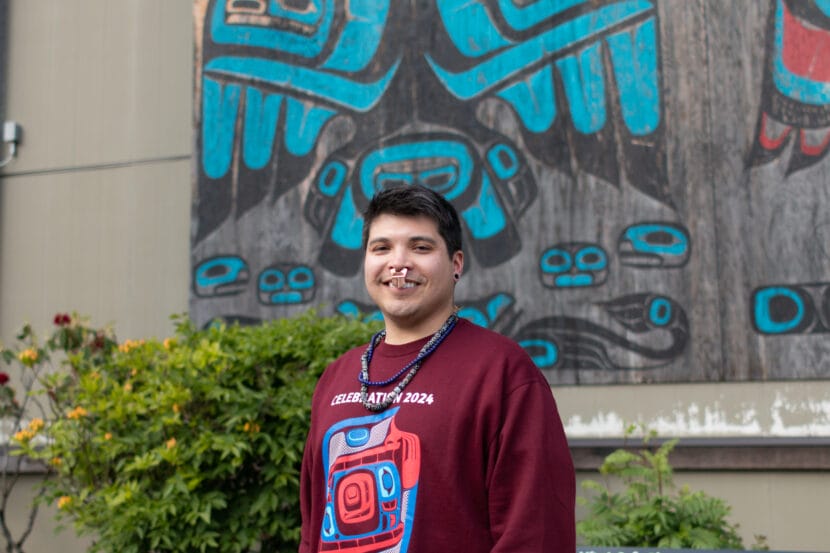
G̱at X̱wéech Nick Alan Foote, whose art was chosen to represent Sealaska Heritage Institute’s Celebration 2024, wears a sweater with his piece “Sacred Embrace” at Village Street in Juneau on June 6, 2024. (Tasha Elizarde/KTOO)

This is Tongass Voices, a series from KTOO sharing weekly perspectives from the homelands of the Áak’w Kwáan and beyond. 

Last week was Nick Alan Foote’s first time at Celebration in almost two decades. In the time he’s been away, he’s made a home in Seattle, left a job in corporate graphic design, and become a full-time Lingít artist alongside his sister, Kelsey Mata Foote. His formline piece, “Sacred Embrace,” was chosen to represent this year’s Celebration. The theme was “Together We Live in Balance.”

He performed at Celebration with the Sheet’ka Ḵwáan dancers, who honored the 50 year anniversary of the Sitka Native Education Program, during their performance at Centennial Hall.

Listen:

This transcript has been lightly edited for clarity.

My name is Nick Foote, Nick Alan Foote. My Lingít name is G̱at X̱wéech. I’m kind of from all over Southeast Alaska. I’ve lived in Juneau, Ketchikan, Sitka and Klawock in the summer. And I currently live in Seattle, but I’m up here for Celebration this year. 

My mom is in Arizona, and my sister’s in Texas, and my grandma is in Ketchikan. So everybody’s spread out, and it’s hard to get everybody together. And we are joining a dance group that we used to dance with in Sitka — the Sheet’ka Ḵwáan dancers. 

Yeah, so the piece I created for Sealaska Heritage Institute’s celebration this year is “Sacred Embrace.” On the outside, there’s a spirit embracing a human, and within that is a raven and an eagle. This represents tradition and culture and our connection to it. And then within it, in the very center, at the heart of it, is a salmon, which represents the connection that Alaska Native people have to the environment and the land. 

My parents always kept a lot of Alaska Native artwork around the house. My Aunt Kathy is an artist, and she would give us a lot of artwork. It was always on our walls. So I would just try to mimic and trace the shapes. And just, that was definitely, you know, the starter, the kicking off point into formline. 

But I also was just being exposed to it through the Johnson O’Malley program. I was also part of the Sitka Native Education Program, so I had a lot of exposure to the artwork because we would make our own regalia. So we would sew on, you know, clan crests to our robes. And by the time I got to college, I was learning Adobe Illustrator and Photoshop, and so I kind of took what I knew about formline design and started bringing it over into the digital aspect.  

I think I really started to take formline design seriously as like a career when I moved to Seattle because I kind of got homesick a little bit for, you know, Alaska. And so I started drawing a lot, creating my own designs to kind of cure my homesickness.

It’s something that I feel like I’ve always been pulled to, but it just had to slowly evolve into making that leap from graphic design corporate world to making my own art. 

I would say, just keep drawing. That’s really…if you love it, do it every day, draw what you love. There’s a place for you in the creative world, and your art.

Tongass Voices: Dave Hanson on the cosmos of Marie Drake Planetarium

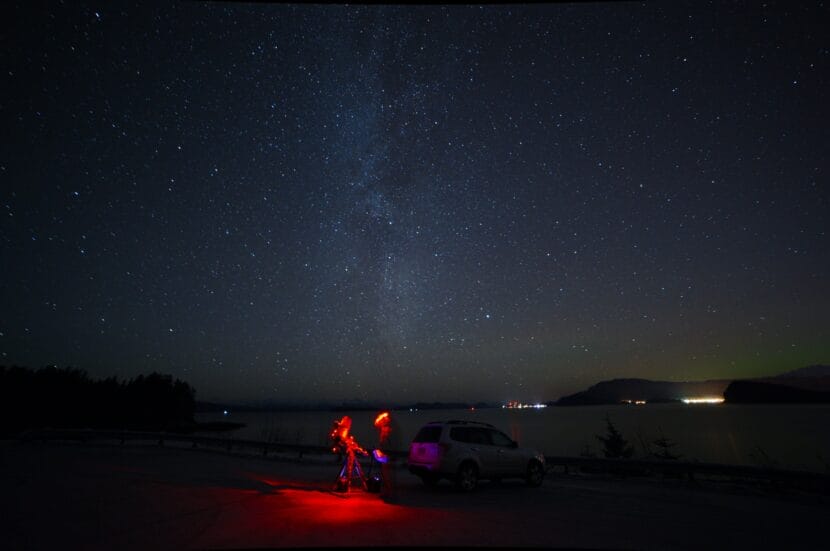
Dave Hanson photographs the starry, auroral night sky at False Outer Point on Douglas Island in December 2017. (Photo provided by Dave Hanson)

This is Tongass Voices, a series from KTOO sharing weekly perspectives from the homelands of the Áak’w Kwáan and beyond. 

Sandwiched between Juneau-Douglas High School and Harborview Elementary is the Marie Drake building, home to Juneau’s planetarium. Volunteers host free lectures, First Fridays, films, and field trips.

Dave Hanson is an astrophotographer and one of the planetarium’s board members. He says they hope to keep the planetarium open after the city takes over the building from the school district. His most recent lecture was about rogue planets.

Listen:

IC 1396, or Elephant’s Trunk Nebula, photographed by Dave Hanson in 2022. (Photo provided by Dave Hanson)

This transcript has been lightly edited for clarity.

Dave Hanson, speaking to the audience: So, welcome to the Marie Drake Planetarium. If you weren’t planning on being at the planetarium, you’re here now. Enjoy the show. 

Interview transcript: Okay, I’m Dave Hanson. I moved to Juneau seven years ago. And when we were thinking about moving here, we started googling Juneau. And one of the things we found was a planetarium, which just amazed me in a town the size of Juneau. 

Speaking to the audience: So tonight’s show is called “Going Rogue in the Cosmos.” The main thing I think we’re going to be talking about is mostly rogue planets. And we’ll talk a little bit in a bit about what that is. 

I woke up yesterday morning. And there was big news from the Euclid Space Telescope — which is yet another space telescope — that it found a bunch of rogue planets. And how timely is that?

Interview transcript: I’ve always been interested in astronomy. I do astrophotography, I had done that previously. So when I got here, I definitely wanted to check it out. I met the people here and started volunteering, stacking chairs, and eventually started doing presentations and joined the board. And it’s been a great experience. 

Speaking to the audience: Euclid is a little bit different. It’s what they call a survey telescope. So it’s going to be actually mapping the entire sky. So what it saw were 50 rogue planets, kind of in one shot. So what it did was, it looked at Orion. Can you see Orion in this photo? The constellation. We’ve got the head up there, we’ve got the belt, the sword, the feet. 

Interview transcript: To me, one of the most rewarding things are the kids. And the questions they ask are just so on point. And they’re so curious. So we bus in kids from all the schools. I don’t know how many we did this year. Last year, I think we brought 800 kids to the planetarium. 

Speaking to the audience: Up here, we kind of see this dark, dusty area with some glowing stuff up there. This is an object called M78, or Messier 78. And it’s a star-forming region. Well, Euclid took a picture of it, and we finally got some of the first science photos from Euclid. Just in this one image, they found 300,000 new objects that we didn’t know about. So these are new stars, planets, protoplanets. And they found 50, approximately 50, planets that aren’t associated with stars — rogue planets. And this is kind of way more than we thought we would find. 

Interview transcript: Yeah, there was a lot of anxiety among the board members, you know, when we first heard about the consolidation. Our hope is that, you know, if this becomes kind of a community center, this whole facility, that we can be one of the anchors for that, you know, as a long-standing organization. And that’s one of the things we’re trying to do is, you know, work with other nonprofits in the community. 

Speaking to the audience: That’s kind of the shocking thing. We think of, you know, our galaxy and our universe being very ordered in these star systems with planetary systems around them, which was a surprise, even, that so many of those existed. And now we found that there’s all these planets that aren’t even associated with stars. The more we know, the more we don’t know. So there’s plenty — don’t worry, all the discoveries have not been made yet.

Tongass Voices: Seth Williams on what it takes to be a karaoke host

Rouel Dela Cruz performing karaoke at the Alaskan on May 22, 2024. (Photo by Yvonne Krumrey/KTOO)

This is Tongass Voices, a series from KTOO sharing weekly perspectives from the homelands of the Áak’w Kwáan and beyond.

Every Wednesday night, the Alaskan Hotel & Bar in downtown Juneau swarms with hopefuls. One by one, they get the chance to step on the stage, mic in hand, and sing whatever they please. 

The man who hands them the mic is Seth Williams. He’s been hosting karaoke in Juneau for a decade at a few bars around town. For this episode of Tongass Voices, Williams shares how he got into the role and what he loves about seeing people get their moment in the spotlight. 

This transcript has been lightly edited for clarity.

Listen:

Seth Williams: My name is Seth Williams. I grew up in Hoonah. But I’ve been in Juneau now longer than I ever was in Hoonah. I’ve been here 17 years.

I had been going to karaoke forever. And  I had filled in a couple of times when the Karaoke Host would leave in the middle of the shift because it’s really not the easiest job.

The last person quit. I’d taken over. What was funny was it kept going on for months. Like, every time Iʼd come in, I was told this is not permanent, you know, “Don’t get comfortable doing this.” 

And then one night, the owner’s wife came in for the Viking, and she asked me to sing a song with her. And so we’re singing the song, we’re having a lot of fun. It was like the random Wednesday night or something like that at the Viking. And she looks at me, she’s like, “Do you know who I am?” I was like, “I’m sorry. I don’t.” And she’s like, “I want you to know that this is your job now for however long you want it.” 

And, you know, a lot of it came from just me doing what I’ve been doing. Just trying to convince people to sing, if they want to, and then kind of help them as they struggle. And I ended up keeping the position for the most part until the Viking closed. 

I think one of the greatest things that’s happened since I’ve taken over the Alaskan — I call them Gen Z kids, younger people. They’re incredibly supportive. And it doesn’t matter the caliber or level of whoever is singing, if the energy is high, they’ll just be up there singing with them. And you could see the look on the person who was very nervous to sing in the first place. And then you have all these people up front singing and dancing. It makes them feel like a rock star for a moment. It’s a really fun thing to happen. 

And so kind of similar things happened at the Sandbar on Friday nights recently. There’s a company, I won’t give the name. It’s a bunch of 20-somethings coming. And they’re very much the same way. They’re very supportive. And they make it a lot of fun, and bring this high energy. And, you know, a lot of people kind of attribute that to me, I can kind of do certain songs to get people kind of into it. But then they kind of take the energy and run with it. And so my job is actually kind of easy in that sense. 

I kind of joke, you know, is it a karaoke night if there isn’t one person who doesn’t sing What’s Up by Four Non Blondes. Even though it’s a much older song in general, it’s still one that kind of gets the crowd hyped. 

And depending on the mood, and, you know, Man, I Feel Like a Woman. Like, especially the Sandbar, it’s really very interesting to watch because somebody will sing it. And all the women there — and there’s quite a few women there at times. They just dance and have fun, like, age doesn’t matter. It’s just this humongous unifying song that gets everybody hyped and they have a lot of fun and it’s just really fun to watch. 

Yvonne Krumrey: Have you ever sung that song at karaoke?

Seth Williams: I havenʼt. It’s not in my range.

Visa programs draw foreign teachers to Alaska’s rural school districts

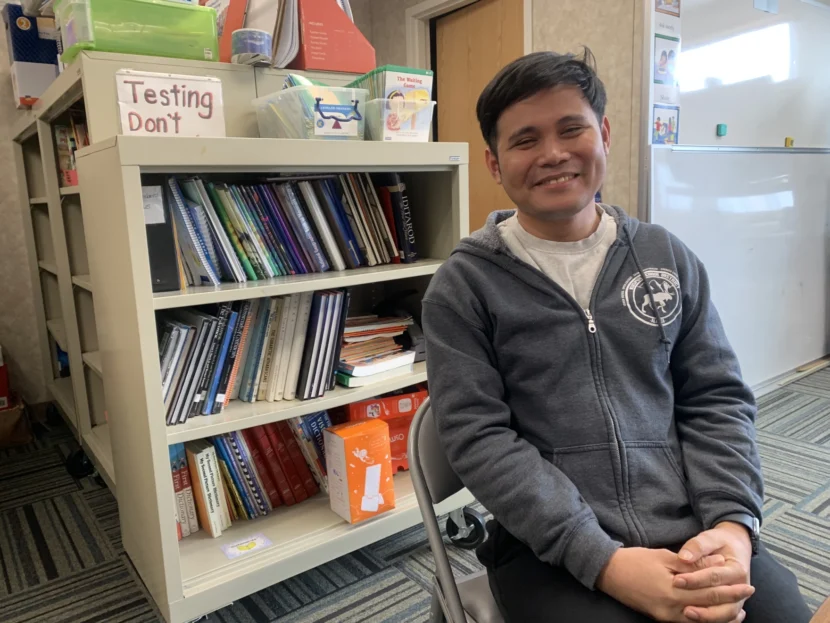
Dale Ebcas teaches Special Education at the Joseph and Olinga Gregory Elementary School in Upper Kalskag. (Emily Schwing/KYUK)

When special education teacher Dale Ebcas moved from his home in the Philippines to the tiny Alaskan village of Upper Kalskag back in the winter of 2020, the warmest layer he brought with him was a trench coat.

“I was imagining a weather like, you know, Korea,” Ebcas laughed. “Because I’m a fan of watching Korean movies and it’s like, ‘oh, they’re just wearing trench coats. It seems like it might work.’”

The average temperature in the Philippines’ coldest month is just about 78 degrees Fahrenheit. By contrast, the climate in Upper Kalskag is semi-arctic and snow can blanket the ground for more than half the year. Needless to say, the trench coat didn’t cut it. Ebcas had to borrow a down jacket from the principal of the school where he’d been hired.

His school district, the Kuspuk School District in Western Alaska, is about the same size as the state of Maryland. While the region is large, the student population is small: only 318 kids spread out across seven villages and none of those villages connected by a road system. Here, like in many other rural school districts across America, it’s a struggle to fill nearly 40 teaching positions. That’s why the Kuspuk School District is bringing in educators like Ebcas from over 5,000 miles away. So many of them, in fact, that they now make up more than half the district’s teaching staff. It’s one of many school districts around the country who are addressing a shortage of teachers by relying on special visas that allow foreign teachers to come work in the United States.

Ebcas is from Cagayan de Oro City on the Philippine island of Mindanao, an island with a population of more than 26 million people. By contrast, there are just over 200 people in Upper Kalskag. While winters are long and the community is tiny, Ebcas has seen a lot of success. Earlier this year, the Governor’s Council on Disabilities and Special Education in Alaska honored Ebcas with an Individual of the Year Award for Special Education in Inclusive Practices. Earlier this month, he was also recognized as one of among 20 teachers for Alaska’s 2024 Educators of the Year.

“I truly believe that that award only signifies that as a school district, we are doing our best to help the kids here in the village. That we are really striving hard to promote inclusion and understanding with kids, with disability and without disability,” Ebcas said.

Ebcas said that he enjoyed teaching in Alaska so much that he encouraged other teachers he knew from the Philippines to join him. His aunt, Vanissa Carbon, now teaches second grade in Upper Kalskag. Although she said that the winter in Upper Kalskag is long, she’s been pleasantly surprised by life here, where the population is predominantly Indigenous. “The people here are also like Filipinos. Their culture is somehow the same in terms of close family ties, being together on occasions and helping each other,” said Carbon.

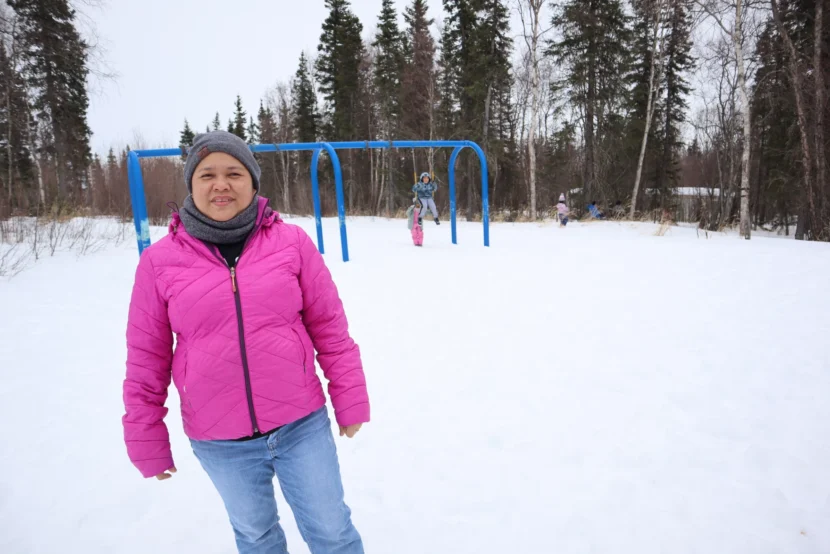
Second grade teacher Vanissa Carbon said that the adjustment to winter in the U.S. took some patience. “Oh my God, it’s so long,” she laughed. But she appreciates the community in Upper Kalskag for its similarities to Filipino culture. (Emily Schwing/KYUK)

In the Kuspuk School district, teachers who come from the Philippines say that they can make 15 times the amount of money they could at home, in addition to benefits. And they have access to teaching tools and technologies that aren’t as readily available in the Philippines.

“I was quite fascinated with the fact that we have resources that are really readily accessible to students with special needs,” Ebcas said. He pointed to tools like a “talking pen,” which assists students in learning to read, among other technologies. “These kinds of devices, we don’t have them in the Philippines. It’s very expensive,” he said.

The teachers who come to the U.S. from the Philippines are highly qualified, said Madeline Aguillard, superintendent of the Kuspuk School District. “These were very highly educated individuals, oftentimes with multiple masters degrees or even an earned doctorate, even after we do a foreign credential evaluation,” she said.

Aguillard did her PhD research on the special education system in the Philippines. She said that the requirements for students working toward teaching degrees there aren’t so different from what’s required in the U.S. “Their studies were purely 100% based on the U.S. model of students receiving special education services,” Aguillard said. She said that her research was in the back of her mind when her school district opted to pursue hiring foreign teachers.

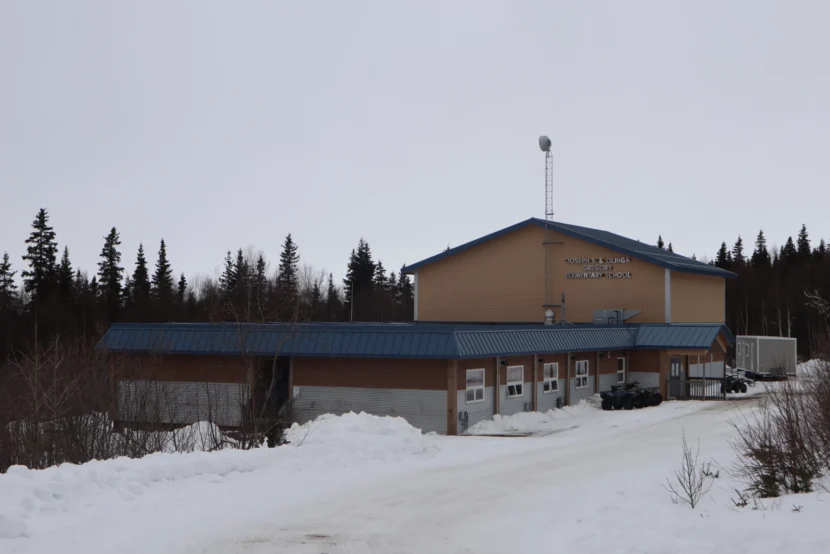
The Joseph and Olinga Gregory Elementary School in Upper Kalskag is one of nine schools in the Kuspuk School District, which serves 318 students spread across an area equivalent in size to the state of Maryland. (Emily Schwing/KYUK)

Both Ebcas and Carbon are here on J-1 visitor visas, which are good for three years and can be extended for two more. The J-1 is a cultural exchange visa for visitors, and J-1 visa holders often fill summer service positions related to the travel industry in Alaska. Childcare workers, including au pairs, also use J-1 visas. Nationwide, there are more than 5,700 teachers in the U.S. on J-1 visas. Ninty-one of them are in Alaska.

“They do have program requirements where they do have to share not only their culture, but also learn about the culture that they are immersed in for their job,” said Aguillard. “A big part of education in rural Alaska specifically is the emphasis on cultural heritage and keeping that culture alive, whether it be Alaska Native culture, or whatever culture an individual brings with them to the space they’re in,” she said.

Aguillard said that the teachers host Filipino-themed events in her school district. “A couple of our teachers have put on informative nights about the Philippines, so they’ll decorate the whole gym, they’ll cook food and do a lecture on Filipino cultural traditions,” she said.

Aguillard said that J-1 visas have had a dramatic positive impact in her school district. “We went from having zero applicants for positions for a year-long posting to over 100 applicants of extremely qualified people with experience, and they’re wanting to come teach our students,” she said.

Still, Aguillard said that the teacher shortage in the Kuspuk School District is so dire that 20% of teaching positions were never filled this year, even with the teachers on J-1 visas. Now the Kuspuk School District is looking at ways to keep foreign teachers on staff for more than five years. One option is the H-1B visa, a specialty occupation visa that paves the way for immigration.

Kuspuk isn’t the only remote school district in Alaska utilizing U.S. State Department visas to fill teaching positions. More than 350 miles south, the Kodiak Island School District has hired an immigration lawyer to secure H-1B visas, and they’re also recruiting teachers in the Philippines.

At an Alaska Senate Finance Committee hearing in March, Kodiak Island School District Superintendent Cyndi Mika said that the district now hosts its own job fair in the Phillipines. “This year we went to both Manila and Cebu City,” she said. “We went to Cebu [City] because it’s rural-remote, and we knew that those are the types of teachers that would be better integrated into our community.”

In Upper Kalskag, Ebcas extended his J-1 Visa for two additional years, but at the end of the next school year his time in Alaska will run out as well. He said that it’s a disappointing reality of the J-1 visa program that he can’t stay on to build on the work he’s already done.

“I could have continued the things I do with the community and the kids if only I could go beyond five years,” Ebcas said. “I consider this already as my family, the community here, the kids here.”

Tongass Voices: Kanik Corinne James on being uplifted by Indigenous women in the art world

Formline artist Kanik Corinne James at KTOO on May 12, 2024. (Yvonne Krumrey/KTOO)

This is Tongass Voices, a series from KTOO sharing weekly perspectives from the homelands of the Áak’w Kwáan and beyond.

Kanik Corinne James is a Juneau-based formline artist who first started selling her designs under the brand Tlingit Aesthetics when she was 18. She learns from traditional formline styles, but adds her own creative twists to them.

Kanik recently designed a piece called “Auntea” and told KTOO what inspired the design.

Listen:

This transcript has been lightly edited for clarity.

Kanik Corinne James:

It’s kind of like a stylized face in the shape of a teapot. So like, the mouth would be the spout. And then on the back of the head would be a claw, almost, or a foot, depending on how you look at it — and that’d be the handle of the teapot.

“Auntea” by Kanik Corinne James.

Something about me is I love tea, in general. And I just became an auntie, so it felt very fitting. And I have so many aunties in my life that just hold me up and support me. And so I felt like it’d be a fun design to dedicate to all my aunties out there. 

Kanik áyá ax̱ saayí. G̱aanax̱.ádi ḵa Gitlaan Ganhada áyá x̱at. Kichx̱áanx’ Metlakatla Ḵwaande. 

My Lingít name is Kanik, and my English name is Corinne. And I’m G̱aanax̱.ádi and Gitlaan Ganhada from Ketchikan and Metlakatla. But I grew up here in Juneau. 

It’s been interesting. I was definitely worried at first I wouldn’t be taken seriously, because sometimes it’s looked down upon wanting to live off of your art, or seen as impossible. But I feel like the community here is so amazing. And everyone’s so accepting, and they’re so encouraging.

But starting a business has been — that has been interesting. There’s lots of growing pains. I think I officially started my business when I was 18, so shortly after I graduated high school. 

I grew up here in Juneau, my whole life. So I’ve always been surrounded by my Lingít culture and heritage. But growing up as a Native in the public school system was kind of hard, to be proud of who I was. So it took me a while to actually get into art. But when the pandemic started, and I felt very disconnected from the world, because everything was online, I couldn’t talk to anyone in person. That’s when I really started connecting to my culture again. And art was what brought me back. 

So for my inspirations, I become such a fangirl when it comes to our women Indigenous artists. And Alison Bremner would be one of the first people I mention. Alison Bremner was the first artist who opened my eyes to the possibilities of what I could do when I grow up. Like when I grow up, I want to be like, Alison, she’s really cool. And growing up, I didn’t really hear about women Indigenous artists, so it never really occurred to me that I could be an artist until I met Alison during middle school Sealaska camp. And ever since then, I’ve just been like a fan girl. 

I feel like lately Juneau has been impressing me with Áak’w Rock and some more traditional classes like weaving and carving. And even like some harvesting classes, which has been pretty cool to see. And Sealaska has also been doing a really good job at offering these classes to the community. And I think UAS is getting there as well. But I feel like, since the Indigenous community is — we’re still learning about our culture as well. And so this is, this is all this has been a learning experience for the community, I think. But it’s been really cool to witness like, I feel so grateful to exist at the same time as all these artists and all these really cool events that are starting.

Site notifications
Update notification options
Subscribe to notifications