Community

Tongass Voices: Rebecca Hsieh on intertwining community and art with Head in the Clouds Collective

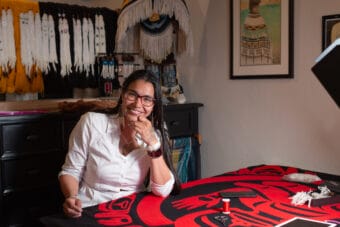
Rebecca Hsieh from ReccaShay Studios sits in her corner of the Heads in the Clouds Collective studio in March 2024.

This is Tongass Voices, a series from KTOO sharing weekly perspectives from the homelands of the Áak’w Kwáan and beyond. 

It’s been over a year since Rebecca Hsieh moved into her new studio space downtown. Since then, she and three other artists have formed Heads in the Clouds Collective, a growing community space for anyone in Juneau to learn a new art medium – or make new friends. 

The four artists work there and also host workshops or camps. As Hsieh explains, community is central to the collective’s ethos.

Listen:

This transcript has been lightly edited for clarity.

Rebecca Hsieh: So, we’re Heads in the Clouds Collective, downtown. There are four artists who share this space. And so there’s Tess Olympia, and she owns Juneau Woolies, she’s back in that corner. And then this is Glo Ramirez of Glo Ink, and she does everything, I think. A lot of things. She illustrates, she has clothing, she’s got earrings. That’s Grace Corrigan from Sundew Print. She’s about to teach the printmaking workshop. 

This beautiful mess is mine. I’m Rebecca Hsieh of ReccaShay Studios. And I do mostly like crocheting, just a lot of fibers.

I, when I was 10, for Christmas I got one of those really typical crochet kits that had a little book. And I remember looking through the book trying to figure it out, and I could not, so my uncle actually figured it out and then pseudo taught me, and it’s just something that I’ve always come back to. And before I moved to Juneau, as a young adult, I kind of picked it up again.

When I first moved to town, I actually worked at Kindred Post, and I don’t think I would have pursued art if I didn’t work there and make the connections I did because everyone was just so supportive. And so I just started making more and getting connected in the art scene. And then like having a market for the first time. And then people bought stuff, and I was like, ‘oh my god.’ And so then, I just keep making stuff that really make me happy and make me smile. 

I just wanted to crochet a hot dog that was like our height. So what’s gonna happen is, in that room in the JAHC, one side is going to be all the eastern foods I grew up with. And so I’m gonna make a dim sum table and all that, and then on the other side will be all the Western foods.

I think Juneau has been the most supportive place, in the sense that sometimes I think people can like gate keep grants, or market opportunities, or show opportunities, like exhibition opportunities. And here, whenever I’ve talked to any other artists, people are just so willing to share that information and be like, ‘Hey, I think you’d be great for this,’ even though they might be aiming for the same thing. But it’s just like, people are here to lift each other up. And so I try to do the same, like promoting other people’s work and all that.

This is what I do full time, so I’m in here the most and everyone kind of comes on their own schedule. This space actually was a nail place beforehand. So I think around a year and a half ago, I actually used to be in a studio across the hall and it flooded. And so we had to move all our stuff — or I had to move all my stuff — in here with another artist, but I’d been kind of eyeing the space just because the views are really nice. 

Just slowly started reaching out to other artists that I was friends with to see if they’d be interested in having a more focused artists space where we can kind of collaborate and you know, make this a community place. We’re trying to open it up and like, collecting other artists to teach in here, because we just want to, you know, make this a big community space where people can learn and create.

You can check out Hsieh’s art show, “Bite Sized”, at the Juneau Arts and Humanities Center now until May 26.

Volunteers want the city to manage Douglas Island’s cemeteries. Instead, the Assembly is asking for help.

Ed Schoenfeld looks at a headstone at the old Douglas city cemetery on Tuesday, May 7, 2024. (Clarise Larson/KTOO)

Trudging through the bumpy, brush-covered grounds at the old Douglas city cemetery, Ed Schoenfeld squints at a headstone. It’s half protruding out of the ground, with fiddleheads popping up around it. 

“It’s a headstone for Fred Schuler. It says he was born in Germany in 1859 and died November 11, 1906. At age 47 years. Rest in peace,” Schoenfeld said. 

The headstone is one of many at the cemetery that have been unearthed in recent years thanks to the work of volunteer groups who spend their own time weeding, clearing brush and cleaning gravestones. 

Without some sort of maintenance, many of the gravestones in this cemetery and others on Douglas would be lost in the growth of the rainforest. 

“Often this is choked with salmon berries and weeds,” he said. “You can’t even see the depressions in the ground where people were buried and the ground sort of settled.”

Many groups and residents like Schoenfeld have advocated that the burden shouldn’t be on volunteers, and they want the City and Borough of Juneau to take over ownership of the private cemeteries.

Ed Schoenfeld looks at a headstone at the old Douglas city cemetery on Tuesday, May 7, 2024. (Clarise Larson/KTOO)

But, at an Assembly committee meeting on Monday, City Attorney Robert Palmer laid out the legal barriers the city would face if it tried to do that. 

“Many of the cemeteries have been a hot topic for Assemblies of the past, and every time that we’ve touched it we’ve kind of run into the same hurdle of ownership,” Palmer said. 

The city says it’s unclear who owns the land where many of the cemeteries are. And, Palmer says it would likely require extensive work to find those owners, acquire the land and then maintain it. 

An alternative idea is that instead, the city could financially support an organization tasked with coordinating the maintenance of the cemeteries. 

At the committee meeting, members were split on what level of action the city should take on the issue. 

Assembly member Alicia Hughes-Skandijs said she doesn’t think it should be the city’s responsibility. 

“I think we also have to figure out where the city should not be involved and where the city should not be all things,” Hughes-Skandijs said. “And for me, this is just one really where it’s not the city’s land, it’s super time intensive.”

But other members, like Greg Smith, said something should be done. 

“This issue actually has been kind of surprising and then the amount of community support that has come out to say we need help, this is history. This is treasured land with people that are important to Juneau,” Smith said. 

The Assembly voted 5 to 2 in favor of the city putting out a request for organizations that might be interested. Members Hughes-Skandijs and Ella Adkison voted against the idea. 

A headstone at the old Douglas city cemetery on Tuesday, May 7, 2024. (Clarise Larson/KTOO)

Schoenfeld, who was at the meeting on Monday, called it a good first step. 

“It’s not the real solution. I think it’s just time — this is me personally, not part of any group — for the city to step up to the plate and say, ‘It is our responsibility,’” he said. “The remains in the cemetery are real people.”

The request for interest will likely go out to the community in June or July. 

Tongass Voices: Haa Tooch Lichéesh Coalition members find inner strength through ocean dipping

People dipping with Haa Tooch Lichéesh Coalition at Auke Recreation Area on March 24, 2024. (Photo by Yvonne Krumrey/KTOO)

This is Tongass Voices, a series from KTOO sharing weekly perspectives from the homelands of the Áak’w Kwáan and beyond.

Haa Tooch Lichéesh Coalition is a nonprofit that offers Indigenous-based healing practices and reconciliation with the violent history of colonization and its impacts on Juneau’s community today.

One of these traditional practices is a dip in the ocean, for strength and healing. It’s methodical and intentional — participants walk in up to their knees, then stop, then up to their waists, then stop, and so on until they are as far in as they feel comfortable. Afterward, participants warm themselves by the fire.

We spoke to Ḵáaḵ’utx̱éich Kai Monture and organizer Saan Jeen Jennifer Quinto about the clarity they find in the frigid waves. 

This transcript has been edited for length and clarity.

Kai Monture: My names are Ḵáaḵ’utx̱éich and Eeḵ Kahaa Ḵáa. My English name is Kai Monture. I come from Yakutat from Tsísk’w Hít, the Owl House.  

My intention for this dip is to introduce my three nephews here who are Teiḵweidí from Yakutat. They just moved back to Lingít Aaní this December, just started to reconnect to their Lingít side. Now this is their very first dip.

Saan Jeen Jennifer Quinto:  The coldness of the water is like the overwhelming moments when we’re in our daily lives. And because we’re not taught how to process and confront those overwhelming moments, like in school or other places, and we really don’t have guidance in that way, I use the water to help teach me how to navigate those really overwhelming things. 

That overwhelming cold sensation is what I equate to those things that we need to start confronting and learn how to navigate in our daily lives.

Kai Monture: I was very lucky to be raised by my grandparents, Elaine Abraham and George Ramos. And they were very traditional. My grandpa in particular taught me a lot about the training of the X̱’éig̱aa Ḵaa which translates to “a true or authentic person.” And that was the title of our traditional warriors.  

Their training began when a boy was six or seven years old. He would go to live with his maternal uncle, who would raise him from that point on. And one of the core parts of their strength training was going into the ocean at sunrise almost every day of their life.

It was always a practice I was really fascinated by but something I actually didn’t start until my adult years. Just from personal experience, it was just like the way my grandparents were describing it to me, as a way to test and build up your toowú latseen, your inner strength. 

The cold obviously is so hard on the body. But the strength of your heart and your soul can like do wonders, especially when you test it for yourself. 

I think a lot of people that are scared to try and reconnect to this practice would really be surprised by themselves. 

I actually was scared Soriano is too small. But he really really insisted he would try it.

Yvonne Krumrey: How was it?

Soriano: Cold.

Ravenstail weaving comes to life at historic Juneau event

Students from Harborview Elementary’s Tlingit Culture, Language and Literacy Program dance on stage during a Ravenstail robe ceremony on Tuesday, April 30, 2024. (Clarise Larson/KTOO)

There’s a story behind every Ravenstail robe. 

“Up here we have the northern lights with the Chilkoot mountains,” said fifth-grader Aurora Southerland, describing a robe she was wearing. “And then down here are bear prints and the salmon going upstream.” 

She’s in fifth grade and in Harborview Elementary’s Tlingit Culture, Language and Literacy Program. And on Tuesday night, she and her classmates made history.

“You have just witnessed the largest gathering of Ravenstail regalia in history — ever,” master weaver Lily Hope told a full crowd at Centennial Hall.

Adult and youth dancers gather on stage during a Ravenstail robe ceremony on Tuesday, April 30, 2024. (Clarise Larson/KTOO)

They had gathered to learn the history — and future — of Ravenstail weaving, or Yéil Koowú. People say the intricate art form slept for a century before it was brought back to life by master weavers like Cheryl Samuel and Kay Parker. 

Both were honored at the event. Weaver Ksm L’x Sg̱a̱a Ruth Hallows commended their dedication to passing their knowledge to others. 

“In 2019, there were fewer than a dozen weavers in the world who had woven Ravenstail dancing robe,” she said. “Today there are four times as many, and our numbers are growing.”

At the event, people learned about the stories behind the weaving and the journey that it took to bring it back to life today. And they got the first look at dozens of newly created, child-sized Ravenstail robes, which will soon be on display at the Juneau-Douglas City Museum.

Not only did they get to look at them — they got to watch them come to life. 

On stage, dozens of students and adults danced and sang in unison to a drum beat. As they moved and twirled, the white fringes of their robes flew in the air like the tail feathers of a bird. 

Memo Contreras, one of the students dancing, said his favorite part of dancing was watching the fringe move.

“Because it looks delightful,” he said.  

Harborview Elementary’s Tlingit Culture, Language and Literacy Program students Jaelyn Jackson (left) and Josephine Lindoff (right) help tie each other’s robes at Centennial Hall before a Ravenstail robe ceremony on Tuesday, April 30, 2024. (Clarise Larson/KTOO)

Marie Johnson was one of the adult dancers on stage. She said it gives her so much joy to see people young and old gather to celebrate their culture. 

“This is a great honor. You know, to bring something to life, and to be able to just share our culture,” she said. “Because every blanket and every article has a story.”

Adult dancers smile while on stage during a Ravenstail robe ceremony on Tuesday, April 30, 2024. (Clarise Larson/KTOO)

After the event, Hope said the journey to grow the number of Ravenstail weavers is far from over. 

“It means we’re doing the good work. It means our communities are strong. It means we have mentors in multiple cities and villages. It means the art form is alive and well,” she said. “And it’s just going to get bigger and better from here.”

Master weaver Lily Hope speaks to a full crowd at Centennial Hall during a Ravenstail robe ceremony on Tuesday, April 30, 2024. (Clarise Larson/KTOO)

On Friday, the robes will go on exhibit at the Juneau-Douglas City Museum. They’ll be on display there through the summer.

Disclosure: KTOO was contracted to produce a broadcast of the event for TV and online. You can watch the recording of Tuesday’s event at ktoo.org and lilyhope.com

Tongass Voices: Malin Babcock on a life intertwined with Juneau history

Malin Babcock, 84, poses outside of KTOO in February, 2024. (Photo by Anna Canny/KTOO)

This is Tongass Voices, a series from KTOO sharing weekly perspectives from the homelands of the Áak’w Kwáan and beyond.

Malin Babcock, treasurer of the Gastineau Historical Society, has lived in Juneau for more than 80 years. Her personal history is deeply intertwined with the history of the city and the state. 

From the traumatic loss of her grandparents in Juneau’s 1936 landslide, to her long career studying salmon across the state, Babcock reflects on her life in Southeast Alaska.

This transcript has been edited for length and clarity.

Malin Babcock:  Well, my name is Malin Babcock, and my grandparents Hugo and Hilja Malin Peterson were both killed in the building. And my mother who was Lillian Peterson Babcock survived.

She was probably one of the first ones that was rescued, because she was on the south end of the slide and right at the very edge when she was hit by the mudslide coming down. And it was the worst disaster that has ever occurred within the City and Borough of Juneau.

My mother was in the hospital for two weeks and then released from the hospital. She talked about it very rarely.

My grandparents were Finnish immigrants. There’s a lot of stoicism that goes throughout that culture. So they emigrated to Juneau late in 1913. My uncle Elmer, and my grandfather were miners, and they both worked for the AJ Mine.

My mother was born on November 9th of 1914, and grew up here, went through high school here. And she obtained a secretarial job with a fella by the name of Frank DuFresne, who was the head of the Alaska Fish Commission at that time. And he did all the arrangement for the funeral and everything else for her parents, which was absolutely amazing.

She later married of fella by the name of Doug Babcock, my dad, who was an early member of the Territorial Sportsmen, plus being one of the first Taku River Rats. And he notably helped in some of the early experimentation for salmon and salmon eggs that led to DIPAC.

Years later – years later – when I went to school at Oregon State and then up to Fairbanks for my master’s degree, where I took ichthyology and fisheries courses, our textbook was by Frank DuFresne. And it was called Alaska Fishes. I mean, it’s absolutely amazing, the webs that we turn that we find out later, you know, and that end up surprising you.

So I went to work at the Auke Bay Lab in 1969. There were not many women biologists, I think there were two when I started to work there. And I spent many, many a summer up in King Salmon in Bristol Bay. And I spent seven years walking the beaches of Prince William Sound working with with the effects of hydrocarbons after the Exxon Valdez oil spill. Anyway, it was just kind of a neat career and I’m very proud of myself.

Iditarod’s iconic Burled Arch collapses in Nome

The Iditarod Trail’s famous Burled Arch rests in pieces scattered across the ground with Old St. Joe’s Church in the background. One of the pillars of the arch lies on the ground. (Ben Townsend/KNOM)

The iconic Burled Arch that marks the finish line of the Iditarod Trail Sled Dog Race collapsed on Saturday near Old St. Joe’s Church in Nome. Residents looked on in awe as they took part in a Ties and Tiaras event taking place just 100 feet away at the church.

The wooden arch fell as the City of Nome experienced its first 40-degree temperatures since Oct. 31. The high temperature observed at Nome Airport on Saturday was a balmy 44 degrees.

The right pillar of the Burled Arch remains mostly intact. One of the pillars of the arch lies on the ground. (Ben Townsend/KNOM)

The Burled Arch most recently underwent renovations in July 2013.

KNOM has reached out to the Iditarod Trail Committee for more details on what happens next.

Site notifications
Update notification options
Subscribe to notifications