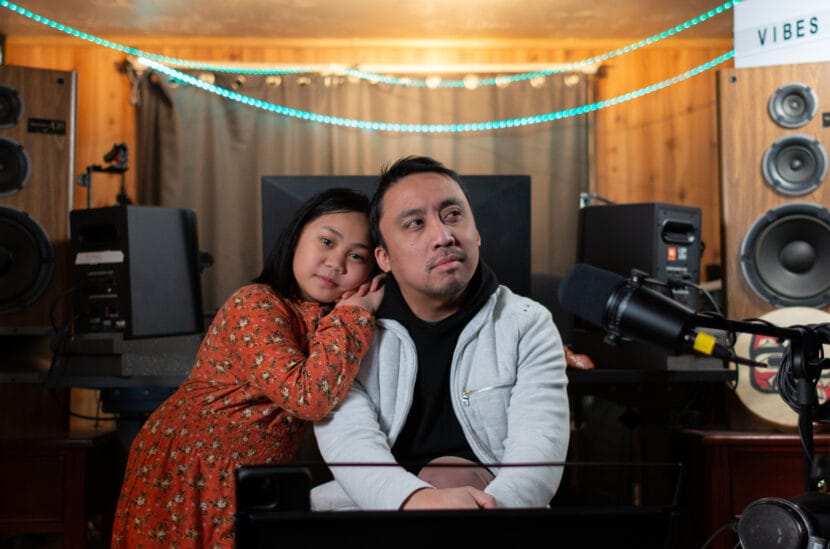
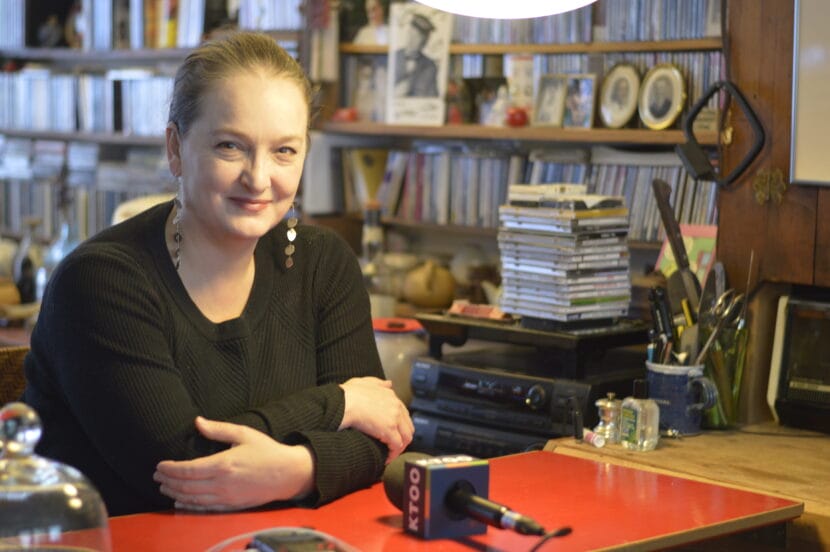
Joshua and Harmony Laboca pose in their home studio in February 2024. (Tasha Elizarde/KTOO)
This is Tongass Voices, a series from KTOO sharing weekly perspectives from the homelands of the Áak’w Kwáan and beyond.
Joshua Laboca, known around Juneau as Jbo, is the music producer and content creator behind dozens of artists in Southeast Alaska. He and his nine-year-old daughter, Harmony, also produce music together.
You can hear their song “Growing” and others on their YouTube page, Harmony & jboaudioe.
Listen:
This transcript has been lightly edited for clarity.
Joshua Laboca: Full name is Joshua Laboca. I go by JBo Audioe, J-B-O A-U-D-I-O-E. That’s what a lot of people know me as in town. And we are here at our home studio, where a lot of artists and bands come in to record and perform in the booth over here. So, I went to school at the Academy of Art University in San Francisco.
So we had some family issues back here in Alaska. So I decided to continue going to school here, online. And then I ended up opening up a studio, but I never wanted to do music for artists. And then, so I had to tell myself, “I want to keep doing this. So how do I? How do I merge what I know about sound design, editing, Foley and effects? How do I apply it to music, like for artists?” So as I was mixing artists, like beats and stuff, and their vocals, I would apply it. And then I eventually grew a passion for mixing and producing for artists in town.
My daughter and I, we do have a YouTube. It’s Harmony & jboaudioe, where we make instrumentals. I’ll have the beat down and I’ll do the mixing, and Harmony will do the guitar and pianos.
Harmony Laboca: Alright, Dad! Play my pre-roll please.
Joshua Laboca: She got inspired by the movie Sing. And there’s this character named Ash that plays the guitar voiced by Scarlett Johansson. And then the only way that I knew for us to continue to work on her playing guitar was that we had to make instrumentals. So every week she would play chords, she would lay chords down on instrumentals that I had. And every week it was just improving on that and that’s how she, she’s four years in now, she plays it pretty good now.
Harmony Laboca: Um, usually we do a guitar first, and then if we’re making a song, we do guitar, vocals and then piano.
Joshua Laboca: And she knows like, the basic controls of when to record, when to stop, going at certain bars and stuff, so.
We usually film this whole process. So even during the mess-ups we still put it in the edit. So because it’s just, you’re never gonna get anything perfect.
But aside from that, once we get it mixed and edited, I’ll put some visuals to it. And then we put it on YouTube. And we just, yeah, that’s our process.
Harmony Laboca: It’s actually really fun. ‘Cuz we do it, he usually like, told me what’s wrong or like, what to improve on. And then he was like, and then sometimes we do games that we made up and like, practice together and sing stuff together, make videos together.
Joshua Laboca: We have a back and forth too, like it’s not always like Brady Bunch or anything. It’s like, ‘No, we should do this. No! No, yeah, no, I know, I know.’ You know, we have this like back-and-forth banter that we always do. But that’s kind of like the relationship that we have. And it makes it so that, you know, if I’m not doing something right, she calls me out, she’s not doing something right, you know, I call her out.
Joshua and Harmony Laboca: The saying that we go, when right before we end our session is, “It’s never a good day without a challenge. So, fail fast. Fail forward. Fail a lot.”
Joshua Laboca: We say the word failure more than we say success. Because we’ve grown in the knowledge of music. And we’ve grown in making music from all of that.
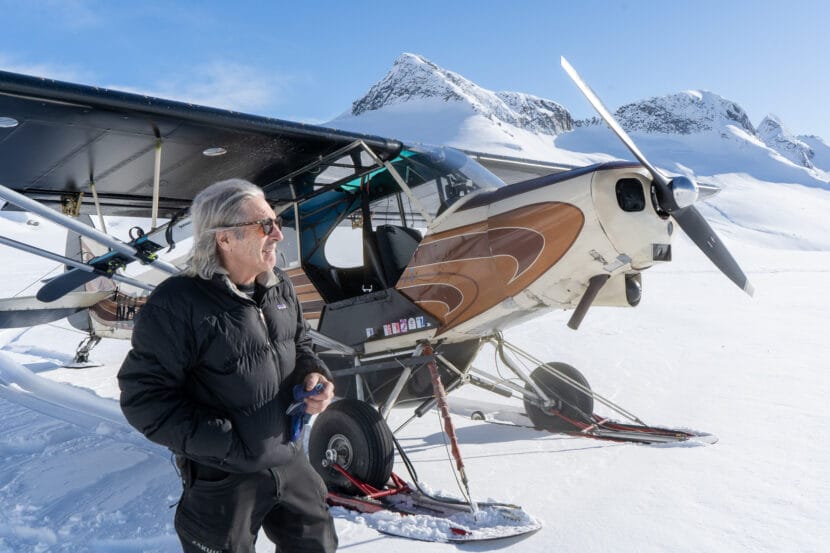
Drake Olson on an unnamed glacier between Haines and Skagway. Olson has carved out a unique niche in Southeast Alaska ferrying adventurers into the little-traveled mountains around Haines. (Lex Treinen/Chilkat Valley News)
“I don’t really know where we are going,” said Drake Olson on a recent joyride shortly after takeoff from the Haines airport in his 1979 Piper Super Cub. “It’s all just one big feel out.”
It’s a clear blue day with only a few clouds at the edge of the skyline, but Olson is intently focused on the instruments in front of him. He keeps a steady conversation going, but it’s clear his mind is on the task in front of him as he reacts to minute pressure and wind differences as the plane gains elevation.
The plane wobbles slightly. He comments on the cold air burbling off the Ferebee Glacier, and the shifting storm patterns that are transitioning from south to north during the morning, making the air “confused.”
“If you’re thinking straight, you’re always feeling, sensing, watching,” says the 68-year-old. “All of us — no matter what you’re doing — you’re trying to get in that state of flow where you’re focused and there’s no noise.”
Olson finds that flow state when he’s fulfilling a childhood dream of flying.
His passion has helped him carve out a unique niche in the Southeast Alaska flying community ferrying climbers, skiers and paddlers to remote sites in the vast and varied mountain ranges around the Chilkat Valley and beyond. Olson’s natural inclination — developed for years as a professional race car driver in his 20s — has kept him and his clients safe since 1997 when he started Fly Drake, his charter flying service that he continues to operate today.
One of his specialties is glacier landings, in which pilots must not only deal with wind and weather, but also the changing ice forms like crevasses on the surface.
“There’s not a lot of demand — it’s pretty niche,” said Doug Riemer, a longtime pilot who runs Nordic Air in Petersburg.
Olson’s service has allowed him to pioneer recreational access around the Chilkat Valley, where helicopter flying is restricted to narrow corridors in the Upper Valley. Olson has developed a reputation among hardcore adventurers for his skill, humor and folk philosophy.
“He knows the area so well and he’s at one with the land out there. You feel comfortable when you’re flying with him,” said Ryland Bell, a professional snowboarder who lives in the Chilkat Valley.
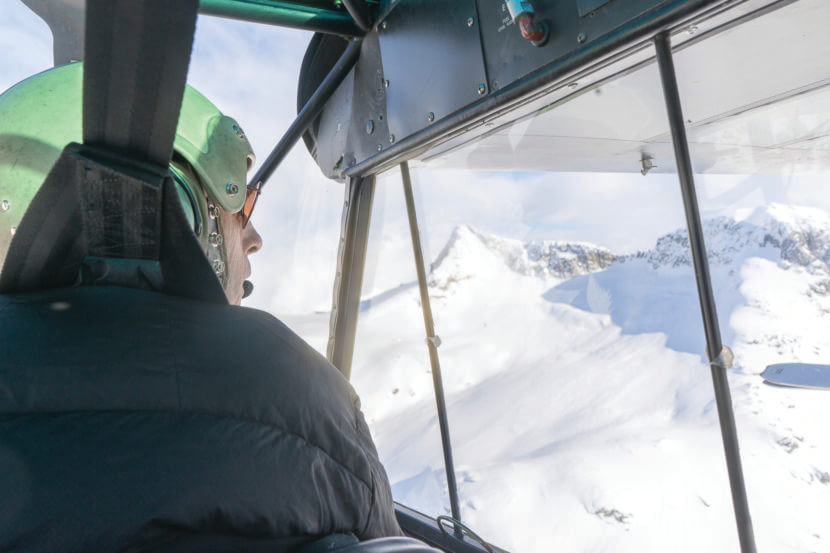
Olson during a recent flight over the Takshanuks. “If you’re thinking straight, you’re always feeling, sensing, watching,” he said. (Lex Treinen/Chilkat Valley News)
A childhood dream interrupted
Olson dreamed of following the footsteps of his father, a pilot who flew reconnaissance planes for the Navy.
“Ever since I had consciousness, it’s been airplanes. Airplanes were so cool as a kid,” said Olson.
But his dad, who was mostly emotionally distant, was focused on sports cars, horses and beer, discouraged the younger Olson, who had a heart murmur that would have excluded him from the service. The family kept horses and lived on a farm in Connecticut.
Despite his hope to fly, Olson got his first taste for engines as a race car driver. He started on an amateur circuit as a young man. He showed a natural ability to find efficient lines around a race track. Soon, he was traveling around the country in a tattered pickup truck he used as a camper to sleep in. The 1983 rig is still parked in his hangar at the Haines Airport, with 375,000 miles on the odometer.
“I lived like a dog,” he said.
With his talent, he soon had engine builders and dealers lined up to get him to drive their cars.
He had success in international racing, notching big wins even as a relatively unknown upstart.
But before long, the realities of the sport caught up to him. A GT prototype he was driving left the ground because of an air disturbance, and he got in a serious crash.
“I was lucky to survive,” he said. He continued to race for three more years after that, but felt rattled by the crash, and felt commodified by sponsors.
He started dabbling in flying and soon met Paul Swanstrom whom he flew with to Haines. (Swanstrom declined to comment on this story.) He flew around Alaska for the next two weeks. He had a vision of what ski planes could do in a country like Alaska.
“I said ‘This is it’,” said Olson.
He returned south and bought a Cessna 180, which he still flies. Within a few years, he had moved to Haines and started working as a pilot. In 1997, he decided to open what became known as Fly Drake.
Fly Drake takes off
From his hangar at the Haines Airport, Olson runs the business by himself, waking up early in the morning to do maintenance.
It hasn’t been easy. Olson is no fan of the paperwork and maintenance that is required of the job when he’d rather be flying. He lives a modest life, driving a 1987 VW sedan and chopping cords wood to heat his shop and home.
He’s learned some hard lessons through some close calls.
A change in lighting during the day can make a safe flight turn precarious. Winds can shift in minutes, and weather can appear out of nowhere.
“I always feel like I’m one little problem away from disaster,” he said.
For glacier landings, a relatively common occurrence is attempting a landing on snow that isn’t hard enough to support a plane landing. Olson has had trips where he and his crew have had to dig for hours to build a ramp out of a pit in the snow.
Through it all, he’s learned to trust himself, and to not get caught in the excitement.
“You learn to leave your ego in a drawer,” he said.
He pointed to a duo of internationally known snowboarders, Vincent De Le Rue and Sam Anthamatten, who visited a few years ago with a handful of spots mapped out. When he flew out there, there was mostly bare rock and ice, not the fluted snow spines that most riders seek. He realized that the famous snowboarders didn’t know the area well enough to pinpoint the right spots on a map. He ended up suggesting another area full of powder-covered spines that he’d seen earlier. (Anthematten and De Le Rue did not respond to messages to confirm the details of this story.)
“You realize the customer is not always right, in fact the customer is often wrong,” he said.
His reputation and the niche he’s carved out has earned him modest renown for his appearances in high profile ski films, including the 2014 Teton Gravity Research film “Deeper.” The film features Jeremy Jones, an internationally-known snowboarder, pioneering multi-day trips in remote areas of Southeast Alaska.
Olson said for the film, he and Jones were able to find what became known as the “spine institute” in the Fairweather Mountains, a magnificent array of snow spines coming down the mountain, that the athletes considered some of the best conditions they’d ever encountered for boarding. For the crew, it felt like a pioneering way of accessing the mountains using planes instead of helicopters.
“It was magic. It was magic for me. It was magic for them,” said Olson. Still, the conditions were fleeting. Olson said the conditions there haven’t been the same since.
Ryland Bell is featured in the film, and had been flying with Olson for years. He said he always feels safe flying with Olson, even while the latter appears relaxed, joking with the passengers and playing music through the headsets.
“So many other pilots are very serious and don’t want to shoot the shit too much,” said Bell. “To a certain extent the vibe I get from them is they’re nervous.”
Bell recalled one trip where his climbing partner had been dropped off by Olson a few days before, only to realize they didn’t have a second sleeping bag. A few days later during a short break in the weather, Olson was able to land and drop off more gear. The weather window was short, and the crew scrambled to get everything unloaded as a wall of dark storm clouds rolled towards them. Olson jumped into the cockpit and headed straight for the clouds.
“He just disappears into the wall — it’s full ‘Hidalgo’ — a sandstorm over the desert,” said Bell referring to the 2004 film about a horseback adventure competition set in Arabia.
Olson, for his part, still has his doubts about whether the risks are worth it.
“You’ve got to really want it. Sometimes I wonder if I really want it that bad,” he said.
For now, the thrill of finding his flow state is too strong to resist.
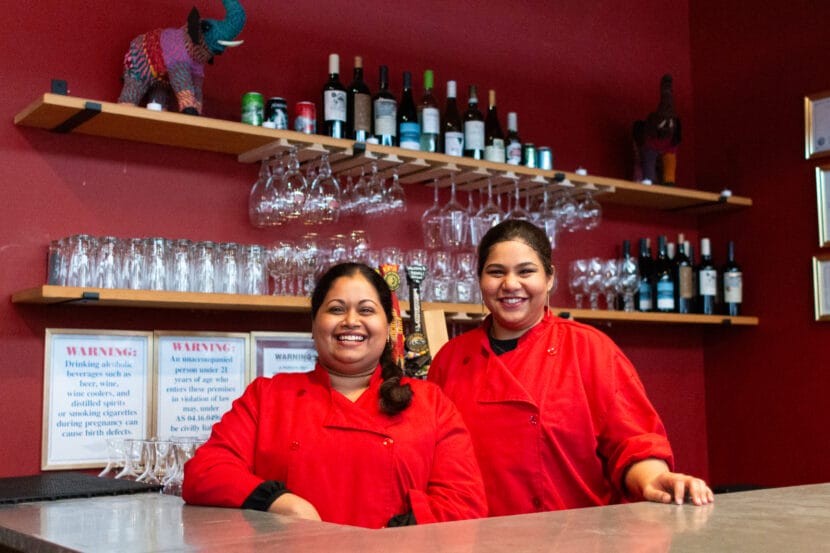
Owner Nimmy Philips and chef Ruth Fisher in Spice Restaurant and Cafe. Photo by Tasha Elizarde/KTOO. Feb. 21, 2024.
This is Tongass Voices, a series from KTOO sharing weekly perspectives from the homelands of the Áak’w Kwáan and beyond.
Nimmy Philips came to Juneau as an engineer, but three years ago, she decided to buy a restaurant. Now, she applies her engineer’s precision to her recipes. One part of that attention to detail: all the spices are ordered whole and then roasted, mixed, and ground by hand.
Enrique Cabrera is her head chef. He shared how he grinds the spices that go in just about every dish.
Listen:
This transcript has been lightly edited for clarity.
Nimmy Philips: I’m Nimmy, I own the Spice restaurant and Spice Cafe and art gallery.
So opening up a restaurant or owning a restaurant has been my dream since I was in, I would say tenth grade or even in high school, mainly because a lot of people don’t understand how food connects each other. It doesn’t matter what culture you’re from, what religion, what color your skin is, it doesn’t matter. Food connects people. That’s the same language that we all speak when we eat the good food. And that’s something I wanted to do.
And I am one of those restaurant owners that, I’m not going to cut costs or take shortcuts to make a dish happen. I have to follow my grandmother’s recipes. My food feelings come from my grandmother. Going back to my grandmother’s house and spending time with her in the summertime, and she only spoke one language. And all her grandkids are well educated and have traveled all over the world. They all come in the summer to visit her and stay with her. The only language she spoke was food. And she showed care and love — support — through her food. And that’s what I want to do for Juneau.
And most of our family recipes call for like secret ingredients that we cannot get in Juneau, Alaska or anywhere down south. So when I go to India, I have to bring it with me.
And if I’m going to make something that is from my family recipe, I’m not going to put on something just to say that I did it. I have to be proud of it. I have to have my 150% effort into it.
And again, this is not just me doing it either. I have an amazing team. If I don’t have an amazing team to back me up, who believes in me, who supports me — otherwise I’m nothing. There’s no me without my group of people, without my Spice team. And my spices.
Spices come from the northern part of India. It comes through Seattle. We have a partnership with a store in Seattle that, whenever they do the Indian shipping from India, we put in our orders, too, and we get the spices through them. And they put it on the barge and we get it here. And we get them all whole spices. We grind our own spices.
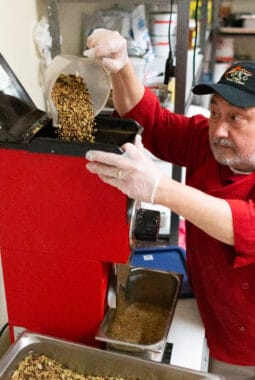
Head chef Enrique Cabrera pours the garam masala mix into the spice grinder at Spice Restaurant and Cafe. Photo by Tasha Elizarde/KTOO. Feb. 21, 2024.
Garam masala is the mix of masala. Masala just means a mix of spices together — that’s all it is. Garam means warm, it gives the life, the warmth to the dish.
Enrique Cabrera: I really enjoyed making the garam masala because you get to see all the spices and you put them together, and you roast them. And when you roast them, the smell of the cloves — that’s one of my favorites.
My name is Enrique ,and everybody calls me Kiké here at Spice. And I’m the head chef in charge in the kitchen and enjoy the work that I do here.
Okay, so let me get my container thing and I’m gonna start getting the recipe together. Coriander seeds, bay leaves, so we’ve got cloves, black pepper, cinnamon. Green cardamom, black cardamom.
One more, we’re gonna one more — Jeera — which is in the kitchen. I’m gonna go get it. Jeera, which is cumin seeds. I’m gonna roast the coriander seeds and the bay leaves and the cloves, and we have star anise to get roasted all over.
Okay, let’s see what’s next. I’m gonna put them all in there and and then I’m gonna mix it, and then I will grind them.
Now you’re gonna smell all the spice together in one smell. This is the easy part, grinding it.
Nimmy Philips: As you can see, we store them either in the container that comes in or sealed containers. We believe every spice has a soul. And that’s something Kerala Indian families believe, we believe that every spice has a soul. You leave the window open and the soul will fly out. I always tell Kiké, you know, “Cover it! The soul is running away! Cover it!”
Enrique Cabrera: At the beginning!
Nimmy Philips: At the beginning. Now Kiké tells me “Cover it!”
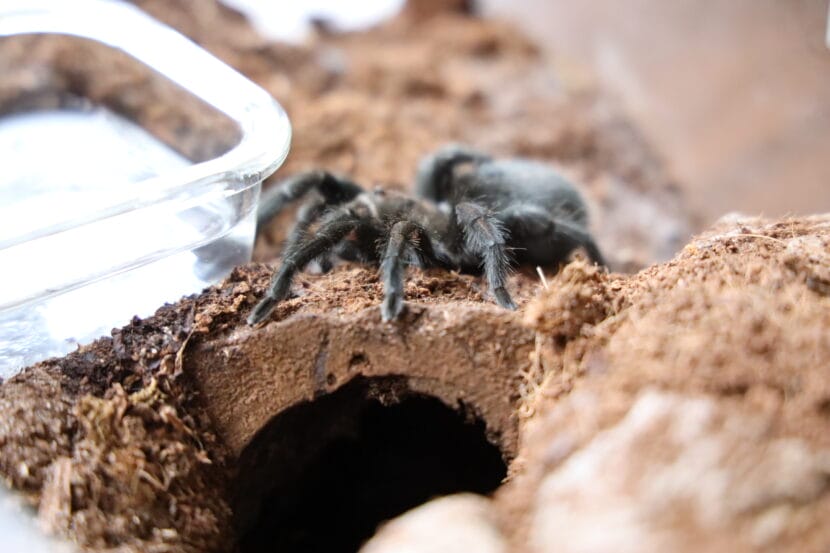
A tarantula sits in a tank at Juneau Animal Rescue on Thursday, March 14, 2024. (Clarise Larson/KTOO)
Update: Two more tarantulas have been adopted, and only one is left.
Juneau Animal Rescue is rehoming a bunch of tarantulas. They’re among the pets taken from a home after the rescue was alerted by police, and the organization had to get creative to find space for the animals and all their legs.
The 16 tarantulas arrived about three weeks ago along with a few other animals: two bearded dragons, a ball python, four cats and two dogs, according to Juneau Animal Control officer Karen Wood.
She said it’s not often that Juneau Animal Rescue receives this many animals from one home.
“We took custody of the animals by request of the police, and when that happens we hold animals for a 10 day safe-keep period,” Wood said.
The safe-keep period applies to arrests, hospitalizations and other short-term emergencies and can be longer, depending on the situation. After 10 days, if the owners don’t make a plan to retrieve an animal, they become the property of the rescue. The organization treats any medical issues, spays, neuters and microchips the animals, then puts them up for adoption.
The tarantulas could skip a few of those steps.
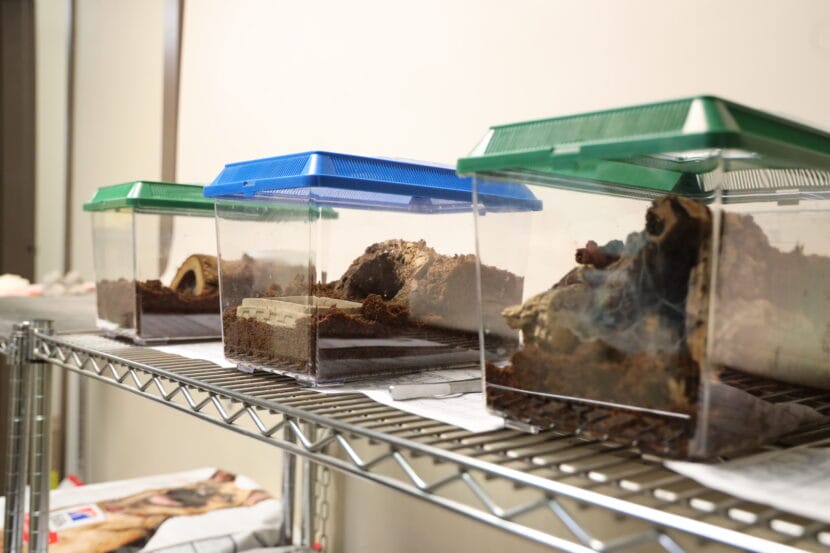
Tarantulas sit in tanks at Juneau Animal Rescue on Thursday, March 14, 2024. (Clarise Larson/KTOO)
The ball python and twelve spiders have already found new homes. One is now a long-term resident of JAR, living in a terrarium upstairs by the staff desks. She’s dark, fuzzy and about the size of a Thin Mint cookie.
“This one’s our office pet,” Wood said. “So she’ll get to be like 6 to 7 inches.”
She said finding places to put all the animals was challenging. Normally, they put smaller animals like rabbits where they can make space, often a hallway.
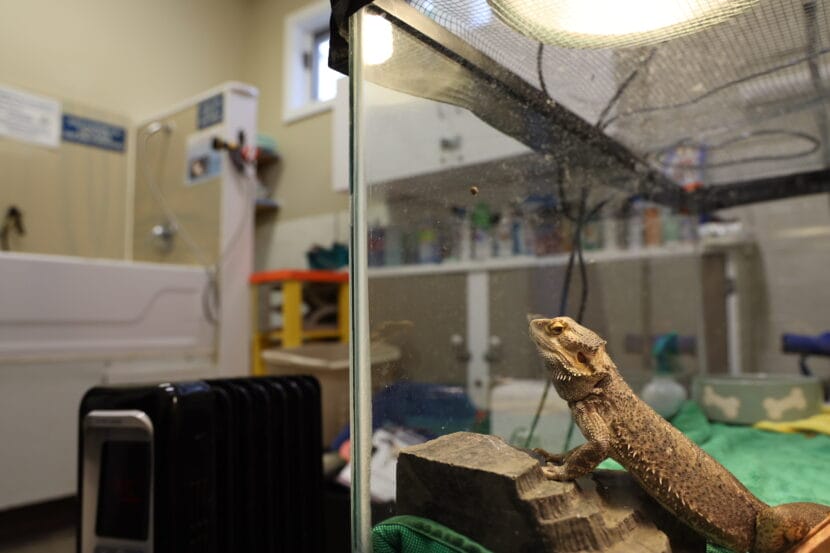
But in that environment, one of the bearded dragons started turning black. Wood said that’s a sign of stress.
So, they moved the spiders and lizards into a room used for grooming dogs and brought in a space heater. Now, the bearded dragon is back to its normal tan coloring.
Three tarantulas and both bearded dragons are still available for adoption.
A bearded dragon sits in a tank at Juneau Animal Rescue on Thursday, March 14, 2024. (Clarise Larson/KTOO)
Juneau Animal Rescue has been struggling with capacity for years. The organization is looking to expand into a bigger space soon, with more room to house all animals that need shelter.
“We’re pretty cramped. This building’s been here a long, long time,” Wood said.
She hopes that one day, there will be plenty of space for tarantulas and lizards that need a place to stay on their way to their forever homes.
Correction: A previous version of this story misstated the type of snake JAR took custody of. It’s a ball python.
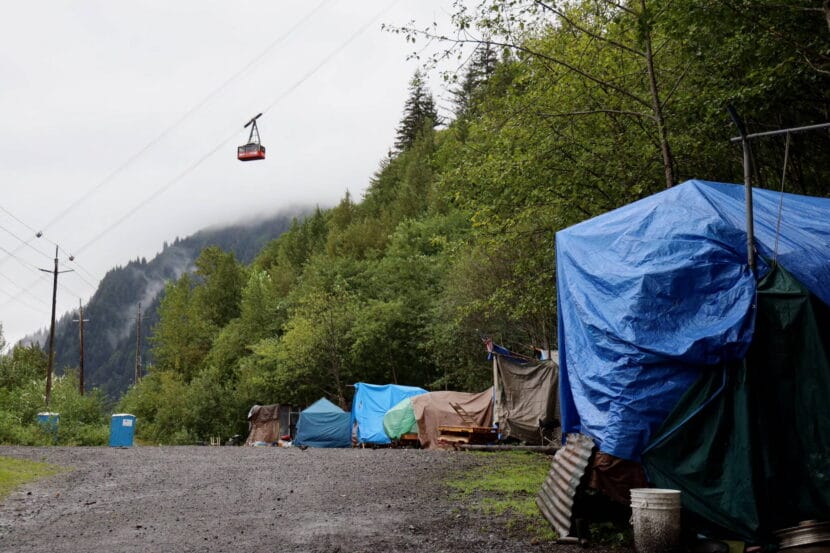
A Goldbelt Tram car rises up Mount Roberts above the Mill Campground in August, 2023. (Clarise Larson for the Juneau Empire)
Juneau is considering moving its city-owned campground primarily used by people experiencing homelessness following an escalation of reported illegal activities there last summer.
Deputy City Manager Robert Barr said moving the campground next to the city’s indoor cold weather shelter would make it easier to provide maintenance and emergency services to campers and ease the campground’s impact on nearby neighborhoods.
“The overall tenor at the campground has really been challenging – last year in particular – but it has been deteriorating over the past couple of years,” he said.
At a committee meeting on Monday, the Assembly unanimously agreed to move forward with the plan and take public comment on it next month. If approved, the new location would open to campers in mid to late April.
For many years the city has run the Mill Campground, a place where people can camp free of charge between April and October. It’s located south of downtown underneath the Goldbelt Tram’s path.
The new location would move campers further south on Thane Road and further away from residential neighborhoods downtown. But, they would still be near many commercial businesses.
Barr cited issues like drug use, vandalism and break-ins and transactional sex as some of the reported criminal activities to be happening at the campground.
“The public impact on this one — I don’t really want to sugarcoat this — I think that the public impact is going to be significant in a geographic vicinity wherever the campground is,” he said.
Assembly member Michelle Bonnet Hale said Juneau is not alone in its struggle to meet the needs of people experiencing homelessness in the community. This winter, the cold-weather emergency center has seen between 40-50 patrons each night.
“This problem is happening across the country in all kinds of places in the country,” she said. “So I think it’s just a very difficult situation and I don’t think we have any good or easy answers right now.”
Currently, it costs the city about $70,000 each year to operate the campground during the summer. Most of the cost comes from clean-up and garbage removal at the site.
Barr said it would cost about $110,000 to move the campground to the new location. He said the city does not plan to provide transportation between the new location and downtown if it is approved.
The new site would have 19 platforms for campers to pitch tents.
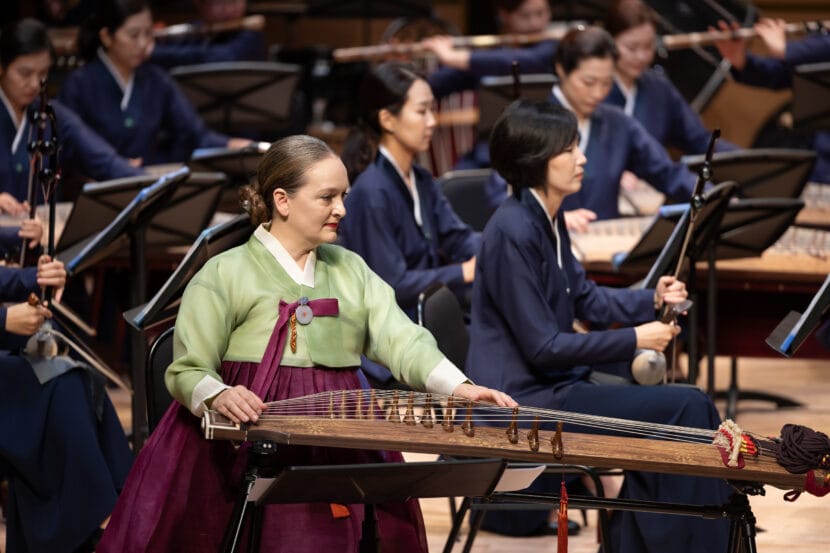
Jocelyn Clark was born in Juneau, but now lives in Korea, and plays the gayageum, a Korean folk instrument. (Photo by Yvonne Krumrey/KTOO)
This is Tongass Voices, a series from KTOO sharing weekly perspectives from the homelands of the Áak’w Kwáan and beyond.
Jocelyn Clark was raised in Juneau, but moved to Asia after high school where she began to study folk music. Now, she’s dedicated her life to playing the gayageum, a string instrument that can be traced back 1,500 years.
She came back to Juneau for the holidays, and sat down with KTOO to talk about her musical pursuits.
Listen:
This transcript has been lightly edited for clarity.
Hi, my name is Jocelyn Clark. I grew up in Juneau and graduated from Juneau-Douglas High School in 1987. And became an exchange student pretty immediately after that. I lived in Japan, then in China, then later in Korea. And I started studying instruments of those countries. Here I’d played with the symphony and other music organizations. I’m currently living in South Korea where I studied an instrument called the gayageum. It’s a 12-string, silk-string zither with movable bridges.
I wanted to work really hard, and you know, show that I was a serious student and all that. And I finally got my first gayageum, when I got a teacher and I was going to work hard. And after playing for about no more than 10 minutes, my fingers were already bleeding. It turned out that you couldn’t practice very hard, even if you wanted to. You know, if you don’t practice, you lose your calluses and then your fingers bleed, so it takes time to build up the calluses and the muscles that you need to play.
You stop each string ringing as you’re playing the next string. So you only hear one note at a time, or one string at a time. And you stop the others vibrating. And that leaves you with just one voice. It’s so it’s almost like singing. It’s almost like singing. There’s no harmony. Just one voice at a time. And very, very rhythmic.
The piece I’m working on — and I have been working on for 30 years — is over an hour long. In the beginning I thought of it as a Westerner, as a piece. You know, I learned the notes so I’m done. But you know, it’s not about the notes. It’s about all the subtleties and all the different tone colors and all those sort of nuances within each of those notes each. Each note in a way is its own world that you have to explore.
Jocelyn Clark is from Juneau, but now lives in Korea, and plays the gayageum, a Korean folk instrument.
I’m a professor at Pai Chai University in Daejeon, South Korea at the moment. I am and have been very interested in the sort of — ethnomusicology is a sort of anthropology plus sound plus music.
For me, living in Korea is very interesting. You know, to think about music, but also to think about Korea’s colonial past, and its pre colonial past, in terms of Japanese occupation really occurs at the same time as Alaska’s colonial past starts. You know the arrival of missionaries in Korea happens at the same time that arrival of missionaries in Alaska occurs. Missionaries became connected to the arrival of Western ways just as it was here. And the consequences for Korean music are, in a way similar to consequences for music and dance here.
So it took me some time to understand how narrow my views were having grown up here.
And to learn how other cultures and instruments and sound systems work with the background in my own ear of, you know, a tempered classical scale, and reading music off a sheet, or something like that. What I’m learning now is an oral tradition that’s orally transmitted through memorization. And uses different notes, different — we don’t even think of them as scales — but different modes than Western music. And it’s been really quite a journey in terms of listening and trying to understand different aesthetics, different tambours, different rhythms, different — everything’s different. Everything’s different.
Close
Update notification options
Subscribe to notifications
Subscribe
Get notifications about news related to the topics you care about. You can unsubscribe anytime.