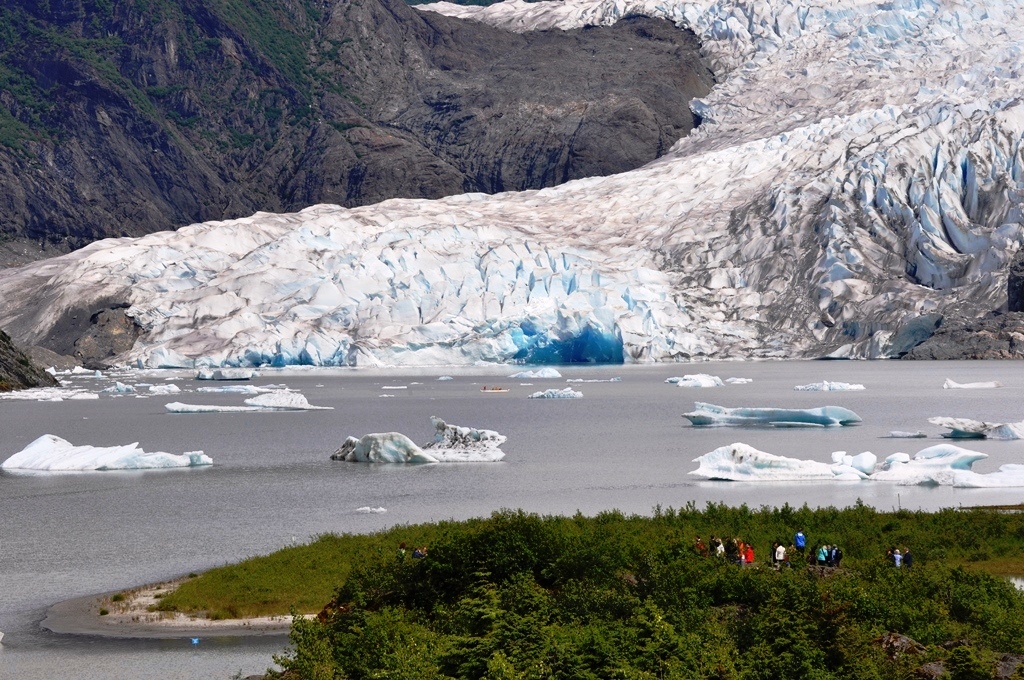
The deep blue ice after a recent calving at Mendenhall Glacier. Kayakers and rafters should stay away from the face of the glacier. (Photo courtesy Laurie Craig, USFS)
Juneau officials met Monday to plan their response to a possible glacial outburst flood in the area around Mendenhall Lake this summer.
Capital City Fire and Rescue Chief Rich Etheridge says the goal is to be prepared for a range of potential flood responses, from closing foot bridges to the use of water rescue boats.
“With the water levels rising in Suicide Basin we just want to be prepared for when it releases, so that we’re not trying to play catch up,” Etheridge says. “People kind of have their tasks lined out, who’s in charge of what items and where resources are, so we can have a very systematic, well-thought out, planned response to it.”
Some flooding has occurred the last three years when an ice dam burst from Suicide Basin on the Mendenhall Glacier. The glacial outburst is known by the Icelandic term jökulhlaup.
In 2012, a sensor was installed in the basin to show when it starts draining. But University of Alaska Southeast hydrologist Eran Hood says it’s impossible to predict the amount of water to be released. Volume also depends on how the ice dam breaks.
“We don’t know how much ice is in the basin and we don’t know how much ice is being lost year to year, so we don’t know how much water is in there, basically,” Hood says. “In other words, if it filled up to the same level every year, because the amount of ice in the basin is changing so much, the amount of water would be different for the same level on that pressure sensor.”
Hood believes a moderate-size flood is likely this summer.
The Suicide Basin sensor shows water levels steadily climbing. Mendenhall Lake levels are expected to increase over the next few days.
Fire Chief Etheridge says it’s nearly impossible to predict where the water will breach the Mendenhall River. But keeping an eye on the gauge will help time the response.
“If we see the water level in Suicide Basin start dropping we can give people some notice, because it takes a little bit of time for it to leave the basin and actually hit the river, so they should have a little bit time to prepare,” he says.
City officials on Friday issued a flood watch and warned people to use caution while recreating in the area. Rafters and kayakers should stay away from the face of Mendenhall Glacier, due to possible calving. Hikers also should watch for waves from calving and be careful at the terminus of Nugget Falls.
If there is a sudden outflow from the glacier, Etheridge warns people stay away from the riverbank, since flood waters can abruptly undercut it.
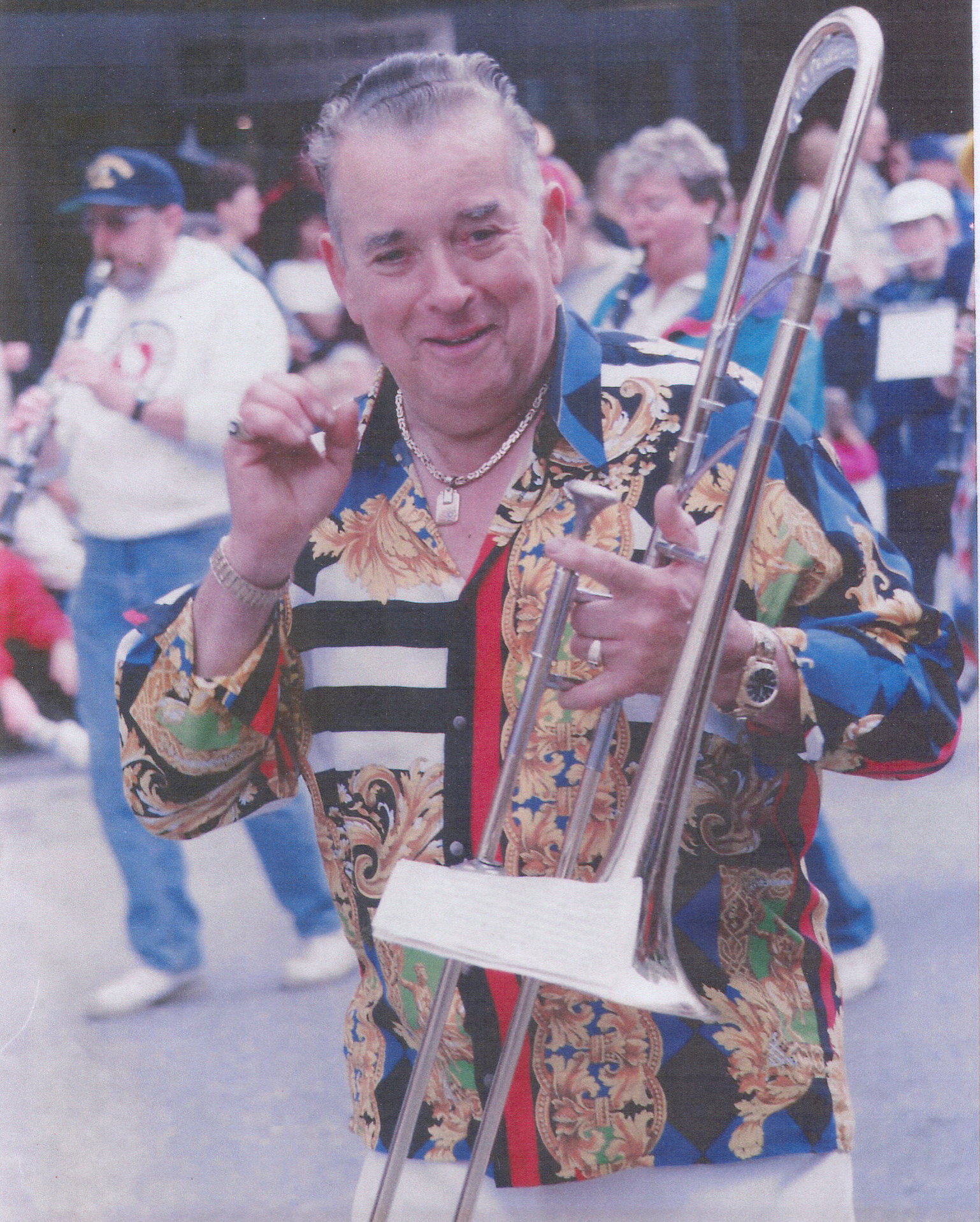
Long-time Juneau resident Dick Garrison is 2014 parade marshal. He usually plays his trombone in the parade marching band. (Photo courtesy Juneau Fourth of July Parade Committee)
It’s time to get ready for Juneau’s Fourth of July parade.
Parade Director Jean Sztuk says 29 participants had signed up as of Monday, ranging from color guards to political candidates.
Entry forms are available at the Valley Library in the Mendenhall Mall and Cycle Alaska downtown. To be eligible for awards, entries must be turned in by Wednesday.
Long-time Juneau resident Dick Garrison will be grand marshal. For the past 60 years, he’s played his trombone in the volunteer parade marching band.
Parade entry fees range from $15 for animals to $75 for floats and big rigs. Active military, color guards and youth are free.
There’s an extra fee for late entries.
Float participants can choose the categories in which they want to compete, such as best use of theme, most Alaskan, most patriotic, or best commercial float.
Vehicle categories are custom, decorated, or best historical vehicle. This year, parade organizers have introduced a watercraft category for boats, jet skis, inner tubes or life jackets.
Marching units will be judged on their energy level.
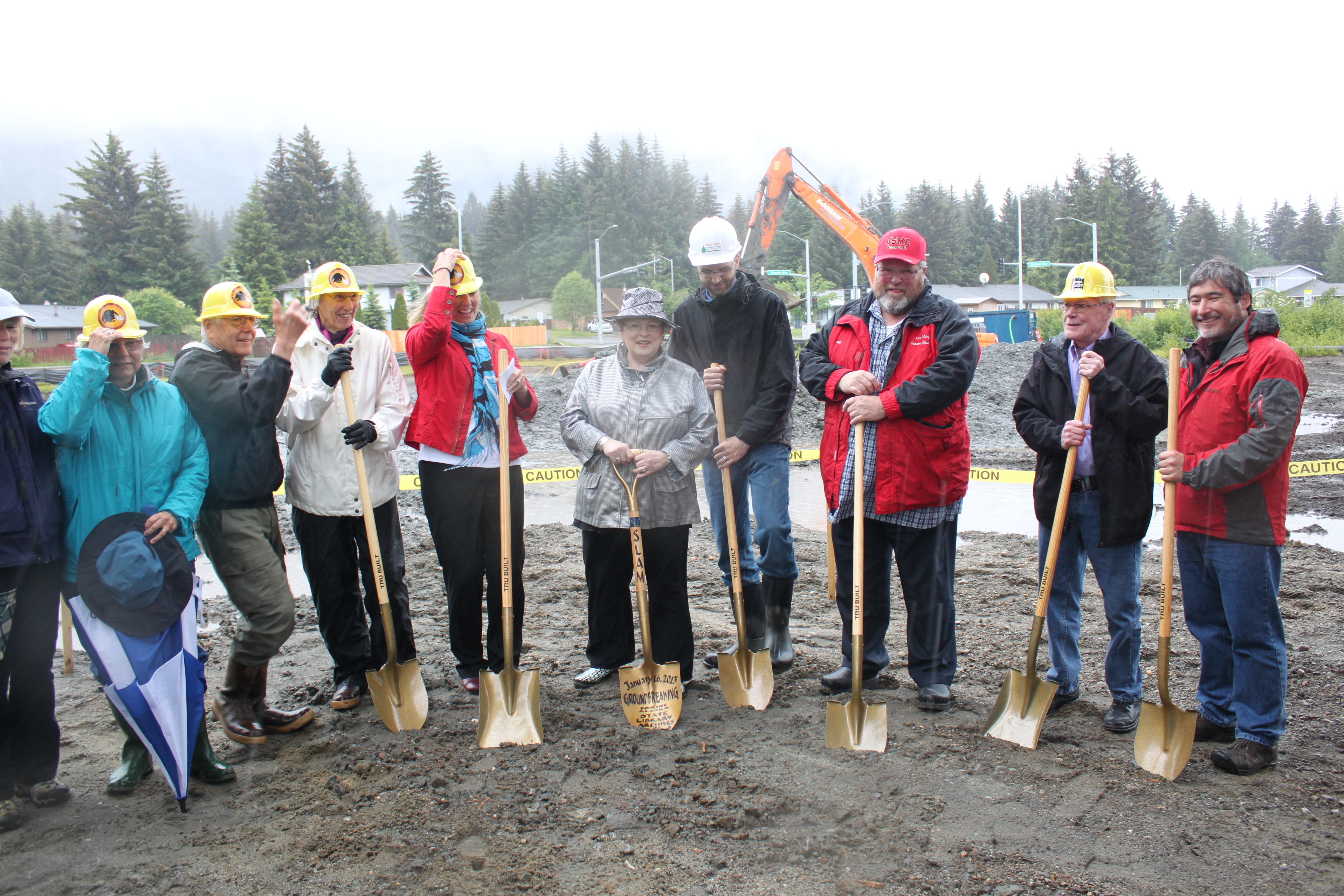
The City and Borough of Juneau and Friends of the Juneau Public Libraries held a ceremonial groundbreaking for the Mendenhall Valley Public Library at Dimond Park on Friday. (Photo by Lisa Phu/KTOO)
Donna Pierce says the groundbreaking of the new Mendenhall Valley Library at Dimond Park on Friday was a euphoric day for her.
“It’s a wonderful day for a whole lot of people who really thought this might never happen, but here it is,” she says.
Pierce was the librarian of the valley library when it moved out of Floyd Dryden Middle School and opened in the Mendenhall Mall in 1983. She later became the library director, then deputy city manager until she retired in 2006. Most recently, Pierce served as project manager for the new library.
She says the mall space has served the public well.
“But with the development of Dimond Park and all of the civic facilities we have here now, I think that it really is going to become the community center for the valley, which the valley hasn’t really had before,” Pierce says.
Former library director Barbara Berg says the valley has also grown.
“The valley is a more mature community now. It was sort of an outlier when we moved to that mall, but now it’s the most populous part of the city. It has the most kids,” she says.
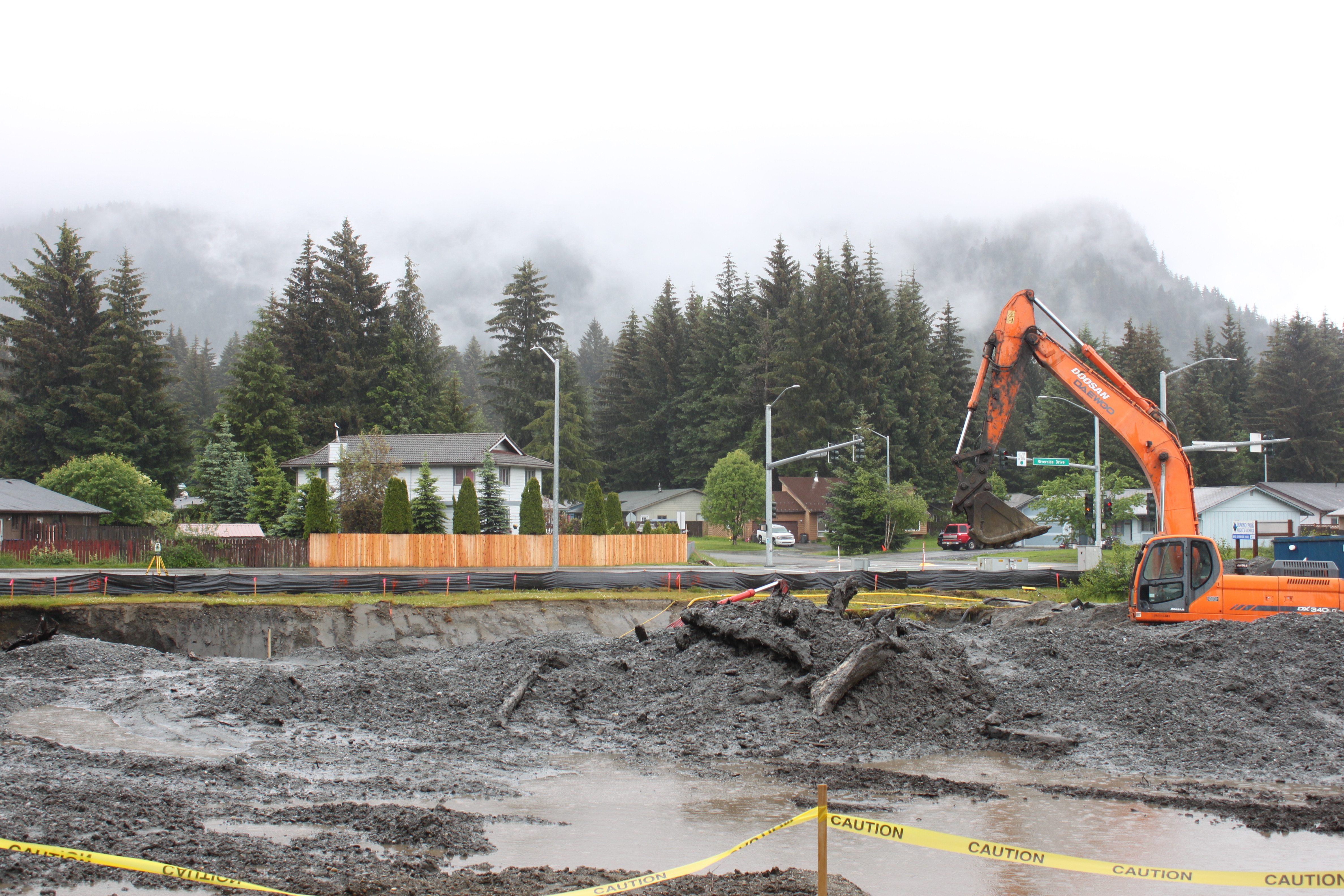
The ceremonial groundbreaking was on Friday, but the actual groundbreaking took place early June. The contractors are Dawson Construction, Inc. (Photo by Lisa Phu/KTOO)
As library director, Berg was responsible for securing most of the funding needed for the $14 million project. Half came from a state grant and another $4.7 million from a 1 percent city sales tax ballot measure. The Friends of the Juneau Public Libraries contributed another million.
Berg says having the library be a stand-alone facility is important.
“I think when people see a space that’s designed to be a library rather than just having a bunch of shelves in a box, which is essentially what we have with the mall, they’re going to have a completely different view of how the library functions,” Berg says.
The library system still devotes a large part of its roughly $2.2 million dollar budget to purchasing books and media. But current library director Robert Barr says the mission of libraries has shifted.
“We are a lot less about being gatekeepers for knowledge and a lot more about being a place where people can come together to learn new things, to gather together, to meet, to work on community projects, to collaborate around issues that are important to all of us that we really benefit best from doing in a face-to-face manner,” Barr says.
The new library will have one large meeting space and five smaller ones for things like board meetings and study groups. The large space can be used for all sorts of functions.
“It’s purposefully segregated from the rest of the library so that space can be opened without the main library being open, so if we have before hours or after hours meetings, events or activities, that’s a possibility,” Barr says. “It’s also separated from the rest of the library from a sound perspective so louder stuff can go on in there. Probably not like band practices and stuff, but, I don’t know, I’d be interested in thinking about it.”
The library will have a large children’s room and a teen room, the first in a Juneau library, which Barr says is appropriate being near Thunder Mountain High School.
The new space is 20,000 square feet, doubling what’s available in the current valley library. Barr says operational costs will remain the same though. The more than $200,000 spent now on renting space in the Mendenhall Mall will go toward things like maintenance, utilities and staffing.
Scheduled completion of the Mendenhall Valley Library at Dimond Park is fall 2015.
Juneau police have launched an investigation into the alleged hazing of incoming high school freshmen.
Lt. David Campbell says two officers have been assigned to look into accusations reported earlier this week in the Juneau Empire about some upperclassmen paddling and injuring several students.
Campbell says the department had not heard from any victims prior to the story. Officers have since contacted a couple of parents of possible victims.
“We are actively investigating it to see what crimes were committed, if the victims and their families want to press charges,” he says.
Campbell says police are also working with the school district.
The alleged incidents happened after school was over for the summer and were not on school property.
District spokeswoman Kristin Bartlett says the administration has received reports of hazing and it doesn’t appear to be limited to one group of students.
“All three of our high school principals, from Juneau Douglas High School, Thunder Mountain High School, and Yaakoosge Daakahidi Alternative High School, are working together to follow any leads that they get on the issue,” Bartlett says.
Juneau School District has specific policies on bullying and hazing. The policies that define hazing as any act that endangers a person’s health or safety, or subjects them to physical discomfort and embarrassment because they’re part of a certain classroom, grade, or school activity.
It’s not clear how many students were involved in the recent incidents, but Bartlett says it’s important that parents and students tell school officials about the activity.
She also says it’s an opportunity to begin to change a culture that seems to accept hazing and bullying.
“If kids feel like this is something that just happens, we as a community need to speak up and make sure that kind of an attitude gets addressed,” Bartlett says.
TMHS head football coach Jeep Rice claims some of his players have been injured in hazing. He has coached high school football for years in Juneau, beginning in the 1980s at JDHS.
He says he has no tolerance for hazing. He recalls the time when his teenager was hazed.
“We were in the same boat 25 years ago as a scared parent of an incoming freshman who was thrown into Gold Creek semi-naked with girls all around to laugh it up and whatnot, you know with seniors there. It wasn’t life threatening, but we were pretty upset, we were pretty scared,” he says.
Rice says he tells parents whose teens have been victims of hazing to “prosecute to the fullest extent of the law.”
Lt. Campbell says there are similarities between bullying, hazing, and domestic violence, including fear, retribution, and peer pressure, but there aren’t laws per se against bullying.
“You can’t turn to the bullying law in Title 11 of Alaska Statutes or in Title 42 of the CBJ statute, but a lot of the actions that get mentioned do meet some of the statutes and that’s what we have to look at,” he says. “Was a person injured, was a person placed in fear, was there offensive physical contact, were they engaged in challenging people to a fight, there’s all these things that do constitute violation of laws and we have to see if we have the elements of those offenses.”
Campbell says the officers assigned to the investigation are following up with witnesses, victims and parents to see if JPD can proceed with an actual case.
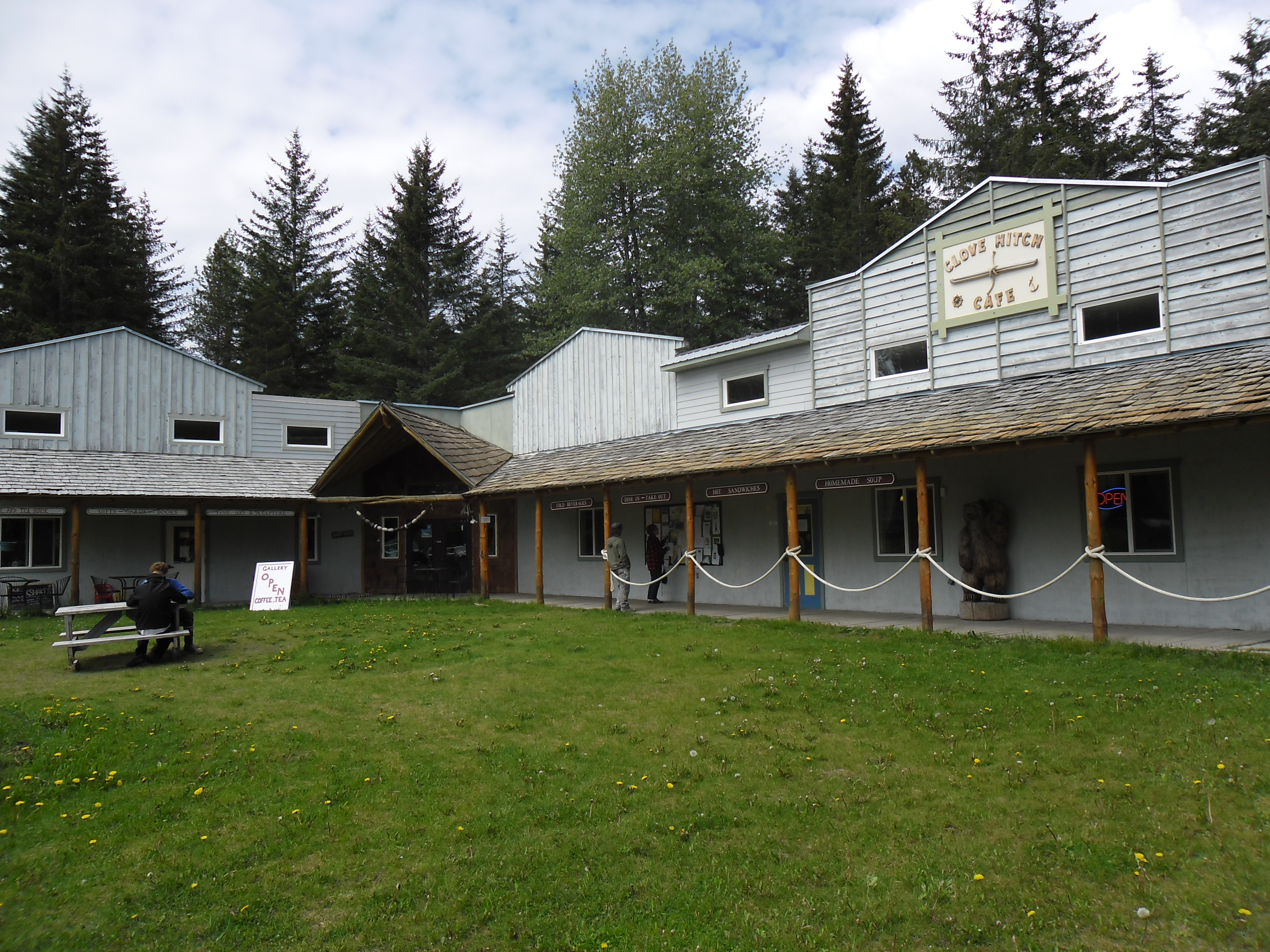
These businesses are found at Four Corners, the main intersection in Gustavus. (Photo by Lisa Phu/KTOO)
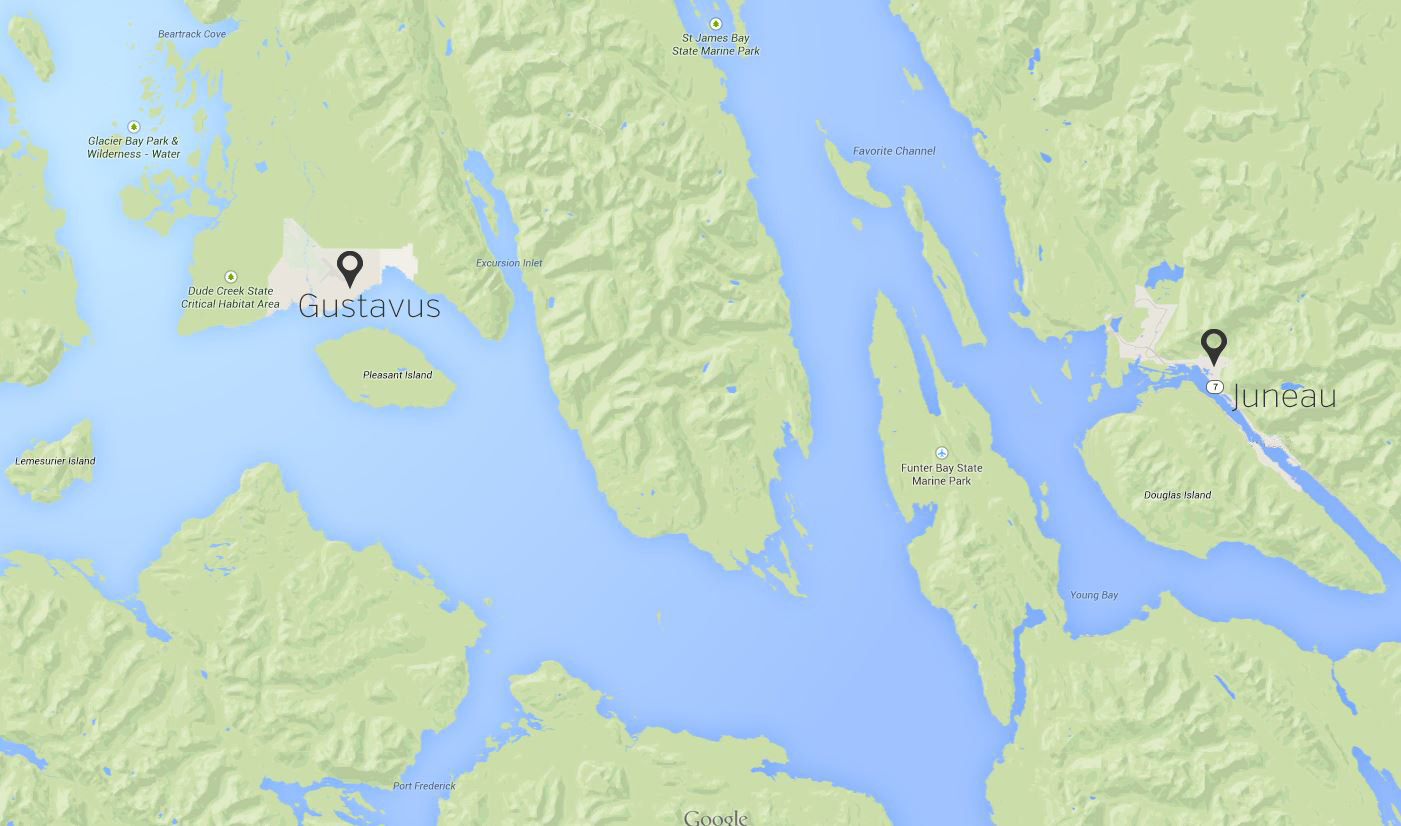
The community of Gustavus, near Glacier Bay National Park, is throwing a big party. Starting June 27, the small Southeast town of under 500 will hold three days of events and festivities in honor of the first settlers who arrived 100 years ago.
In the summer of 1914, three newlywed couples from Seattle decided to make their way to Southeast Alaska and find some flatlands they had heard about from a steamship captain.
“They were three couples that were friends that were looking for an adventure,” says Linda Parker, cofounder of Gustavus Historical Archives & Antiquities. “Homesteading was becoming the thing to do and they thought maybe they’d come up here and see what it was like, see if they could farm and make a living. The little voices of Alaska were calling them and they came.”
She says the three couples – Verne and Janie Henry, Bill and Margaret Taggart, and John and Bernice Davis – traveled most of the way from Juneau in a hired fishing boat. The final leg of the journey up the Salmon River was in a skiff.
Tlingits lived across Icy Straight in Hoonah and had fish camps in the Gustavus area.
The three couples lived in tents at first. By fall, they built a log cabin where all three couples lived together. The structure no longer exists but is still referred to as the “honeymooner” cabin.
“The first winter, with nothing much else to do in a very small cabin, all three ladies got pregnant and that was a complication that they hadn’t foreseen,” Parker says.
It was tough for the young couples, Parker says. And homesteading proved more difficult than they expected.
The Gustavus of today has lots of trees and many residents grow vegetable gardens. A hundred years ago, Parker says, the land had very few trees and was boggy, oftentimes requiring hip boots. The only crop that grew was rutabaga.
“That was the big thing back then here in Southeast was rutabagas. Some of the homesteaders — the old stories — they got tired of rutabagas. It was rutabaga everything and then they would keep them in their cellars and eat them all winter,” Parker says.
The Taggarts left just after one year, the Davises after the second. Of the original three couples, Verne and Janie Henry stayed the longest. They hoped to make a living selling rutabagas to canneries elsewhere in Southeast. But crop after crop met with catastrophe and by 1919, the Henrys left.
Meanwhile, others arrived, like Abraham Lincoln Parker’s family in 1917. They were involved in the Gold Rush and had lived in Skagway and Douglas. Lee Parker, Linda Parker’s husband, is one of the grandchildren.
The Parker homestead was on Good River.
“It was quite large – two-story home, many outbuildings, barn, saw mill, a second or third cabin on the property. They had some horses to pull wagons and things, but they decided to do some cattle and they did that for their own meat and milk and also they butchered and sent the meat out to the various canneries that were around,” Parker says.
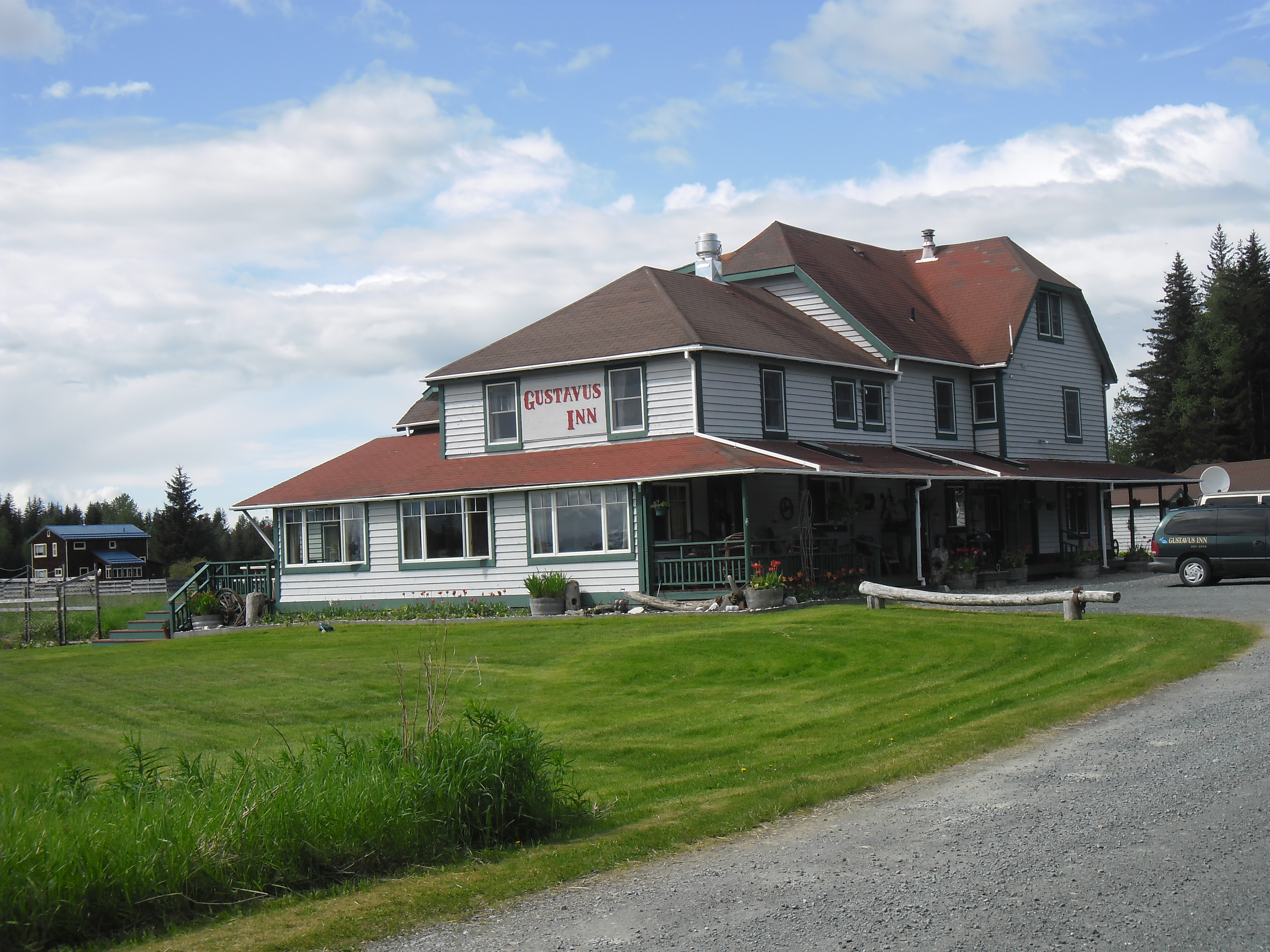
The Gustavus Inn will hold a sourdough pancake feed Sunday morning, June 29, for the Centennial Celebration. (Photo by Lisa Phu/KTOO)
Back then, the area was called Strawberry Point for its fields of wild strawberries. The name was changed to Gustavus in 1925, but many residents still call it Strawberry Point.
Parker says the homesteaders who stuck it out had an independent spirit.
“Many of them were looking for ways to be off on their own and pioneer a place that didn’t have a government looking over their shoulder for everything and they liked the isolation and freedom,” Parker says.
Local government only came in 2004 when Gustavus was incorporated as a city.
Paul Berry is a former mayor and city council member, and is the current manager of the city’s Disposal & Recycling Center. Since incorporation, Berry says the independent spirit of residents has only gotten stronger. As a city worker, he calls himself a “city apologist.”
“It’s been difficult. I have friends who don’t really want the city. They didn’t see it as a positive development. It’s kind of like, ‘Can’t we do better?'” Berry says.
Besides the disposal center, the city also runs the library, fire department, parts of the boat harbor and the bulk fuel facility. Gustavus has no local law enforcement. That idea failed in an advisory measure in 2012.
Berry says people are slowly getting used to the idea of Gustavus as a city. While some issues can divide the tight knit community, it’s the community that’s kept him around.
Berry moved to Gustavus from Fairbanks 30 years ago for the land. He arrived with his brother to build on property they got from a state land lottery.
“It’s a cool place. It’s a cool thing to be a part of. I like that sense of community. Some of my customers at the recycling center, I was landfilling their diapers and now they have kids. And to be a part of that is a one shot deal,” Berry says.
The first three couples that arrived in Gustavus didn’t end up staying, but they paved the way for many others who did.
The Gustavus Centennial Celebration kicks off next Friday evening. The Alaska Marine Highway System is running a special ferry for the celebration that departs Juneau the morning of Saturday, June 28 and returns Sunday afternoon.
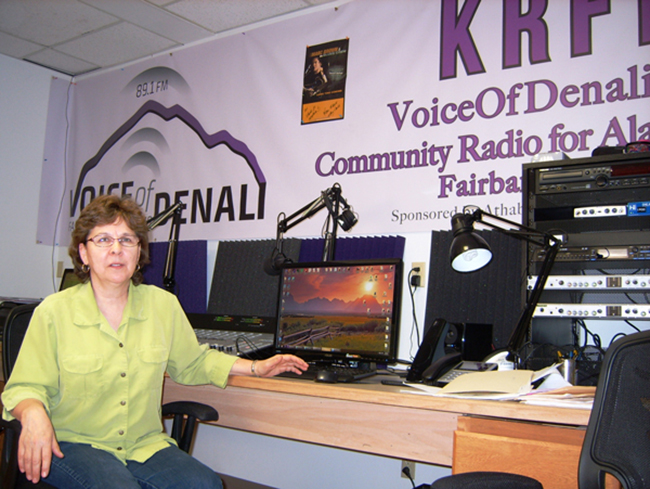
Athabascan Fiddlers Association General Manager Ann Fears in the KRFF studio on College Road in Fairbanks. (Photo by Tim Ellis/KUAC)
A new Fairbanks radio station is broadcasting programs aimed at the Native community in the Interior. Another group hopes to launch its station early next year to provide radio programming for other groups that they say are not being served. The ventures are part of a nationwide trend of community-based radio.
KRFF reminds its listeners at the top of every hour that Native people in the Interior have a new voice. The station ID includes an Athabascan greeting: “Do’int’a! You’re listening to 89.1 KRFF Fairbanks.”
The station was launched last November by the Athabascan Fiddlers Association. Ann Fears is the association’s general manager. And she’s the driving force behind KRFF. Fears says the station provides information and entertainment about native people. But she says KRFF hopes to offer something of interest to everyone.
“It’s a culturally focused radio station, but it should be for the purpose of serving the whole Interior – all the people, all the listeners,” Fears said.
KRFF’s signal reaches as far as Nenana, to the west, and Delta Junction, to the east. It’ll go worldwide when the station sets up web streaming, which Fears says should happen soon.
KRFF mostly airs Native Voice 1 programming from Anchorage-based Koahnic Broadcast Corporation. And Fears says KRFF is developing more local programming like the morning show that debuted in February. Including, they hope, a regular call-in feature with news and information about rural Alaskans.
“They have a lot of stories to tell,” she said. “They would be telling their story, and we would all be learning from the Alaska Native people, and people of the Interior.”
Fears says KRFF also hopes to expand its entertainment offerings, like its live-music broadcasts by local performers – including, of course, Athabascan Fiddlers.
The Fiddlers Association supports KRFF largely through gaming revenues. The station got its Federal Communications Commission license from another local group that wasn’t able to secure a source of funding – Fairbanks Open Radio.
Flyn Ludigton is a member of the group. She says Fairbanks Open Radio members were disappointed that their initial venture fell short. But she says the outcome benefited the group’s mission of expanding local radio programming. And she says her organization and the Fiddlers Association share many of the same goals.
Fairbanks Open Radio has now regrouped, and in January it secured a new FCC license to operate a low power FM station, KWRK. The station’s signal will reach a 4-mile radius that’ll cover most of Fairbanks – and beyond, when its signal goes online.
Ludington says KWRK’s model is based on a growing national movement that’s arisen in recent years in response to the trend of multimedia corporations buying up radio stations and using mostly syndicated programming, which is cheaper than local programming.
“We’ll be able to produce some experimental, very locally based, locally produced programming,” she said. “Including the under-represented population, the people who may not be able to participate in radio.”
Ludington says that includes military and family members, youths, gays, and prison inmates and ex-cons. She anticipates KWRK going on air early next year.
Close
Update notification options
Subscribe to notifications
Subscribe
Get notifications about news related to the topics you care about. You can unsubscribe anytime.