Juneau School District superintendent Glen Gelbrich will remain in his job for a while. He has not been selected to lead Kalispell Public Schools.
Gelbrich was one of five finalists for superintendent in the Montana community near Glacier National Park. He interviewed with the district’s education board earlier this week.
Cle Elum, Wash. superintendent Mark Flatau was the front-runner, according to the Daily Inter Lake newspaper in Kalispell.
Gelbrich said last month that he applied for the job because it would have put him closer to family.
He has been superintendent in Juneau since 2009 and last year signed a three-year contract with the Juneau School District. It expires in June 2016.
Meanwhile, Juneau teachers and the administration go into negotiations again Thursday. Teachers have been working without a contract for nearly a year and have unable to reach agreement.
The Juneau Education Association still hopes the district will agree to a raise, but has scaled back its proposal.
Dirk Miller is JEA spokesman. He says the latest proposal was presented to the district last week in what was described as a positive meeting.
Teachers have been picketing school board meetings this fall and even threatened a strike if efforts fail to produce an agreement. Their one-year contract, which included no financial increases, expired last June.
Miller says teachers are more positive as negotiating teams go into Thursday’s session.
“I can’t tell you how close, but we have come a lot closer. So we are moving, we are negotiating. I hope to see that same effort on the district’s side,” Miller says.
Calls for this story were not returned by district officials.
After several delays, the two sides await an arbitrator’s decision, due sometime next month. It will be advisory only.
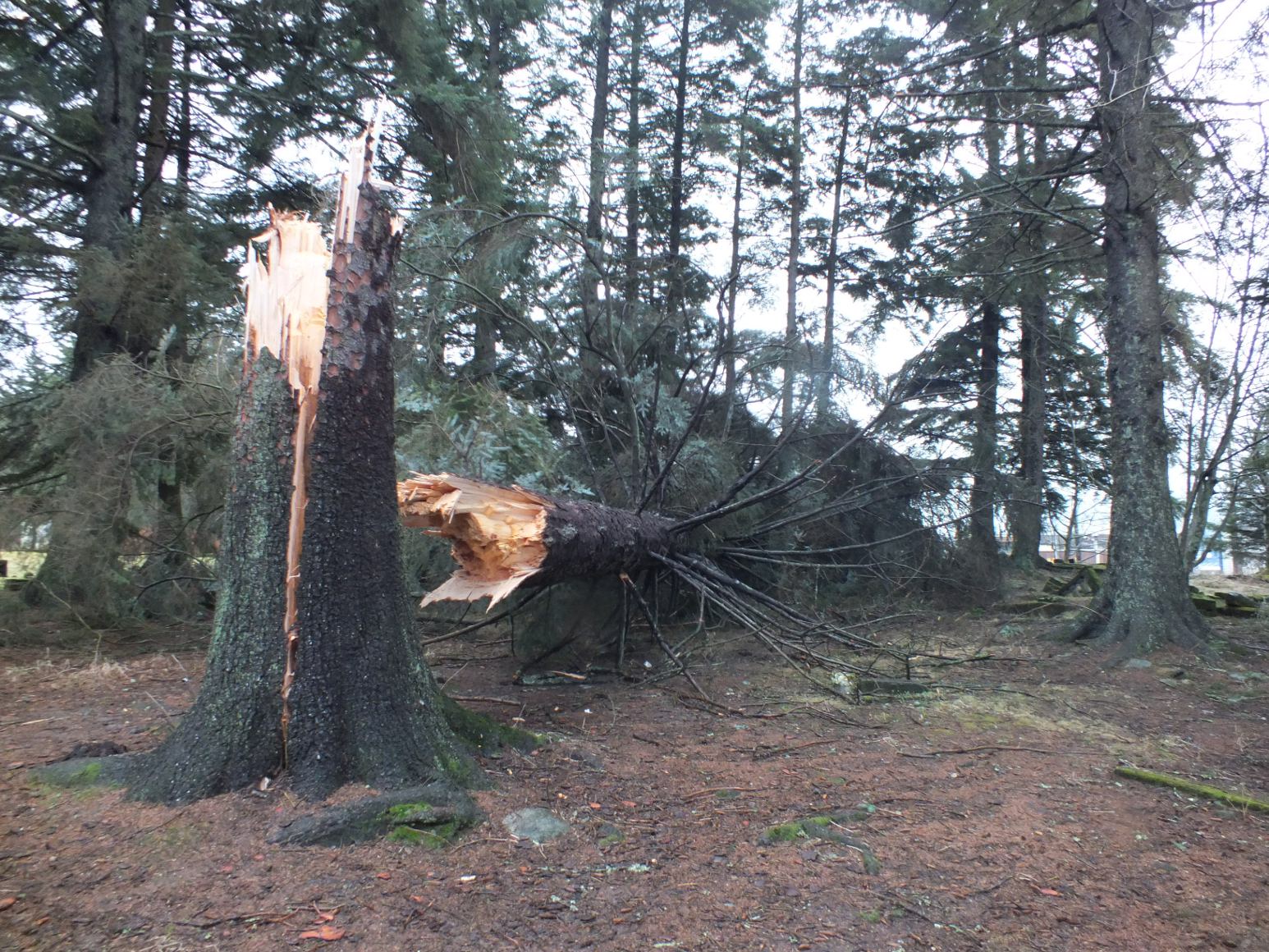
A large Sitka spruce fell in Juneau’s Evergreen Cemetery during a storm that blew through Southeast Alaska Tuesday. Photo by Casey Kelly/KTOO.
We’ve all heard the riddle, “If a tree falls in a forest and no one is around to hear it, does it make a sound?”
How about if a tree falls in a cemetery?
That’s what happened Tuesday in downtown Juneau during the rain and wind storm that blew through Southeast Alaska… except someone was around to see it.
The large Sitka spruce toppled over in Evergreen Cemetery within striking distance of the offices of MRV Architects. Project Manager Zane Jones watched it fall with some colleagues.
“We had some wind gusts that pulled our front door open, so we started looking out the windows,” said Jones. “Sure enough, as soon as we did, a gust came around the building and we watched it bend clear down and snap.”
Fortunately, the tree fell away from the building. A large stump with a crack in it is all that’s left in the ground. The rest of the trunk came down on top of some graves, surrounded by a stand of other trees.
“It was just one of those kinda planet Earth moments, where we were just in awe and quite amazed that it took down such a big tree,” Jones said, adding “and also so fortunate that it fell in neutral location.”
Juneau’s Parks and Recreation Department manages Evergreen Cemetery. Parks and Landscape Superintendent George Schaaf says the plan is to cut up the fallen tree and clear it from the cemetery, hopefully by the end of the week.
“Get it bucked up into rounds, and get those moved out of the cemetery, and at that point people would be welcome to come by and take what they would like,” Schaaf said. “But the big concern we have is that we don’t want people driving into the cemetery, because the tree came down over some very old graves that really wouldn’t be able to support vehicles.”
Schaaf says he won’t know the approximate age of the tree until they can cut it up. He estimates it was close to 100 feet tall and says the trunk is about 3.5 to 4 feet in diameter.
“Certainly not a very young tree,” he said. “It’s pretty old for downtown Juneau anyway.”
The tree fell around 1:30 or 2:00 in the afternoon. National Weather Service observation data from the nearby Juneau Federal Building shows wind gusts between 25 and 50 miles per hour Tuesday morning. But the largest gust recorded at the Federal Building that day was 73 miles per hour at about 2:30 p.m.
Full disclosure: George Schaaf is a member of KTOO’s Board of Directors.
He says Juneau also ranks high nationally, “Our water is so clean that it’s cleaner than the stuff you buy out of a plastic jug. We’ve got a wonderful health infrastructure around here for our size. Our hospital is an amazing hospital even with a target population regionally of 50,000, so it’s the reason why we’re so well rated by national surveys in terms of health.”
Felix says part of the report’s goal is to give community health planners an indication of how to make a community healthier, so the report also focuses on Juneau’s weaknesses.
“The primary ones are drug and alcohol abuse and all the diseases associated with those two things. And there were two surveys done in Juneau – one in 2005, the Compass Survey, and another, the McDowell Survey in 2010 – and people in the community identified alcohol and drug abuse as the main issues, too, so the community is aware,” Felix says.
According to the report, Southeast Alaska is the heaviest drinking region in the state and one of the highest consuming regions in the nation.
Felix says Juneau also has a high rate of Hepatitis C, similar to the rest of the state, and a high rate of sexually transmitted diseases.
The Healthy Indicators report also shows that Juneau’s population is rapidly aging, says Felix:
“We are one of the fastest – if not the fastest – communities in the United States in terms of our aging population. That’s going to impact our healthcare system here tremendously both financially and in terms of special kinds of care that we’re going to need.”
A transitional housing facility opening in two months in Juneau will fill an important need for Southeast Alaska. Haven House will provide temporary housing for as many as nine women who’ve just been paroled or released from prison.
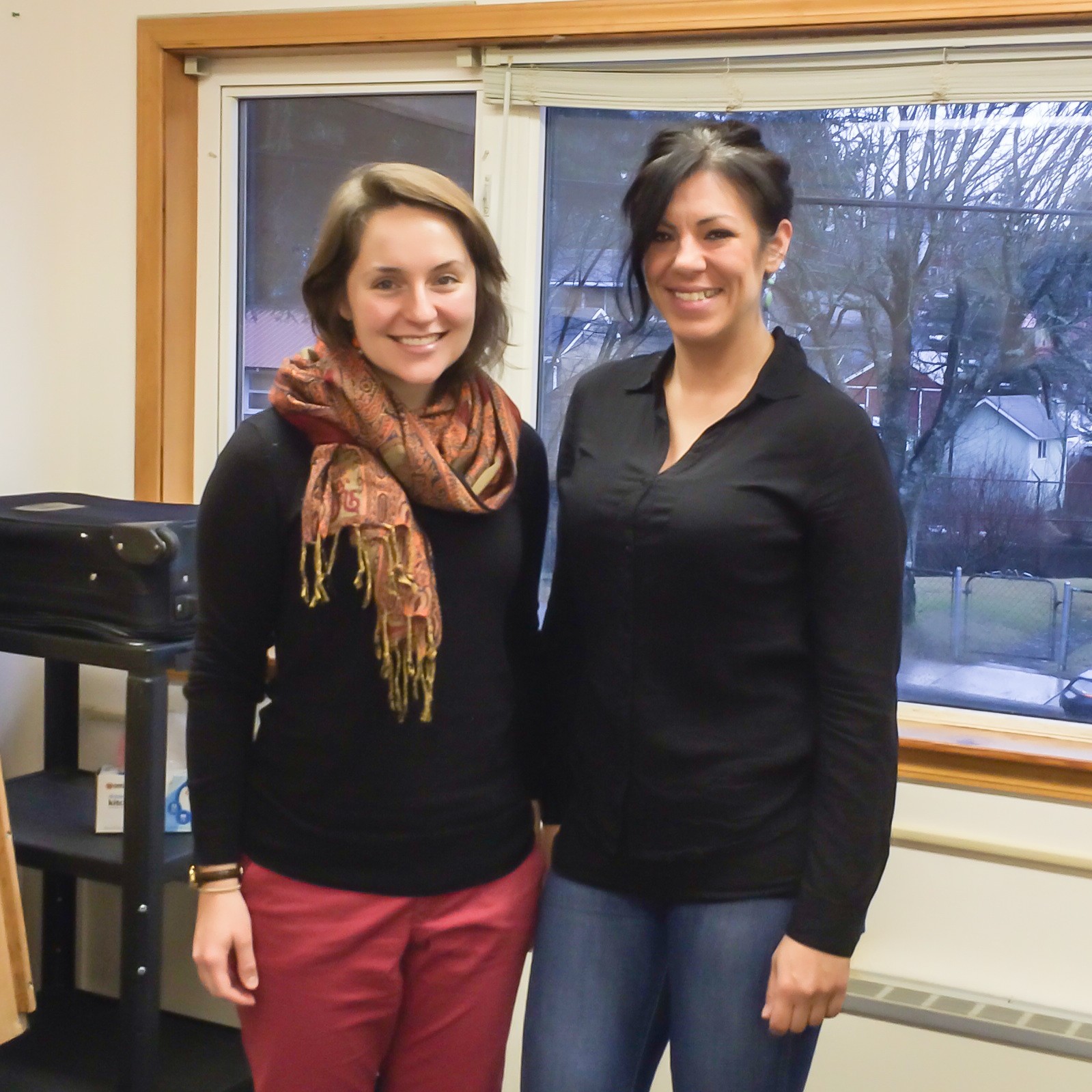
“There are not any transitional living homes in Juneau. It’s going to make a difference for women coming out of jail,” said Katie Chapman who is chair of the Juneau Reentry Coalition, a group of agencies and local social service organizations created to coordinate resources for those who have left the corrections system. Anne Flaherty (left) and Kara Nelson (right) will serve as Co-Directors of Haven House when it opens in March as transitional housing for women just out of prison. Photo courtesy of the Juneau Community Foundation.
Two-thirds of all Alaska inmates return to prison within three-years, according to research done by the Alaska Judicial Council in 2007. Former inmates are especially susceptible to recidivism — or getting stuck in the revolving door of reoffending and returning to prison — sometimes as soon as the first six months after release.
Chapman said there are several factors in a former inmate’s success on the outside:
The housing, finding a job, and finding a safe, pro-social group of people to connect with and establish a good start in their recovery and their integration back into the community. When they don’t have that support, it makes it very difficult for them to stay connected and it’s easy for them to fall back into patterns and whatever survival mechanisms they had in place that got them involved in criminal activity.”
Haven House will operate in a six-bedroom home just purchased in the Mendenhall Valley near Glacier Valley School.
“We’re really excited. We’re finally going to be opening,” said Rachel Sanders of the Haven House board. She said the idea for a transitional home originated many years ago with prison volunteer Ellen Campbell. Sanders said they had the home picked out last month and put down earnest money for a potential purchase. They planned on applying for an Alaska Housing Finance Corporation loan to cover the rest of the purchase price. But an anonymous benefactor stepped in and purchased the residence on Christmas Eve.
Yeah, we were just thrilled!”
The “anonymous angel donor,” as they are being called, will rent it back to the Haven House organization until they can acquire grants to purchase the home outright. Sanders said they just closed on home’s purchase late last week.
The Juneau Community Foundation has offered a matching grant from the Gaguine Fund to raise $10,000 in additional donations for the home’s furnishings and appliances.
“We think that it’s an important project for the community to have housing or transitional housing for women coming out of the correctional facilities,” said Amy Skilbred, executive director of the Foundation.
Women paroled from Lemon Creek Correctional Center in Juneau or Hiland Mountain Correctional Center in Eagle River can apply for one of nine spots in the home.
Haven House’s Rachel Sanders said they will have a structured, faith-based living environment that will include referrals to counseling, life skills training, employment coaching, and connections to substance abuse treatment programs.
It’s the resident’s choice to participate because, of course, we can’t force them to participate given that we’re accepting State monies. So, knowing that there’s going perhaps be Bible studies, or mentors that come into the house and work with the residents on crafts, or whatever, it will definitely be a part of the daily structure.”
Each resident can stay up to two years. They will be expected to find a job, pay rent, and help with household chores.
Haven House’s Kara Nelson will share management duties with co-director Anne Flaherty. As a felon herself, Nelson knows full well all of the challenges that women face when they get out of prison.
With felonies, there’s actually a lifetime ban on getting housing through the State (of Alaska) or other public assistance… As well as just coming out of prison and not having anywhere to go, whether that’s going back to your abusive partner, or family and friends that use (drugs), and not having that safe place to live to really get to the core of the issues and move forward.”
Nelson said she was able to move forward with the support of family, community organizations, and local mentors.
For me, it was having those mentors and getting to a place of self-acceptance where I can then go out into the community and believe that I’m not just a felon, or I’m not just a drug addict, or I’m not putting these labels on myself which is a big stigma. Not just in society, but for us having been in that for so long.”
It is unclear how many women are released in the Juneau area every year. Nelson estimates that it could be several dozen.
She said they just got the keys to the house on Monday and they’re not opening until mid-March, but they’re already taking applications.
Students and parents protest the middle school sports travel ban during a school summit at Thunder Mountain High School in September. (Photo by Heather Bryant/ KTOO)
A community task force recommending middle school sports teams be allowed to travel is taking comments on its draft report.
The Juneau School Board in September voted to ban sports travel at the middle school level, prompting a public outcry and organization of the task force.
The group has researched the issue and come up with options that would allow 6th, 7th and 8th graders to travel outside Juneau for athletic competition.
Rhoda Yadao chairs the Floyd Dryden Middle School site council.
I hope the school board makes a decision that speaks the voice of the community.
From responses to the school board’s decision, it appears the public felt left out of the process leading to the policy limiting athletes’ travel at both Juneau middle schools.
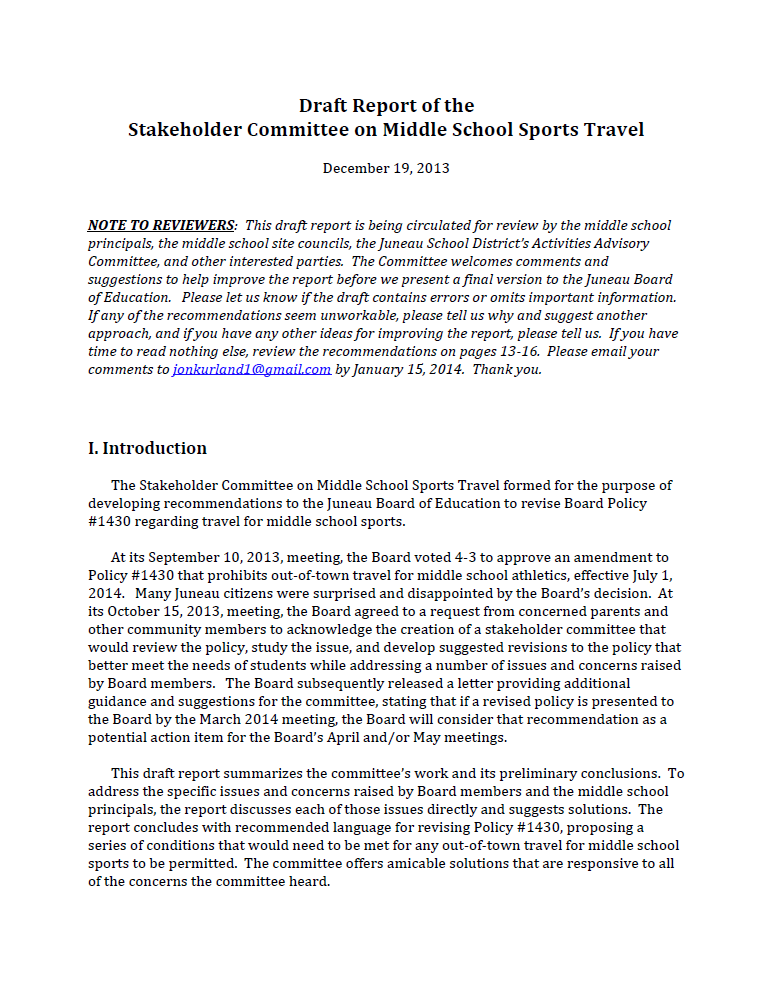
So parent Jon Kurland organized the Stakeholder Committee on Middle School Sports Travel. The stakeholders included parents, teachers and coaches from Dzantik’i Heeni and Floyd Dryden middle schools as well as community members. It did not include any school board or district officials. When the committee formed, board president Sally Saddler said the school district had spent enough energy on the issue.
Dzantik’i Heeni has not allowed its sports teams to travel outside Juneau since the 2011-12 school year, while Floyd Dryden’s teams continue to compete with other Southeast Alaska schools. The new policy is to take effect next fall, putting Floyd Dryden on par with DZ.
Kurland said the committee tried to address concerns raised by school board members and principals at both schools, and offer solutions.
“And the hope is that both the principals would be able to get behind this or whatever the final version is and say OK there’s a reasonable set of conditions here and we can live with that and those are reasonable side boards to put on the rules allowing out of town travel.”
Last week Kurland took the draft report to each school’s site council for input. Yadao says she knows the Floyd Dryden site council will wholeheartedly endorse the committee’s options when the report is finalized.
“We’ve supported our travel teams. You know we live with the motto ‘no child left behind,’ that if there’s funding that ‘s needed for a child who financially can’t go that there are means, whether it’s the sports activity itself and its members, or the families of students in that sport, to contribute to allow for all students to be able to travel,” Yadao said.
The report suggests the Floyd Dryden travel policy would be a good model for the board to follow.
It recommends principals limit the cost per student for travel, as well as the number and length of trips.
Floyd Dryden teacher Molly Box was part of the Stakeholder Committee. She says it’s important the public understands that travel is not restricted to the best players.
“Traveling opportunity is for all kids regardless of skill level and regardless of economics. So that all kids can fund raise, we make sure that teams fund raise together as much as we can,” Box said.
With budget cuts, both schools have lost office staff, making travel logistics more difficult to coordinate.
The report offers several options to address the problem, including the most obvious – that the district could handle middle school arrangements as it currently does for some high school activities.
Kurland also took the report to the district’s Activities Advisory Committee, which did not endorse the ban, though the school board last fall said it had.
“That couldn’t be farther from the truth,” said long-time coach Tom Rutecki.
He has been an AAC member since it was formed in 2008. He said the group is adamant the school board retract its statement. But he also said the district should develop a philosophy for middle level sports programs before it comes up with a new travel policy.
School district athletic director Sandi Wagner said most middle school sports polices are based on high school athletics, and the belief is the younger students should be involved in more developmental than competitive programs.
“We need to come up with philosophy and guidelines for middle school activities,” Wagner said. “Probably the most important things about it is the concept that all kids should be involved and there should be a no-cut policy. ”
Wagner said an AAC subcommittee is just beginning to work on the middle school guidelines.
Meanwhile, Wednesday is the deadline for comments on the Stakeholder Committee’s report. Kurland plans to present the final recommendations to the school board next month.
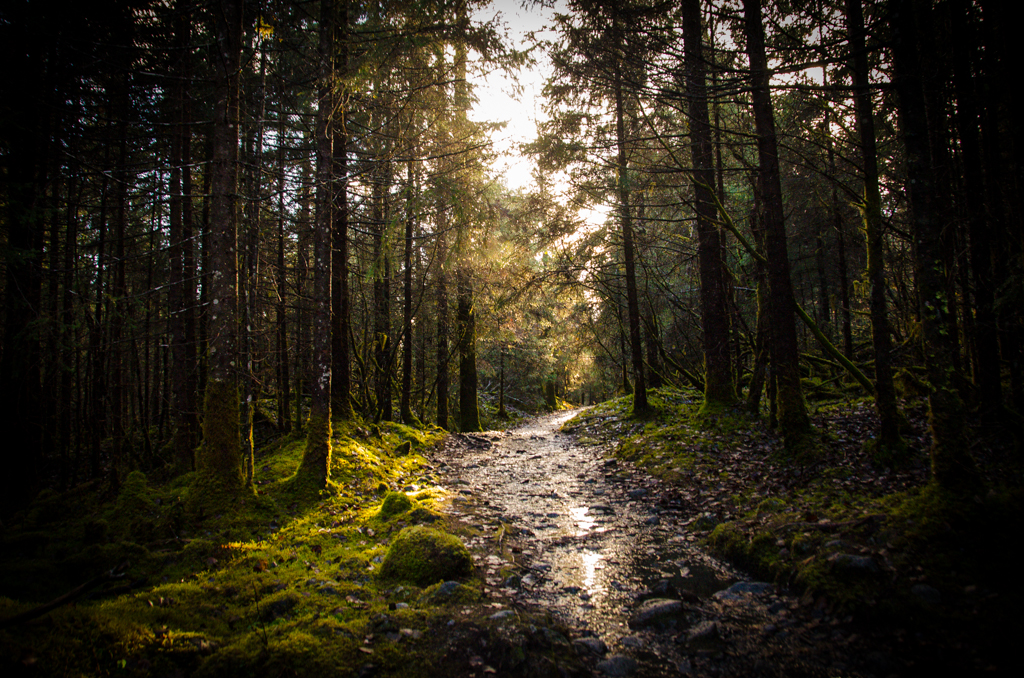
The body of a 57-year old man was found on a trail Thursday between Switzer Village Trailer Park and Dzantik’i Heeni Middle School, according to Juneau police.
Lt. Dave Campbell says the body was discovered by a man walking on the wooded trail. He says the witness called police and took officers to the area.
From the condition, it looks as though the person had probably been there for a while. The preliminary investigation doesn’t show any kind of foul play to the person’s body.
Campbell says the body was identified as Juneau resident Hoyt Edward Galvan.
He says police are investigating the death. Galvan’s body has been sent to the state medical examiner’s office in Anchorage for an autopsy.
Close
Update notification options
Subscribe to notifications
Subscribe
Get notifications about news related to the topics you care about. You can unsubscribe anytime.