


Community

Juneau enjoys the fifth Governor’s Family Picnic

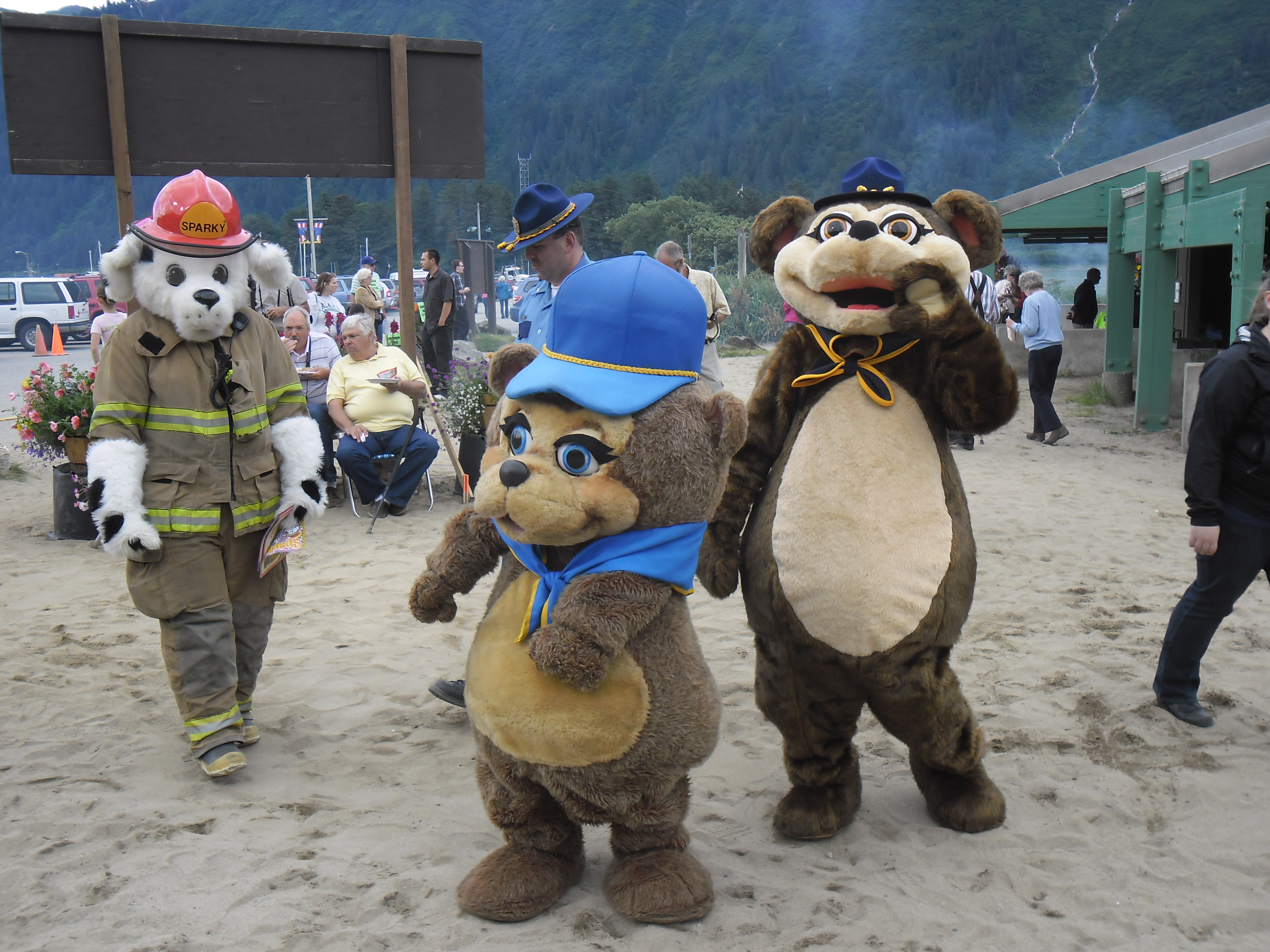
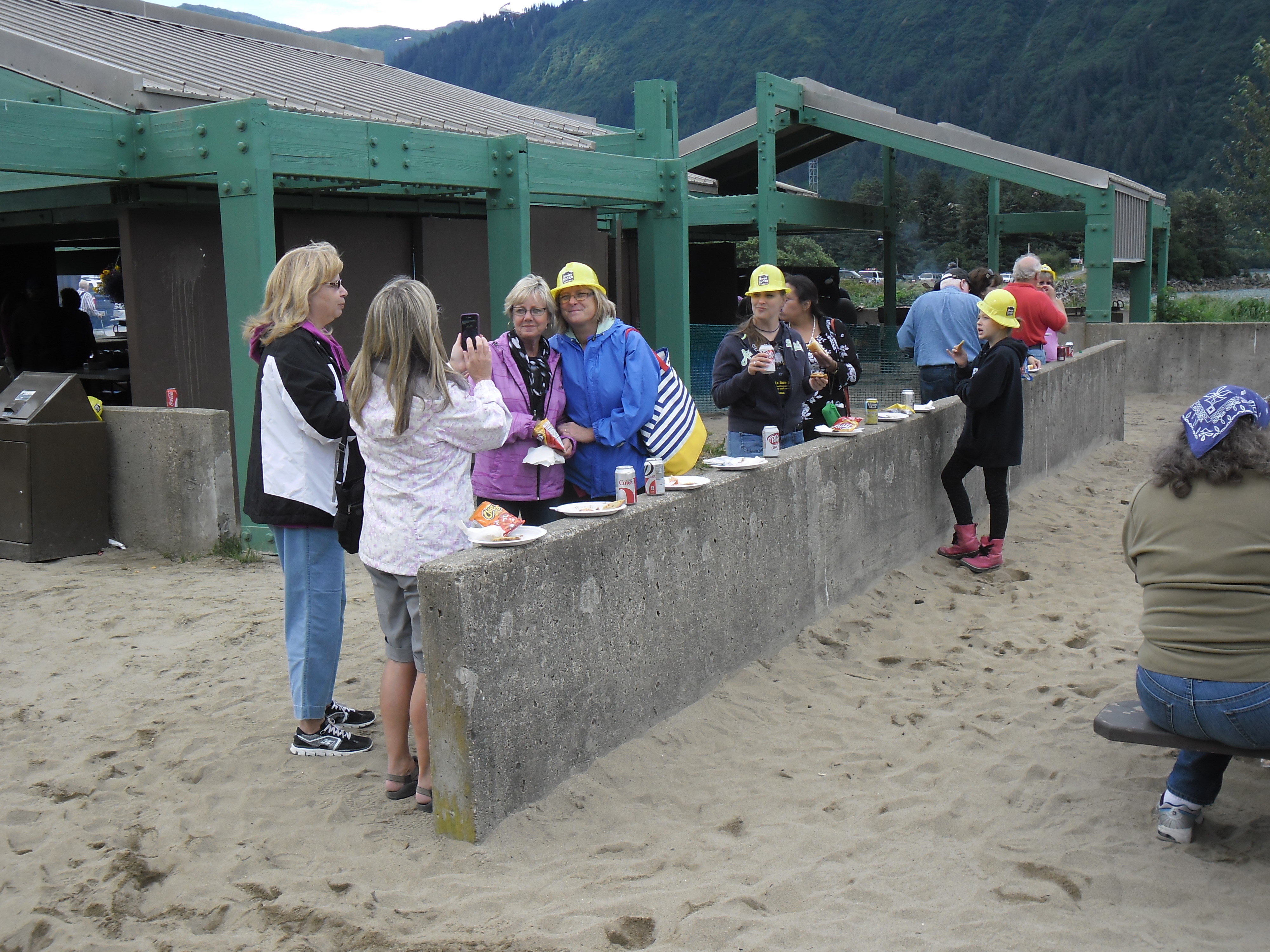
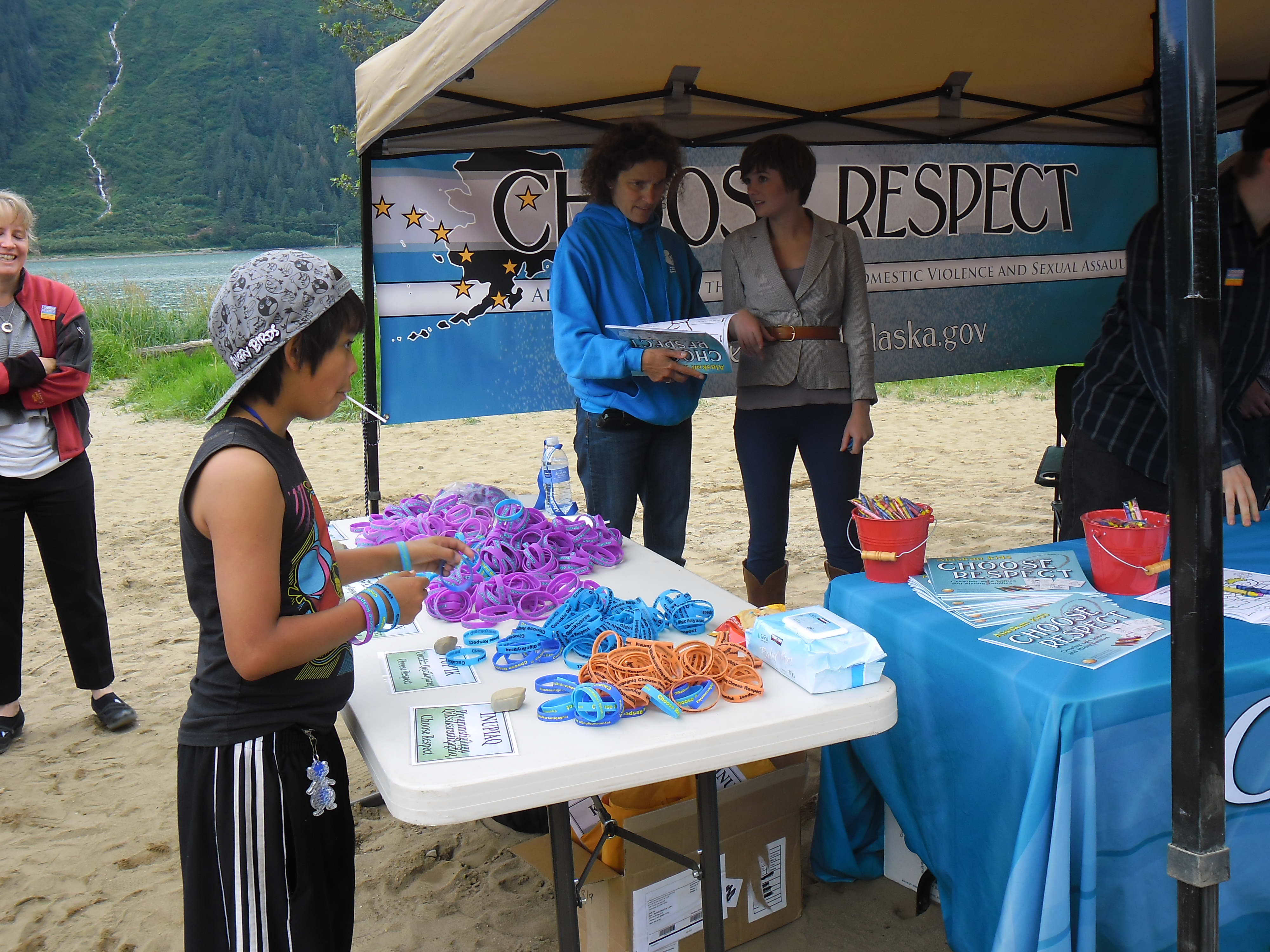
Lines at the Governor’s Family Picnic  Tuesday evening at Savikko Park were short but steady.

“I think people know we’re not going to run out of food and people just kind of came when they got off work and their families are here. Sandy Beach is packed,” said Cathie Roemmich, co-chair of the governor’s picnic committee.

The picnic’s menu included hot dogs, cookies, soda, chips and 250 pounds of salmon. Fillets of sockeye and coho came from local processors Taku Smokeries, Icy Straight Seafoods, Alaska Glacier Seafoods, as well as from local fishing boats.

Glenn Haight and his crew were responsible for grilling the marinated fish. “It’s a little bit of soy sauce, brown sugar, lemon juice, garlic and butter,” Haight described.

Joining commissioners, deputy commissioners, and cabinet members in the serving line was Lieutenant Governor Mead Treadwell.

“I enjoy serving as Lieutenant Governor and I enjoy serving hot dogs and salmon,” Treadwell said.

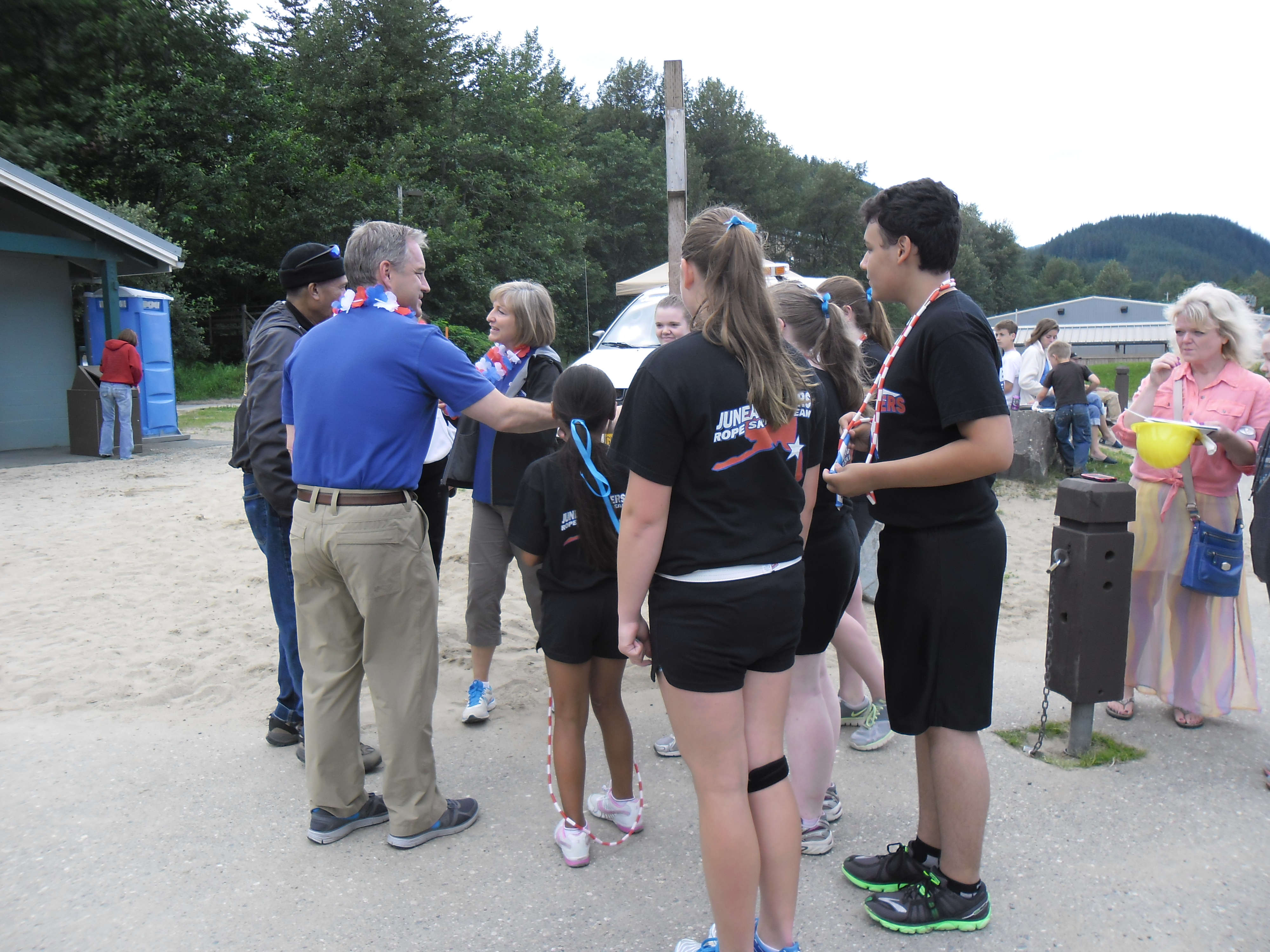
Governor Sean Parnell and First Lady Sandy Parnell hosted the event for the fifth year in a row. In between serving food, the couple shared how they like their hot dogs cooked.

“Slightly burned on one side and more raw on the other, ” Governor Parnell laughed.

“I like it with a little bit of black on the sides,” said First Lady Sandy Parnell. “Definitely got to be grilled; can’t be boiled.”

Juneau was the fourth stop for the Governor’s Family Picnic. The last picnic of the summer will be in Homer on Thursday.

Sockeye run brings bears; Steep Creek trail closed

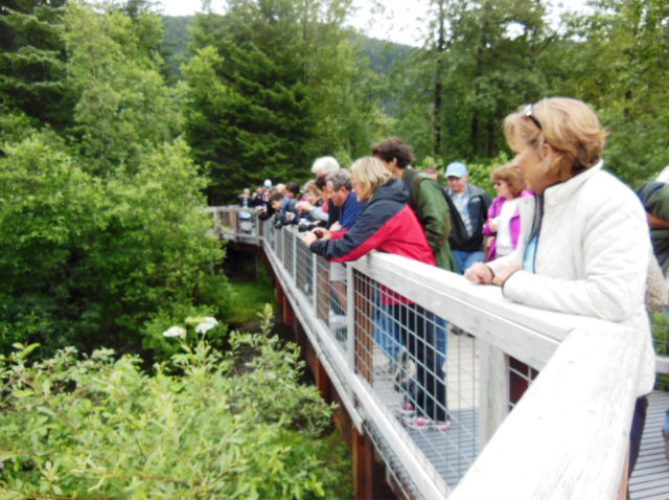
This juvenile male is one of several hanging around Steep Creek at the Mendenhall Glacier Visitors’ Center. Photo by Heather Bryant / KTOO.

Steep Creek Trail near the Mendenhall Glacier Visitor’s Center is closed until fall.

Sockeye began running over the weekend and the black bears are feasting.

The U.S. Forest Service closes the back side of the trail this time of year to protect both the bears and the people who want to watch them.

Visitor Center director John Neary says giving the bears space improves bear viewing.

“If we allow the bears to have a little space they’re more likely to come closer to the platforms where we can see them even better,” he says.  “It seems kind of counter intuitive, but the more relaxed the bear, the more space they have to retreat if they need to, the more likely they are to come nearby when they want to feed and seek our presence.”

Neary says most of the dozen to two-dozen black bears that use the area around the glacier are juveniles or sows with cubs.  The best place to watch them is from the visitor center grounds and the viewing platform.

“They’re very interested in hanging out right next to the people because it keeps away what they would consider the scarier bears, the big adults or big males that would maybe threaten their cubs.  So what we’re running here is a nursery.  The tourists are a key part of that as well as all the visitors who stay on those platforms and trails sort of  reinforcing for the bears that the people area is there and ‘if I walk right along them with my cubs I’ll be safe,’ ” he says.

Signs are posted and maps explain the area that is closed to walkers and bicyclists between the Moraine Ecology and Steep Creek trails.

Neary says Steep Creek will remain closed through the Coho salmon run.

Non-profit looks at Juneau for assisted living facility

The Juneau Pioneer Home offers some assisted living space, but the waiting list is long.

The CEO of a large non-profit organization that operates senior housing across the country is looking at Juneau as a possible site for an assisted living center.

Retirement Housing Foundation offers services for older adults, people with disabilities and low-income families in 170 communities, but none in Alaska.   A Juneau group developing an assisted living center proposal contacted RHF.

Sioux Douglas of Juneau Community Foundation is hopeful the company could become part of a public / private partnership for a facility.

“We don’t know a lot yet about their expectations and the various ways they have invested in communities across the nation.  That’s part of the reason for the site visit, and to enlighten them on the things that could be possible here and the challenges,” she said. “It’s more expensive to operate here. It’s more expensive to build here.  That’s why I’m so hopeful that we can find donated land.”

Douglas outlined the effort for an assisted living home Thursday to the Juneau Chamber of Commerce.

The Community Foundation, Juneau Commission on Aging, Juneau Economic Development Corporation and Senior Citizens Support Services are spearheading the quest.

A kick-off meeting last month brought out more than 120 people and about half said they would be interested in serving on a senior-housing task force.

That list is being whittled down. Douglas said the first job of the task force will be to identify land for a facility.

“You know my dream would be that we would have that figured out by the time our first visitor comes up to check Juneau out.  I doubt if we can move that quickly, but if anybody is listening and wants to contact me with a few acres of land we’ll be happy to talk,” she said, with a chuckle.

Douglas has been talking to the city and borough, private land trusts and others who could offer a site.

An assisted living facility was the top concern identified by senior citizens responding to a 2010 Juneau Commission on Aging Survey.  Such facilities are an intermediate level of care for people who need help with medications, meals, housekeeping, and other daily routines, but not nursing care.

AELP to test sirens

The dam above Salmon Creek.
The dam above Salmon Creek. (Wikimedia Commons)

Alaska Electric Light and power will test the Salmon Creek emergency sirens Thursday morning at 9 o’clock.

The high-pitched siren will last about three minutes and be heard in the 30-acre flood plain downhill from the dam.  The evacuation area extends from Bartlett Regional Hospital to Jack’s Plumbing on Glacier Highway along Twin Lakes.

AELP has two sirens and is required to test them periodically to ensure adequate sound levels.  Spokeswoman Debbie Driscoll says the company needs to know if businesses and residents in the area do not hear the noise.

“The biggest concern at this stage obviously when we’re dealing with the evacuation area is that everyone within the area can hear the sirens,” she says.

In an emergency, the company also would called every business and residence in the area, and notify local radio stations, “but there really is  a small window if the dam ever failed to get people out of that area quickly,” she says, “so the sirens are the thing we rely on most.”

The concrete dam has never failed.

The Federal Energy Regulatory Commission requires the power company test its emergency and communications systems on a regular basis. Every five years, an actual evacuation drill is required.

The dam itself is inspected monthly by the company.

“FERC comes out and inspects the dam once a year and makes sure that our emergency evacuation plan is complete and acceptable to them. And then every five years we have to have an independent source come and do a complete inspection outside of FERC and ourselves. So it’s a very well-monitored system,” she says.

Thursday’s  test will be heard only in the immediate area of the dam.  It is an audible test, not a drill, so evacuation is not necessary.

Dunbar sets Alaska mile mark at 3:59.06

Kodiak High School graduate Trevor Dunbar did something Monday night in Portland that no other Alaskan – not even his father – had ever accomplished: He ran a mile under four minutes. His time of 3-minutes 59.06-seconds came in the Portland Roughrider Twilight Meet.

Dunbar told an interviewer from the running website Flo-Track that he was thankful to have runner Robb Finnerty pushing him.

“I was just happy to have him and race it into the line,” he said. “Hey … thinking I could run a little bit faster, but the goal was just sub-four, and I’m happy.”

Finnerty, a runner for the Wisconsin Badgers, was just a third of a second behind Dunbar.

Trevor’s dad Marcus, a long time competitive runner and coach in Alaska, was there at the race to watch his youngest son set a mark that he had once dreamt of.

“Well, it’s been a long time coming. I made several attempts myself, and came up short every time, so it’s vindication to have Trevor,” Marcus Dunbar said. “Especially since no Alaskan’s ever done it. You know, I kinda wanted that to be at one time, but there’s been a lot of guys who came before me and guys that came after me, but we all came up short. It’s good to see Trevor getting it done.”

For his part, Trevor honored his dad by wearing his old high school jersey in the meet.

“Definitely a special one. I knew the season finale would be a special one. I wore his old jersey that he used to race in, so that was a little extra, extra little thing to make it a little more symbolic.”

Dunbar will be entering his senior year at the University of Oregon this fall, where he competes in cross country and middle-distance track.

New JPD chief tweaks department organization

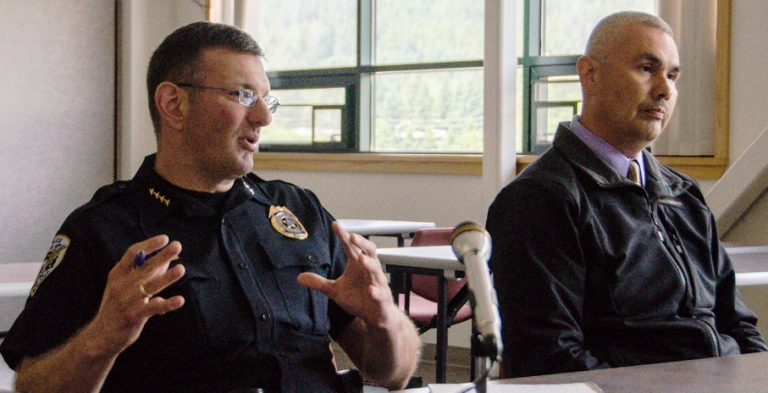
Juneau Police Department Chief Brice Johnson (left) has been on the job about six weeks. Operations Captain Ed Mercer (right) will become Deputy Chief.

The position of Assistant Police Chief no longer exists in the Juneau Police Department.

It’s part of reorganization under new Chief Bryce Johnson, who’s been on the job since June 3rd.

Johnson held an informal meeting with members of the Juneau news media Tuesday to describe what he said will be a more open police department.

Assistant Chief Page Decker retired in May and his job has not been filled.

Johnson said a captain position will also go away.  He calls it a flatter chain of command, with fewer administrative levels and managers.

“We’ll have the same number of people doing jobs, but there’ll be a shorter step between officer and the chief.  Hopefully (it will) facilitate a little bit better communication, making us more responsive to what’s going on and taking care of the needs of our employees,” he said.

It’s really semantics.  Johnson said the assistant chief will now be a deputy chief, and still second in command.

“The way the command structure used to work is the entire department filtered to one assistant chief and then to the chief.  Instead of that, most of the department – the patrol function, the investigative function and communications — will report to a deputy chief, who will be Deputy Chief Mercer.  Then there will be other people like the administrative manager and one lieutenant who will still report to me, so I’m going to take on a few more duties,” he said.

The deputy chief position will be filled by  Ed Mercer, who is now Operations Captain.  Johnson said the new command structure will be in place by August 1st.

While shrinking administration will not save money, Johnson said it’s a step toward community-oriented policing.  That philosophy is based on the premise that the causes of crime are not within the control of the police department.

“It’s nothing we can control that causes people to commit crimes; it has to do with other things,” he said. “So we can go round everybody up and throw them all in jail and it still will not get at the root of what’s causing the crime.  The more we can partner with other governmental agencies, non-profit groups,  more citizen groups, the more we can partner out there with people the better job we can do at reducing crime.”

The 43-year-old Johnson was Assistant Bureau Commander in the Salt Lake City Police Department before he accepted the job to replace now-retired Chief Greg Browning.

Johnson said he’s spent his first month learning about the capital city, JPD and ways to make the small department more efficient.

He said one of the biggest challenges is recruiting and filling the seven officer positions currently open.

Site notifications
Update notification options
Subscribe to notifications