Community

USCG celebrates 223rd birthday

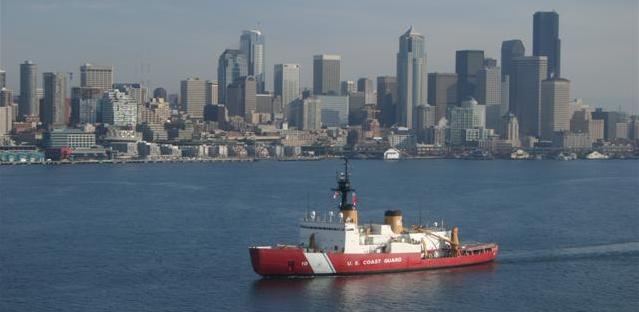
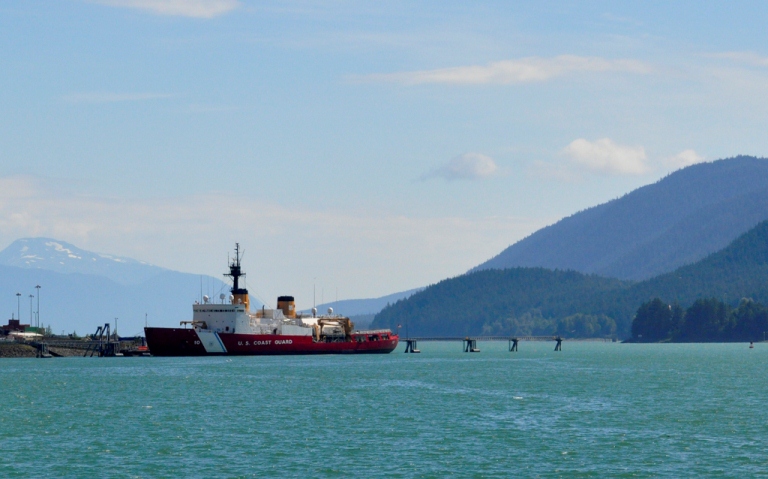
The U.C. Coast Guard heavy ice breaker Polar Star pulled into Juneau’s AJ cruise ship dock on Friday. The ship was open to the public on Saturday and left Sunday morning for Seattle. Photo by Dick Isett.

The U.S. Coast Guard is 223 years old.  The maritime service was created on Aug. 4, 1790 as the Revenue Cutter Service under the U.S. Department of Treasury.

Juneau is headquarters of the 17th Coast Guard District, which includes the Arctic.

Part of Juneau’s weekend celebration included a visit by the heavy ice breaker Polar Star, on its way to its Seattle home port after conducting ice tests in the Bering Sea.

The ship has been rebuilt and is the Coast Guard’s only heavy ice breaker in operation.   The Polar Star was open to visitors on Saturday.

Polar Star Executive Officer Kenneth Boda was one of the tour guides and offered a Coast Guard history lesson without prompting.

“We were built to basically collect customs and taxes, collect tariffs of vessels coming into port.  Over the years, we absorbed the Lighthouse service and the Life Saving Service, the Bureau of Steamboat Inspections as well.  Along the way along we were part of the armed forces,” he said.

The modern Coast Guard was created in 1915 as the fifth military uniformed service.

“Our vessels are fully compatible with all the Navy standards so we can operate in conjunction with the Navy,” Boda said, “but we also have the law enforcement side, the Homeland Security side, as well.”  

Boda called the Coast Guard a unique entity of the federal government. Its presence is local, regional, national and international, from the North Pole to the South Pole.

Most coastal Alaskans are familiar with the Coast Guard missions of safety, security and stewardship.

“Saving people’s lives is one of the big responsibilities of the Coast Guard,” Boda said. “Making sure that the ships that leave port are safe, we do vessel inspections.  Making sure that foreign ships that arrive have been inspected and have cleared all the U.S. regulations before they come into U.S. ports.” 

In 2012, according to the Coast Guard website, more than 436,000 vessels and their 29 and a half-million crewmembers and passengers were screened prior to arrival in U.S. ports.

The Coast Guard is the only military organization within the U.S. Department of Homeland Security.  Boda said that means it is responsible for ensuring U.S. harbors and ports are secure from any kind of threat.

“When I say threats, people think terrorist threats, but it’s not always terrorism that’s a threat, sometimes just a hazard to navigation.  For instance, a vessel that might wander out of the shipping lane and lose situational awareness.  In some other ports like Valdez, for instance, we have a vessel traffic service, you know that basically monitors ships as they come in and out and make sure everyone’s safe,” he said.

While enforcing U.S. fisheries laws is one of the most visible roles of the Coast Guard in Alaska, stewardship is protecting the oceans.

“Stewardship is environmental pollution response, so that the Coast Guard is called out to an Exxon Valdez or a Deep Water Horizon as well,” Boda said.

The Coast Guard is still investigating Royal Dutch Shell’s 2012 Alaska drilling operations after some vessels failed inspections, the oil rig Kulluk ran aground, and the company had other safety and environmental violations.

During the Polar Star’s brief stop in Juneau, KTOO had the opportunity to speak with Commanding Officer George Pellissier about its Arctic and Antarctic missions.  Check back for those stories.
Groundbreaking held for Walter Soboleff Center

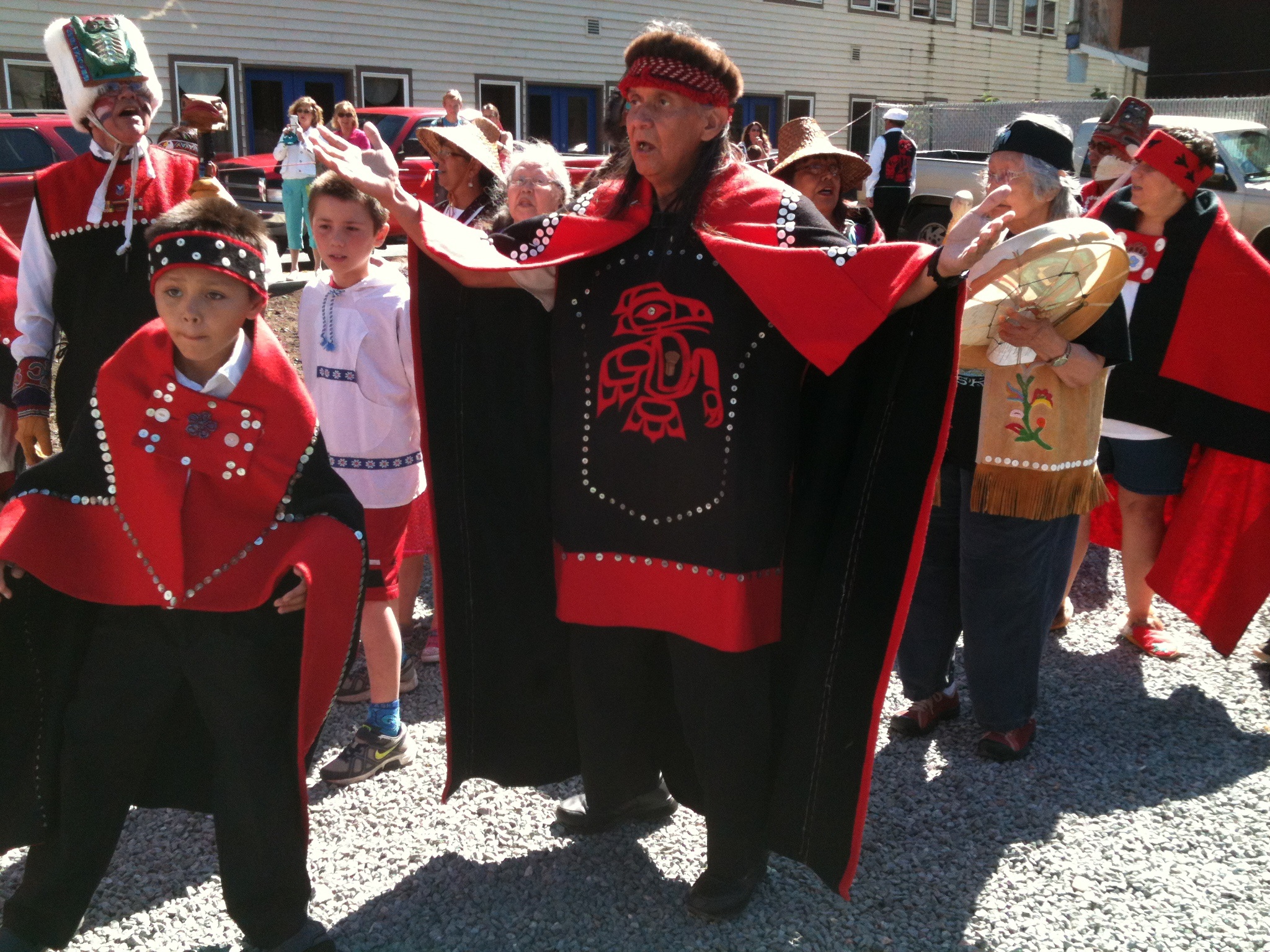
Members of the Yees Ku Oo dance group perform before and during the groundbreaking for the Walter Soboleff Center at Seward and Front Streets in downtown Juneau. Photo by Matt Miller/KTOO News

Local, state, and Native officials, and Native elders donned hard hats and picked up shovels on Thursday afternoon to break ground on a new cultural center planned for downtown Juneau.

The Walter Soboleff Center will be erected at the corner of Seward and Front Streets with Shattuck Way running along the rear of the building.

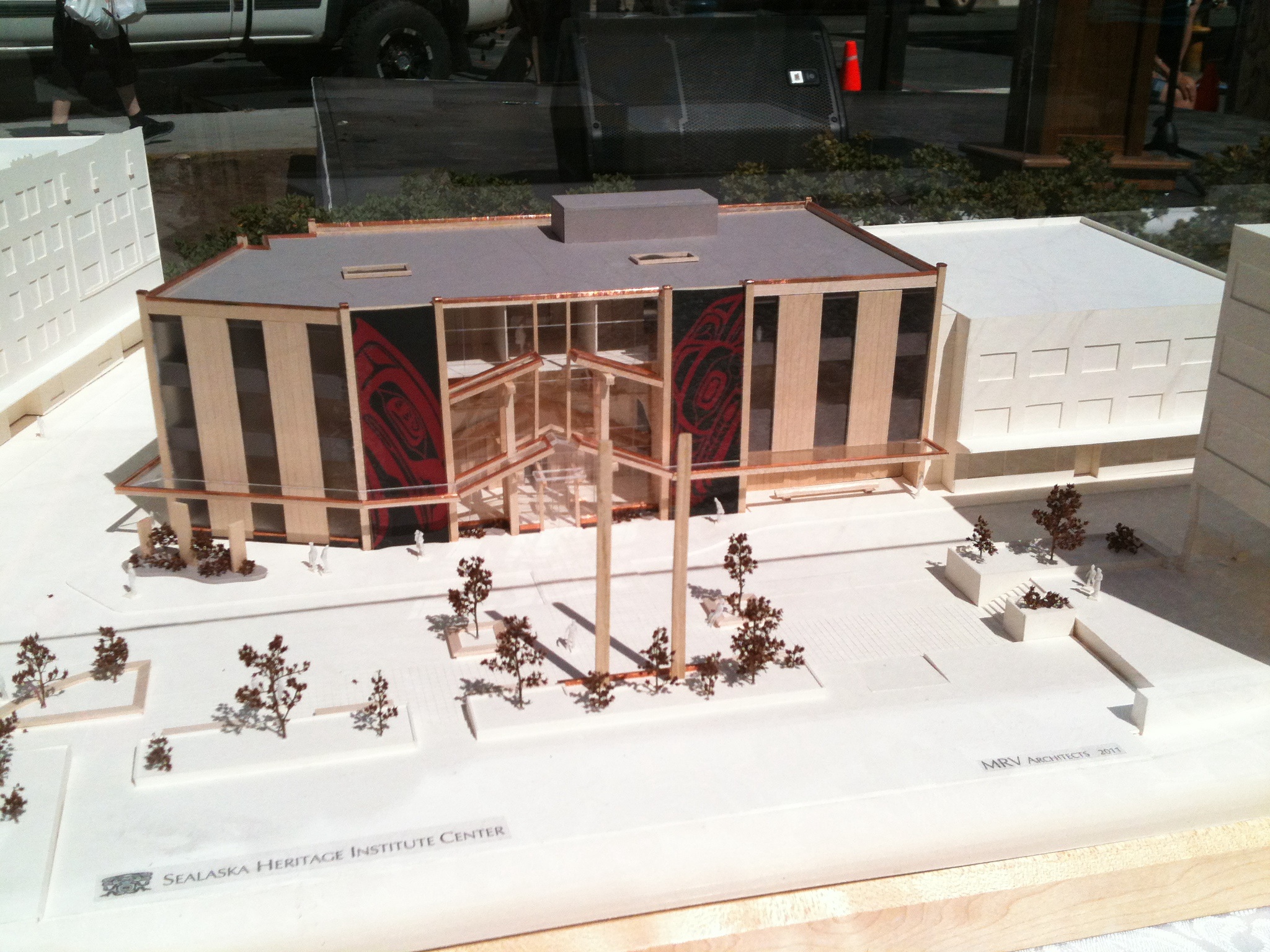
The 29-thousand square foot space will be devoted to the research and study of the Tlingit, Haida, and Tsimshian cultures. The building will house education, arts and language programs, archives and artifact collections, and offices of the Sealaska Heritage Institute.

Former Juneau mayor and former Sealaska corporation chairman and CEO Byron Mallot heads up the group raising funds for the center’s construction.

This is what ANCSA is all about. To create another giant step in Alaska’s Native peoples contributing their strength and their essence, their beauty, their values, their traditions, and their heritage to all Alaska and even to the nation.”

First Lady Sandy Parnell spoke on behalf of Governor Sean Parnell who attended the event, but who could not speak because of laryngitis.

“Like Dr. Soboleff himself, let this center stand for peace and understanding, for mutual respect and honor, for working together to lift all people up. That, by lifting people up, it will communicate to the world the values of Alaska and the values of Dr. Soboleff.”

Governor Sean Parnell (from left), Sealaska Heritage Institute Trustee Chair Marlene Johnson, Sealaska CEO/President Chris McNeil, and Juneau Mayor Merrill Sanford break ground for the new Walter Soboleff Center in downtown Juneau. An architectural model of the center sits on a table at the far left. Photo by Matt Miller/KTOO News

Dr. Soboleff’s sons Ross, Walter Jr., and Sasha also participated in Thursday’s groundbreaking.

And for those things which we hold dear in our hearts, it is so grateful to have this unfold before us in the name of our dad, Dr. Walter Soboleff.”

Selina Everson, past Grand Camp president, represented the Alaska Native Sisterhood:

We have progressed from our Tlingit box of culture to a building that will carry on Dr. Walter Soboleff’s legacy. We have come a long way. We have a long way to go.”

Everybody gets their digs in. Eagle Clan Leader David Katzeek (from left), Paul Marks of the Raven Clan, and Rosita Worl of the Sealaska Heritage Institute participate in the groundbreaking with their own form of Tlingit hard hats as Sealaska Chairman Albert Kookesh watches in the background. Photo by Matt Miller/KTOO News

Other speakers included Albert Kookesh, Chairman of the Sealaska Board of Directors; Chris McNeil, Sealaska CEO and President; Juneau Mayor Merrill Sanford, Juneau Representative Cathy Munoz; Ed Thomas, President of the Central Council of Tlingit and Haida Indian Tribes of Alaska; Eagle Clan Leader David Katzeek, and Paul Marks who provided the Raven response. A letter from Juneau Representative Beth Kerttula and Juneau Senator Dennis Egan, who could not attend the groundbreaking, was read during the ceremony. The Yees Ku Oo dance group performed before and during the event.

Sealaska Heritage Insititute officials say they have raised about 75-percent of the funds needed for the $20 million project. Some of that money included state and CBJ appropriations, or grants from the Alaska Native Education Program or the Cruise Industry Charitable Foundation.

Completion is expected for the end of 2014.

The center’s proposed site, previously known as “The Pit” or the “Hole in the Ground,” was turned into a temporary park after Sealaska corporation acquired the vacant lot and donated it to the Sealaska Heritage Institute. The space used to be site of the Endicott Building or the Skinner Building which burned down almost exactly nine years ago.

The Reverend Doctor Walter Soboleff was a Presbyterian minister, and spiritual and cultural standard bearer of the Tlingit people. He passed away two years ago at the age of 102.

Walter Soboleff Center model
Architectural scale model of the proposed Walter Soboleff Center was on display at Thursday’s groundbreaking ceremony. Photo by Matt Miller/KTOO News

Celebration highlights the reversal of DOMA

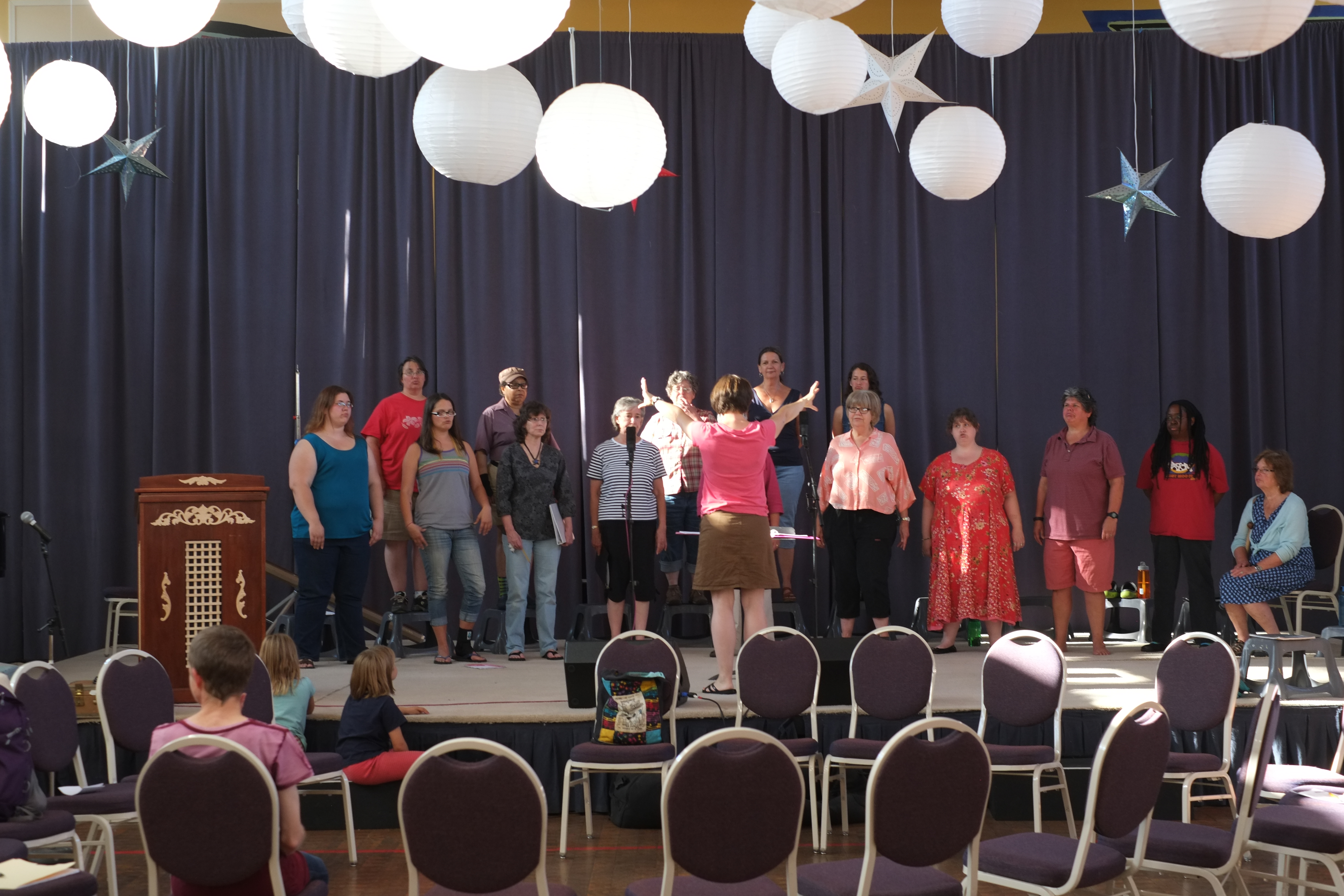
Members of the Juneau Pride Chorus rehearse for Friday night’s Equality for All celebration. The group is one of many live acts scheduled for the event. (Photo by Lisa Phu/KTOO)

A celebration in the Capital city called Equality For All, which centers around the recent Supreme Court’s landmark reversal of the Defense of Marriage Act, is more than an awareness event for equal rights.

“This is basically a giant wedding party,” explains Maureen Longworth, one of nine organizers of the event.

Since DOMA was struck down in June by the US Supreme Court allowing same-sex married couples equal treatment under federal law, Longworth has been celebrating, and wants the rest of Juneau to join in.

“It’s a big deal.”

Fellow event organizer Kimberly Crawford recognizes Alaska still has a long way to go.

“Things are changing but we still don’t quite have the rights that we deserve yet – the full, full rights.”

Longworth knows that change takes time.

She and her partner Lin Davis were one of several couples involved in a 1999 lawsuit against the state of Alaska, filed right after the state amended its constitution to define marriage as only between a man and a woman. The American Civil Liberties Union demanded the state offer domestic partner benefits to employees in same sex relationships.

Six years later, the ACLU won. It was another three years before benefits were actually given.

“It’s been incremental change all the way along. At this point, I really do envision being able to be equal, completely equal, in our state. I’m not sure how long it’s going to take,” says Longworth.

Joshua Decker is interim executive director of ACLU Alaska. Since DOMA was reversed, he’s been traveling around the state conducting informational sessions and having what he calls a “happy conversation.” Juneau is his next stop.

“This is a new area of the law that same sex couples are now being recognized under and so it’s important that Alaskans know what their rights are so they are able to fully enjoy the benefits of being a citizen,” Decker explains.

One example of these rights pertains to the military and federal government employees who’ve been married.

“Civilian and military employees are now going to be eligible for all the spousal benefits in terms of health insurance, dental, life insurance. If you’re a military service member, you’ll be able to live on base, you’ll be able to move off base with the spouse, you’ll be able to get command-sponsored visas. It’s the US government fully recognizing the fact that those individuals are married,” he says.

Crawford is excited to hear about other rights and changes to law at the Equality For All celebration.

“I think we’re coming into a new age where people do realize that equal rights are just that – they’re equal rights – and everyone deserves them.”

Crawford says the recent Supreme Court decision is a big step forward and is optimistic more changes are to come.

The Equality For All celebration at the JACC, featuring local entertainment, food, drinks, and a silent auction, starts Friday at 7 pm. Saturday’s 1 pm event is a Q&A session at McPhetres Hall with a panel of experts discussing how recent Supreme Court decisions will impact same-sex couples in Alaska.


Polar Star to visit Juneau

The ice break Polar Star will visit Juneau on Saturday and will be open to the public. Photo courtesy U.S. Coast Guard.
The only heavy ice breaker in the Coast Guard’s fleet will be in Juneau this weekend and open for tours.

The Polar Star is returning from its first trip to the Arctic Ocean since a four-year, $57 million overhaul of the ship.  It was reactivated in December in Seattle then tested in the open ocean before heading to the Arctic.

Coast Guard Petty Officer Kip Wadlow says the ship and crew have been conducting ice tests.

“The ice tests allowed the crew of the Polar Star to travel back up into the Arctic, test the ship’s capabilities going through the ice and also train their crew up so that they’re going to be ready to meet the Coast Guard’s Arctic and Antarctic missions in the future,” Wadlow says.

The Polar Star is returning to its home port in Seattle.  It was commissioned in 1976 and is one of two active Coast Guard ice breakers.

The smaller Healy paid a port call to Juneau in November.

Tours of the 399-foot Polar Star are Saturday from 1 to 4 p.m. at the AJ Dock.

Children must be accompanied by an adult.  Pets are not allowed on board.

AJ Mine compact renewal stands — without a public hearing

Despite a public outcry on a recent AJ Mine resolution, the Juneau Assembly Monday refused to reconsider a vote and discuss the issue.

The Assembly two weeks ago approved Resolution 2656, renewing a 1979 compact for property owners CBJ and AJT to act as a single entity for future mine exploration and development.

Before it appeared on the July 16 agenda, the resolution had not gone through an Assembly committee, nor had a public hearing.  Attempts by three members failed to table the resolution or send it to the Committee of the Whole. At the end of that  meeting, member Jesse Kiehl called for reconsideration of his vote, vowing to bring up the issue again.

The public beat him to it.  Several residents came before the panel on Monday, asking members to reconsider, including Juneau resident Bob Sylvester.

“I think that democracy, for lack of a better word, is time consuming and inefficient. I know people would like to get on with this project (re-opening the mine). But I believe the public has the right to be heard in a thorough public process,” Sylvester said.

The city and borough owns two-thirds of the AJ Mine property and one-third of the Treadwell Mine in Douglas. AJT Mining Properties, a sister company to Alaska Electric Light and Power, owns the rest. The 34-year-old compact joins the property.  City Manager Kim Kiefer previously called the compact update a “housekeeping” measure that only demonstrates the commitment of CBJ and AJT to make the property available for mining development.

In the two weeks since the Assembly approved Resolution 2656, members have received on online petition with 140 signatures as well as numerous emails asking that it be brought up again. They’ve have been stopped on the street by constituents, and criticized in letters to the editor.

Kiehl said he’s had personal conversations with ardent mine supporters and critics, all saying the resolution should have a public hearing.

“What I’ve heard overwhelmingly in those comments  from the public is that they still don’t know what it does, and they’re not sure if it’s a good idea and they’d like us to hash it out a little more and to do so in public,” Kiehl said.

Guy Archibald, of the Southeast Alaska Conservation Council, was one of those reminding the Assembly that re-opening the old mine has been one of the most divisive issues to ever come before the town.

“There cannot be any Assembly action on the AJ Mine that’s dismissed as either routine or just processing paperwork without also dismissing the very strong feelings and emotions from a large portion of this community,” Archibald said.

When Kiehl called for reconsideration of the resolution, his motion failed on a six to three vote.   Only Kiehl, Karen Crane and Loren Jones voted to hear the issue again.  Mayor Merrill Sanford, and members Carlton Smith, Randy Wanamaker, Mary Becker, Jerry Nankervis, and Johan Dybdahl voted against reconsideration.

Thane Road resident Larri Spengler was surprised that no members explained why they would not allow a public hearing on the resolution.

“I think it would have lost nothing to have a meeting, talk about it in public and then have the vote. And if the Assembly still thought it was a good idea they could still do it, but people would have been brought along, and that’s really the key,” she said.

The question before the Assembly was simply whether to talk about the AJ Mine compact update in public.  It was not a question of the merits of the compact .

Juneau’s main source of water comes from Last Chance Basin, which sits atop, adjacent to and beneath the ore body, just above downtown.

Willoughby District will benefit from a performing arts complex

A layout of the arts and culture complex within the Willoughby District. (Image courtesy of James Bibb/North Wind Architects)

A future performing arts complex is essential to the development of what’s known as the Willoughby District, according to a local architect.

The Juneau Arts and Humanities Council and Perseverance Theatre are teaming up to create a Willoughby Performing Arts Complex.

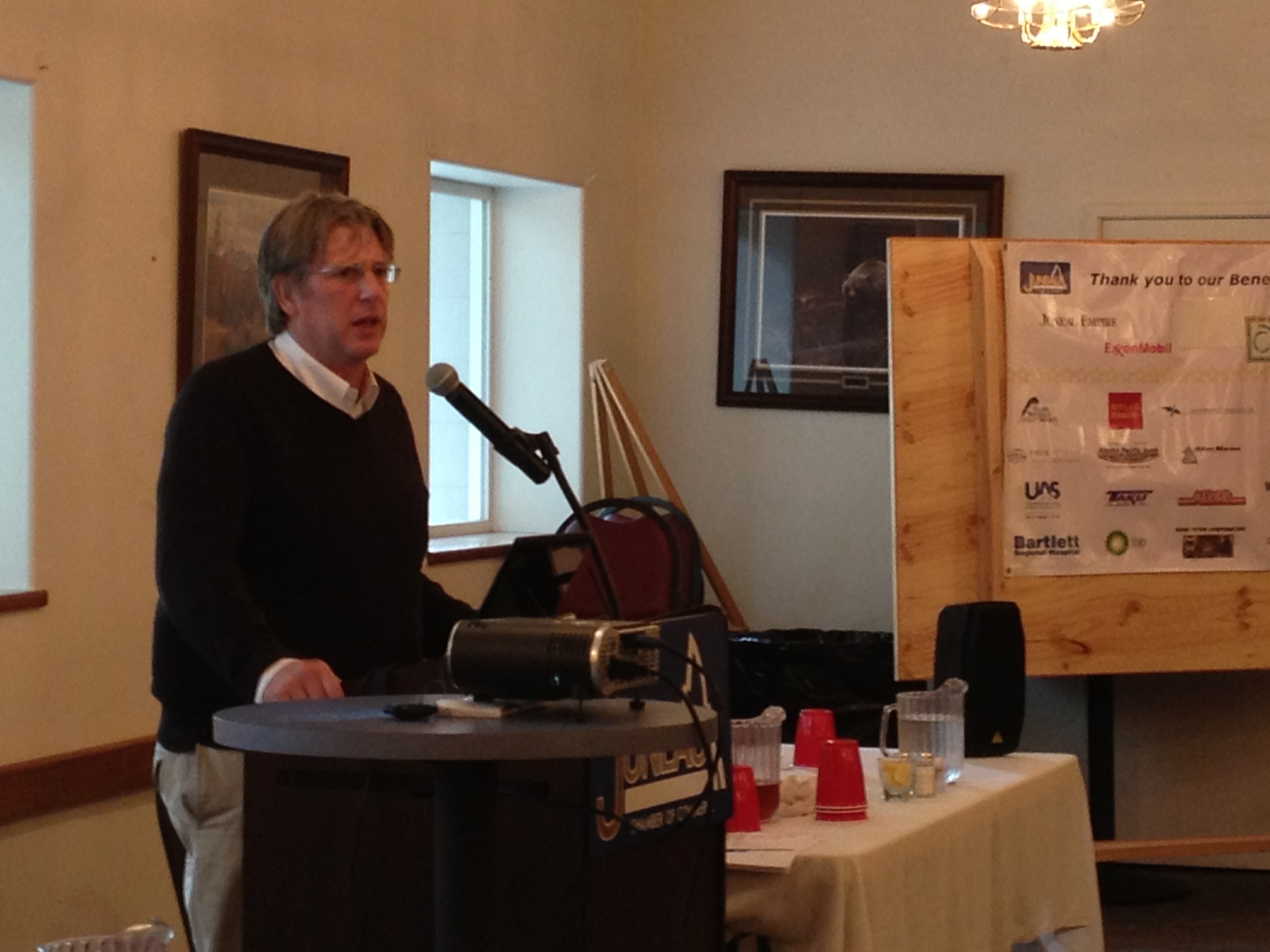
North Wind architect James Bibb at Thursday’s Chamber of Commerce luncheon speaking on the development of the Willoughby District. (Photo by Lisa Phu/KTOO)

North Wind architect James Bibb says the collaboration is critical for how the rest of the district grows. Bibb spoke at the Chamber of Commerce luncheon yesterday.

“If the buildings around the arts and cultural district are developed, it starts to build a neighborhood, build an identity. It creates a campus.”

The complex would be the new home for Perseverance, containing the theater, rehearsal space, offices, and costume shop.

Perseverance artistic director Art Rotch says the current theater building is nearing the end of its life. Being part of the Willoughby Performing Arts Complex would mean moving from Douglas, which has been the theater’s location since it was founded in 1979.

“That’s tough, but the theater serves the whole community, in fact the whole state, so we have to think about how to do that best,” Rotch says.

A Willoughby Performing Arts Complex will be an expansion of the current JACC building. (Photo by Lisa Phu/KTOO)

Nancy DeCherney is executive director of the Arts and Humanities Council. She says the new arts complex will also have a second theater for public use, a restaurant and bar, apartments, offices, and a potential dance studio.

“The apartments and offices would offer both mixed use in the neighborhood and give us operating income to support the facility.”

The goal, says DeCherney, is to expand the JACC by building into the parking lot. This would take away 55 parking spots, an idea she’s gotten unfavorable reaction to.

“The parking in this area is a problem whether we build it or not, and maybe we can use this project as a way to have community conversations about ways to solves the issues in the Willoughby District with regard to that,” she says. “That’s how I’m approaching the parking – yes, it’s a problem. Let’s fix it.”

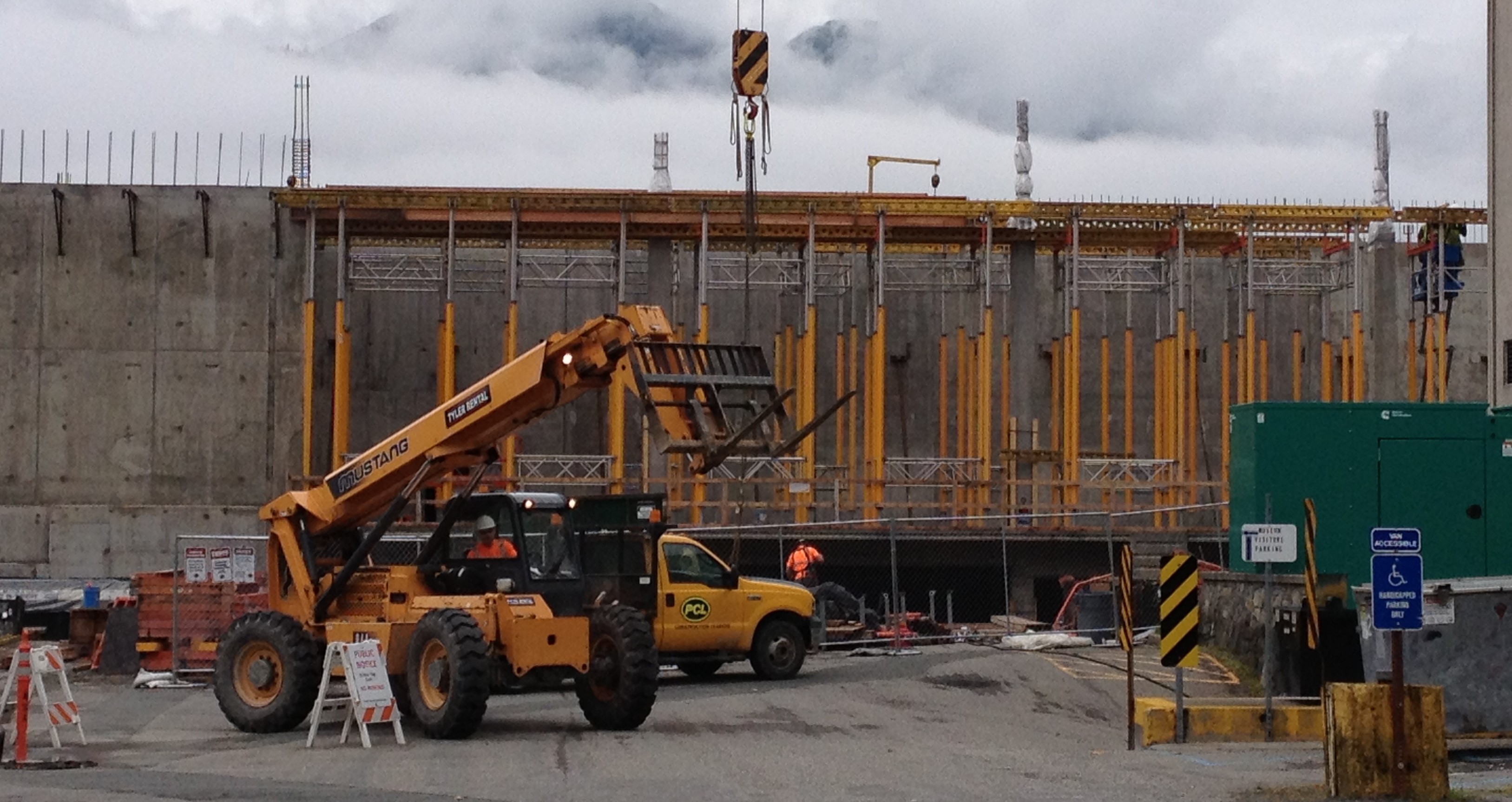
The State Library Archives Museum (SLAM) project is being built within the Willoughby District. (Photo by Lisa Phu/KTOO)

Developing Willoughby District is long-range goal of the city, and includes the current SLAM project.

Last year, voters approved an extension to Juneau’s 1% sales tax allocating $1 million towards a JACC expansion.

DeCherney says the current estimate for a new performing arts complex is around $18 million. DeCherney hopes to see the project started within five years.

Site notifications
Update notification options
Subscribe to notifications