Endurance cyclist Dr. Janice Sheufelt of Juneau waits for a train to pass in Flagstaff, Arizona during her recent Race Across America. Sheufelt and her race partner, Joel Sothern, finished in less than a week, setting a record for the mixed gender, two-person, 50-59 year old division. Photo courtesy Peter Apathy.
A Juneau physician is blazing a trail in the world of competitive ultra-cycling.
Dr. Janice Sheufelt was half of a two-person team that finished the Race Across America last Saturday in record time for their division.
She and California cyclist Joel Sothern completed the 3,000-mile bicycle race from Oceanside, California to Annapolis, Maryland in six days, 21 hours and 48 minutes. Not only is that a record for the mixed gender, 50-59 year old category, but good enough for second among all two-person teams in this year’s race.
Sheufelt calls Race Across America “the ultimate bicycle race challenge.”
“Once the clock starts, it doesn’t stop,” she says. “So, you just have to get to Annapolis as soon as possible.”
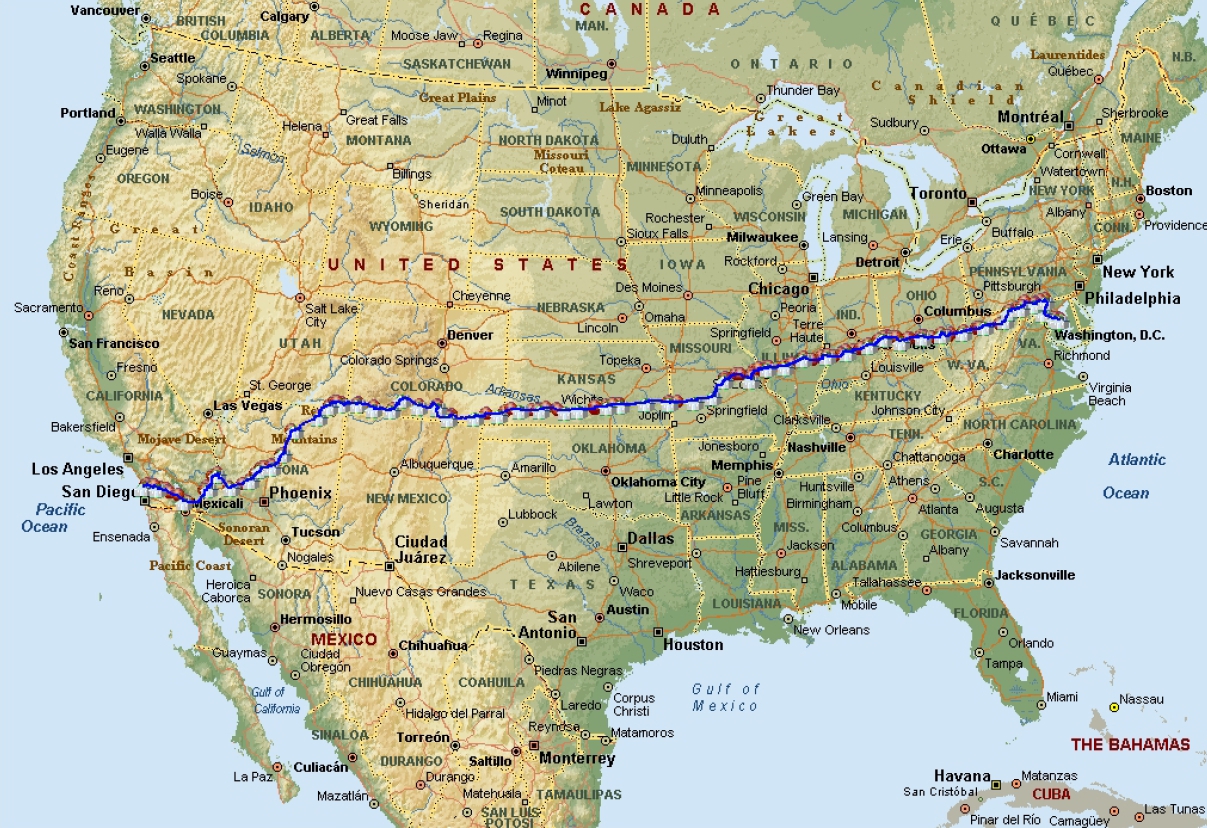
Sheufelt and Sothern – who called themselves the Flying J’s – alternated one-hour shifts on the bike throughout the cross-country trek. The route goes from southern California, through parts of Arizona, Utah, Colorado, Kansas, Missouri, Illinois, Indiana, Ohio, West Virginia, Pennsylvania and Maryland.
Challenges along the way included lack of sleep, bad weather, and hilly terrain.
“Kansas was hard with some cross winds, and we had a bad thunderstorm. Once we crossed the Mississippi and got into some rolling hills it got harder, and then the Appalachians were extremely challenging,” Sheufelt says. “The roads are just so steep. All the way up, almost to the finish line, we had really steep hills that surprised me how hard they were.”
Sheufelt says Sothern emailed her last fall to see if she’d be interested in doing the race with him. They’d never met before, but he’d seen some of her ultra-marathon times and thought she’d make a good partner.
“He’s done a number of RAAm’s before,” she says. “He did a four-person team, he’s done a couple of two person teams. He likes to set records for the various categories, and so that was his goal was to set a record this year, which we did do.”
Racers are organized by the average age of team members. Sheufelt is 46; Sothern is 55, putting their average age at 50 and a half. So, they competed in the 50-59 age group.
A map of the Race Across America route recently completed Juneau cyclist Janice Sheufelt and teammate Joel Sothern in record time. Image courtesy Race Across America.
The Flying J’s used an eleven-person support crew that included some of Sheufelt’s co-workers at the Southeast Alaska Regional Health Consortium, as well as her husband, James, and daughter, Megan. She says they contributed to the record-setting run just as much as she and Sothern.
“Just this intense bonding experience with this group of people working together, that was by far the best part of the race,” she says.
She trains year-round in Juneau by riding a training bike in her garage.
“I know there are lots of people in Juneau who ride through the winter, but I’m not that tough,” Sheufelt says with a laugh. “So, I just train indoors until about mid-April. What I do is I normally take a couple of trips down south to California during the winter to get some outdoor riding in.”
Juneau’s Cycle Alaska bike shop sponsored the Flying J’s. Sheufelt says she may try to do a solo Race Across America one day, but needs some time to rest and bask in the glow of her record-setting trip.
Marie Darlin (left) was honored by the CBJ Assembly for her many years of volunteer service in Juneau. AARP’s Liz Lucas (right) also presented flowers to Darlin. Photo courtesy Liz Lucas.
Juneau’s Marie Darlin is 88 and still advocating for causes she’s worked on for years – including services for senior citizens.
Darlin was honored Wednesday night by the CBJ Assembly at a meeting she helped organize to discuss an assisted living facility for the capital city.
She also was surprised at the recognition. Mayor Merrill Sanford delivered the proclamation, which aptly describes her energy and passion for volunteering. Sanford said Darlin’s “volunteering in organizations that make Juneau and the entire state of Alaska better places to live make her an exemplary model for all citizens to follow.”
Darlin belongs to the fastest growing segment of Alaska’s population – senior citizens.
She’s well beyond the baby boomer group. The first of that generation started turning 65 in 2011.
“A lot of them moved up to Alaska, which means that Alaska actually has the fastest growing senior population of any state,” says MaryAnn VandeCastle, chairman of the Juneau Commission on Aging. Darlin is one of its most active members.
The Commission on Aging has joined with Juneau Community Foundation, Juneau Economic Development Corporation and Senior Citizens Support Services to come up with a plan for an assisted living center.
The idea has been discussed for years and nothing has happened. But 110 people attended Wednesday’s meeting, including officials from state of Alaska senior programs, legislators and Assembly members, folks over and under 65, and adults concerned about caring for aging family members. Organizer Sioux Douglas says it’s a good cross-section of Juneau for a topic that needs community balance.
About 45 people signed up to serve on a task force. Douglas says they will be contacted to reaffirm their interest.
The city has little support for elderly people who need special services, but not full-time care.
Alaska Pioneer Homes, including Juneau’s, offer assisted living, but the waiting lists are long. Wildflower Court near Bartlett Regional Hospital is 24-hour nursing care. Independent senior housing is offered at Fireweed Place and Mountain View Apartments downtown, and Smith Hall in the Mendenhall Valley.
Assisted living facilities are an intermediate level of care for seniors who need help with medications, meals, housekeeping, bathing or dressing, exercise and other daily routines, but not nursing care.
Douglas says the task force should be comprised of people who are strong community stakeholders, including developers, builders, philanthropists, businesses, and citizens who anticipate the need for assisted living for themselves or family members:
“So we want a really good cross-section of folks willing to stick with this project until its completion. And we know it’s in the community. We have a wonderful, generous, talented and smart community. There’s no reason why we can’t do this. It’s just a matter of pulling the right resources and people together to make it happen.”
Douglas says the best option could be a collaboration with an organization that operates assisted living facilities elsewhere. She hopes an assisted living center is reality in Juneau within a couple of years.
The crowd outside the Supreme Court yesterday. (Photo by Photo Phiend/Flickr Creative Commons)
The U.S. Supreme Court ended its term striking down the federal Defense of Marriage Act and sending a California same-sex marriage case back to the lower court. But the court does not affirm gay marriage as a constitutional right.
DOMA controls more than a thousand statutes and numerous federal regulations pertaining to Social Security, housing, income taxes, and other benefits available to heterosexual married couples.
Kennedy said its “principal purpose is to impose inequality,” so in ruling DOMA unconstitutional, legally married same-sex couples would be eligible for federal benefits.
“In neither case, does the court say that there is a firm constitutional right for people of the same sex to get married.”
University of Alaska Justice Center Professor Jason Brandeis calls Justice Kennedy’s opinion a criticism of a “mean-spirited law.”
“It was intended to relegate same-sex couples to a level of being second class citizens and the impact that could have on their families and their children seems to be a part of his decision making process.”
Kennedy’s opinion also makes it clear that federal recognition and benefits would only apply to couples married in states that have legalized same-sex marriage.
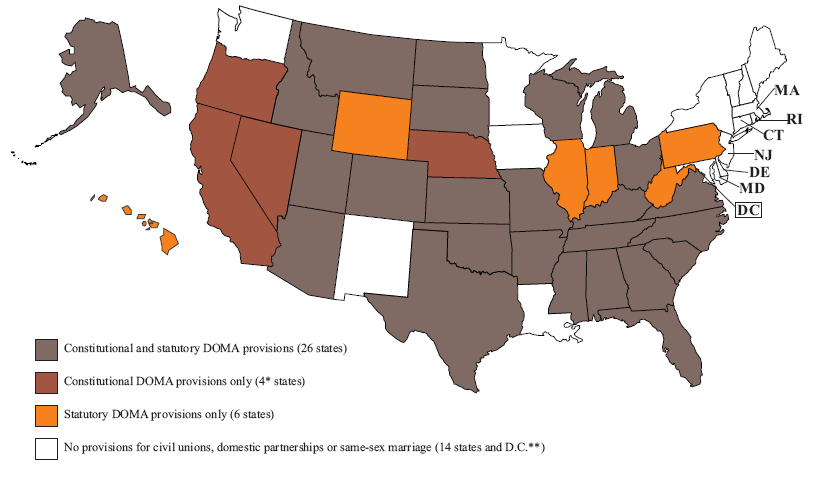
Constitutional amendments in 29 states limit marriage to heterosexual couples. Alaska was the first to do so in 1998.
“After today about 1/3 of Americans live in a state that offers marriage equality,” says Joshua Decker.
Decker is with the Alaska ACLU.
“We’re really happy about this because with the Defense of Marriage Act case, Alaskans who get married outside and come back to Alaska are now able to have the thousands of federal benefits that apply to married couples, apply to them.”
It is likely states that ban gay marriage will become battlegrounds over the issue. Decker says Alaska may well enter the fray.
Both Alaska’s U.S. Senators applauded the Supreme Court’s DOMA ruling. Senator Mark Begich called it a “victory for individual rights.”
Senator Lisa Murkowski officially announced her support for same-sex marriage last week. After the court’s ruling, she said the federal government should empower households, respect the decisions of states and otherwise get out of the way.
Jim Minnery with Alaska Family Action says the Supreme Court is respecting states’ rights in the DOMA decision.
“It’s very clear that Alaska’s still in the driver’s seat with how we define and regulate marriage.”
But Minnery says the discussion has just begun.
“Alaskans need to stay engaged on the issue of marriage because Justice Kennedy, who wrote the majority opinion, basically acknowledges in no uncertain terms that states have the right to define and regulate marriage.”
Minnery said organizations like the Family Action council will do their part to make sure Alaska marriage remains limited to “one man and one woman,” as the constitution states.
Professor Brandeis believes a clear line can be drawn from the movement for racial equality to equality based on sexual orientation. History shows such movements take years, but Brandeis believes public opinion is shifting significantly on the issue of same-sex marriage.
“I think that people that are in charge of making laws that are consistent with the United States Constitution and state constitutions and have a responsibility to their constituents really need to take a step back and think about what side of history they want to be on.”
For the last few days, people have gathered outside the Court in anticipation of the rulings. (Photo by Victoria Pickering/Flickr Creative Commons)
Update: June 26 – 10:54 a.m.
Senator Mark Begich is calling the ruling a “victory for individual rights.”
His office sent out a press release with this statement:
“Today’s decision is a victory for individual rights and Alaskans who are fed up of government intrusion. I have said all along that I do not support discrimination of any kind and that is why I believe same sex couples should be able to marry and have the same rights, benefits, privileges and responsibilities as any other married couple. While we still have a long way to go, today, the Supreme Court confirmed that the government needs to step aside, leave the decision to states and churches, and stay out of our private lives and daily business.”
Update: June 26 – 7:22 a.m.
Senator Lisa Murkowksi has released a statement on the ruling:
“I welcome today’s Supreme Court decision to strike down the Defense of Marriage Act because the federal government should empower households, respect the decisions of states and otherwise get out of the way. This ruling represents victories for states’ rights and equal treatment under the law.”
Original Story: June 26 – 7:04 a.m.
The Defense of Marriage Act has been ruled unconstitutional by the U.S. Supreme Court.
This morning the court issued an opinion saying that DOMA deprives people of equal liberty as protected by the Fifth Amendment.
The opinion was issued by Justice Kennedy joined by Justices Ginsburg, Breyer, Sotomayer and Kagen.
Same sex couples who are legally married will be entitled to equal treatment under federal law.
After reading the ruling this morning, Peter-Contesse says it’s surprisingly more powerful than she expected.
“It’s indescribable. Not something I expected to experience in my life…and about damn time too.”
Olejasz was following the decision online but says she had a hard time believing what she was reading.
“I think my mind interpreted the words, but my emotions wouldn’t let me go there. I understood the words, but I kept saying ‘is this really true, is this really true. I don’t know.’ ’”
The ruling means when the couple gets married in Washington, a state where same-sex marriage is legal, their marriage will be recognized under federal law.
“Our marriage [will be] on the same par as everyone else’s marriage which is a bigger deal than I expected it to be. It’s definitely a very emotional time this morning.”
The court found there was no standing to rule on Hollingsworth v. Perry and the case was sent back to the Ninth Circuit Court with instructions to dismiss the appeal because it lacks jurisdiction.
This is a developing story, check back for more details from the ruling.
Main Street re-opened to traffic on Thursday. Photo by Justin Heard / KTOO.
Juneau’s Main Street has opened to traffic on a smooth new asphalt surface that one driver described as “beautifully done.”
Two blocks of Main Street have been closed to traffic since mid-April as crews installed underground utilities, and replaced water, sewer and storm drains.
The street opened to downhill traffic only on Thursday.
The current phase of the project includes traffic islands, landscaping and a sidewalk canopy.
Aimee Olejasz and Fabienne Peter-Contesse have been together for 23 years and have spent most of their life in Alaska. This fall, they’re headed to Washington to say their vows. (Photo courtesy Fabienne Peter-Contesse and Aimee Olejasz)
Update:The Supreme Court did not issue rulings in either the DOMA (United States v. Windsor) or Prop 8 (Hollingsworth v. Perry) cases on Thursday. The only remaining scheduled day for opinions is Monday, or the court may add an additional day.
The U.S. Supreme Court could rule as soon as Thursday on two same-sex marriage cases: The Defense of Marriage Act, and California’s Proposition 8, which recognizes marriage only between a man and woman in that state.
For same-sex couples in Alaska who want to marry, the only option right now is to head out of state.
Alaska was the first state to ban gay marriage through a constitutional amendment in 1998. By statute same sex marriages from other states are not recognized.
In 2005, the Alaska Civil Liberties Union sued the state and Municipality of Anchorage on behalf of nine gay and lesbian couples who were seeking benefits for their spouses.
The Alaska Supreme Court said denying spousal benefits for gay couples was an equal protection violation. The result was that local governments as well as the state had to make employment benefits available to people in domestic partnerships.
Fabienne Peter-Contesse and her soon-to-be wife Aimee Olejasz were plaintiffs in the case. Both Peter-Contesse and Olejasz work for state agencies.
When the Alaska Supreme Court ruled in favor of the ACLU, Peter-Contesse describes it as a feeling of relief.
“It feels a little bit that way with DOMA, with the Defense of Marriage Act now. It’s just the right thing to do,” she says.
According to DOMA, marriage is between one man and one woman. DOMA’s definition prevents married same-sex couples from receiving any federal marriage benefits.
“If the Supreme Court decides that to strike down the Defense of Marriage Act and allow same sex partners to receive all the same protections and responsibilities and rights that heterosexual couples have, it will be on one hand a huge celebration and on the other hand it’s like ‘yeah, about time,’ ” Peter-Contesse says.
Peter-Contesse and Olejasz are planning a fall wedding in Washington state. Washington legalized gay marriage last year. When they heard the news they were elated, and that’s when they knew they would get married in Washington where Peter-Contesse has family.
They wanted to get married in Alaska, but Olejasz says they didn’t know how long they would have to wait for that to be possible.
“Until perhaps there’s a shift in the culture here in Alaska, I think that will be slow in coming,” she says.
University of Alaska Anchorage Justice Center Professor Jason Brandeis also thinks Alaska isn’t there yet:
“I just don’t see that happening anytime soon. But if there was a United States Supreme Court decision that required the state to change its laws then that would be a whole different story.”
The cases before the Supreme Court cover two main issues.
[learn_more caption=”Possible rulings in the United States versus Windsor case”] Justice Center Jason Brandeis believes there are three likely outcomes in the U.S. v. Windsor case:
1. The Supreme Court could rule that in defining marriage as being a union between a man and a woman, the Defense of Marriage Act is unconstitutional; therefore same-sex couples who married in states that recognize same-sex marriage, would be entitled to the benefits available to heterosexual couples under federal law.
2. The court could rule the law is constitutional and the U.S. government has the power to define marriage as between a man and a woman. In that case, the status quo remains and married same-sex couples will continue to be denied those benefits.
3. The court could decide it lacks jurisdiction to hear the case, because the Obama administration has taken the position that DOMA is unconstitutional. The administration is not defending it. Some members of the U.S. House of Representatives have formed the Bipartisan Legal Advisory Group to intervene as a defendant in the case. The Supreme Court could say the group does not have standing to defend DOMA, therefore the Court of Appeals decision in U.S. v. Windsor would prevail.
[learn_more caption=”Possible rulings in the Hollingsworth versus Perry case”] Justice Center Jason Brandeis believes there are four possible outcomes in Hollingsworth v. Perry:
1. The Supreme Court could uphold Proposition 8 as constitutional; therefore California’s ban on same-sex marriage is within the rights of the state.
2. Justices could decide the case on a technicality, ruling that groups intervening in the case don’t have standing. The California attorney general’s office and the governor are not defending the initiative because they don’t agree with Proposition 8. One of the groups that supported the initiative intervened as a defendant in the U.S Supreme Court case.
3. The court could rule that a domestic-partner benefits law allowing same-sex couples the benefits and burdens of marriage without the designation violates the constitution.
4. Because same-sex couples were allowed to marry in California for a period of time, the U.S. Supreme Court could say the state can’t withdraw a right established by the California Supreme Court after it’s been given.
[/learn_more]
Brandeis says marriage has traditionally been a state issue.
“If you think about marriage, you think about the classic wedding ceremony and someone says ‘by the power vested in me by the state of Alaska, I now pronounce you husband and wife.’ You never hear ‘by the power vested in me by the United States of America.’ Marriage is a creation of state law, though there are a number of federal laws that also affect marriage.”
In fact, there are more than 1,000 federal laws and programs that affect married couples from taxes to adoption.
Jim Minnery is president of Alaska Family Action. He calls same sex marriage an issue of state’s rights, federal overreach, and protecting the sanctity of marriage.
“It’s a 10th Amendment issue really in our view. That states should have the right to define marriage,” Minnery says.
Minnery believes same sex marriage does not uphold essential aspects of marriage such as monogamy, permanence and opposite-sex parents:
“It’s difficult for the public to grasp — but I think it’s important for people to know — that as some components of marriage become optional, meaning it’s no longer just one man and one woman, who’s to say that the other components are just as easily tossed aside.”
Professor Brandeis describes a number of U.S. Supreme Court justices as state’s rights advocates, who tend to defer to states to define social policies.
Given the makeup of the court and tenor of the oral arguments heard in March, Brandeis says it’s unlikely justices will ban all laws prohibiting same-sex marriage. However, he thinks the rulings will provide language that can be used in future cases to challenge bans on same-sex marriage.
No matter how the high court rules, couples like Olejasz and Peter-Contesse will be touched by the decision.
“If the Defense of Marriage Act is not struck down, basically that’s saying that we–our relationship of 23 years is not as important, it’s not equal to, it’s not recognized as any other straight couple would be. That doesn’t have just financial impact. That has emotional impact.”
Close
Update notification options
Subscribe to notifications
Subscribe
Get notifications about news related to the topics you care about. You can unsubscribe anytime.