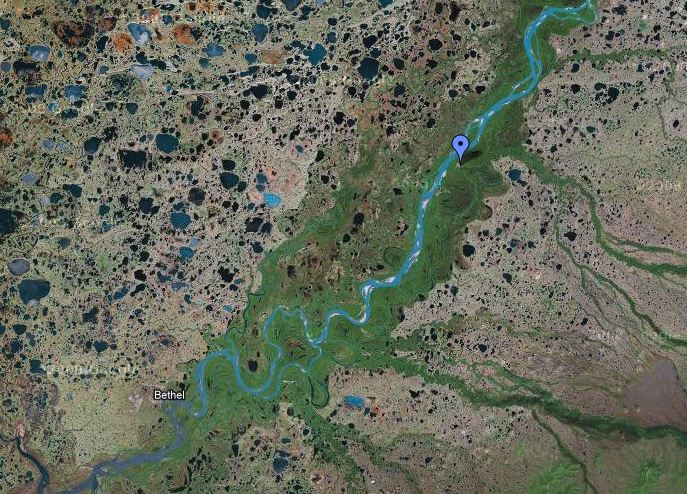
Tuluksak is approximately 50 miles north of Bethel.
The village of Tuluksak regained power early this morning after a two-day outage. It required the help of the Alaska Energy Authority to finally get the lights back on.
The lights went out in Tuluksak around 4pm Monday afternoon, when its only generator stopped running.
“The water pump overheated and stopped,” says Willie Phillip.
Phillip, Tuluksak’s power utility manager, says the village received another generator engine just yesterday.
That engine came from the Alaska Energy Authority’s Emergency Response Program.
Sandra Moller is the Deputy Director for Rural Energy at AEA.
“And what we able to do is locate an engine for one of their generators to get it back online. We diverted one of our remote maintenance workers who was in the area. And we sent him over to Tuluksak,” Moller says.
She says the Emergency Response Program was implemented for emergencies just like this one …
“Typically for when a community has basically gone dark,” Moller says.
Phillip says the village’s backup generators were non-functioning as well, so the new engine was vital.
“So we got it online about 2 o’clock this morning or 2:30 or somewhere around there,” Phillip says.
He says after a few cold nights, Tuluksak residents were pretty happy to have the lights and heat back on.
“Calling, calling, calling me and my coworkers,” Phillip says.
But, he says, the power wouldn’t have come back on without help from community volunteers helping to transport and install the new engine.
The AEA may be able to help villages like Tuluksak with yet another program…
“The Rural Power Systems upgrade program. We’ve just completed a six or eight month process of evaluating all power plants in rural Alaska,” Moller says.
She says Tuluksak and other rural villages in-need, may qualify for assistance through that program, pending legislative funding.
The U.S. Postal Service recently announced an end to Saturday delivery. People will stop receiving letters on Saturdays by the end of summer.
A postal reform bill is expected before then, and bypass mail will likely be targeted for reforms.
Seven short words in Article 1, Section 8 of the United States Constitution assure that everyone in Alaska will receive their mail.
The Congress shall, the Constitution reads, “establish Post Offices, and post Roads.”
In 1971 Congress mandated a sea change: The postal service now needed to function as a self-sustaining business – without federal dollars.
A year later came another change: bypass mail. The Postal Service would pay private air carriers to deliver mail and packaged goods to bush communities in Alaska … bypassing the Postal Service completely.
Steven Hatter is deputy commissioner at the Alaska Department of Transportation. He says state does not pay anything for bypass mail.
“It’s just a really important component to serving rural Alaska. It cuts across the private sector. It cuts across state government. There are other agencies besides Alaska Department of Transportation that both benefit from and are interested in the long term outcome of policy with bypass mail,” Hatter says.
The public policy Hatter mentions is federal. Bypass mail is a partnership between the Postal Service and federal Department of Transportation.
DOT sets the rates, and the Postal Service pays for the program. It’s bleeding money, and it has been since the program began. A USPS inspector general report showed the bypass system lost more than seventy million dollars in 2010.
“There are some inherent inefficiencies in it,” Hatter says.
Darrell Issa is a San Diego area Republican who chairs the House Oversight and Government Reform Committee. Long a critic of bypass mail, he now says the government needs to maintain the program.
Issa traveled to and around Alaska last year … without any of the Alaska Congressional delegation alongside him. He came back a convert … saying he sees the necessity of the program.
One of the bypass inefficiencies he’s looking to change is the requirement that planes carry both freight and people.
The Post Office pays four large carriers and twenty-two smaller ones to deliver the packages.
In turn, it assures a steady stream of flights to smaller airports. Critics say it subsidizes the aviation industry – at a cost to anyone who pays for stamps. Postage is the only way the Post Office makes money.
Issa says he’ll look at the frequency of flights and which planes the carriers are sending to different airports.
“Where you have small amounts, the dual use makes a lot of sense,” Issa says.
Because, he says, if there’s not much mail, it makes sense to sell more seats.
“In some cases where you have a 737of freight going every single day, it may not make sense to make sure there are seats on every single flight,” Issa says.
Issa did not say whether he’d push to require the state to contribute to the program.
The notion alone scares Steven Hatter.
“We don’t really want to get into ‘what ifs’ in terms of the state picking up any subsidies at some point,” Hatter says.
People on Capitol Hill say a reform bill will need to come before July. Last Congress, the Senate passed a version – only to see it founder in the House.
Senator Mark Begich says he’s ready to make another go.
“I will do everything I can to ensure that what we passed last year, which protected bypass mail, will pass this year,” Begich says.
But the real fight in postal reform won’t be whether the Post Office pays for a program it doesn’t operate, but over congressional requirements that the Postal Service pay future benefits for future retirees.
Power has been out in the village of Tuluksak the past few days. The village is located 50 river miles upstream of Bethel.
On Tuesday, Tuluksak Native Community President Waska Fly said the one generator in the village was no longer operational. It is believed that the electric generator burned out after overheating. Witnesses say a piston broke through the side of the cylinder.
The generator was located in a newly built powerhouse in the village.
Fly said he did not know when the village would get power back up and running.
The village has not been able to sell any gasoline or stove oil to the residents because of the power outage.
Residents without wood heat are staying at the Tuluksak School, which has its own power generator. Wind chills on Tuesday dipped to 50 below zero.
Dianne George the Assistant Administrator of the Yupiit School District, located in Akiachak, says she has been trying to contact the Tuluksak School but the phones were down since last night and residents are not answering their cell phones.
The Alaska Energy Authority in Anchorage confirmed that they were helping the village but would not comment further.
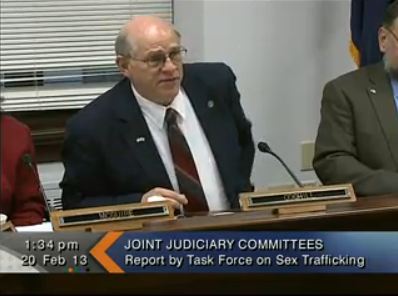
The task force presented its findings to the House and Senate Judiciary Committees.
The scope of Alaska’s sex trafficking problem remains unclear, but there’s plenty that can still be done to help victims — that’s the conclusion of a report issued by state task force charged with studying the issue.
Over the past few months, a team of state officials and non-profit workers have been trying to figure out the extent of sex trafficking in both urban and rural Alaska. They went out to Anchorage, and Bethel, and Hooper Bay, and they learned about what makes a young person vulnerable to trafficking and heard how most of the state’s shelters don’t have the resources to deal with victims. But even with all the testimony and research they did, it was still a struggle to quantify the number of Alaskans coerced into prostitution. Alaska courts have only made about 20 sex trafficking convictions over the past six years.
Attorney General Michael Geraghty was part of the trafficking task force, and he says that’s because by its very nature, the problem is underground.
“It’s beneath the surface, and the fact that we can’t get more hard data on it doesn’t mean that it does not exist,” Geraghy says.
The task force was mostly left with anecdotes when they talked to shelters and social service organizations across the state, and a report they issued this month speaks of both gaps in information and gaps in services.
But the anecdotes that the task force heard were — in their words — “heartbreaking.” Gwen Adams, a pastor of women’s ministries at ChangePoint Church in Anchorage, served on the task force, and she told her own story about trafficking before a legislative committee on Wednesday. Adams described a woman she had known who had been coerced into prostitution by a family who was supposed to be fostering her. When she learned this, Adams asked the woman if she was participating in this against her will.
“She said, ‘No, I have a choice.’ And I said, ‘Well, what happens if you would refuse.’ ‘Well, I would be beaten. I wouldn’t get to eat. And I would be locked in a closet for days.’ ‘So, how do you have a choice?’ ‘Well, I can choose to be beaten or I can choose to have sex.’ Completely unaware of the fact that she was being trafficked or a victim. She just felt like these were her circumstances in life and had no way out.”
The task force came up with about a dozen ways to help the woman described and others like her. In their report, they advocate for more short- and long-term shelters, and they say they would like to see prosecutors and social workers trained to better recognize trafficking victims. They also said that Alaska’s laws should be strengthened so that the state could subpoena websites where solicitation occurs, like Craigslist.
The task force also suggested that the legislature might consider changing the law so that trafficked prostitutes could have their records expunged. Attorney General Michael Geraghty says a provision like that would make it easier for trafficking victims to find jobs and secure housing.
“If you’re a victim like that, you should have an opportunity to clear your record and be able to return to gainful society,” Geraghty says.
An expungement law for trafficking victims exists in a handful of other states.
The task force’s work is complete with this report, but they’ve asked the state to create a permanent working group to implement these recommendations and continue studying the issue of sex trafficking.
Original Story:
A new report says human trafficking most likely occurs in Alaska but it’s not clear how prevalent the crime is.
A state task force on human and sex trafficking presented its findings to a joint session of the House and Senate Judiciary Committees on Wednesday.
The legislature passed a measure establishing the task force last year.
While both the governor and lawmakers have raised concerns with the issue, the extent and nature of trafficking remains elusive because of its underground nature and the fact that many victims don’t report the crime.
The five-month study yielded 13 recommendations on how to better identify victims and raise public awareness of the issue, including making permanent a working group that could continue researching the subject.
The cover of King Island Christmas, one of Rogers’ most well known stories.
Long-time Juneau resident Jean Rogers is being remembered as a loving mother, beloved children’s book author, and patron of the arts.
Rogers died Wednesday due to heart failure. She was 93.
Rogers said she always wanted to be a writer.
“I like to make up things and to use my imagination and to make a story,” she told KTOO in 1988. “For me the story is it.”
Her most famous book, King Island Christmas, is about a village’s struggle to overcome a winter storm and bring a priest ashore to celebrate the holiday. It’s based on the experiences of Rogers’ longtime friend, Juneau artist Rie Munoz, who lived on King Island in the Bering Sea in 1952. Munoz illustrated the book, which was later adapted into a musical.
Rogers talked about how the collaboration came to be.
“From hearing her talk and seeing her pictures, gradually I got the idea that it would make a good story to tell about their leaving the island,” she said. “That’s kind of universal refugee story. You have to leave your homeland and go someplace else, and I thought it would make a very poignant story to tell.”
Born Jean Clark in Idaho on October 1st, 1919, she attended Teachers College and taught in her home state until she saved enough money to go to the University of California at Berkeley. There she earned a Bachelor’s degree in English and met George Rogers.
They were married in 1942, and moved to Juneau three years later aboard the Princess Nora steamship. Throughout their nearly 69 years of marriage, they remained very much in love. George passed away in 2010.
George and Jean Rogers
In a 2009 Story Corp segment for KTOO, George and Jean remembered the first time they met.
“I can still remember the day you first came within my sights at Berkeley,” George said. “I was the treasurer of a student co-op and you were a transfer student from Idaho, and you walked in and I said to myself, ‘This is the girl I’m going to marry.'”
Jean replied, tongue in cheek, “That’s what he tells me, but he didn’t tell me that for quite a while.”
George Rogers was a consultant to the state Constitutional Convention, and is considered Alaska’s first economist.
Together they adopted and raised six children. Daughter Sidney Fadaoff says her mother worked quietly behind the scenes, volunteering at local schools and non-profits, serving on boards and commissions, and still finding time to mother a house full of kids.
“She was a mom to not just the six kids she adopted but all of our friends as well,” Fadaoff said with a laugh. “Mom and dad loved kids and they didn’t care whose they were, and their door was always open to everybody.”
The Secret Mooose
Jean always found time to write. Children’s book author Susi Gregg Fowler was part of a Juneau writer’s group with Rogers for many years. Fowler’s husband Jim illustrated Rogers’ book The Secret Moose.
“Jean encouraged all kinds of people in wherever their heart was taking them,” Susi Fowler said.
When an early draft of Fowler’s book Albertina, the Animals and Me was rejected by a publisher, she reworked it, and brought it to the writers group. Fowler says members encouraged her to resubmit it to the same publisher.
“Jean was perhaps the most adamant of them, because she knew the editors to whom I was going to send it,” said Fowler. “She said, ‘You need to send it back in. It’s different! They’ll love it! Do it!'”
When the book was published Fowler dedicated it to the writers group.
In another KTOO interview, Rogers talked about the difficulty of getting published.
“It’s difficult to find a story good enough, to do it well enough to have somebody take it,” Rogers said. “And it’s a great big fat joy when you do.”
One of Fadaoff’s favorite stories happened in her parents’ later years. Jean was driving George home after knee surgery and stopped at a bakery to pick up some bread. When they got home, she helped George into the house and left the car door open. When she returned, a bear was after the bread.
“Mom stood there and yelled at that bear to leave her bread alone and get out of that car, just like she was talking to a child,” Fadaoff said. “And the bear looked at her, and picked up the bread, and left.”
In 2001, the Rogers’ house burned down while they were on vacation. Though they were both in their 80s, Fadaoff says her parents did not hesitate to pick up the pieces, especially Jean.
“Your dad’s going to design me another house and we’re going to rebuild.” Fadaoff recalled her mother saying.
The couple moved into their new home on the same Evergreen Avenue lot just before Christmas 2002.
In the Story Corp segment they recorded, Jean and George talked about their rich lives and growing old together.
“The terrible thing about interviewing old people, George, is that so much has happened that you just can’t… You know, we’ve lived nearly a hundred years apiece, and there’s so much to talk about,” she said. “We could rattle on for a year.”
Jean Rogers passed away Wednesday, surrounded by family. She’s survived by five children, three of whom live in Juneau, as well as numerous grandchildren, great-grandchildren, and a large extended family. She was preceded in death by her husband and a son.
A small service will be held soon, to be followed by a larger community celebration.
Original Story:
Alaska children’s author and long-time Juneau resident Jean Rogers has died. She was 93.
Jean Rogers came to Juneau by steamship in 1945 with her husband George, who was considered Alaska’s first economist.
The Rogers met in an English class at the University of California at Berkley, when they were students. They were married in 1942, and adopted and raised six children. They were just a month short of their 69th wedding anniversary when George passed away in 2010.
Rogers was a well-known author of children’s books, including the popular holiday tale King Island Christmas; now a musical performed nearly every season. The book was based on the experience of artist Rie Munoz, who had lived on King Island in 1952. Munoz illustrated the book, and several others written by Rogers.
Rogers served on the Alaska Public Broadcasting and Alaska Public Offices commissions. She was given an Honorary Doctorate in Humane Letters by the University of Alaska for her published work.
This is an ongoing story. Check back for more on the life of Jean Rogers.
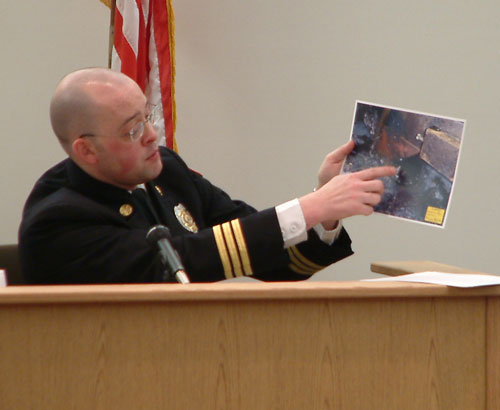
CCF&R Fire Marshall Dan Jager points out damage to turf laying equipment from a suspected arson fire at Adair-Kennedy Memorial Park last June. Photo by Matt Miller/KTOO News
The defense of an accused arsonist is suggesting that investigators went easy on another defendant because he is the son of a veteran police officer.
Ashley Johnston, 19, is standing trial this week on felony arson and criminal mischief charges, and a misdemeanor criminal trespass charge.
She’s accused of hopping a fence surrounding the field at Adair-Kennedy Memorial Park last June and starting the fire that destroyed equipment and supplies for the laying of new turf. She’s also accused of vandalizing an announcer’s booth at the field that included the discharge of a fire extinguisher.
Ryan Martin, 24, and Dillon West, 24, are expected to stand trial April 1st on charges related to the arson.
After the jury had been excused for the day on Wednesday, Johnston’s attorney, public defender Timothy Ayer, said he wanted to question the Juneau Police Department’s lead investigator in the case about possible bias that favored Martin.
Martin is the son of Detective Kim Horn. He was read his rights during an in-custody interview at the police station and a search warrant was served at his home. Johnston was not Mirandized during an interview at a neutral location and her backpack, in plain view of officers, was simply seized. Detective Horn was interviewed by a department colleague who was one level above her immediate supervisor.
Assistant District Attorney Amy Williams suggested that questioning the investigator’s bias on the stand would eventually require the jury to hear earlier interviews with both Martin and Johnston as a comparison.
Superior Court Judge Philip Pallenberg said there isn’t enough objective evidence of any bias which has any real relevance to the case.
“The fact is that Mr. Martin has been charged with essentially the same crimes as Miss Johnston,” Judge Pallenberg said.
If there was some favoritism, it certainly has not been manifested in the nature of the charges.”
Judge Pallenberg indicated he might be willing to revisit the issue after hearing testimony from the investigator in the case.
Ayer tried to bring it up during opening arguments on Wednesday morning, but Williams objected before he could continue describing the relationship to the jury.
During her turn at inital arguments, Williams said that Johnston changed her story about the fire as much as six times in conversations with investigators.
So, we go from ‘I wasn’t even there, not even there,’ to ‘OK, maybe I did. But I don’t know because I was not myself that night.’”
But Ayer said Johnston’s comments that she made to investigators were not an admission. He said there was no video of her starting the fire or discharging the fire extinguisher.
There’s actually no hard evidence to point to Miss Johnston as the one who started the fire.”
Some of the first witnesses on Wednesday included Deputy Fire Marshall Sven Pearson and Fire Marshall Dan Jager of Capital City Fire and Rescue. Pearson described the scene and Jager described the investigation process. Jager testified about ruling out mechanical, electrical, and natural causes – like lightning – for the fire. What was left, as a process of elimination, was that the fire was intentionally set.
A small tractor was damaged. A pallet of containers of adhesive, and a small trailer – towed behind the tractor – used in laying the turf were destroyed in the June 19th fire. Damages were estimated at least $20,000.
Another witness included Donny Haynes, Jr. who delivers papers for the Juneau Empire. He said he saw black smoke near Floyd Dryden Middle School, reported the fire to emergency responders, and talked to a girl on a bike leaving the scene.
I told her that if she didn’t want to talk to anybody, then she better get out of here. And not to say anything to me because I don’t want to know.”
When asked, Haynes said he did know the girl, and said Johnston – as she appeared in the courtroom with mostly black hair – probably was not her.
“I would have to say no,” answered Haynes when asked if he recognized her in the courtroom. He said he only noticed the girl’s bike and her blond frizzy hair. But, just as Haynes left the stand, Johnston took a moment to flip and readjust her apparently-bleached ponytail in plain view of the jury.
Ashley Johnston looks at a photographer during her trial on charges related to arson at Adair-Kennedy Memorial Park last June, revealing hair that appears to have been bleached several months ago. Her attorney, Timothy Ayer, is at the left with his back turned to the camera. Photo by Matt Miller/KTOO News
More testimony and presentation of evidence is expected on Thursday.
A seven-man, six-woman jury is hearing the case.
One of the jurors appears not to be giving the case his full attention. Seated in the jury box adjacent to where reporters have set up shop in the courtroom gallery, the juror appears to have dozed off at least once, and played with his smartphone or checked his email at least three times on Wednesday. That’s even after he was gently reminded by Judge Pallenberg after the first time to turn off his phone and put it away.
(Spelling of Donny Haynes’ name has been corrected in this story.)
Close
Update notification options
Subscribe to notifications
Subscribe
Get notifications about news related to the topics you care about. You can unsubscribe anytime.