Oil taxes remain the legislature’s top issue this week, with six hearings scheduled on Gov. Sean Parnell’s bill to bring them down. But there’s also plenty else going on in Juneau, from consideration of education and home energy bills to visits from state dignitaries.
This week, the legislature may send its first passed bill of the session up to the governor’s office. And it could be an item that Parnell specifically asked for.
A bill to roll back regulations on cruise ships is scheduled to appear on the Senate floor on Monday. It easily passed the House last week, with all but one member of the Republican majority supporting it. The bill has received criticism from environmental groups, tribal organizations, and some members of the fishing industry because it would allow cruise ships to release their wastewater into mixing zones instead of having them meet water quality standards at the point of discharge.
A number of bills will get their first committee hearings this week. On Monday, an item creating a low-interest loan program for heating system upgrades will be introduced in House energy. It’s received support from members of both parties. On Tuesday, the House Health and Social Services committee will hear a bill that would require people receiving state public assistance or Alaska Native family assistance to undergo drug tests before receiving cash benefits. Urine tests would be “random and suspicion-based.”
The bill would also amend state code to prohibit undocumented immigrants from receiving benefits. Friday, a bill that would allow school districts to implement four-day school weeks will make its first appearance in the House education committee. The bill is sponsored by two Republicans and a Democrat, and the intent is to give rural schools with traveling athletes, and the like, more flexibility with their schedules.
Some of the state’s top legal and military officials will be visiting the Capitol this week. Both chambers will meet together on Wednesday for an address from Dana Fabe, the chief justice of the Alaska Supreme Court. On Thursday, high-ranking officers from the Air Force, National Guard, and Coast Guard will brief members of the House and Senate Armed Services committees.
The Alaska Forum on the Environment held its 15th annual conference last week in Anchorage, bringing together people in business, rural and urban Alaska, science, and tribes. Sessions covered everything from oil spill response, and youth-led projects, to invasive species.
Moderator Justin Wilson, a retired Cheeshna tribal council member, says the goal of a session on climate change was to let tribal participants know that the kinds of events they’re seeing are part of a widespread pattern:
“People have a tendency to live in silos. And this discovery is so new they don’t talk about it. But today, people have come out and started saying it’s here and it’s all over the state,” Wilson says.
In his own area, eastern Interior Alaska, Justin says warmer temperatures are allowing plants to grow at higher altitudes:
“Over the years, long-term, we’ve watched the vegetation go up the sides of the mountains a thousand foot at a time. When I was about fifteen, we’re talking 3500 foot level for greenery, now at 5500 foot, which is near the passes where the ice used to be. That’s one change,” Wilson says.
Tina Tinker, of the Aleknagik Traditional Council, in the Bristol Bay region, remembers when fish were so plentiful nets quickly became heavy with salmon:
“One year they had a really good salmon subsistence. Our net was sunk and we had to have three skiffs bring that net up to Aleknagik. That was more than two hundred fish. It fed the whole village. Now we get 20 fish here, 30 fish there,” Tinker says.
Mike Brubaker, of the Alaska Native Tribal Health Consortium says surveys of villages across the state are showing changes that can affect health:
“We see new challenges for water safety and supplying water and building sustainable infrastructure to provide water all across the state and a really big issue for Alaska Natives is the ability to harvest foods,” Brubaker says. “We’re seeing around the state harvest failures and more and agencies and the research community is looking very closely at climate change as one of the contributing factors.”
Brubaker says surveys in communities across Alaska also show mental health effects — such as anxiety, fear, and grief over flooding, forest fires, storms, and food loss.
Victoria Hykesteere, an Alaska Pacific University assistant professor of Alaska Native studies, says different communities are going to be facing different issues. She urges people to start conversations in their communities to come up with local solutions:
“The pride in taking ownership of finding our own solutions is really critical long term to how we adapt to what’s happening. It’s a great way to encourage our young people to see themselves as capable, as real human beings with their own kind of knowledge and beauty. We don’t have to mimic what everybody else is doing. We don’t have to be everybody else. We can keep our communal society intact but we have to choose to do so,” Hykesteere says.
The Alaska Forum on the Environment conference wrapped up Friday.
Visitors from the Kennedy Center clap after watching a performance by students at Glacier Valley Elementary. (Photo by Heather Bryant/KTOO)
The John F. Kennedy Center for the Performing Arts is recognizing arts education efforts in Alaska’s Capital City.
The center today announced from Washington, DC that Juneau has joined its prestigious “Any Given Child” program, which promotes city-wide arts education for students in kindergarten through eighth grade.
Juneau is the 11th city admitted to the program since it started in 2009, joining much larger communities such as Sacramento, California, Portland, Oregon and Austin, Texas.
The goal of “Any Given Child” is to provide a quality arts background for all children. Kennedy Center experts will work with the Juneau Arts and Humanities Council to figure out the community’s needs and come up with affordable solutions.
Former JAHC president Annie Calkins wrote Juneau’s “Any Given Child” application.
“We wish to increase the equity across all of our schools. Some of our schools have excellent arts education happening at the elementary level and others do not have the same level of intensity or exposure and we want to make sure that across both of our middle schools there’s some equity as well,” Calkins says.
Kennedy Center Vice President for Education Darrell Ayers says the center is federally mandated to reach out to communities across the country. Any Given Child expands that reach by using chosen communities as examples for arts education.
Even though the Kennedy Center doesn’t provide any grant money, local funding can perk up after Any Given Child comes to town. Ayers says one funder gave Austin an additional $1 million.
“They see that the arts community has come together and people, rather than it being kind of a helter-skelter approach to arts education, everybody’s working now hand-in-hand,” Ayers says.
Visitors from the Kennedy Center watch a group of students perform a Tlingit dance at Glacier Valley Elementary. (Photo by Heather Bryant/KTOO)
In December, Ayers and a colleague came to the Capital City to fact-check Juneau’s application. Second-graders at Glacier Valley Elementary School performed a violin concert and Tlingit dance. The performance exemplifies what drew the Kennedy Center to Juneau in the first place.
The violinists are part of Juneau, Alaska Music Matters, or JAMM. Lorrie Heagy started JAMM in 2011. Now those students are continuing their music education in second grade. Heagy says nearly 300 students are in JAMM.
“Their listening skills have become so fine-tuned that by the first half of the year they could identify the first four strings. But by the end of their kindergarten year in the spring, they could come up to me and say ‘Ms. Heagy, my A-string is out of tune,'” Heagy says.
Ayers says next week, the other ten communities will meet at the Any Given Child Annual Exchange. Juneau representatives will join the cross-country brainstorming session in DC next year. Any Given Child planning in Juneau begins next month.
Sen. Mark Begich says the U.S. Postal Service’s decision to stop delivering all Saturday mail except for packages is “bad news for Alaskans.”
In a release Wednesday, he said the decision will “undoubtedly slow overall delivery time.” He said the agency should have let Congress address the issue.
The cash-strapped agency expects to save $2 billion annually with the change, set to take effect in August. The agency suffered a $15.9 billion loss in the past budget year.
Sen. Lisa Murkowski says the time has come for the Postal Service to evaluate how it does things.
She says she has wanted to ensure Alaskans maintained access to postal services for critical prescriptions and commercial deliveries without added expense or harm to the economy. She says this proposal satisfies her concerns.
Original Story
Calling it “absolutely necessary” if the U.S. Postal Service is going to stop losing billions of dollars a year and reach anything close to financial stability, Postmaster Gen. Patrick Donahoe confirmed Wednesday morning that USPS is moving to eliminate Saturday delivery of first-class mail.
“Beginning the week of Aug. 5 this year,” Donahoe said, USPS will provide “six days of package delivery and five days of mail delivery. … We will not deliver or collect mail on Saturdays.”
Its decision could, however, run into challenges from Congress and from unions that represent the Postal Service’s employees. Donahoe made the case, though, that USPS has no choice. The Postal Service, which lost nearly $16 billion last year, will save about $2 billion a year with this change, Donahoe said.
Eliminating Saturday mail delivery, said Donahoe, is “just one part of a much larger strategy to return the Postal Service to long-term financial security.” That strategy has included the closing of many facilities.
As for whether it’s legal for the Postal Service to do this without an OK from Congress, Donahoe said “it is our opinion that the way the law is set right now … that we can make this change.” The Postal Service’s current “continuing resolution … does not bind us” to a six-day delivery schedule, Donahoe said.
Questioned further about the legality of the decision and how members of Congress may react, Donahoe said that “part of my job is to make a very clear and concise argument in front of Congress and in front of the administration that what we’re doing is the right thing.”
What if Congress moves to block the elimination of Saturday service? Donahoe did not comment on how USPS might react to that, other than to say USPS hopes to work with lawmakers on its plans.
With only three short interruptions, the Post Office has been delivering mail six days a week since 1863.
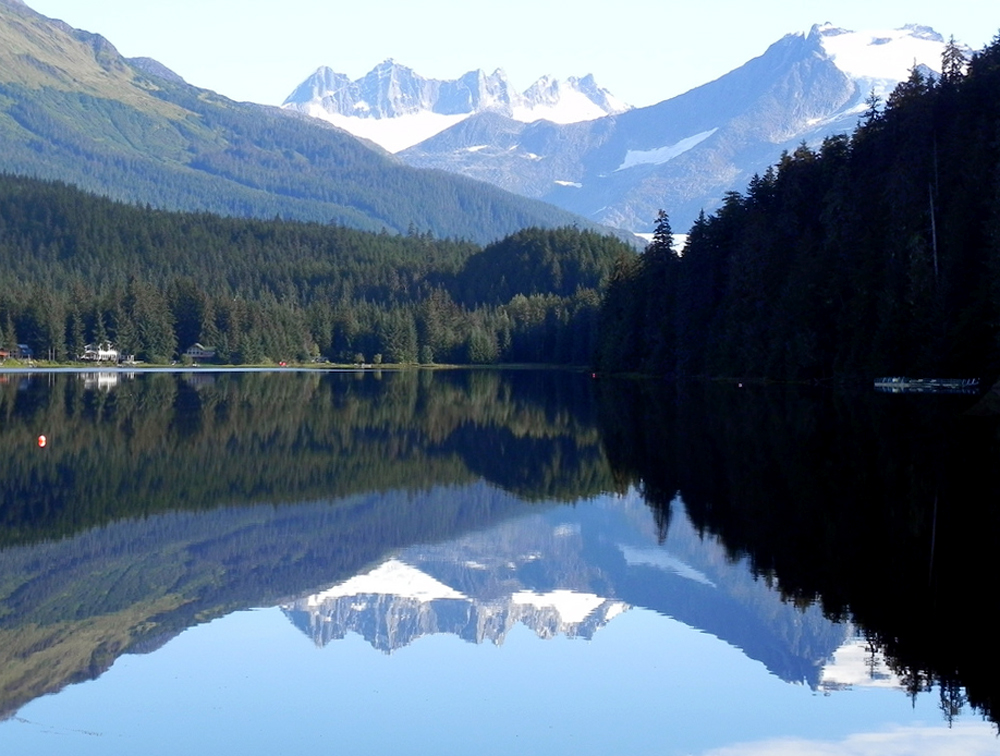
Auke Lake reflection. (Flickr Creative Commons photo by Alaskan Librarian.)
Juneau’s Parks and Recreation Advisory Committee last night (Tuesday) recommended the CBJ Assembly adopt an Auke Lake Management Plan developed by Parks and Rec staff largely as written.
The PRAC made minor changes to the plan, unveiled in early January. The panel also made an alternative recommendation that would mean fewer restrictions on motorized use, but require additional city funds for enforcement and boater safety education for Auke Lake users.
The recommendations now go to the Juneau Assembly Committee of the Whole for its consideration.
Sixteen-year-old Savannah Cayce was being towed in an inner tube by a jet ski and collided with another jet ski. She died two days later. While the investigation did not result in any charges, the city manager promised a review of management at the small lake.
Current law limits the size of water craft to 16 feet. Motorized use is prohibited between shore and a buoy line; several areas are no wake zones, in fact only 70 acres of the 165-acre lake are considered useable. Refueling is also prohibited.
Enforcement is the problem, according to most of the public comments. Some lakeshore residents say the sunny warm days are so busy that it’s “mayhem out there.” And that it’s not safe.
But many say the lake does not get that busy.
The draft plan would replace vessel size regulations with a 10-horse power limit; no towing would be allowed, more highly visible buoys would be placed and a seasonal park ranger would be responsible for enforcing regulations.
As written, the draft plan would eliminate jet skis, water skiers and wake boarders, and any vessel with a motor above 10 horsepower.
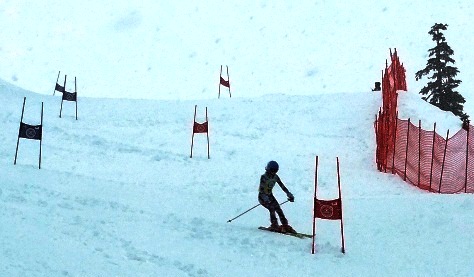
Young racer skis through the “throat” on Hilary’s run at Eaglecrest Ski Area. The soft snow made it difficult to stay forward on your skis.
Nearly 80 Juneau youth – ages 6 to 18 — are in race programs this season at Eaglecrest Ski Area.
The youngest group, known as the Mighty Mites, is also the largest group, with more than 40 kids training each weekend. The key is keeping the young skiers interested in racing over the next few years.
This past weekend Eaglecrest hosted one of two statewide qualifying races for older youth, with 40 skiers from Anchorage, Fairbanks and Juneau.
As Rosemarie Alexander reports, it takes a community to put on a ski race.
Forerunner Sophia Wahto radioed some valuable information to the racers waiting at the top of the course.
“Way soft so that coming into the throat you’ve got to be really, really prepared and up, and don’t dig your edges in too deep because you’re going to get sucked down.”
Home on break from college, Sophia Wahto has skied the trail known as Hilary’s hundreds of times in training and races. Her dad, Doug Wahto, is the technical director of the race. He stands at the throat of the course and lets officials at the top know when each racer has passed.
His daughters were about six when they started racing in Mighty Mites. They’re adults now, but Wahto still works with the Juneau ski team.
“Thirty years here. Actually I still have my original USSA card from 1964, Juneau High School then University of Alaska in Fairbanks. I skied for Jim Mahaffey up there for a number of years, and have been involved in racing ever since.”
Ski racing is usually a family affair.
“Typically the kids that are racing here, their parents were involved in skiing and their parents were involved in skiing.
Parents lined the course or worked in the race shack during the three-day race series for youth ages 11 to 16, sponsored by Juneau’s NAPA Auto Parts store.
Some of the parents recently became certified race officials with the United States Ski and Snowboard Association, taking classes and passing tests. There are lots of jobs –technical directors, race and course chiefs, referees, timing officials – and all to make sure the Alaska racers are ranked evenly with their USSA peers across the country.
Juneau Ski Club head coach Dan Ord says it would be impossible to pull off even a local race without the parent volunteers.
“The coaching staff – we’re two junior coaches and three devo (development team) coaches and you know we don’t do this. The parents and volunteers do it,” Ord says. “And the mountain, too. The mountain manager, we talk every day, and the groomers are in our court. You know, we’re gettin’ it done.”
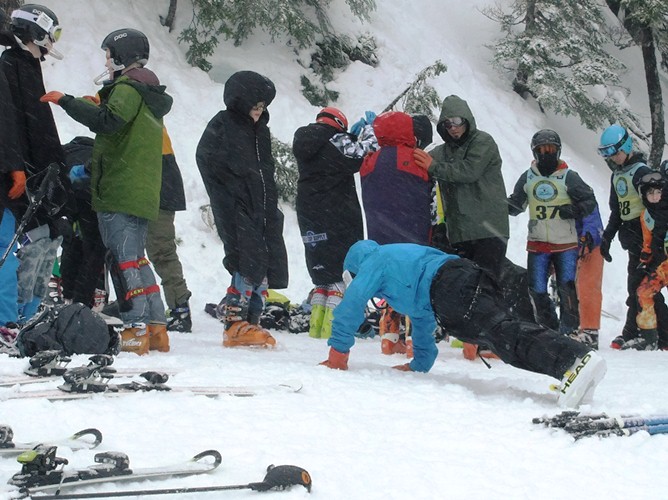
The weekend was wet and cold, and it was hard for racers to stay warm as they waited their turn.
Challenging weather
Juneau’s blustery wet weekend weather posed big challenges for the young racers.
The first race was Friday – a giant slalom. Fourteen-year-old Jeanne Lin Muller of Juneau says her first run was “OK.”
“It started off kind of slow, but it was really like fast and rhythmical.”
And she knew she needed to get more forward on her skis in the second run.
“And rolling my ankles and absorbing more,” Muller says.
Fifteen-year-old Riley Howard of the Alyeska Ski Club calls giant slalom his thing.
“I just like going fast. I don’t know (why), I just love it.”
Even on a day when weather changed from heavy wet snow at the top of the course then to sleet then to a downpour at the finish.
“It was tough conditions. You had to be on that downhill ski, couldn’t be late (or) you’d get in that soft snow and lose all your speed,” Riley says.
Joe Greenough, 16, of Juneau, was the top overall racer for the three-day NAPA Auto Parts Race Series.
Sixteen-year-old Joe Greenough of Juneau is also a GS fan, but he wasn’t impressed with his first run.
“I got late a lot, back seat too much. Couldn’t hold an edge, skied out way too much. ”
By the end of the weekend, Greenough and Riley took home medals for their overall performance.
Greenough was happy to show off his gold medal for finishing all three races and earning the highest number of World Cup points for the series.
“It was a combination of speed, mental determination. Mostly I had fun.”
With an eye on Western Region Championships in March, Greenough will compete next week in the second statewide qualifier at Alyeska Ski Resort in Girdwood.
“And there’ll be a lot stiffer competition. A lot more intense. It’ll be a great time.”
Meanwhile, Eaglecrest hosts another state championship next month for racers under the age of 14; Coach Ord is planning.
“So all our youth ski league, Mighty Mite, Devo programs across the state send down their kids. I hope we get a hundred kids here,” Ord says.
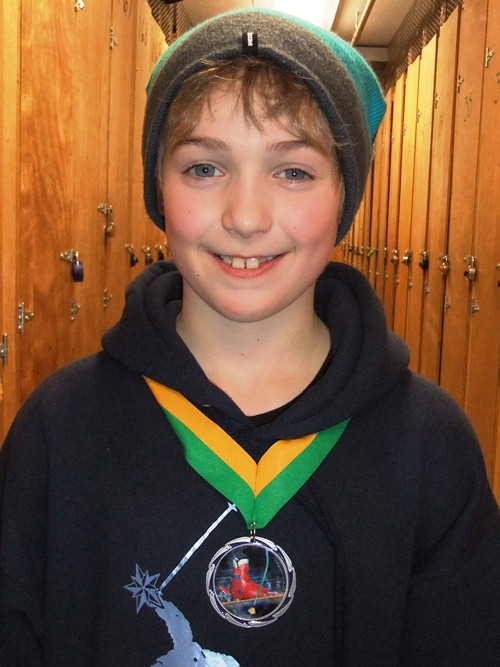
Tyler Weldon, 12, of Juneau, shows off his medal for his overall performance in the NAPA race series.
Eleven-year-old Tyler Weldon, of Juneau, expects to compete, with new confidence from the races just finished. He was sporting a medal after Sunday’s award’s ceremony.
“I DQ’d in my slalom but I got second in the GS and the Kombi,” he says.
And what did he learn from the weekend races?
“To just go for it and have fun.”
Close
Update notification options
Subscribe to notifications
Subscribe
Get notifications about news related to the topics you care about. You can unsubscribe anytime.