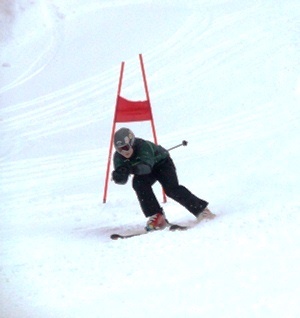
Former Juneau ski racers Nathan Ord and Brian Vandor took the top two spots for men in Sunday’s Town Downhill, while former ski team head coach Jeffery Johns came in third.
Heidi Denton and Lucy Squibb, both former Juneau ski racers, were first and second for women, and current race team member Quincy Bates came in third.
Nearly 60 skiers and snowboarders competed in the second annual community Giant Slalom race at Eaglecrest Ski Area. The race was open to those age ten and up, and participants raced in categories ages 10 to 12; 13 to 16; 17 to 39; and over age 40.
Before the race, Juneau Ski Team Head Coach Dan Ord said he had “ordered the sun” for the Sunday event. It turned out to be probably the most beautiful Sunday since the season started in December.
Original story:
The second annual Town Downhill is Sunday at Eaglecrest Ski Area.
The community race is open to skiers and boarders age ten and up.
“I ordered the sun; sun’s going to come out for the event,” says Juneau Ski Team Head Coach Dan Ord.
We can only hope!
Even if the sun doesn’t shine, the race will start at noon on what’s known as the Super G trail, above tower 12 of Ptarmigan lift.
Ord makes the course sound almost easy:
“Let’s say a 15 to 20-foot steep start down onto the flats right above the tower, then it shoots you straight down the last bits of Super G. Nice right footer and a left footer, and you’re out, coming across Upper Hilary’s over towards what I know to be Thiokol Lake. And then it’s just four cat tracks wide, nice element of glide and you’re swooping out over onto Lower Face. Then it’s just a big right footer and you’re down a pitch then you’re back onto Lower Hilary’s.”
Young Juneau Ski Club racer on Lower Hilary’s run.
Last year about 50 racers turned out for the first community race held in years at the city-owned ski area. Ord hopes it will spark an adult race series like the Rainier Challenge in the 1980s. The winner then got a pair of K2 skis topped with the Rainier beer logo. Those skis can still be seen making turns at Eaglecrest.
No free skis this year, but the event will end with a free barbeque and awards ceremony.
Juneau Ski Club parents are putting on the Town Downhill. Sign up before 10:30 Sunday morning at the Eaglecrest Lodge. Training runs begin at 11 a.m. and the race at noon. Each racer gets two runs.
The City and Borough of Juneau is sponsoring a free housing forum today (Wednesday) at the University of Alaska Southeast.
The Capital City has long had one of the tightest housing markets in the state, so in recent years officials have made changes to zoning and other regulations to encourage more development. But City Manager Kim Kiefer says most people aren’t aware of the changes. She says the housing forum is an effort to change that.
“This is geared toward builders, realtors, anybody that’s developing to talk about the changes that have happened – changes in code, changes in zoning that people may not be aware of. Or, if you’re just interested in building a house, it’s a great thing to be able to come and learn the new things. What’s the density? What changes have been made? How to walk through the process, and there will be Community Development staff there that will help answer your questions and help you walk through that process,” Kiefer says.
The event is free, but attendees were asked to register in advance. Participants can earn five continuing education credits toward a residential contractor endorsement by attending the forum.
It’ll be happening from 9:30 a.m. to 2:30 p.m. today at the UAS Glacier Room.
Studies by the U.S. Army Corps of Engineers and Government Accounting Office show increasing numbers of Alaskans will be affected by floods and erosion in coming years due to rising waters and extreme weather events. And the studies predict some communities are likely to be destroyed by 2017. Of those, Newtok is the furthest along in relocating.
But an Anchorage human rights attorney says changes are needed so agencies can more effectively help people being dislocated due to the impacts of climate change.
The Yup’ik village of Newtok, situated between the Newtok and Ninglick rivers in southwest Alaska, is facing destruction. Rising waters and melting permafrost there have lead to two floods since 2004. Water has flooded the sewage disposal area, carrying contaminated water into the village and creating a health hazard. Stanley Tom is Newtok Tribal Administrator. He says the village is losing up to 150 feet per year to erosion… and their water source is only 154 feet from the river:
“When the village safe water was doing tests and we did pick three of them and they were already contaminated with salt water. It’s the only water we have left. It’s in front line of erosion. If it’s impacted this summer, how do we get our water?” Tom asks.
Erosion has destroyed the landing where barges used to deliver fuel and other supplies, as well as the former landfill. The village no longer has enough fuel tanks to hold a year’s worth of fuel.
Robin Bronen is Executive Director of the Alaska Institute for Justice.
Drawing on her research for her PhD dissertation, she gave a January 2013 presentation to the Brookings Institution. She’s calling for the creation of a framework that allows agencies to more effectively work with communities that choose relocation over protection in place… a decision some come to only after protection systems have repeatedly failed. But Bronen says the decision on whether to move would need to come from the community.
“The controversy is that we in the world have a horrific legacy of relocations, most of forcible by governments without people making the decisions whether or not they want to relocate and we have that history in Alaska not that long ago,” Bronen says.
In Newtok, villagers began working towards relocation in the 1990s. They selected a new site nine miles away, called Mugtarvik. After years of negotiations and lobbying, it acquired title to the land in 2003.
In 2006, the Alaska Department of Commerce, Economic Development and Community Affairs organized a Newtok planning group of more than two dozen federal, state, tribal, and regional organizations with Sally Russel- Cox as its coordinator. She says the group has pooled resources – for instance, two projects have used resources from the Bureau of Indian Affairs, federal department of commerce, state department of transportation, and a Department of Defense training program. She says one of the group’s biggest strengths is it’s collaborative approach.
“I like to think of the work that we have done, with Newtok, especially as in a way following the Yup’ik model of decision-making. Because it’s definitely a group type of decision making and that’s definitely been what’s happened, everybody sitting around the table brainstorming and coming up with ideas and building consensus among themselves on how things should happen, and with the community being in the lead in all that,” Cox says.
Bronen says that collaborative process can serve as a model for communities around the world facing relocation due to climate change.
But she says for Newtok to get as far as it has, it’s taken a remarkable and extraordinary effort. Bronen describes other communities that have gone through an extended public process to pick a new site, only to have an agency say it doesn’t meet certain criteria – criteria that wasn’t spelled out beforehand. And funding is often based on population. So Newtok finds itself in a Catch 22 position – it can’t move to Mugtarvik without water, power, transportation, and communications systems. But it can’t get funding for some of that infrastructure until people are living there. Bronen says it shouldn’t be that difficult.
“The relocation effort is taking an extraordinarily long time and people need to be moved now. Their community is not safe. I know everybody wants them to be able to move as qucikly as possible to their relocation site, but there are really difficult stat and institutional challenges that government agencies are working around,” Bronen says.
Then, she says, once a village is identified as needing to be relocated, funding for infrastructure in the current village site dries up, leaving villagers to cope with deteriorating conditions. Stanley Tom says the workload of keeping Newtok running while also writing grants, coordinating activities at Mugtarvik, and lobbying for money can be overwhelming.
“I’m worried about the funding, the community. It’s a lot of things in my mind I’m worried every day, every night. I have to wake up 5- 6 in the morning and worry about my work,” Tom says.
Still, Tom says the Mugtarvik village now has a barge landing, the foundation built for an emergency evacuation center, a road to the evacuation center, and six homes, He’s encouraged that the tribe has funds to build the community evacuation center at Mugtarvik, and 17 villagers trained to do the work. He’s also proud of the new website the village had created, at newtok moves.org. His next big goal is to find funding to build a total of 60 homes to accommodate the 350 or so villagers.
And Bronen applauds Newtok’s progress. She says it’s years ahead of several communities agencies forecast will no longer be viable by 2017, villages struggling against all odds to relocate.
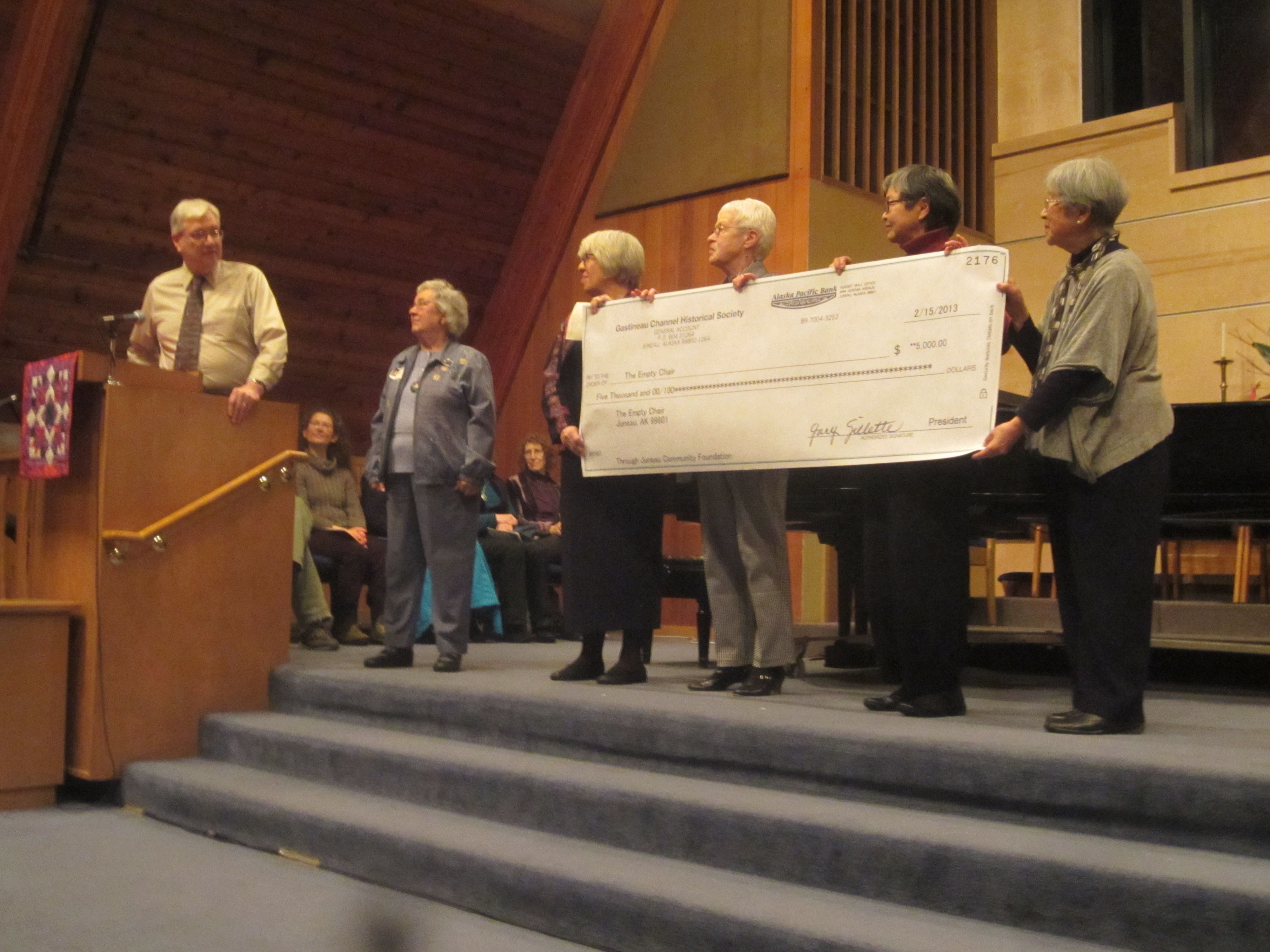
The Gastineau Channel Historical Society presents a $5,000 check to organizers of the Empty Chair project in Juneau. On the far right are sisters Mary Tanaka Abo and Alice Tanaka Hikido, whose brother John inspired the proposed memorial to Juneau’s Japanese American internees. Photo by Casey Kelly/KTOO.
A proposed monument in Juneau to Japanese Americans interned during World War II got a big boost last weekend.
The Gastineau Channel Historical Society donated $5,000 to the Empty Chair Project, and a fundraising concert raised nearly $2,000. Organizers have been collecting funds for about a year and need about $6,000 more to meet their $40,000 goal.
Third generation Japanese American violinist Steve Tada and pianist Nancy Nash performed several compositions, including Michio Miyagi’s “Haru no Umi” at the Empty Chair benefit concert on Saturday.
Sisters Mary Tanaka Abo and Alice Tanaka Hikido sat in the front row as honored guests. Alice Tanaka was nine-years-old in 1942 when the entire family was taken from Juneau and placed into internment camps.
“We were identified with the enemy when we were not the enemy at all,” she said.
Brother John Tanaka, who died several years ago, inspired the Empty Chair project. He was valedictorian of Juneau High School’s class of 1942, but could not attend graduation after the family was taken from the Capital City. The school set up an empty chair at the ceremony to acknowledge that John Tanaka was not there.
The memorial will be a slightly larger than life-size bronze replica of the empty chair at Juneau’s Capital School Park, located next to the old Juneau High School. Project organizer Margie Shackleford has been friends with Mary Tanaka since childhood.
“We can’t always redress everything, but we can at least acknowledge that an injustice occurred,” Shackleford said.
The Tanakas’ father, Shonosuke, operated the City Café in downtown Juneau for more than 50 years. In the early 1940s, the territorial capitol was home to about 6,000 residents, and the restaurant was open 24 hours a day to serve miners, fishermen and other laborers.
Alice recalls that federal agents came for her father just a day after the Japanese attack on Pearl Harbor in December 1941.
“They took all the men, actually. It wasn’t just my father, but all the immigrant-born men,” she said. “Then shortly after that they were taken away from Juneau. We didn’t know where they were going to be taken to, so, there was a lot of unknown.”
While their father was interned in Santa Fe, New Mexico, the Tanaka children and their mother were sent to Camp Minidoka in Idaho, where they would spend the next three years.
“It was a small room that we shared with a pot-bellied stove, and that was our home for the duration of the war,” Alice Tanaka Hikido said.
“And then we had all of our meals in the mess hall, did all of our showering and bathroom needs in what they called the laundry room. So, it was kind of communal living.”
Violinist Tada, whose family lived in the Seattle area, had relatives taken to Camp Minidoka as well.
“They published what was called a ‘Memory Book’ and it has group photos of everybody’s family in front of their barracks,” he said. “And it kind of reads like a school yearbook. They had social clubs, they tried to have dance bands, and morale builders, and they even had Boy Scout troops.”
After the war, the Tanakas returned to Juneau, where Alice says her father re-opened the City Café with community support.
“He had to take a loan out from the bank, and the bank gave him the loan unconditionally,” she remembers. “And suppliers were family friends who told my father that he didn’t have to pay his bills until he had a cash flow that made it possible.”
Seattle artist Peter Reiquam has a design concept for the Empty Chair memorial. Shackleford says it will include the names of all the Japanese Americans taken from Juneau during World War II.
“Plus a Japanese symbol for remembrance and memory, and a text telling a story of the empty chair,” Shackleford said.
With the funds raised at the benefit concert, organizers are confident they’ll be able to dedicate the memorial in the summer of 2014.
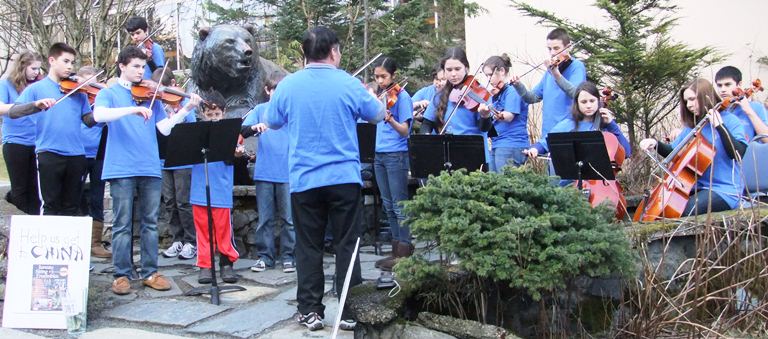
Juneau String Ensemble musicians play a late afternoon concert near the capitol building to raise funds for their upcoming trip to China.
About 20 Juneau student musicians have raised $19,000 through street performances for an upcoming trip to China.
Members of Juneau String Ensembles logged 700 hours last year as downtown buskers. Taking advantage of Monday’s sunshine, they opened their instrument cases, set out the money jar and performed in front of the bronze bear in the Dimond Courthouse plaza. Though the crowd wasn’t big, even a legislator or two came out to listen.
Diane Antaya acted as spokeswoman. Her 15-year-old son plays first violin and is practicing for a duet with a student in China. She says the young musicians, ranging in age from 9 to 16, will visit four major cities, and perform in Beijing and Shanghai. The students’ instructor, Guo Hua Xia, is from China.
“The students will be playing on the Great Wall of China, they’ll be playing with a student symphony in Beijing, playing in some of the local schools, and interacting and playing soccer with the kids in China. They’ll be doing a shared concert as well,” she said. “Kids who can’t really talk to each other, they’re practicing the same music to get ready for this shared concert in June.”
A parent must accompany their child on the 14-day trip, which begins May 28th. While parents are responsible for their own airfare, each student needs to raise $3,000. Antaya says some of their funds have come from the Permanent Fund Dividend program known as Pick. Click. Give. She says that’s one reason the students chose the capitol area to perform this week.
“We’re trying to raise $75,000, we have about $40,000 raised right now and Pick. Click. Give. is one of many options to help us get to China,” she said.
Program Manager Heather Beaty says this is the first year Juneau String Ensembles have been part of the check-off program, which now has 451 organizations on the list. Donations made through the PFD are unrestricted.
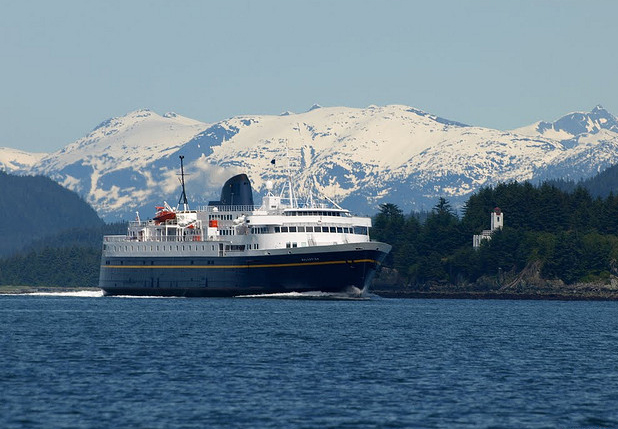
The Malaspina returns from Skagway. (Photo by Gillfoto/Flickr Creative Commons)
The ferry Malaspina will take a celebratory trip through Southeast Alaska in early May.
Spokesman Jeremy Woodrow says it’s one of the Alaska Marine Highway’s 50th anniversary events.
“This is to celebrate in part its inaugural run in 1963. And that will include community events in Ketchikan, Wrangell, Petersburg, Juneau, Haines and Skagway,” Woodrow says.
Woodrow says the Malaspina will make extended stops in each community and be open for tours. Local celebrations are also being planned during port calls. One will also take place this fall in Sitka.
He says the ferry will make special excursions in the gateway and capital cities.
“One will be sailing through Misty Fjords National Monument. They’ll start in Ketchikan and do a day trip through Misty Fjords and back to Ketchikan. And the other, when it’s in Juneau, will sail from downtown, not Auke Bay, to Tracy Arm fjord and back,” Woodrow says.
What’s called The Golden Voyage will run May 1st to May 5th.
More details on the sailings and community celebrations are on the website www.FerryAlaska.com.
Close
Update notification options
Subscribe to notifications
Subscribe
Get notifications about news related to the topics you care about. You can unsubscribe anytime.