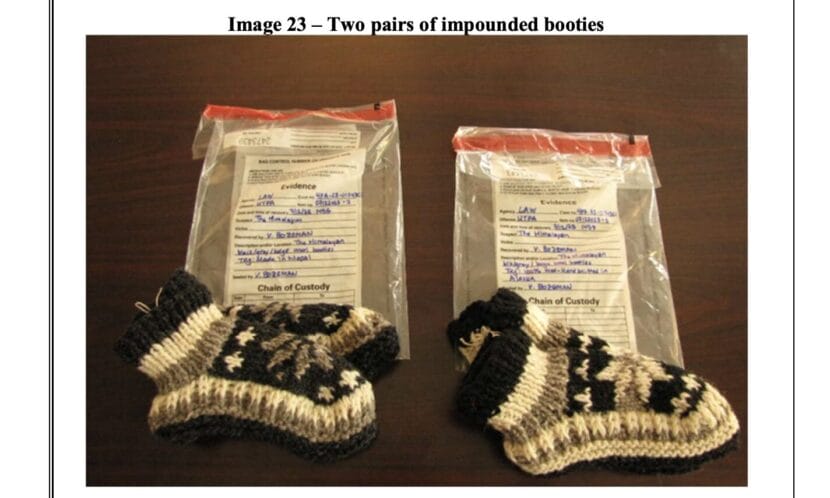
This screenshot from a court filing by the Alaska Department of Law shows two identical pairs of wool booties taken from a tourist shop near Denali National Park. One pair bears the label “made in Nepal,” while the other says that it was made in Alaska. (Screenshot)
A clothing shop near Denali National Park will pay $53,000 in fines to the state of Alaska after telling an undercover investigator that it was selling items made from Yakutat alpacas, which do not exist.
The fines are the result of a consumer protection lawsuit filed in July by the Alaska Department of Law against the owners of a shop known variously as The Himalayan and Mt. McKinley Clothing Company. State prosecutors reached a settlement agreement in November.
State law prohibits someone from falsely claiming that a product was made in Alaska.
According to the state, the clothing shop repeatedly attempted to mislabel foreign products as Alaska-made, something verified by an undercover investigation.
Under the terms of the settlement agreement, the shop will have to pay fines and notify the state before it sells any products labeled as “made in Alaska.” The terms of the agreement expire in 2028.
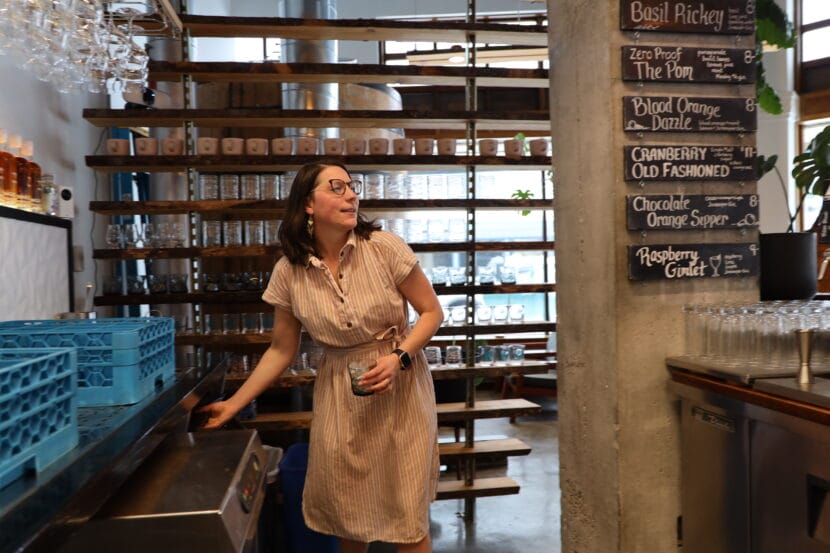
Maura Selenak fixes a gin and tonic at Amalga Distillery. Feb. 1, 2024. (Yvonne Krumrey/KTOO)
The environment of Amalga Distillery’s taproom in Juneau feels different from other drinking establishments in town. It has light wood, mid-century inspired furniture and natural light from the large, street-facing windows competes with the stylized exposed bulbs that hang from the ceiling.
The vibe of the taproom is a focus for co-owner Maura Selenak.
“When you come into our space, it’s distinctively not a traditional bar feel,” she said.” We really wanted it to be open and airy and light and welcoming,”
She said she and the staff create an environment where people can enjoy and learn about what they can do with the alcohol that Amalga makes. And now, it’s been noticed by those outside of Juneau.
Juneau’s Amalga Distillery is a semifinalist for the 2024 James Beard Awards in the category of “Outstanding Bar.” It’s their first nomination, but they’re not the first business in Juneau to be recognized for the prestigious culinary award.
At first, Selenak couldn’t believe her distillery had been nominated. She and her co-founder and husband, Brandon Howard, found out through a friend.
“We woke up and had an Instagram message from a friend saying ‘Congratulations! James Beard!’,” Selenak said. “It was shocking, we had to double check, we were like ‘is it a joke?’”
She said that even getting this far is a big enough deal for her.
“It was not even on our radar as something that was even possible for us.”
The bar category includes any establishment that serves beverages, including breweries, distilleries and even coffee shops.
The category is for “consistent excellence” in what they serve, and also “outstanding atmosphere, hospitality, and operations, while contributing positively to its broader community.”
A block away, chef-owner of In Bocca al Lupo Beau Schooler rolled out bagels in the kitchen.
The restaurant has been named a semifinalist seven times, including last year. He said the process is still a bit of a mystery to him.
“They take an open call for nominations, and they kind of narrow it down from there to their list, and then people come out and judge that list and that narrows it down to the nominees and then they come and judge again. But I don’t know who or what or when or how,” he said.
He said he thinks that the recognition is helpful for restaurants in larger cities, but here, he isn’t sure it makes a big difference.
“As far as locals go, we’ve had a lot of support from the local community so it doesn’t really change that in their eyes for us,” Schooler said.
Schooler said for him, what makes In Bocca al Lupo worthy of recognition is the staff.
“I kinda wish it wasn’t my name on there, just the restaurant’s,” he said
Selenak feels the same way. She said Amalga’s taproom wouldn’t be what it is without the staff.
The James Beard award winners will be announced this summer.
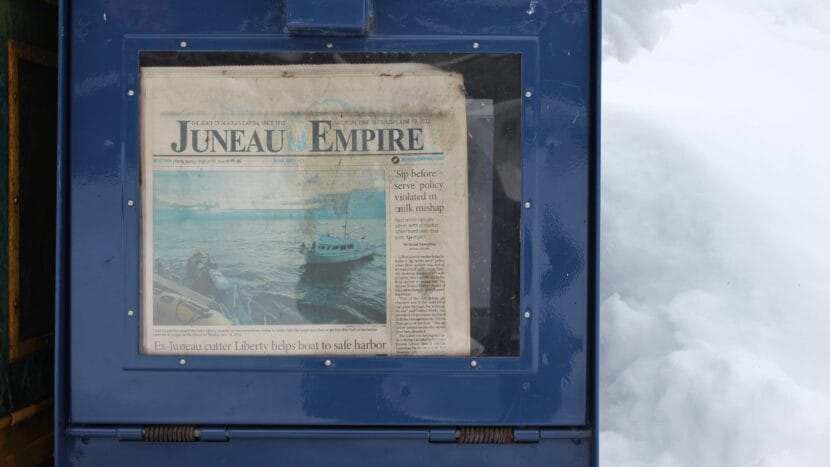
A Juneau Empire newspaper box, photographed on Wednesday, Jan. 17, 2024. (Katie Anastas/KTOO)
Black Press Media, the owner of three Alaska newspapers, is seeking a new owner as it restructures its finances. The Canadian company’s U.S. branch, Sound Publishing, owns the Juneau Empire, the Peninsula Clarion and the Homer News.
Boyd Erman, a spokesperson for Black Press, didn’t answer questions about whether the Alaska papers would continue to publish long-term or whether layoffs were planned. But he said the company plans to continue publishing its newspapers during the restructuring process.
“The purchasers and the company are committed to continue providing journalism excellence and outstanding advertising solutions to the many communities that Black Press serves,” Erman wrote in an email.
Along with the three papers in Alaska, Black Press publishes 94 newspapers in Canada, 35 newspapers and websites in Washington and six newspapers in Hawaii.
The proposed buyers are Carpenter Media Group, which operates newspapers throughout the southern U.S., and two Canadian investors. Black Press has filed for creditor protection in Canada, which allows them to come up with a plan to pay off debt under court supervision and avoid bankruptcy.
The Juneau Empire began publishing in 1912, as the Alaska Daily Empire. Last spring, Sound Publishing stopped local daily printing of the Empire and the Peninsula Clarion. Instead, both papers are now printed twice a week — the Empire in Washington.
The Empire’s staff has also shrunk over the last several years. In 2017, the paper had a managing editor, a digital editor, a state reporter, a crime and courts reporter, a city reporter, a general assignment reporter and a photographer. In 2021, there were four newsroom staff, and the papermoved its offices from Channel Drive to the Jordan Creek Center. Now, the paper has one editor and one reporter.
Editors for the three Alaska papers and their publisher declined to comment on Black Press Media’s potential sale.
The company’s announcement came on the same day that founder David Black announced his retirement. In a press release, his family thanked the company’s employees, readers and advertisers for their support of community news.
“The Black family is confident that the restructuring of Black Press announced today will be successful and enable Black Press to continue to provide high quality community journalism, and that the proposed new owners will be excellent stewards of Black Press’ treasured publications,” the release read.
Case documents say the company’s earnings “have steadily fallen” over the last decade, as print readership has declined and advertising revenue has dropped.
“The Company has limited remaining cash on hand and is unable to make payments on its secured funded debt obligations as they become due,” the documents say.
According to case documents, Black Press Media’s sale is expected to happen by March 15.
KDLL’s Riley Board contributed reporting.
Correction: The Peninsula Clarion is printed twice a week in Anchorage, not Washington.
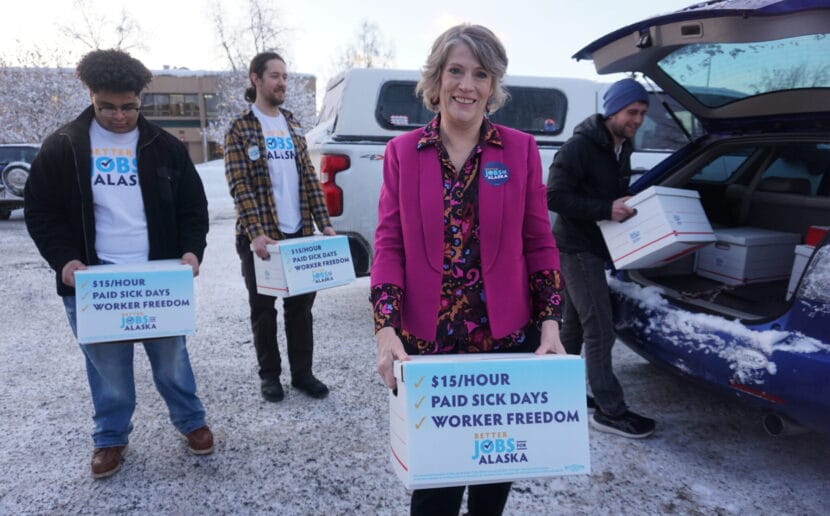
Joelle Hall, president of the Alaska AFL-CIO, carries a box of signed petitions for an increased minimum wage to be delivered to the Alaska Division of Elections on Tuesday. Hall is a leader of the campaign to pass a ballot initiative increasing workers’ minimum pay, mandating paid sick leave and ensuring that workers are not required to hear employers’ political, religious or anti-union messages. Behind her are other advocates for the ballot initiative. (Photo by Yereth Rosen/Alaska Beacon)
Supporters of a ballot initiative that would increase the minimum wage increase, mandate paid sick leave and provide other worker protections submitted more than 40,000 petition signatures to the Alaska Division of Elections on Tuesday, bringing their cause one step closer to a decision by voters.
The group, called Better Jobs for Alaska, brought boxes of signed petitions to a Division of Elections office in East Anchorage.
The initiative proposes to hike the state’s minimum wage, currently at $11.73 an hour, to $13 an hour next year, $14 an hour in 2026 and $15 an hour in 2027. Thereafter, the minimum wage would increase with inflation, according to the initiative.
“Over 32,000 Alaskan workers, in households with 22,000 children, will get a raise by 2027 when this goes to $15 an hour,” Ed Flanagan, a former state labor commissioner who is one of the primary sponsors of the initiative, said at a news conference held Tuesday at the Alaska AFL-CIO office in Anchorage.
To qualify for the November ballot, there must be at least 26,705 signatures of registered voters – equivalent to 10% of the total who voted in the last statewide general election – with signers meeting legal requirements for geographic diversity, according to the Division of Elections.
If the signatures are verified, this would be the third time in 22 years that a minimum wage increase will have qualified for the statewide ballot. Voters in 2014 approved a ballot initiative that established a stepped increase in the minimum wage to its current rate. A petition drive more than 10 years earlier resulted in enough signatures to get the measure on the ballot, but the Legislature in 2002 passed a similar bill, making the initiative moot.
“Hopefully, the third time’s the charm. Frankly we didn’t go high enough the last time,” Flanagan said at the news conference.
Joelle Hall, president of the Alaska AFL-CIO and another leader of the campaign, said the initiative campaign is a necessity for this issue.
“This is the only way the minimum wage gets raised in this state,” she said at the news conference.
An increase in the minimum wage would affect more than those at the lowest pay levels, Hall said.
She cited as an example the Teamster-represented school bus drivers who are entitled, by contract, to starting pay of twice the minimum wage. “This will help us attract and keep those bus drivers,” she said. “There’s lots of ways this reaches a lot of the people maybe who aren’t necessarily making $14 an hour right now. It has a big ripple effect.”
Salaried employees who do not get overtime pay, such as managers at fast-food restaurants, will also benefit because they are entitled to pay that is equivalent to at least twice the minimum wage, Flanagan added.
The initiative has other worker-friendly elements aside from the pay increase. It would mandate paid sick leave and would prevent workers from being compelled to attend or listen to employer meetings or messages about politics or religion.
The importance of paid sick leave was highlighted during the COVID-19 pandemic, initiative supporters said. Without it, sick employees may be exposing coworkers or, especially in the food industry, customers, they said.
Rebecca Reiss, a caregiver for elderly and disabled people, said the lack of paid sick leave presents “an impossible set of choices” for workers like her.
“Do I stay at home with a sick kid, knowing my client goes all day without care? Even if I do stay home, can someone cover my work? How will I pay the bills without any benefits? These are things we need to fix,” Reiss, who lives in Wasilla, said at the news conference. She had her own health crisis that caused so much economic hardship last year that she and her daughter lost their apartment, she said.
The employer-messaging provision addresses what has become an increasingly important subject nationally, said Patrick FitzGerald of the Alaska Teamsters Local 959.
“A lot of people are unfamiliar with the practice of captive audiences. That is essentially when an employer is able to share their influence with their employees, and there is nothing their employees can do about it, whether it is religious connotation, political or anti-union discussions,” FitzGerald said at the news conference.
The Alaska ballot initiative became the first in the nation to address the issue, he said.
For initiative sponsors, one task in coming months will be preventing what they characterized as legislative interference.
In 2003, the year after lawmakers passed a nearly identical bill, causing the minimum wage initiative to be dropped from the ballot, the Legislature repealed important provisions: an inflation adjuster that would have increased pay over the years and a requirement that Alaska’s minimum wage be at least $1 above the federal minimum.
“This was an act of cynicism breathtaking even for the Legislature” Flanagan said.
In 2014, “the House majority tried to do the same damn thing. They must have thought we were stupid or asleep,” Flanagan said. While the House passed a substantially similar bill that would have removed the minimum-wage initiative from the ballot, “fortunately, the Senate majority said no,” he said.
The 2014 initiative passed with nearly 70% of the vote, and Flanagan said he believes support for the current initiative remains similarly high.
Some business groups opposed previous efforts, and that opposition may resurface this year.
The Alaska Chamber has not yet taken a position on the ballot initiative, said Kati Capozzi, the organization’s president.
The issue is to be discussed at an upcoming board meeting, Capozzi said. The chamber is still evaluating the initiative and trying to sort out “unintended consequences and potential pitfalls,” especially for small businesses and certain sectors like the seafood and tourism industries, she said.
At stake is a shakeup of the U.S. grocery landscape, where the companies say they face stiffening competition from Amazon, Walmart, Costco and even dollar stores. Employees, state officials and some lawmakers have argued the tie-up would reduce options for shoppers and workers, farmers and food producers.
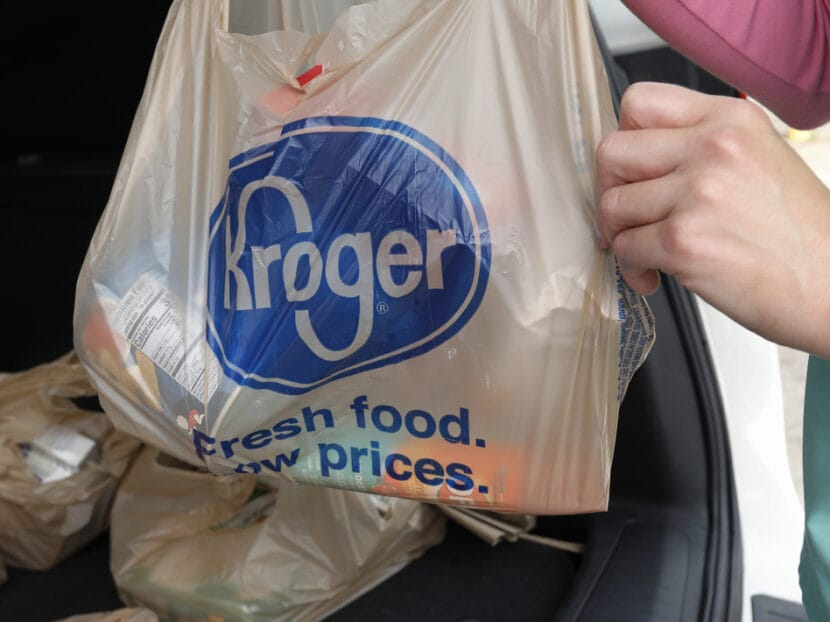
Kroger, the biggest U.S. supermarket operator with 2,719 locations, owns Ralphs, Harris Teeter, Fred Meyer and King Soopers. Albertsons, the second-largest chain with 2,272 stores, owns Safeway and Vons. Kroger employs about 430,000 people; Albertsons 290,000.
The chains overlap particularly in Western states. The companies tried to assuage regulators’ concerns about diminishing grocery competition in those markets by agreeing to sell up to 650 stores as part of the deal.
However, antitrust experts in the Biden administration in the past have expressed skepticism about whether divestitures can sufficiently protect competition — on prices, jobs or terms for suppliers, for example. The regulators have also pushed for tougher scrutiny of megadeals, making this merger a high-profile test.
The Federal Trade Commission has been reviewing the proposed deal for over a year and is expected to make its call as early as this month. A lawsuit to stop the deal would not be a shocker. In May 2023, Kroger CEO Rodney McMullen said the grocery chains “committed to litigate in advance” if federal regulators or state attorneys general rejected the deal.
Combining forces to compete with Walmart
Ohio-based Kroger and Idaho-based Albertsons say together, they’d be in a stronger position to compete against Amazon online and Walmart in physical stores. The latter is the nationwide leader in groceries, selling more than Kroger and Albertsons combined.
“This merger will help protect the local community grocery stores that people love,” Albertsons CEO Vivek Sankaran said in his testimony at a Senate antitrust hearing in 2022.
The companies also argue that together they would be able to lower prices and pay higher wages. They emphasize that they offer union jobs, in contrast to their rivals.
Yet, the United Food & Commercial Workers Union, which represents more than 350,000 workers across the two grocery chains, opposes the merger. At public forums around Colorado, for example, workers noted it could become more difficult to negotiate a union contract with an even bigger, more dominant employer.
“The areas [our members] are concerned with are what happens to competition and food prices,” UFCW International President Marc Perrone said, adding that his members also worried about the long-term prospects for their current collective bargaining agreements.
Will selling off stores satisfy regulators?
Grocery competition historically gets assessed on a local level: Will shoppers in a given area have fewer options after the merger? Trying to address this, Kroger and Albertsons in September agreed to sell at least 413 stores in locations where they overlapped to C&S Wholesale Grocers, a supplier company that also runs some Piggly Wiggly supermarkets.
C&S agreed to buy retail locations in Arizona, California, Colorado and Wyoming, as well as some private brands, distribution centers and offices. The company said it was “committed to retaining” the stores’ existing workers, pledging to recognize the union workforce and keep all collective bargaining agreements.
Perrone said his union welcomed this decision, but remains concerned about the merger’s approval hinging on the sale to the much-smaller C&S:
“Can they operate efficiently and be competitive to where the customers, over the long haul, will stay with them?” he said.
Many antitrust experts in recent years have questioned the effectiveness of such divestitures.
For instance, when Albertsons merged with Safeway in 2015, the FTC required it to sell off 168 stores as part of the deal. Within months, one of its buyers filed for bankruptcy protection and Albertsons repurchased 33 of those stores on the cheap.
“Over time, there has been some skepticism about how well divestitures work,” said Kathleen Bradish, acting president of the American Antitrust Institute, which advocates for tougher scrutiny of mergers. “The divestitures that were deemed acceptable in the past may not be acceptable [now].”
Indeed, federal antitrust regulators last year updated their guidelines for policing mergers to include, for example, greater focus not only on how deals affect prices or consumer choice but also suppliers or workers.
Copyright 2024 NPR. To see more, visit https://www.npr.org.
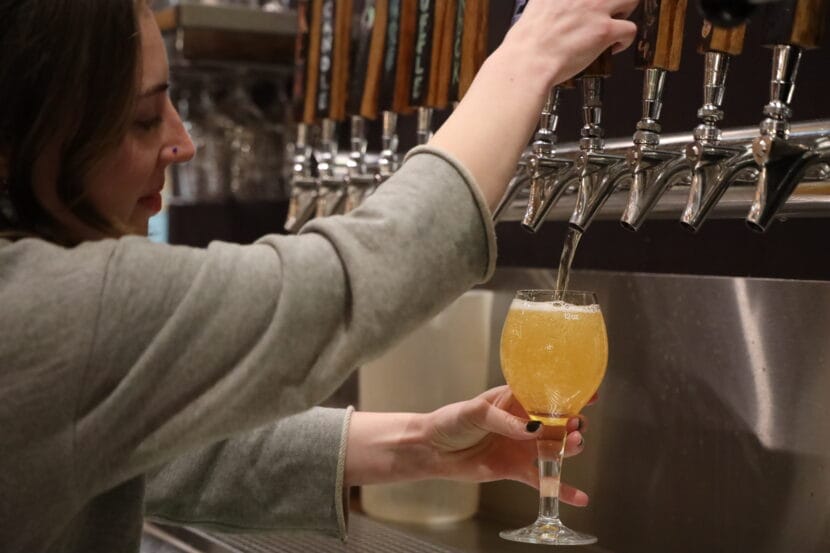
Taylor Ranney pours a beer at Devil’s Club Brewing Company in downtown Juneau on Tuesday, Jan. 2, 2024. (Clarise Larson/KTOO)
Amanda Neyenhouse poured a Devil’s Club IPA called Fresh Lines from a tap in the brewery’s large, wood-paneled taproom. Beer-drinkers and sandwich-eaters sat around a few tables. It seemed like a typical evening, except for one thing: it was a few minutes past 8 p.m.
Until this week, brewery and distillery taprooms weren’t allowed to serve alcohol after 8 p.m. according to state law. But since Jan. 1, legislation passed in 2022 allows taprooms to serve drinks until 9.
“I think that we will have people that are wanting to be here that extra hour. I mean, I appreciate that we’re allowed to be open later,” Neyenhouse said.
Brittni Wisner has been coming to Devil’s Club Brewing Company since it opened in 2018.
Wisner was headed out of town for graduate school Tuesday evening, and she realized she’d have time to get Devil’s Club one more time before flying out.
“We’re like, ‘Oh, they’re open till nine, so we could go,’” she said.
Before the changes, staff also couldn’t let patrons play games or host live music events. Now people can bring cards and games. Wisner said she saw people embracing the new rules already.
So far, Devil’s Club is the only business in Juneau that’s changing its schedule. Evan Wood is one of the founders, and he said he’s been waiting for the law to take effect since it was passed in 2022.
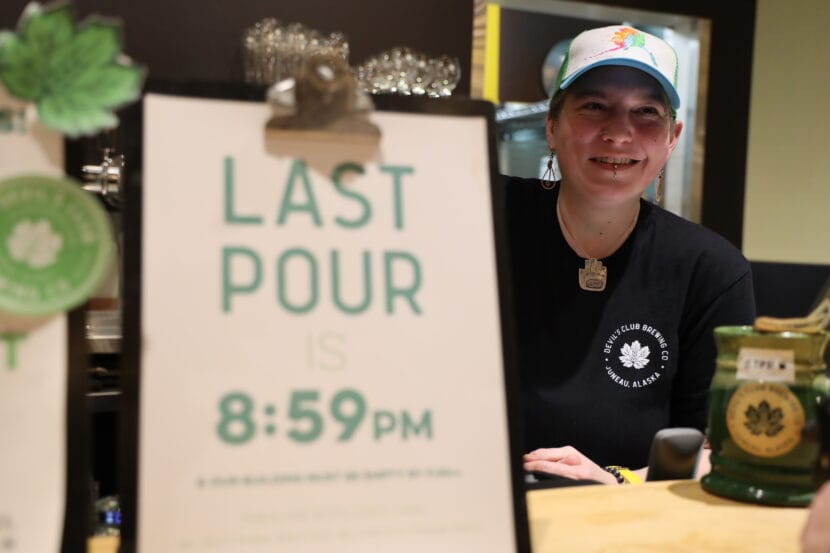
Amanda Neyenhouse smiles behind the counter at Devil’s Club Brewing Company in downtown Juneau on Tuesday, Jan. 2, 2024. (Clarise Larsonh/KTOO)
“We were ready to pull the trigger and stay open an extra hour and invite everybody in for some more time,” Wood said.
Devil’s Club is serving until 9 p.m. Tuesdays through Saturdays. Wood said they’re going to see how the extra hour plays out.
“We’re going to play it by ear,” he said. “We’re going to try as often as we can to stay open until nine to see if people are out and interested.”
These types of businesses can host four events in a year, starting now. Wood said he has big visions for what Devil’s Club’s events will be.
“Since there are only a few events a year, we’re being very careful to pick things that we think would be the most fun and the most innovative things that haven’t happened in Juneau before,” he said.
Customers still can’t drink more than 36 oz of beer at breweries or more than two drinks at distilleries. And taprooms can’t have TVs or allow people to sit at the bar.
Those rules are a part of a swath of limitations placed on breweries and distilleries by the state legislature. Bar owners and brewery owners debated over limitations for years, in a back-and-forth that’s known as the “bar wars.”
Joan Wilson, with the Alaska Alcohol and Marijuana Control Office, said it’s a sign of compromise that the changes finally passed.
“The bill would not move forward that last year unless the recovery community, the bar community and the brewery community agreed on the changes,” she said. “And often they had to agree on changes against their own interest for that bill to move forward. So that, to me, is an incredible accomplishment.”
Barnaby Brewing plans to stay open until 9 p.m. for big events like First Fridays. Forbidden Peak, Amalga Distillery, and Alaskan Brewing Company aren’t making changes to their hours just yet.
Close
Update notification options
Subscribe to notifications
Subscribe
Get notifications about news related to the topics you care about. You can unsubscribe anytime.

9(MDEwMjQ0ODM1MDEzNDk4MTEzNjU3NTRhYg004))