Seaweed farming with Seagrove Kelp Co. in Doyle Bay, near Craig, on Prince of Wales Island. (From NOAA Fisheries)
Aquaculture is a new, but rapidly growing industry in Alaska. That’s according to a recent report from the National Marine Fisheries Service, or NOAA Fisheries, on the state of Alaska’s water-based farming.
James Currie is an Alaska Sea Grant fellow who authored the February report. He said it’s meant to provide an approachable overview for curious non-experts.
“So there have been steady increases over preceding years in our production of oysters and seaweed,” Currie said. “And it’s a really exciting time for the aquaculture industry overall, just in terms of we’re receiving more applications on average year by year.”
Finfish farming is illegal in Alaska, so the primary species grown are shellfish like oysters or various types of kelp. The total pounds of seaweed harvested has ballooned in recent years, going from just over 18,000 in 2017 to nearly 900,000 in 2022.
But along with the excitement around the growing industry, Currie said there are a few notable challenges — what he called “fundamental bottlenecks.” Most of those involve a headache shared by many Alaska entrepreneurs: logistics.
Currie said oysters can be challenging to keep alive and ship long distances, and seaweed is primarily made up of water, making it extremely heavy.
“So one of the needs for the aquaculture industry is more industry to actually process that seaweed immediately as it comes out of the water and dry it down and refine it in some way, so that it is stabilized and easier to ship in large quantities,” Currie said.
Currie sees that as something that can be addressed on a community level, creating new business opportunities for locals to find collaborative solutions.
The report also provides easy access to the various funding opportunities available to Alaskans interested in getting into aquaculture.
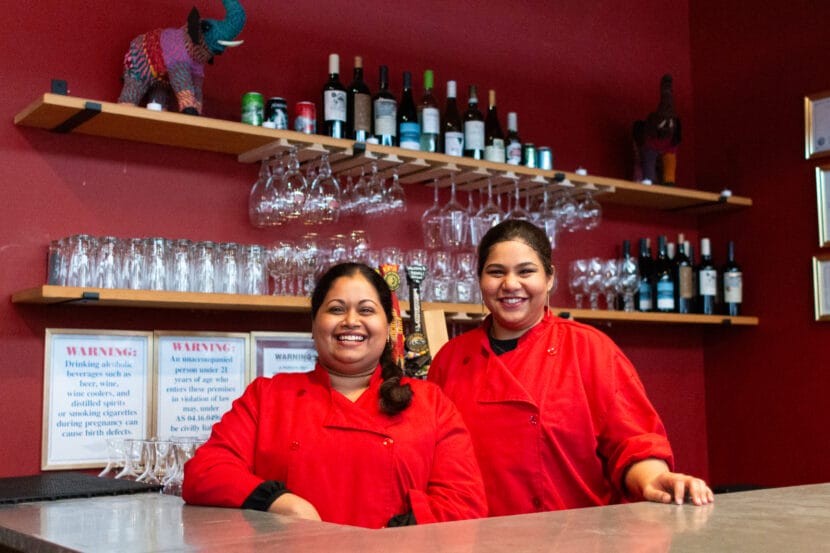
Owner Nimmy Philips and chef Ruth Fisher in Spice Restaurant and Cafe. Photo by Tasha Elizarde/KTOO. Feb. 21, 2024.
This is Tongass Voices, a series from KTOO sharing weekly perspectives from the homelands of the Áak’w Kwáan and beyond.
Nimmy Philips came to Juneau as an engineer, but three years ago, she decided to buy a restaurant. Now, she applies her engineer’s precision to her recipes. One part of that attention to detail: all the spices are ordered whole and then roasted, mixed, and ground by hand.
Enrique Cabrera is her head chef. He shared how he grinds the spices that go in just about every dish.
Listen:
This transcript has been lightly edited for clarity.
Nimmy Philips: I’m Nimmy, I own the Spice restaurant and Spice Cafe and art gallery.
So opening up a restaurant or owning a restaurant has been my dream since I was in, I would say tenth grade or even in high school, mainly because a lot of people don’t understand how food connects each other. It doesn’t matter what culture you’re from, what religion, what color your skin is, it doesn’t matter. Food connects people. That’s the same language that we all speak when we eat the good food. And that’s something I wanted to do.
And I am one of those restaurant owners that, I’m not going to cut costs or take shortcuts to make a dish happen. I have to follow my grandmother’s recipes. My food feelings come from my grandmother. Going back to my grandmother’s house and spending time with her in the summertime, and she only spoke one language. And all her grandkids are well educated and have traveled all over the world. They all come in the summer to visit her and stay with her. The only language she spoke was food. And she showed care and love — support — through her food. And that’s what I want to do for Juneau.
And most of our family recipes call for like secret ingredients that we cannot get in Juneau, Alaska or anywhere down south. So when I go to India, I have to bring it with me.
And if I’m going to make something that is from my family recipe, I’m not going to put on something just to say that I did it. I have to be proud of it. I have to have my 150% effort into it.
And again, this is not just me doing it either. I have an amazing team. If I don’t have an amazing team to back me up, who believes in me, who supports me — otherwise I’m nothing. There’s no me without my group of people, without my Spice team. And my spices.
Spices come from the northern part of India. It comes through Seattle. We have a partnership with a store in Seattle that, whenever they do the Indian shipping from India, we put in our orders, too, and we get the spices through them. And they put it on the barge and we get it here. And we get them all whole spices. We grind our own spices.
Head chef Enrique Cabrera pours the garam masala mix into the spice grinder at Spice Restaurant and Cafe. Photo by Tasha Elizarde/KTOO. Feb. 21, 2024.
Garam masala is the mix of masala. Masala just means a mix of spices together — that’s all it is. Garam means warm, it gives the life, the warmth to the dish.
Enrique Cabrera: I really enjoyed making the garam masala because you get to see all the spices and you put them together, and you roast them. And when you roast them, the smell of the cloves — that’s one of my favorites.
My name is Enrique ,and everybody calls me Kiké here at Spice. And I’m the head chef in charge in the kitchen and enjoy the work that I do here.
Okay, so let me get my container thing and I’m gonna start getting the recipe together. Coriander seeds, bay leaves, so we’ve got cloves, black pepper, cinnamon. Green cardamom, black cardamom.
One more, we’re gonna one more — Jeera — which is in the kitchen. I’m gonna go get it. Jeera, which is cumin seeds. I’m gonna roast the coriander seeds and the bay leaves and the cloves, and we have star anise to get roasted all over.
Okay, let’s see what’s next. I’m gonna put them all in there and and then I’m gonna mix it, and then I will grind them.
Now you’re gonna smell all the spice together in one smell. This is the easy part, grinding it.
Nimmy Philips: As you can see, we store them either in the container that comes in or sealed containers. We believe every spice has a soul. And that’s something Kerala Indian families believe, we believe that every spice has a soul. You leave the window open and the soul will fly out. I always tell Kiké, you know, “Cover it! The soul is running away! Cover it!”
Enrique Cabrera: At the beginning!
Nimmy Philips: At the beginning. Now Kiké tells me “Cover it!”
A Joann store is seen in Tigard, Ore., in August 2020. The arts and crafts retailer announced Monday that it was filing for bankruptcy. (Ted Hsu/Alamy Stock Photo)
Joann — the craft store chain formerly known as Jo-Ann Fabrics — has filed for bankruptcy amid ongoing financial troubles.
But DIYers need not worry just yet: The company’s more than 800 stores nationwide will remain open and its website will stay active as the Hudson, Ohio-based company restructures its finances.
“We remain committed to our suppliers, partners, Team Members and other stakeholders, and are focused on ensuring we continue to operate as usual so we can continue to best serve our millions of customers nationwide,” Joann’s chief financial officer Scott Sekella said in a statement.
Joann and certain affiliates have filed for Chapter 11 bankruptcy in the U.S. Bankruptcy Court for the District of Delaware.
As part of the court-supervised bankruptcy process, Joann expects to receive $132 million in new financing. It said it will also slice its funded debt by about $505 million, but that “customers[,] vendors, landlords, and other trade creditors will not see any disruption in services.”
Additionally, Joann will become a private company again and will be delisted from the Nasdaq stock exchange, just two years after it went public in March 2021.
The company said in an SEC filing earlier that year that the COVID-19 pandemic had spurred growth in the sewing and broader crafting industry, with people across the U.S. fashioning their own masks and using the additional time at home for DIY pursuits.
“[W]e view the significant number of new customers and increased engagement by new and current customers as a very encouraging signal for the future of our business,” the company said.
But in September 2023, during a sales slump, Joann announced that it was restructuring its field and corporate operations and laying off an unknown number of workers, Retail Dive reported.
The company said in a December earnings report that its third-quarter net sales had dipped by 4.1% compared to the same period the year before, and its long-term debt was roughly $1.2 billion.
Copyright 2024 NPR. To see more, visit https://www.npr.org.
Pre-rolled marijuana joints at the Alaskan Kush Company on Wednesday, March 13, 2024. (Clarise Larson/KTOO)
A new marijuana business in the Mendenhall Valley where customers can smoke or consume edibles on site received the greenlight from the Juneau Planning Commission Tuesday night.
The plans for the business, Alaska Vibes, have been long in the making — so long that this was actually the second time the commission granted approval after its previous permit expired.
Speaking on behalf of the business, Director of Operations Tara Smith says that the process of opening an area for people to enjoy marijuana products is taking much longer than anticipated.
“With this business, it’s not like we can just open up a restaurant — we have to deal with the legal side of everything and that’s where we get out roadblocks and our timelines can get pushed back because of some of those things,” she said.
In 2019, Alaska approved on-site consumption laws allowing customers to smoke marijuana and consume edibles at cannabis retailers that have permits for it. So far, only a few permits have been approved across the state.
To offer on-site consumption, the state requires the area to have a separate ventilation system or be outdoors, and only products purchased on site can be consumed. Juneau also has additional requirements like ensuring the odor doesn’t leave the premises.
The recently approved permit allows for a retail and cultivation facility and outdoor consumption area. The business will be located in the Valley near Pavitt’s gym and will be a sister location to the downtown Alaskan Kush Company.
State law prohibits cannabis products from being consumed in public areas, and tourists aren’t allowed to take them aboard a cruise ship. Smith says having an area for people to enjoy their products will allow the business to tap into the tourism industry. They plan to shuttle visitors from downtown to the store.
“Tourists want a place to go, our locals want a place to hang out. It’s cool, it’s fun and it gets us out of the bars,” she said.
Smith says the retail area of the business will open first, followed by the outdoor consumption patio and cultivation area, but the timeline of when that will happen is still up in the air. The business will still need approval from the state Marijuana Control Board before it can open its onsite consumption area.
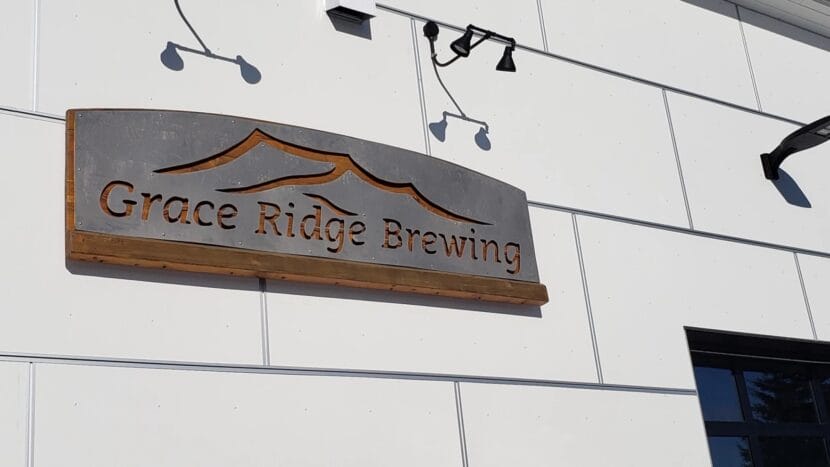
A sign for Grace Ridge Brewing on the side of its taproom on Feb. 27, 2024. (Jamie Diep/KBBI)
It’s a slow afternoon at Grace Ridge Brewing, but it’s hardly quiet. The sound of machinery whirred throughout the Homer taproom as co-owner Sherry Stead talked about starting the brewery eight years ago with her husband, Don.
“Don wanted to open a brewery to make good beer, but mostly to be part of the community and to be able to offer a few year-round jobs in Homer,” Stead said.
Grace Ridge is one of three breweries and wineries suing the Alaska Alcoholic Beverage Control Board and Joan Wilson, the director of the Alaska Alcohol & Marijuana Control Office, over rules on offering live entertainment. Up until the beginning of this year, state laws banned breweries and wineries from having live entertainment on site.
A Senate bill that took former state senator Peter Micciche — who is now the Kenai Peninsula Borough’s mayor — nearly 10 years to create allows breweries to hold four events a year with live entertainment. Businesses must spend $100 to apply for a permit every time and they must pay double that to apply for a permit within three days of an event.
Stead said Grace Ridge serves as a hub for community events and fundraisers but the restrictions limit what people can do there.
“We love being a community spot. And we’ve had singers want to come and practice. We’ve had play people want to come and practice and we’re just like, ‘no,’” she said.
Anchorage brewery Zip Kombucha is another plaintiff in the case. Owner Jessie Janes said he started the business in a Jewish synagogue by making kombucha, a fermented tea drink.
Over time, Zip got its own facility and staff added various alcoholic drinks including cider and hard kombucha. He said initially they had a restaurant license and held open mic events, dance classes and more. But, when they changed to a brewery license, the rules prevented them from holding those events.
“I think that the state government doesn’t really have the constitutional right to pick and choose which businesses they think should succeed and fail or have priorities over others,” he said. “And I think that’s all these laws are really meant to do is give one business type preference over another business type.”
Pacific Legal Foundation is representing the breweries in the lawsuit. Attorney Donna Matias said that by not allowing live entertainment, the law is a clear violation of freedom of speech under the state and federal constitutions.
“It’s not just, ‘I’m speaking words,’ or ‘I’m writing words,’ it’s performances, it’s theater, it’s poetry, it’s all, all of that is considered protected by the First Amendment,” she said.
By only restricting entertainment for certain businesses that serve alcohol, Matias said the rules also violate the equal protection clause of the state constitution.
Alaska Assistant Attorney General Kevin Higgins said in an email statement the state is considering filing a motion to dismiss the case.
“We have seen a copy of the complaint and are considering whether to file a motion to dismiss before we file an answer,” Higgins wrote. The state will have 40 days to respond once it has officially been served.
The lawsuit doesn’t have the support of the Brewers Guild of Alaska. The guild works to develop craft brewing in the state through holding conferences and working to change laws. Board president Lee Ellis said that attempting to change things through a lawsuit takes a long time. It also only targets one issue breweries face.
“From our standpoint, the sooner we start looking at further legislative changes, to enhance privileges of manufacturers across the state, the sooner we’ll probably reach those goals,” he said.
But Jason Davis, owner of Sweetgale Meadworks & Cider House in Homer signed onto the lawsuit. He started his business three years ago and is known for sourcing most of his ingredients locally on the Kenai Peninsula. He said while they stay busy in the summer, the restrictions on live entertainment keep them from having events with performers to bring in more business.
“I’m often asked by musicians if they could perform out on my patio, or if they could announce to their fans that they’re going to be having a pop up live performance here,” he said. “And it’s something that would be fun for me, fun for my customers, and it would be a great way of bringing in more business, especially during the slower winter months.”
At the end of the day, Davis says winning the lawsuit would be a small step towards leveling the playing field between breweries and bars.
Ezra Croft from North Carolina saw his annual homeowners’ insurance surge to $1,600, a $700 increase. Many others across the country are also seeing surging auto and home insurance premiums. (Courtesy of Ezra Croft)
Ezra Croft has never filed an insurance claim, and his house in Raleigh, North Carolina isn’t close to a stormy coastline or a fire-prone forest.
So Croft was surprised when his annual homeowner’s insurance premium shot up to $1,600, or $700 dollars more than he was paying just a couple of years ago.
“I’m a middle income guy,” Croft says. “Don’t make a ton of extra money. At this point I’m teetering on the point of inaffordability.”
Similar complaints can be heard all over the country. On average, insurance companies sought to raise homeowners’ premiums by more than 11% last year, according to S&P Global Market Intelligence.
Take Paul Morro. His auto insurance bill just jumped by $600 a year.
“Here’s the kicker,” Morro says. “My wife and I both work from home. So we have no commute to speak of.”
He’s bracing himself for the bill to insure his house, in Herndon, Va.
“It just feels like everything is rising at a scary rate,” Morro says.
Why insurance costs are surging
Insurance companies insist they’re just playing catch-up, after two years of big losses. For every dollar in home and auto premiums they collected last year, insurance companies paid an average of $1.10 in claims and expenses, according to the Insurance Information Institute.
“Nobody wants to have that higher-price bill,” says Sean Kevelighan, the institute’s CEO. But he added companies “need to price insurance according to the risk level that’s out there.”
Inflation is partly to blame for those big payouts. The cost of fixing or replacing damaged homes and cars has jumped sharply in recent years as a result of rising labor and material prices.
Even as those prices start to level off, though, insurers are having to contend with a mounting toll of natural disasters, and not just in the usual places like Florida and California.
A car remains in the wreckage after a house and garage were abruptly destroyed by a landslide as an atmospheric river storm inundates the Hollywood Hills area of Los Angeles on Feb. 6, 2024. A spate of natural disasters is helping lead to soaring insurance premiums across the country. (David McNew/AFP via Getty Images)
Last year, there were around two dozen severe storms in the U.S. with billion-dollar price tags, spreading lightning, hail and damaging winds through many parts of the country.
“While a lot of these storms don’t make national headlines, they do tend to be very costly at the local level,” says Tim Zawacki, principal research analyst for insurance at S&P Global Market Intelligence. “And the breadth of where these storms are occurring is something that I think the industry is quite concerned about.”
As a result, insurance premiums are likely to keep climbing this year even as overall inflation cools.
Insurers have a lot of pricing power
While state regulators have some power to limit those price hikes, insurance companies tend to get their way. Regulators know that if they move too aggressively to limit premiums, insurance companies might stop offering coverage altogether.
“The insurance companies have become really aggressive in their bullying,” says Doug Heller, director of insurance for the Consumer Federation of America. “You’ve heard a lot about companies that are threatening to pull out of the market if they don’t get what they want. Generally speaking that bullying has worked.”
Douglas Heller, director Of insurance at the Consumer Federation of America, speaks during a Senate Banking Committee hearing about the property insurance market on Capitol Hill in Washington, D.C., on Sept. 7, 2023. (Anna Moneymaker/Getty Images)
Last week, the Treasury Department hosted a roundtable with consumer and environmental groups to discuss the ways climate change is rattling insurance markets. The department also plans to host a meeting on the topic with insurance industry stakeholders.
Customers can sometimes save money by shopping around. Alicia Pitorri switched insurance carriers after the cost of her family’s auto policy jumped more than a thousand dollars.
“It was Liberty Mutual,” she says with a rueful laugh. “We’ve since switched to State Farm since the renewal went up so much.”
Pitorri, who lives in Nashville, says while she managed to shave a few hundred dollars off the bill, she’s still paying a lot more than she did two years ago.
“What can you do?” she asks. “You need insurance. You can’t have a vehicle or a house without them. So you have to pay for it. And you figure out where you can cut other things to make sure you can drive around.”
Going without insurance
Auto insurance is required in nearly all states. And lenders typically require homeowners who have a mortgage to carry insurance as well. Still, as premiums keep climbing, more people are scaling back their coverage or even going without.
Ezra Croft considered dropping his homeowners’ coverage, but ultimately decided to pay the higher premium.
“I’m fairly good at home repairs, but if something like a tree fell on my house or a tornado or a fire, I don’t know what I would do,” Croft says.
A survey by the Insurance Information Institute last year found 12% of homeowners had no insurance, up from 5% four years earlier. Going without coverage is risky, though, for both individuals and communities.
“Insurance is an important product, not only for economic stability but for community resilience,” says Heller. “We are very concerned that these escalating premiums are going to lead to escalating rates of uninsured drivers and homeowners, which makes us all quite vulnerable.”
Copyright 2024 NPR. To see more, visit https://www.npr.org.
Close
Update notification options
Subscribe to notifications
Subscribe
Get notifications about news related to the topics you care about. You can unsubscribe anytime.




9(MDEwMjQ0ODM1MDEzNDk4MTEzNjU3NTRhYg004))




9(MDEwMjQ0ODM1MDEzNDk4MTEzNjU3NTRhYg004))