Business

Juneau teachers win career & technical education awards

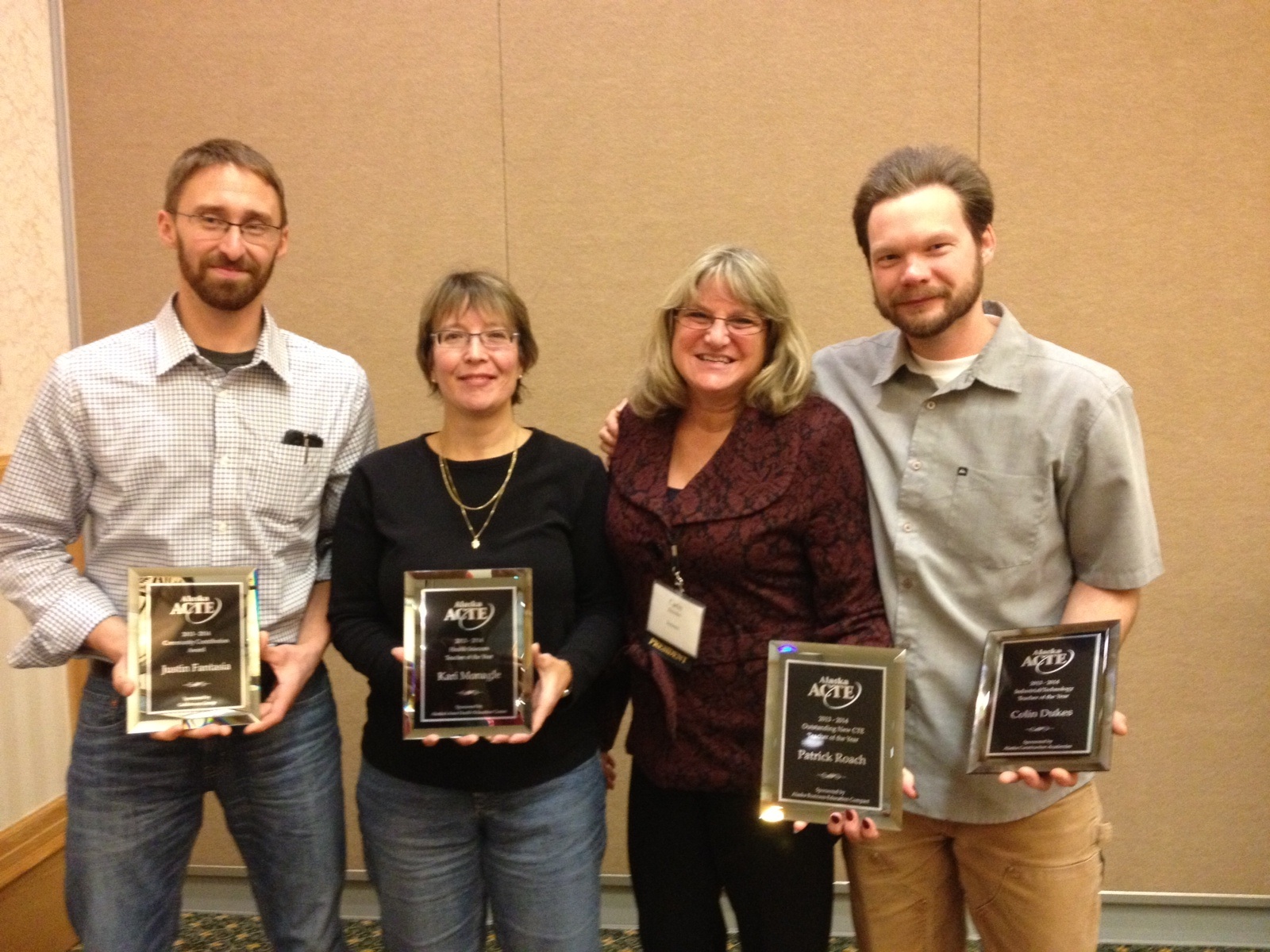
Pictured left to right: Justin Fantasia, Kari Monagle, CTE Coordinator Carin Smolin (holding Patrick Roach’s award), and Colin Dukes. Photo courtesy Juneau School District.

Four Juneau teachers and a community program partner have been recognized by the Alaska Association for Career and Technical Education as 2013 Outstanding Teachers.

The awards came at the association’s annual conference in Anchorage on Oct. 30th , according to Carin Smolin, Career and Technical Education Coordinator for the Juneau School District.

The association’s mission is to strengthen career and technical education and develop an Alaska workforce.

JDHS Health Sciences Teacher Kari Monagle is the Outstanding Health Services Teacher of the Year.

Monagle is a Juneau Douglas High School graduate and has been teaching science there for about 20 years.  Smolin says Monagle helped develop the health sciences curriculum.

“We have alignment with the university so students can earn dual credit with high school and university credits.  We know that health sciences is a high demand occupation in our state along with the country. And she’s been very dedicated and passionate about her work and her teaching, and students just love her as well,” Smolin says.

Colin Dukes has been teaching at JDHS for six years and has earned the Outstanding Industrial/Technology Teacher of the Year award for his classes in wood, construction, house building, and CAD, or computer-aided design.

Smolin calls Dukes’ classes a model of applied learning that incorporate literacy, math, and science skills in meaningful projects.

She reads from a letter supporting Dukes for the award:

“He customizes classroom learning to meet student needs and teams of colleagues to create classroom projects and build student engagement in meaningful learning.”

One of the most popular classes at Thunder Mountain High School is taught by Patrick Roach.  He’s received the Outstanding New CTE Teacher of the Year award for preparing and cooking food, otherwise known as culinary arts.

He’s also been teaching less than three years, an important part of the category for the new CTE teacher award.

Smolin says this is not the first award Roach has received in the short time he’s been teaching.

“This past spring he also was recognized by the state and he won the Alaska 2013 Teacher of the Year by the National Restaurant Association Education Foundation, and he won the Alaska Educators’ Excellence award,” she says.

The Community Contribution award has gone to Justin Fantasia,  a SAGA employee who is construction manager for the JDHS House Build Program.

Fantasia has been working with the program for five years.  Smolin says his award recognizes the connection between a school and a workplace.

“He has been a mentor for students and helps them transition  into the construction field following high school and he engages in class as well as on site with the work,” she says. “He’s truly dedicated to our students.”

The JDHS House Build program currently has a house for sale in the Lemon Creek area and is building another.

The Juneau teachers who won the awards competed with other career and technical education instructors from across the state.  Smolin says the applications are accompanied by letters of support, many from students and former students, and all are reviewed by an impartial committee of business leaders and the association.
 

AEL&P parent company agrees to merger with Spokane-based Avista

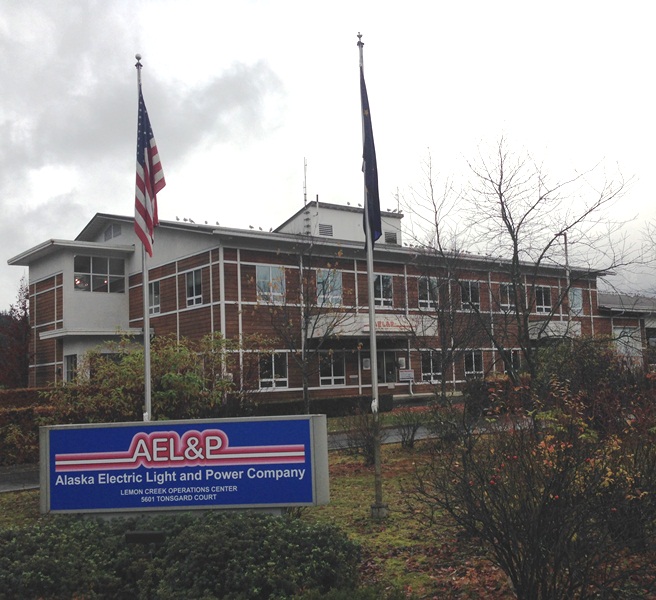
AEL&P headquarters in Lemon Creek. Photo by Casey Kelly/KTOO.

The parent company of Juneau electric utility Alaska Electric Light & Power has agreed to merge with Spokane, Washington-based Avista Corporation.

Alaska Energy and Resources Company will join Avista subsidiary Avista Utilities by July 2014, pending the approval of state and federal regulators, as well as AERC shareholders.

Bill Corbus and his family have owned a piece of Alaska Electric Light & Power almost from the day the company was founded. His grandfather and a great uncle bought into the utility in 1896, when it was only two years old. His father, William Corbus, was the longest serving company president from 1949 until 1987.

Bill started working for AEL&P in 1970 and went on to serve eight years as president and CEO in two separate stints. Even after he retired in 2002, Corbus and his family remained the majority owners of Alaska Energy and Resources, AEL&P’s parent company.

But Corbus says they’ve reached “a turn in the road” and now is the time to sell.

“I’m 76 years old,” Corbus says. “There is no Corbus family member here to continue to be involved with the company at the board of directors level or as part of the employment team.”

Corbus says there would be inheritance tax obligations if the company is not sold before he dies. He also says several AERC shareholders are looking to sell their stock, and the company wants new sources of capital for future projects to provide energy to its nearly 16,000 customers.

He says AERC wanted a buyer that would focus on three things: Providing reliable and competitively priced electric service; being a good corporate citizen in Juneau; and taking care of AEL&P’s employees.

Corbus says the company had other suitors, but in the end, “the management team and the board of directors decided that Avista was in our case by far the best match.”

Dennis_Vermillion
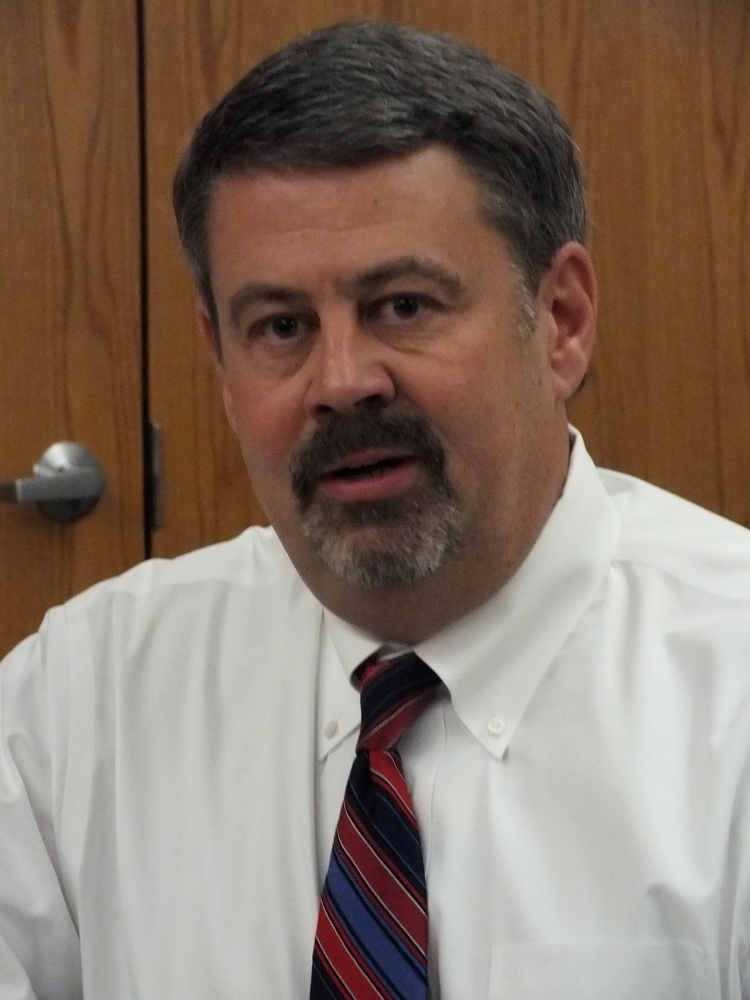
Dennis Vermillion is President of Avista Utilities. The company will acquire the parent company of Juneau’s Alaska Electric Light and Power for $170 million in a deal announced Monday. Photo by Casey Kelly/KTOO.

Current AEL&P President and CEO Tim McLeod says the two companies have a number of similarities.

“Other than they being much bigger than we are, we felt like we are very similar in corporate values and corporate culture,” McLeod says.

Dennis Vermillion, President of Avista Utilities, sees that too. The company was founded in Spokane in 1889 as part of an effort to build a power station on the Spokane River.

“We’re very much like AEL&P in that we started, really, in a very small community over a hundred years ago, with a foundation of hydroelectric energy,” Vermillion says.

Today Avista serves more than 600,000 customers with electricity and natural gas in Washington, Idaho, Oregon and Montana. Vermillion says Avista sees an excellent growth opportunity in AEL&P.

“A big deal for us, it fits nicely from a strategic perspective in what we’re trying to do,” says Vermillion. “And that is grow our utility business and diversify our energy assets.”

And while he admits it won’t happen for several years, he says there also could be opportunities to grow Avista’s natural gas business in Juneau and beyond.

“There’s been a lot of discussion about CNG, compressed natural gas, and LNG, liquefied natural gas,” he says. “And Tim and I and others have talked about that, and it’s something that we look forward to rolling up our sleeves on and exploring what the opportunities might be, not only for the Juneau area, but all of Southeast Alaska.”

Bill_Corbus
Bill Corbus’ family has been involved with AEL&P almost since the company was founded. The Juneau utility will merge with Spokane, WA based Avista Corporation in a deal announced Monday. Photo by Casey Kelly/KTOO.

Vermillion says the proposed re-opening of the AJ Mine did not play into the company’s decision to pursue the merger. Another Alaska Energy and Resources subsidiary – AJT Mining Properties – is a part owner, along with the City and Borough of Juneau, of the old mine near downtown.

“We’re a utility company. That’s what we do. We think we’re pretty good at it,” says Vermillion. “And we know there’s a very well-run and good utility company in Juneau, and that’s really what the impetus of this transaction is for us.”

In the immediate future, both parties say there should be no noticeable changes at AEL&P. The company’s headquarters will remain in Juneau, and Avista has promised to retain all of its 60 full time employees for at least two years after the transaction closes.

As for Corbus, he plans to stay on until the ownership transition is complete. And at the very end of Monday’s press conference announcing the deal, he said he has plans for his share of the Avista stock.

“It is my intention to sign over 90 percent of my new Avista shares to the Juneau Community Foundation,” Corbus says.

The community foundation helps donors direct charitable funds to nonprofits in Juneau. It named Corbus Philanthropist of the Year in 2012 for his many years of community giving.

Corbus says he’s not sure how much this gift will total until the sale is complete, but guesses it will be somewhere north of $40 million dollars.

To read our original story, click here.

Can logging switch to second-growth sooner?

Trees start to grow back in a clearcut area on Admiralty Island, as seen from a float plane. A new study says second-growth timber can replace old growth within five years. (Ed Schoenfeld/CoastAlaska News)

Can Southeast’s timber industry survive while only logging second-growth forests? An Oregon research group says it can. And it could happen sooner than many expect.

An organization called the Geos Institute just released a study based on new Forest Service data. It takes a look at acreage regrowing after earlier logging.

It concludes the Tongass National Forest has enough second-growth stands, also called young growth, to provide a steady supply of marketable timber. (Read the Tongass second-growth report.)

Dominick DellaSala is president and chief scientist for Geos. The Ashland, Oregon,-based group advocates protecting older forests to reduce climate change.

“The faster we can get the Forest Service to move out of old-grown logging, the better it will be, because the Tongass is such a global resource. And that would help with subsistence values and fisheries and the tourism that takes place on the Tongass,” DellaSala says.

The study, researched by Corvallis, Oregon-based Mater Limited, says trees can be harvested at the age of 55. Forest Service policy considers trees mature and ready to log at about 90.

DellaSala says that change, plus a few others, means the Tongass could switch to cutting second-growth trees within five years.

“That could be harvested over the next six decades at which time, forests that were already harvested that are younger would be available six decades out in to the future. So you can kind of continue this cycle of renewing the forest and going back into the second-growth and harvesting it again and never have to touch another stick of old growth,” DellaSala says.

The Sealaska regional Native corporation, headquartered in Juneau, has been harvesting second-growth trees for about the past five years.

Its timber subsidiary is one of its largest businesses. Rick Harris, executive vice president, says it’s been cutting and selling 50- to 75-year-old trees.

“We’ve been able to get those trees into the market and the market took them on an experimental basis. But in subsequent years, they’ve actually been asking for it,” Harris says.

Sealaska’s logs were sold in the round to mills in Asia. Most Forest Service sales require milling before export.

Harris says the study’s information is useful. But the Geos Institute underestimates the difficulty.

“They make a simple statement that all we have to do is change a few rules about when second growth can be harvested. Unfortunately, that rule is a federal statute. And our experience with getting federal statutes changed is that it’s very difficult. It can’t be done by the administration or by the Forest Service. It actually requires Congressional approval,” Harris says.

Sealaska has been trying for years to get Congress to change land-selection rules so it can boost its timber base. Despite increased support, it’s unlike that legislation will go anywhere this year.

Forest Service officials said they haven’’t fully reviewed the Geos Institute report.

But the Tongass is already transitioning from old- to second-growth logging. Officials have said it will take 10 to 15 years – maybe longer – before enough younger trees are of marketable size.

Other challenges must be overcome to speed such a transition.

Among them: Retooling Tongass-area mills and repairing old logging roads used during earlier harvests.

Geos Institute’s DellaSala says that cost could be covered by federal funds.

“We’re appropriating logging the old-growth forests, so it would just be a matter of evaluating the appropriations to deal with the infrastructure changes,” DellaSala says.

But it may not be that easy.

Sealaska’s Harris says second-growth timber would have to compete with a long-established supply from Northwest tree farms. Those companies have lower shipping and operational costs.

“This is not an easy just-flip-on-the-switch kind of thing. It’s going to take time to develop the skill to produce the boards and to be able to build the markets and be competitive in those markets,” Harris says.

A 2011 study, by Oregon forest appraiser Ray Granvall, said the Forest Service badly overestimated its harvestable second-growth acreage.

Granvall said such stands won’t have commercial potential for decades. The Forest Service disagreed with his conclusions.

Juneau Empire’s Director of Audience hopes to engage community

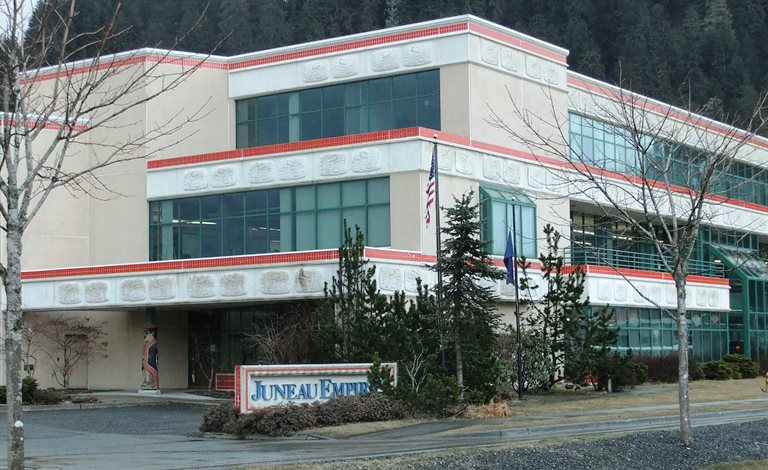
The Juneau Empire building at 3100 channel Drive.

The Director of Audience at the Juneau Empire says the newspaper may be entering a period of stability.

Former managing editor Charles L. Westmoreland has returned, replacing John Moses, who left earlier this month.  No word as to whether he was asked to resign, and Moses also would not comment.

In April, publisher Mark Bryan was replaced, just days after the paper rolled out a digital content pay wall.  Reporters have been coming and going.

But Director of Audience Abby Lowell says reporting staff is up, with the hire of three reporters in the past few months.

Lowell’s job itself is new.  She says Empire owner Morris Communications created the position at papers it owns outside Alaska, so when current publisher Rustan Burton took over, he added Director of Audience.

Lowell was already working for the paper, applied and got the job.

“Basically it’s my job to help make sure the paper is valuable to all the audiences we serve.  Whether it’s an advertising audience, whether it is readership, whether it’s contacts for stories, I want to make sure we are valuable to them and that the proper messages are getting to the right folks,” she says.

Lowell says she has her hands in a “little bit of everything,” from advertising to circulation to the newsroom and the web.  She studies web analytics, conducts surveys and reaches out to the community. One new thing is “lunch with the publisher.”

“It’s all of us reaching out to the community and saying ‘hey we’re doing this and we want your input, would you like to come over for lunch some time and talk you us about what you see were doing, and where you see opportunities?’  Essentially, give us the good, bad and the ugly.  It’s OK, we want to hear it,” Lowell says.

The Empire also is starting a new Readers’ Council, which Lowell calls another editorial board that is unaffiliated with the newspaper.  She says the group would contribute opinion pieces to the paper.

Lowell says the Readers’ Council would be another way the Empire hopes to engage the audience so readers feel they have a say in what goes into the capital city’s newspaper.


Alaska Airlines alliance with Delta evolves into ‘frenemies’

Alaska Airlines jet at the Juneau International Airport
(Photo by Heather Bryant/KTOO)

A business partnership involving Alaska and Delta airlines is fraying around the edges.  The two companies have turned into what some would call “frenemies.”

Alaska Air Group and Delta Air Lines signed a long term partnership in 2008.  Both sides agree it’s been a profitable alliance.  The carriers feed connecting traffic to each other, coordinate some schedules and offer reciprocal frequent flier benefits.  But Delta clearly ruffled some feathers at Alaska Airlines this fall.  Delta added new flights from the Pacific Northwest to Las Vegas, Los Angeles and San Francisco.  Alaska Air Group CEO Brad Tilden says his company will aggressively defend what it considers core markets.

Brad Tilden: “Alliances can be complicated. It’s likely that in the future there will be markets where it is in our interest to work together with Delta and there will be markets where we will compete because it is in the best interest of Alaska Air Group to do so.”

During a regular conference call to discuss earnings, Tilden said his airline is on track to book a record profit in 2013.

Alaskans, Yukoners filled doomed steamship

Iconic photo of the steamship Princess Sophia grounded on Vanderbilt Reef on October 24, 1918. Photo courtesy of Alaska State Library Historical Collections, Winter and Pond. Photographs, 1893-1943. ASL PCA-87 ASL-P87-1701

This week marks the 95th anniversary of the most tragic Alaska voyage that may have also changed the course of history of the Far North.

Or, did it?

It was very late on the night of Oct. 23, 1918 when the steamship Princess Sophia had just departed Skagway for its trip south to Vancouver, Victoria, and Seattle. Many on board were Yukoners and Interior Alaskans heading for a warmer climate during the winter. Others were leaving for good.

The crew of the 245-foot vessel Princess Sophia struggled against blowing snow and strong winds as they headed down Lynn Canal in the dark. The steamship grounded on Vanderbilt Reef northwest of Juneau and remained there for close to forty hours as a storm blew through the area.

Other local vessels waited out the weather before trying to approach the reef and help evacuate at least 343 and, perhaps, as many as 356 passengers and crew. But they never had the chance. Sometime during the following night of Oct. 24, the vessel pivoted in place on the reef, its stern pushed by northwesterly winds. With the hull severely damaged, the vessel flooded and slipped backward beneath waves. Everyone on board — men, women, and children — had perished.

Another classic shot of steamship Princess Sophia about ten hours after she grounded on Vanderbilt Reef. Photo courtesy of the Alaska State Library Historical Collections, Winter and Pond. Photographs, 1893-1943. ASL-PCA-87 ASL-P87-1702

They included Juneau’s customs collector, as much as ten percent of Dawson City’s population, all of the Princess Sophia’s crew that lived in Vancouver and Victoria, over 85 riverboat crewmembers and captains from the White Pass and Yukon Railway company and their family who traveled on the Princess Sophia. Also on board were laborers, businesspeople, and civil servants from all over the Yukon and Alaska.

“The thing is we did our research 25 years ago, which was the 70th anniversary of the sinking. It’s now the 95th anniversary and there’s a lot of time has passed,” said professor emeritus of history Bill Morrison.

Morrison was co-author of the definitive history of the disaster, The Sinking of the Princess Sophia: Taking the North Down With Her.

Morrison was in Juneau last weekend for the Al-Can Summit organized by the Juneau World Affairs Council and University of Alaska Southeast. He was also the featured speaker on the Princess Sophia disaster during the University’s Evening at Egan presentation.

In an interview with KTOO before his presentation, Morrison talked about his initial research in Victoria for the book roughly 25 years ago.

Someone phoned me and said ‘Did you know that a crewmember from the Sophia is still alive?’ I said, ‘Can’t be. They’re all dead.'”

Morrison describes finding Phillip A. Hole, 95-year old man in a Victoria seniors home who served as a purser on the Princess Sophia in 1916.

“I said to him ‘How did they navigate in the dark?’ Because you’re coming down the Lynn Canal, in 1916, you don’t have radar, how did you navigate? ‘How did you keep from running into Vanderbilt Reef every time you went down?’,” remembers Morrison.

“And he said ‘What we did is blow the whistle or the ship’s horn, and then listen for the echoes off the steep sides of the canal.'”

“I still remember this frail old man, shifting on his left foot, then right foot, ‘A thousand-one, a thousand-two. Boom, boom.'”

Morrison remembers asking Hole “‘What did they do when it was screaming wind and snowing?’ He didn’t have an answer.”

Morrison said enlistment for World War One and the decline of hand mining and the rise of mechanized dredge mining had more of an impact on the Yukon Territory then the loss of a large number of residents on the Princess Sophia.

Site notifications
Update notification options
Subscribe to notifications