Business

State monitoring cruise industry’s treatment of local businesses

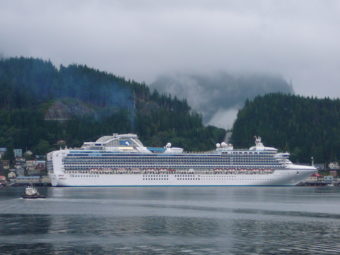
Disney and Princess cruise ships coming into Juneau
Disney and Princess cruise ships coming into Juneau. (Photo by Heather Bryant/KTOO)

The summer cruise ship season is like Christmas for a lot of coastal retailers, and they depend on the tourist income to stay open. But because the stakes are high, business can get a little dirty. For the first time, the Department of Law is cracking down on shady business practices allegedly taking place aboard vessels.

It’s a weekday afternoon, and the Mt. Juneau Trading Post is quiet. Four carvers are up in the loft area working on masks, and the only other person in the store is at the cash register. But in the summertime, the place comes alive. Tourists flock there to buy bentwood boxes, drums, and soapstone figurines.

Jack Tripp owns the place, and it’s a point of pride for him that the trading post doesn’t need to advertise with cruise ships to get their business.

“The store’s been there for 45 years, so it’s kind of a downtown institution and it’s the Native trading post in town,” Tripp says.

Tripp says that in the past, he’s been approached by cruise ship advertisers to see if the trading post wants to be part of their onboard shopping program. In exchange for a fee or a percentage of his sales, these third-party companies would advertise his business in store guides and in maps for passengers. They would also have their onboard representative — or “port lecturer,” in industry speak — promote his store directly to passengers.

“If you pay money, they’ll pitch your business in a favorable light and steer customers your way,” Tripp says.

I visited six stores in downtown Juneau, and Tripp was the only person I met who would speak about these port lecturers on tape. But that doesn’t mean the other store owners and employees didn’t have anything to say about them. A couple talked about the exorbitant fees they charged, running into the tens of thousands of dollars. One person described it as a kickback scheme. Others alleged that the port lecturers had a reputation for saying bad things about stores that didn’t play ball with them. And a few explicitly stated that the reason they didn’t want to talk on tape was because they didn’t want these companies to blackball them, since so much of their business is dependent on tourism.

Tripp spoke very carefully about the port lecturers and said he doesn’t fault the cruise ships or even the advertising companies for a situation “run amok.” And he says that as an established business, he’s never really felt real pressure to buy into the arrangement.

“But I could see if you were a more marginal store or if you were highly competitive — like if you sell t-shirts or jewelry where there are many, many options — it could be a very favorable tool to have the port lecturer talk about your store,” Tripp says.

Concern about the way port lecturers operate in coastal communities hasn’t escaped the attention of the state. On Monday, the Department of Law and the three Florida-based advertising groups that put port lecturers on board cruise ships reached a settlement over unfair business practices.

The agreement serves more as a warning than anything else, and it doesn’t include any admission of wrongdoing from Onboard Media, the Royal Media Group, or the PPI Group. But it does require them to pay over $200,000 for future enforcement of the state’s consumer protection act.

Ed Sniffen is an assistant attorney general, and he says the agreement also creates mechanisms for monitoring the companies’ activity. Their port lecturers are now required to make video or audio recording of their shopping presentations, and the Department of Law has the authority to request and analyze those tapes if they suspect consumers are being deceived.

 “The big penalties will come down the road if we find out there are violations, and if that’s the case and we become aware of them there are penalties of up to $50,000 that we can assess.,” Sniffen says.

The settlement also lays out what qualifies as disparagement of businesses that don’t participate in the cruise line shopping program. Port lecturers aren’t allowed to suggest that stores that aren’t part of their shopping program are risky.

It prohibits port lecturers from lying about warranties or price reductions. And it gives them a script to read about how they pick which stores to mention at the start of every shopping presentation. That’s to make sure:

“They aren’t misleading and that they’re not deceptive and that there’s full disclosure that these stores have actually paid to be featured in these programs, and some of them pay big commissions to the port lecturers and these shopping ambassadors that are giving these presentations on board the cruise ships,” Sniffen says.

Sniffen adds that the companies will also have to file two reports over the next cruise season on their efforts to comply with consumer protection law.

In an e-mail, Onboard Media stated that they were “very pleased to have the standards [they] have always followed formalized” through the settlement.

The Royal Media Group and the PPI group did not respond to requests for comment.


Cruise ship wastewater bill passes House

A bill sponsored by Gov. Sean Parnell to relax cruise ship wastewater standards passed the House on Monday. House Bill 80 was approved on a 27 to 9 vote. A similar measure is nearing a floor vote in the Senate.

In committee hearings on the measure, much of the testimony has focused around a preliminary report by the Cruise Ship Wastewater Science Advisory Panel. The report concludes that cruise ships have gone as far as possible toward meeting the state’s standards, and that there’s little benefit to the environment to be gained – even by spending millions more on technology.

A member of the majority opinion on the Science Advisory Panel stands by that claim, but the co-author of the 2006 ballot initiative which imposed the standards disputes it.

Haines resident Gershon Cohen’s background is in molecular biology. He’s frustrated by how proponents of the bills are framing their argument.

Well the department’s trying to say they’re doing this on the basis of the best science. And that’s completely backwards. The best science are the water quality standards – those are the limits which have been found, through scientific experimentation, to provide protection for fish, or humans, or whatever standard you’re using.”

In this case, the standard is for marine organisms. Cohen calls the administration’s effort to relax wastewater standards risk management, not science.

That’s a black-and-white world. And we don’t live in a black-and-white world.”

Sitkan Steve Reifenstuhl has been on the Cruise Ship Wastewater Science Advisory panel since 2009.

It’s important to look at the context. If we applied these standards to the City of Sitka, the Blue Lake dam would look cheap.”

Blue Lake is priced at roughly $140-million, the most expensive project in Sitka’s history. Reifenstuhl is a biologist, and a pragmatist.

The effluent and the waiver that every city that’s on the ocean’s gotten – from Anchorage to Ketchikan – puts out way more effluent, even the metals (they don’t even have to document nickel and zinc) copper, ammonia. It’s many times what the cruise ships put out.”

Gershon Cohen was initially appointed to the science advisory panel, but his name was pulled three weeks before the group convened, because of opposition from the industry, he says. Cohen, who co-wrote the language in the initiative that created the panel, says it was supposed to be looking at alternative technologies, like reverse osmosis.

And they ended up spending a lot of their time talking about how they were going to change the rule, and whether or not the discharges there now are okay, and the equipment satisfactory. And that wasn’t what they were supposed to be doing.”

Cohen says there is no recognized standard for Advanced Wastewater Treatment Systems used by cruise ships. He calls AWTS a “public relations term.” The bills before the House and Senate would sample wastewater – not at the point of discharge, but in a mixing zone outside the ship. Proponents say this is what coastal cities do. Cohen says ships are cities – that move.

You can’t survey the organisms, and what the water quality is like before, during, and after the discharge. So there’s absolutely no accountability.”

Reifenstuhl says cruise ships have been toeing the line since the late 1990s, following a series of egregious discharge violations. He suggests they’re less accountable than the rest of us for the cleanliness of the water.

If you just look at the million people that visit Alaska on cruise ships every year, and take 70-percent of those – 700,000 – compared to the 700,000 citizens of Alaska who are here 365 days. You do the math on that – which I’ve done – and it’s twenty times more.”

Reifenstuhl has a vested interest in fisheries. He’s visited several ships and seen the effluent that’s discharged – it often looks clear. But heavy metals wouldn’t color a glass of water. I asked him what if a cruise ship discharged in front of Bear Cove, where NSRAA’s Medvejie Hatchery sits just outside of Sitka. He said this was already happening in Juneau, where every ship calls.

There’s 15 million chum salmon, there’s chinook salmon released right there. Those fish are going to swim right by the cruise ships. There’s also 100-million chum salmon released just north of Gastineau Channel. And so those fish are in those waters. And so would I be comfortable? As long as it’s what’s happening in the Juneau waterfront, I would be comfortable.”

Cohen says the passage of the bills would be a setback to Alaska’s image, and provide a toehold for the farmed fish industry.

So much for Alaska producing fish that’s coming from pristine water. I think it’s a serious mistake, and it’s basically caving in to an industry demand that’s absolutely unnecessary.”

The 191-page report from the Cruise Ship Wastewater Science Advisory Panel is preliminary, and references about 500 pages of data. Reifenstuhl thinks the panel could meet for at least another two years to finish its work. He welcomes peer review of the group’s findings.

Top Chef in Juneau to be served up on TV next month

Top Chef contestant photo courtesy of Bravo TV

The cat is out of the bag, or, rather, the salmon is out of the net.

Starting next week, Juneau residents will be able to see the final product from last August’s super-secret television production that was believed to have included crew and contestants from the popular Top Chef television show. A production crew from Los Angeles-based The Mission Productions was identified as setting up at various locations in Juneau including Tracy’s Crab Shack, the Gold Creek Salmon Bake, Safeway, the Thunder Mountain High School kitchen, and the Governor’s House.

Alaska Department of Commerce, Community, and Economic Development officials confirmed in a release on Thursday that, yes, those were the final episodes of the tenth season of Top Chef that were being filmed in Juneau.

For all of those Juneau residents that signed non-disclosure agreements to keep mum in exchange for participation in the production, that means that relief may be just around the corner.

The January 30th episode featured the remaining contestants boarding a Celebrity Cruise ship.

The Juneau episodes will be broadcast on Bravo TV starting on February 6th with the Final Elimination Challenge, produced at the Governor’s House, to be broadcast on February 13th.

Cruise ship wastewater discharge deregulation moves in Alaska House and Senate

Sapphire Princess
The Sapphire Princess tied up in Juneau. Photo by Casey Kelly/KTOO.

Legislation sponsored by the Parnell administration to relax the state’s cruise ship wastewater discharge rules has now cleared both the House and Senate Resources Committees.

House Resources moved HB 80 Wednesday, with all seven Republicans on the committee voting to advance the bill, while the panel’s two Democrats said it needs more work.

Homer Republican Paul Seaton also said he couldn’t support the current version. But he didn’t want to block the bill from going to the next committee.

Seaton said he’s worried HB 80 would allow mixing zones, where multiple cruise ships can discharge wastewater in the same area. He’s also concerned about losing recent advances in pollution control made after the 2006 citizen initiative that ushered in current regulations.

“The mixing zones are being given. They’re not going to be really monitored,” Seaton said. “The individual vessels can become lax again, like they were in the past.”

Anchorage Democrats Geran Tarr and Chris Tuck unsuccessfully offered several amendments to the bill, including limits on where and when vessels would be allowed to discharge wastewater.

Tarr said she was concerned about the potential harm to salmon and other fish from heavy metals like copper, which is still used in the onboard wastewater systems of some ships.

“In five years, we’ll have missed the boat in terms of protecting [fish],” said Tarr. “So, hopefully we won’t look back on this and really regret our move today.”

At one point Tarr cited California standards, which prompted Anchorage Republican Craig Johnson to say California’s solution is “just say no.”

“I do not want to be compared to California. I do not want to be a state that just says no,” Johnson said. “I want to be a state that continues to work with industry, and maybe we can turn off that ‘Not Open for Business’ sign that we seem to have placed at the borders of our state.”

The bill has yet to be scheduled in another House committee. Companion legislation (SB 29) cleared the Senate Resources Committee on Monday and is currently awaiting a hearing the Finance Committee.

Non-resident hire continues to increase

The number of non-residents working on Alaska’s North Slope continues to increase, according to state Labor Commissioner Dianne Blumer.

She told the Senate Labor and Commerce Committee yesterday (Tuesday) that training programs are in place for Alaska hire, but a forthcoming report shows more workers hired from outside the state.

Blumer said an update on nonresidents working in Alaska is due out Thursday.  It tracks the percentage of nonresident workers in Alaska by industry, occupation, and geographic area.

The annual resident-hire report showed nearly 31 percent of workers in Alaska oil and gas industry came from outside the state in 2010.  It showed the percentage of nonresident workers in the oil and gas industry has historically been higher than the statewide average for all industries.

The Senate Labor and Commerce hearing was the first in the confirmation process for Blumer, who was appointed by the governor in May to replace Click Bishop, when he resigned to run for the Senate.

Many of the questions focused on Alaska hire, especially the North Slope.  Blumer said the Alaska Workforce Investment Board has developed an oil and gas pipeline plan and believes the petroleum industry will provide a lot of future employment opportunity in Alaska.

“We’ve identified 113 occupational job classes that would be needed if and when – I would like to say when – pipeline construction occurs.  So any company that comes and has a program that would meet any of those 113 occupational codes, we work with them to get people either in on the job training, registered apprenticeships, or just training programs,” shd said.

Blumer has worked 22 years in state service, in the Transportation and Administration departments as well as the governor’s office.  She’s a former director of the state Division of Personnel and has been a negotiator for the state in public employee union contract agreements.

The Senate Labor and Commerce Committee recommended Blumer be confirmed.  That must be taken up by the full legislature.

EPA fines Princess Cruise Lines for 2011 Clean Water Act violation in Glacier Bay

Princes Cruise Lines has agreed to pay a $20,000 fine for dumping water from on-board swimming pools into Glacier Bay National Park and Preserve in 2011.

The fine was announced by the Environmental Protection Agency Tuesday, along with six other enforcement actions taken in Alaska late last year.

In a signed consent agreement and final court order, the EPA says Princess violated the Clean Water Act in May 2011 when more than 66,000 gallons of pool water was discharged into Glacier Bay.

The order says there was a software malfunction on the ship the Golden Princess, causing the pool dump valves to open. The malfunction allowed chlorinated water from six of the ship’s pools and spas to drain into the national park and preserve.

Princess notified the EPA of the discharges the next day.

The wastewater permit for large cruise ships prohibits the discharge of pool or spa water in national parks and refuges. The federal Clean Water Act allows the EPA to fine cruise companies for permit violations.

The Golden Princess can carry more than 500 passengers and sails in Alaska during the summer. It sails to Hawaii, the South Pacific and South America at other times of the year.

Site notifications
Update notification options
Subscribe to notifications