Business

Juneau makes it to the top of a surprising list

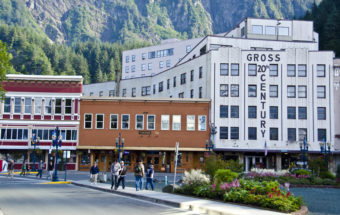
Downtown Juneau. (Photo by Heather Bryant)

When you think of cities with a lot of restaurant options places like Seattle, San Francisco, New York or New Orleans often come to mind.

However, a new study says that Juneau tops the list in terms of the most restaurants per capita in the U.S.

Juneau boasts 112 restaurants, which means there are 36 restaurants for every 10,000 people in the Capital City.

NPD group is an industry market research firm that did the study. According to their press release, the number of restaurants nationwide increased by 4,442 between the fall of 2011 and fall 2012.

They say the total number of restaurants in the U.S. is now 616,008. Their survey includes restaurants that were open as of Sept. 30, 2012.

Approximately 55 percent of the restaurants counted in the survey were independently owned.

Juneau, is followed by Salisbury, Maryland and Bend, Oregon then Panama City, Florida and New York City for the top five most “restaurant-crazy cities,” according to the Huffington Post.

Anchorage was number 7 on the list with 1,012 restaurants which equals roughly 24 restaurants per 10,000 people.


In new campaign, McDonald’s plugs Alaskan Pollock

The MSC logo on the Filet ‘o’ Fish packaging. (Image via McDonald’s Facebook page)

This week, McDonald’s doubled down on its commitment to Alaskan pollock. The chain announced that it will stop using other fish and switch to 100 percent Alaskan pollock in all 14,000 of its United States restaurants.

The pollock is served in Filet ‘o’ Fish sandwiches, and in a new menu item called Fish McBites.

McDonald’s also unveiled new packaging for those products, featuring the Marine Stewardship Council’s ecolabel. The label says McDonald’s fish is verified as sustainable, “wild-caught Alaskan Pollock.”

McDonald’s is paying the MSC to use that label, though they won’t divulge how much.

According to Erik Gonring, a public affairs representative with McDonald’s, it’s part of a strategy to attract socially conscious diners.

“We know customers are increasingly interested in knowing where their food comes from, and also understanding what a business does to be a responsible corporate citizen,” Gonring says.

Sylvia Ettefagh, who manages the fishing boats in the Unalaska Fleet Cooperative, says McDonald’s new menu and marketing could give Bering Sea fishermen a boost.

“With the addition of the fish bites, they’d be using more pollock,” says Ettefagh. “And it certainly isn’t going to hurt, by putting the MSC label on even their fish sandwiches.”

McDonald’s started using Alaskan pollock 55 years ago. Since then, the fishery’s developed a reputation for sustainability. It was certified by the nonprofit MSC almost a decade ago. Some environmental organizations have criticized the MSC’s standards as being too lax.

But regardless, the designation has given Alaskan fishermen an edge over their major competitors in Russia. Alaska’s pollock is more expensive, but considered more sustainable than Russian fish.

But now, the Russian fishing industry is now pursuing the MSC designation as well. One segment of the Russian fishery just passed its sustainability study with the lowest required score.

Ettefagh says that’s a big letdown for Alaskan fishermen:

“We’ve worked hard at getting the word out and changing things within our own systems, to step up to the plate and be good stewards and good citizens,” says Ettefagh. “And yet, the Russian certification is sliding in on the minimum.”

Gonring, the McDonald’s PR representative, says he can’t confirm whether McDonald’s would buy fish from a certified Russian source.

“I know that our commitment is to source from 100% sustainable fisheries, and the MSC standard is the one we’ve chosen,” Gonring says.

The MSC is supposed to make a final judgment on the Russian pollock fishery in February. McDonald’s new Fish McBites will also debut in February.

Check out McDonald’s promotion of their fish sources in Alaska:

Annie’s frozen pizzas recalled

Annie’s Homegrown has issued a recall for all varieties of the company’s frozen pizzas, because they may contain fragments of flexible metal mesh.

Annie’s manufacturers have metal detectors, but pieces of fine wire have been found in flour and dough.

That’s according to a release from the Alaska Department of Environmental Conservation. The department says Annie’s pizzas are sold at stores in Alaska, but there have been no complaints, illnesses or injuries here or elsewhere.

All Annie’s rising crust frozen pizzas with a best by date between January 9th and September 14th of this year are affected by the recall.

Varieties include pepperoni, supreme, cheese, spinach and mushroom, and barbecue chicken.

Bill would lessen cruise ship discharge standards

This poster illustrating cruise ship wastewater was displayed at a Sept. 20, 2012, science panel open house.

The Parnell Administration wants to change another part of the 2006 cruise ship initiative.

The voter-approved measure required strict new standards for wastewater discharges.

Bills introduced this session at the governor’s request would effectively allow more chemicals and minerals to be released into the water. Backers say the levels would still be safe.

Senate Bill 29 had its first hearing Wednesday before the Senate Resources Committee.

Environmental Conservation Commissioner Larry Hartig told the panel the bill would allow a more practical approach to controlling pollution.

“It recognizes that it’s really difficult, if not impossible, for many dischargers to meet the water quality standards at the point of discharge,” Hartig says. “So they allow a limited area of mixing the treated effluent … with the receiving water at the edge of the mixing zone. “

The industry has asked state officials to make such a change. Cruise lines say strong new standards that start in 2015 are impossible to meet.

Hartig says wastewater-control measures would remain in effect under the legislation.

“It can’t bioaccumulate, it can’t have toxic effects, it can’t affect anadromous fish that would be going through that area, it can’t affect that water body’s ability to produce aquatic life in the future. It just goes on and on about the things it can’t do,” Hartig says

The committee took no testimony, but the measure has opposition.

“I think the bill is unnecessary,” says Chip Thoma, president of Responsible Cruising in Alaska, which backed the 2006 initiative standards.

“And the reason is because the cruise ships and DEC have made such great improvements in the last few years in lessening the effects of some of their discharge problems,” Thomas says

Thoma and Hartig both agree it’s important to remove copper from cruise-ship wastewater. That’s because, among other things, it affects salmon behavior.

Thoma says copper-removal is an example of how new technology can reduce pollution.

“These are older ships that were all piped with copper. The new ships are all flex-piped with plastic. It’s an incredible revolution. Just in the last few years, we’ve eliminated the copper problem on the new ships,” he says.

An appointed science panel has been investigating technological solutions for about two years. Hartig says it hasn’t found economically-viable equipment.

The Senate Resources Committee will hold another hearing Friday afternoon where it will take public comments on the bill. An identical bill will be heard that day in the House Resources Committee.

The Legislature has already rolled back one part of the cruise ship initiative.

At the administration’s request, it reduced head taxes that fund local tourism projects by more than 50 percent. It did not change a portion of the tax that funds onboard environmental monitors.

Alaskan Brewing Company recycles grain to make “green” beer

Brandon Smith
Alaskan Brewing Company Engineer Brandon Smith holds a bag of spent grain, now the sole source of heat for the company’s beer making operations. Photo by Casey Kelly/KTOO.

Most people only drink green beer on St. Patrick’s Day. But next time you tip a bottle of Amber, Pale or IPA from Juneau’s Alaskan Brewing Company that’s exactly what you’ll be drinking: Green beer, as in good for the environment.

Alaskan has cut its oil consumption by nearly 70 percent after installing a new grain-fired steam boiler, which burns spent barley used in the brewing process.

As any good home brewer can tell you, the basic beer ingredients are water, barley, hops, and yeast.

While the finished product is best enjoyed cold, making beer involves a lot of heat. Malted Barley is combined with hot water in a process called mashing. After various temperature increases, the barley-water mixture, or wort, is brought to a boil.

“We have to boil it. We have to cool it down. We have to move heat from one place to another,” says Brewing Company Engineer Brandon Smith. “It takes a tremendous amount of energy.”

As of late last year, Smith says Alaskan is using spent grain from the brewing process as the sole source of heat for making more beer.

When the company started in 1986, burning oil was the only heat source. In the mid ‘90s, Smith says Alaskan began burning some spent grain, but not for making beer.

“Since we put in this large brew house in 1995 we have been burning some of our spent grain to generate hot gasses to dry more spent grain,” he says.

Some Lower 48 breweries give away used grain to farmers for cattle feed. But with no farms in Juneau, Smith says Alaskan started drying its spent grain to make it easier to ship down south.

Then a mash filter press installed in 2008 produced an even dryer spent grain product, resulting in about a 30 percent decrease in the brewery’s oil consumption. But Smith says the company didn’t want to stop there, wanting to recapture as much of the byproduct as possible for use in the brewing process.

“It’s kind of like a coarse flour,” he says. “It’s very dry, burns pretty well. The trick is that burning spent grain isn’t like burning sawdust or any other traditional fuel.”

So, Alaskan ordered a custom built steam boiler, which burns the grain at about 1,600 degrees Fahrenheit. After a few months of tweaking it finally came online in late 2012.

With a price tag of $1.8 million, it didn’t come cheap. But Smith estimates a 65 to 70 percent reduction in oil use, or about 150,000 gallons per year.

Alaskan Brewing Co. steam stack
The steam stack at Alaskan Brewing Company’s headquarters in Juneau’s Lemon Creek area. Photo by Casey Kelly/KTOO.

“We expect further gains in that percentage by creating other efficiencies in the operation,” Smith says. “The eventual goal is to be completely oil free. Whether or not we ever achieve that, I don’t know. We’re going to get as close as we possibly can.”

Julia Herz is the craft beer program director with the industry group Brewers Association. She says it’s not unusual for small breweries to reuse materials as much as possible. In fact, Herz says it’s ingrained in the business model of craft beer.

“The small brewers can experiment in very creative ways and that’s what’s exciting as a beer lover frankly,” Herz says. “To watch these breweries dip their toe into the business world as much as the innovation world in beer styles.”

In addition to cutting its oil consumption, the new boiler means Alaskan is no longer shipping grain to the Lower 48. That’s yet another cost saving measure, and as Smith points out it too is reducing the company’s carbon footprint.

“From a corporate sustainability standpoint, we want to make as much use of the materials we have as we can,” Smith says. “So, keeping that material here in Juneau, keeping that much oil out of Juneau, and not having to burn that fossil fuel is a big advantage for everyone.”

And it could make many in the Capital City and around Alaska want to raise a glass to green beer.

Developers to CBJ Assembly: ease regulations and provide more incentives for housing

Developers
Local developers from left to right: Murray Walsh, Richard Harris, Wayne Coogan, Dave Hanna, and Jeff Grant. The Assembly is asking members of the local housing industry for recommendations on housing. The developers’ panel was the first to present at a Committee of the Whole work session Monday night. Photo by Casey Kelly/KTOO.

The City and Borough of Juneau should relax its planning and zoning regulations and implement tax incentives to encourage more home building.

That was the message a panel developers had for the Juneau Assembly Monday night in the first of series of discussions assembly members hope to have with representatives of the local housing industry.

Wayne Coogan of Coogan Construction did most of the speaking on behalf of the developers. He acknowledged that a lot of factors go into the cost of housing — land, materials, labor, and insurance to name just a few. But he said planning and zoning influence all of them.

“Housing is regulated by all branches of government, federal, state, etc,” Coogan said. “However, the most influential and overreaching regulations are the local zoning and building codes administered by the city.”

The developers gave the Assembly a list of 18 recommendations to make it easier to build homes in Juneau. They range from eliminating the city-led plan review, which is required even when a licensed architect or engineer is involved in a project, to tax incentives for subdivision amenities and new multi-unit construction.

General contractor and consultant Dave Hanna urged the Assembly to look into a new state law that allows municipalities to defer property tax increases on new subdivision lots until those lots are sold.

“The difference between the property taxes on a raw piece of land and a subdivision that’s about to be built is atrocious,” said Hanna. “It would go from a few thousand an acre to maybe $150,000 for a large subdivision. This basically doubles the carrying costs for a developer who’s trying to bring a new subdivision on line.”

Assembly member Jesse Kiehl noted that much of the city’s building code is based on national and international standards. He asked the panel if there was a better approach for Juneau.

Coogan didn’t give any specifics, but encouraged the Assembly to pursue it.

“You’re raising a point that should be looked into,” he said. “Spend a few dollars on some legal research and find out how much liberty the city has to surgically modify the code for its own use.”

Other members of the developers’ panel included Murray Walsh, Richard Harris and Jeff Grant.

Juneau has some of the highest costs and one of the tightest markets in the state when it comes to housing. The Assembly also plans to meet with property owners, lenders and realtors to find solutions to the problem.

Monday’s meeting took place at a Committee of the Whole work session. The Assembly’s ad hoc Housing Committee continues to work on organizing a one-day summit that would bring together all segments of the industry.

Site notifications
Update notification options
Subscribe to notifications