Business

Administrative law judge sets hearing on Arrow Refuse, state Law Dept. agreement

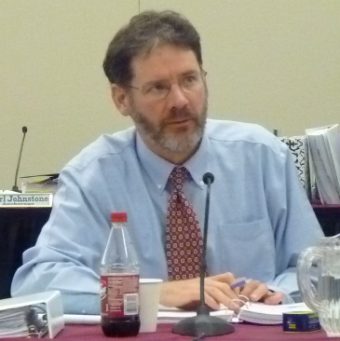
Photo by Heather Bryant/KTOO.

An administrative law judge wants to review an agreement that allows Arrow Refuse to include container rental fees in the overall rate for garbage pickup in Juneau.

Judge John P. Wood on Tuesday ordered the state Law Department and Alaska Pacific Environmental Services to address the September settlement agreement at a December 14th hearing in Anchorage.

Alaska Pacific Environmental Services is the parent company of Arrow Refuse, which rolled out its automated trash pickup service in June. Since then, most Arrow customers have been charged a monthly rental fee for specialized garbage cans that include a gravity lock lid designed to comply with the City and Borough of Juneau’s bear ordinance. Some customers have continued to use their own containers, but Arrow charges a tipping fee if a worker has to manually dump trash into a garbage truck.

The Regulatory Commission of Alaska, which sets the amount Arrow can charge for its services, allowed the company to move forward with the new pickup system using an interim rate. But the RCA said it would rule later on whether the company can charge a separate container fee.

The agreement appears to resolve that issue, pending the regulatory commission’s approval. However, Judge Wood wants to hear how it affects customers who purchase their own garbage cans.

The RCA has given Alaska Pacific Environmental Services until September 2014 to file a cost of service study to determine how much the company can charge for its automated service long term. The study will be based on Arrow’s operating costs for the 2013 calendar year.

OSHA hands out $55,000 in fines for ammonia spill

It’s been four months since an ammonia spill on a processing vessel shut down parts of Unalaska. Now, the Occupational Safety and Health Administration has wrapped up their investigation into the accident.

The result: more than $55,000 in fines – and some valuable lessons for emergency responders.

This July, the Seattle-based processing vessel Excellence was on its way to Unalaska when the crew discovered a tiny leak in their ammonia line. They tried to empty it out, and called Alpha Welding to patch the hole.

According to Scott Ketcham, OSHA’s Anchorage area director, that’s where the trouble started.

“The ammonia line would have been, or should have been, evacuated,” says Ketcham. “In this case, the valve was not locked out, and they cut into a live line.”

That oversight is one of five worker safety violations that OSHA found on the Excellence. All five were rated “serious,” and one was a repeat offense. That added up to $50,000 in fines for the seafood company that owns the vessel.

In all, two welders and a crew member from the Excellence were exposed to a cloud of ammonia. They were sent to the hospital, where one welder was treated for serious lung damage. The rest of the ship’s crew was evacuated. Roads around the Kloosterboer cold storage dock, where the Excellence was tied up, had to be shut down.

Abner Hoage had been Unalaska’s fire chief for just two weeks when the spill happened. He was fresh out of the Air Force, and had just moved to town from Idaho. While he was up for a challenge, he didn’t know what kind of assistance he could expect.

Fortunately, it didn’t take long for local processors to offer help.

“Westward provided personnel to participate in the command structure. They had a refrigeration expert who was out there a lot,” Hoage says. “UniSea was down there with their hazmat team and personnel. Alyeska had people down there with equipment and personnel.”

The plants also offered to house the displaced crew of 130 people for more than a week while the Excellence was fixed. In a way, Hoage says, the accident had its upsides.

“I got to meet people and develop relationships with the industry and the other resources in the community that may have taken me a year to otherwise meet,” says Hoage.

Hoage says he’s also writing up agreements with the processors that lay out their response capabilities so the city is prepared for future emergencies.

In the wake of the ammonia leak, the city also learned it can call on Anchorage’s fire department. That agency has said they’re willing to charter a plane or use military aircraft to get to Unalaska in the case of a big emergency.

For now, OSHA’s case against the Excellence is still open. Anchorage-area director Scott Ketcham says the vessel’s owner has been extremely cooperative. Premier Pacific Seafoods has planned a serious overhaul of their safety system, which he says helped them get their fines reduced from $65,000 to $50,000.

“Yes, there was some reductions in return for good faith,” Ketcham says. “But they gave us some really good corrections for these things, happening in the future. And I feel very comfortable with the other contractor.”

By “other contractor,” he means Alpha Welding. OSHA found that they didn’t have the right permits or properly-fitted safety equipment when they took on the Excellence welding job.

Their fine was only $4,000, but they’ve spent five times that amount on new safety programs and permits. Going forward, Alpha Welding has a new rule when working on refrigeration systems. They won’t make the first cut into a pipe that could potentially contain ammonia. Instead, they’ll leave that up to the ship’s crew.

Sealaska dividend due out in December

Sealaska shareholders will soon get their largest end-of-year dividend in three years.

Sealaska Plaza, the corporation's Juneau headquarters. Officials announced the December distribution, the largest in three years.
Sealaska Plaza is the corporation’s Juneau headquarters. Officials have announced the December distribution, the largest in three years.

But it’s mostly due to the success of another regional Native corporation.

The Southeast regional Native corporation will issue dividends to about 21,000 shareholders on or around December 6th.

Payments range from $96 to $868, depending on the class of shareholders.

Almost 90 percent of the larger dividends are funded by a pool of all regional Native corporations’ resource earnings. It’s known as 7(i) money.

Sealaska spokesman Todd Antioquia says it’s mainly from the Red Dog mine, owned by the Kotzebue area’s corporation.

“NANA continues to be the bulk of the distribution. Historically, Sealaska was the major contributor to 7(i) revenue sharing throughout the state through our own [timber] resource development,” he says.

Shareholders who are also members of urban Native corporations, such as Juneau’s Goldbelt, will receive $772. That’s assuming they have 100 shares of stock, the most common number. (Scroll down for all classes’ numbers.)

Members of village corporations, such as Angoon’s Kootznoowoo, will only get $96 directly. That’s the part of the dividend funded by corporate earnings. But Sealaska will pay the rest to their local corporation, which can pass part or all of the money on to shareholders.

Qualified descents of original shareholders will get only $96. And enrolled elders will be paid an extra $100 or so.

A little more than 5 percent of the larger dividends are paid out of corporate earnings, including investments. A slightly larger percentage comes from Sealaska’s permanent fund.

Its payments are based on a five-year earnings average. Antioquia says that’s been held down by low returns from the Wall Street crash.

“We have continued to feel the effects of 2008 through the last few years. Now that 2008 is rolling off of these averages into the future, as long as the markets remain stable or if they continue to improve, then we’re optimistic that we’ll see improvement there,” he says.

This December’s distribution is about 10 percent more than 2011’s, and about 35 percent more than 2010’s. But the previous two years were 37 and 26 percent more, respectively. (Scroll down for a five-year perspective.)

December’s payout totals about $13 million. Last April’s came to $14 million. That means shareholders are getting a total of around $27 million this year.

A little less than half live in Southeast. That means dividends are contributing about $13 million to the region’s economy this year.

Brian Holst of the Juneau Economic Development Council says it’s significant, especially to villagers.

“We know the Alaska Permanent Fund in some rural communities can be a very significant part of income. And in that sense, a Sealaska dividend can be similar to the permanent fund dividend in that it helps maintain a lifestyle in these small communities, which is very important for the sustainability to these places,” Holst says.

Holst ran the numbers and came up with several ways to explain the dividends’ economic impacts.

He says the total equates to the annual income of nearly 300 average Southeast Alaskans. Or a quarter of the region’s mining wages. Or around half of the value of seafood landed in Juneau.

Holst says it’s also about 7 percent of what tourists contribute.

“We know our cruise-ship passengers spend about $200 per person when they visit Juneau. And so, if we were going to think of that infusion of the Sealaska dividend as though it were cruise-ship passengers spent the same way, that would be the equivalent of about 68,000 cruise ship passengers additional in our communities,” he says.

Sealaska pays dividends twice a year.

Its businesses include timber, gravel, investment, plastics, government-contracting and environmental-cleanup operations.

December 2012 Distribution & Stock type:  Per Share   Per 100 Shares

Non-Elder Urban and At-Large Shareholders        $7.72                  $772

Elder Urban and At-Large Shareholders                 $8.68                  $868

Non-Elder Village and Leftout Shareholders          $0.96                    $96

Elder Village and Elder Leftout Shareholders         $1.92                  $192

Descendant Shareholders                                       $0.96                   $96

December dividend only per 100 shares for urban shareholders

2012:    $772

2011:    $714

2010:    $577

2009: $1,227

2008: $1,046

Yearly total per 100 shares for urban shareholders

2012: $1,617

2011: $1,430

2010:   $989

2009: $2,208

2008: $1,605

The Sealaska dividends distribution chart, courtesy Sealaska.

Can small wood-gas systems lower energy costs?

Wes Tyler, left, stands by a new wood gasifier at Icy Straits Lumber in Hoonah. John Hillman of the Hoonah Indian Association is on the right
Wes Tyler, left, stands by a new wood gasifier at Icy Straits Lumber in Hoonah. John Hillman of the Hoonah Indian Association is on the right. Photo courtesy Sealaska.

Wes and Sue Tyler run Icy Straits Lumber & Milling in Hoonah, about 40 miles west of Juneau. They make log cabin kits, siding, beams and other finished products out of Southeast Alaska wood.

But high energy prices have increased operating costs. A particular problem is equipment used to dry damp wood.

So Wes watched closely as a new system using wood chips to generate electricity was turned on earlier this month.

“All of a sudden the engine comes to life and we’re able to go in and turn on all the lights in the building and a fan that was pushing some warm air around in the dry kiln and with a few more KWs involved, why you could ultimately have the dry kiln running on that sort of fuel,” Tyler says.

The system is called wood gasification.

It’s part of an experiment to see if compact devices – this one is 4 by 4 by 8 feet high – are a viable alternative to oil-powered systems.

So far, the generator at the Tylers’ has been working fine.

Sealaska Executive Vice President Rick Harris, speaking at a press briefing in Juneau, says Icy Straits Lumber is the right place to try it out.

“He’s already got the wood supply there. He has the technical know-how to deal with these kinds of things. But based upon his experience then we can see if we can transfer this type of technology to other areas,” Harris says.

In fact, a second unit is also being tested at the mill, for eventual use at a Hoonah tourist attraction.

Wood gasification is not new technology. It’s been around, in one form or another, since the late 1800s. Small gasifiers were even used to power cars, trucks and trains in German-occupied territory during World War II fuel shortages.

How they work is not that complicated.

“So what we do in a gasifier is burn part of the wood and generate heat, which converts the solid to a gas,” says consultant Tom Miles of Portland. He worked with Sealaska’s Haa Aaní subsidiary and Icy Straits Lumber to select and install this particular system.

“And then the mixture of the gas with charcoal solids further reduces the fuel to a fuel gas. And the fuel gas is about half nitrogen, about 20 percent carbon monoxide, and about 20 percent hydrogen. And that will burn in an internal combustion engine,” Miles says.

Sealaska’s Rick Harris talks about wood gasifiers at a Thursday press briefing while consultant Tom Miles listens. Photo by Ed Schoenfeld.

It’s not as efficient as gasoline or propane. And it won’t replace hydropower. But if wood scraps or leftovers from milling or thinning trees are easily available, it can be cheaper.

Miles says it can take about a third off the cost of a diesel-powered generation. (Read more about wood gasifiers.)

“We will be not only generating electricity but we can capture waste heat from the engines so it’s micro-scale combined heat and power [system],” he says.

Sealaska’s Harris says a Hoonah lodge-owner has already shown interest in the system.

And the corporation is working with the Icy Strait Point tourist attraction, which is owned by Hoonah’s village Native corporation, to use gasification to power and heat a cultural center, and eventually, a greenhouse.

“It’s one of those things where in the summer they have a lot of visitors come in. So we can grow in the greenhouse certain plants and vegetables that they can use. And then in the winter when they’re not using it, we can move that stuff into the Juneau market or the local market,” Harris says.

Sealaska and its consultant have looked at a lot of gasification options. Harris says the Hoonah experiments will show whether they chose the right technology.

“In a month, Wes may tell us this just isn’t going to work. I think we’re fairly optimistic that it will work. But that’s why we’re doing it in a place where we have the ability to make the necessary adjustments and to prove it can work in a rural community environment,” he says.

Sealaska’s energy experiments have been funded in part by the federal Department of Energy and other sources.

It’s already heating its Juneau headquarters with a wood-pellet boiler, which is cheaper than diesel heat. It also considered building a waste-wood ethanol plant at Ketchikan’s Ward Cove, but concluded it wasn’t economically feasible.


Alaskan Brewing’s Birch Bock wins silver at Great American Beer Fest

Alaskan Brewing Company employees (Left to Right) Brent Kesey, Darin Menapace (Top row), Mike Jaskari (Bottom row), Curtis Holmes, Rob Day, and Suzanne Lawless toast the Alaskan Birch Bock’s silver medal at the Great American Beer Festival on Saturday October 13, 2012. Photo courtesy Alaskan Brewing Company.

A beer brewed by Alaskan Brewing Company in Juneau won a silver medal at last weekend’s Great American Beer Festival in Denver.

The Birch Bock placed second in the “Specialty Beer” category, for beers that use “unusual fermentable sugars.” In this case, birch syrup harvested from Alaska’s Interior.

“It’s a lager. It’s kind of dry and malty and you get a little bit of a tart-ness from the birch syrup,” says Alaskan Brewing Company Brewer Rob Day. “You can taste the alcohol a little bit. It’s at 8.5 percent. So, it’s one of those beers that you don’t want to drink more than four pints, but you can sit there and drink it and enjoy the flavors you get from it.”

The Birch Bock was released in March as part of Alaskan Brewing’s limited edition Pilot Series. As with all the brewery’s smaller releases, it was a collaborative effort.

“We all kind of had a hand in it throughout the brewery,” says Day. “We start usually on a one barrel and then we scale it up and then everyone gets their little say on it, and then we go from there.”

The birch syrup came from two manufacturers based in the Mat Su area – the Alaska Birch Syrup Company and Kahiltna Birchworks.

Day says Alaskan Brewing strives to use home-grown ingredients whenever possible.

“The Alaskan brewery is based in Alaska, so the more Alaska ingredients we get to use, that’s a bonus and it helps out other companies in Alaska,” he says.

The Alaskan Brewing Company is no stranger to the Great American Beer Festival awards. The brewery has attended the event 25 times in its 31 year history, bringing home 23 medals.

More than 660 breweries entered more than 4,300 beers in this year’s competition. The 185 judges, representing 11 countries, decided which of the 84 categories each beer would be judged in.

Tour businesses meet, discuss mixed season

Fishermen pass the ferry Kennicott in Whittier’s harbor at the end of the 2011 season. Ferries and cruise ships deliver tourists to Southcentral at this port. Photo by Ed Schoenfeld.

About 500 people are in Anchorage this week for the Alaska Travel Industry Association’s convention and trade show.

They’ll hear from a variety of industry experts and advocates.

ATIA President Ron Peck says this year’s tour season was mixed, with more cruise passengers and fewer people driving the Alaska Highway.

He says the good news is a larger percentage of international tourists.

“We’re very encouraged by the fact that Korean Airlines and Japan Airlines both offered charters again this year. But the other great news, because I think folks see market opportunity, is the fact that Iceland Air has announced twice-weekly service starting in 2013,” Peck says.

Another airline, Condor, offers direct flights to and from Germany.

The cruise-passenger increase was about 6 percent. Similar growth is projected for next season, bringing the total up to about a million people.

There’s bad news as well. Peck says non-resident sport fishing license sales, once a third of a million, have trended downward. That means fewer people are coming to Alaska to fish.

The nearly 25 percent drop, over six years, is tied to stricter halibut catch limits and poor runs.

“Given the fact that fishermen talk, and given the fact that there’s still concerns about the overall sustainability of the halibut fishery and concerns that people are seeing in the Kenai and Mat-Su drainages, we as an industry are concerned about what’s happening with the fishery in Alaska,” Peck says.

The tourism industry convention runs Tuesday through Thursday at Anchorage’s Dena’ina Center. ( ATIA convention agenda.)

Peck says in-state marketing is also on the table.

“I think we’ll continue to see discussion about funding levels and the level of involvement from the state and the industry in terms of the actual tourism marketing program.

Those attending will also hear updated statistics and attend skill sessions such as Cultural Sensitivity and Social Media Techniques. Speakers include Daniel Halpern of Brand USA, which targets foreign visitors. U.S. Senator Mark Begich will also speak.

About a million and a half tourists come to Alaska during the summer season.

Tour industry data compiled by the state.


Site notifications
Update notification options
Subscribe to notifications