Energy & Mining

Federal funding to bring $200M in electrical grid improvements for Alaska’s Railbelt

Bradley Lake Dam in 2014 (Ian Dickson/KTOO)

The Biden administration is sending Alaska more than $200 million to improve the Railbelt electrical grid, which runs from Homer to Fairbanks.

The project includes a high-voltage submarine cable between the Kenai Peninsula and Anchorage and multiple battery energy storage systems.

All three members of Alaska’s congressional delegation lauded the Department of Energy award. In a joint press release, they noted that the money comes from the Bipartisan Infrastructure Bill of 2021, which both U.S. senators voted for.

Congresswoman Mary Peltola says her office took the lead on pressing the Biden administration for the grant. She says she personally spoke to the president and the Energy secretary about it.

“Every penny that we asked for we received so I think that really says something,” she said.

The Alaska Energy Authority has long advocated for infrastructure improvements to make the grid more reliable and to better deliver hydroelectric power from Bradley Lake, near Homer. The federal grant must be matched by an equal amount from elsewhere, bringing the total to $413 million.

Peltola says the improvements will allow power from a variety of sources.

“We’ve got to update our grid to allow for renewables to go into the grid and provide some redundancies,” she said. “And with our extreme weather and long distances, it certainly is an investment that we need to make.”

The project is expected to be completed in eight years.

Correction: The original version of this story relied on a press release from the congressional delegation to report that the Alaska Energy Authority would provide the matching funds. The AEA says the source of the required match has not been identified.

At water blessing ceremony, Klukwan residents speak out against planned mine

(Alain d’Epremesnil/KHNS)

On Thursday, Klukwan residents led a water blessing ceremony to honor the Chilkat watershed and the life it sustains in the valley.

Under a steady rain, organizers set up shelters and started a fire by the bridge over the Klehini River, 26 miles from Haines. They held hands and listened to Lani Hotch tell the story of how Raven brought fresh water to the world.

”We have very deep roots here, and we feel a keen sense of responsibility to protect the river for future generations who will live here,” Hotch said. “And not just humans. The eagles are our neighbors, the bears are our neighbors, the wolves.”

Hotch said she sees eagles pick salmon out of the river, sometimes out of her own fishing net. She said she often finds the remnants of those fish at the bottom of a tree. The carcasses decompose into the soil and feed the trees, keeping the forest alive. Hotch said this healthy interconnection is threatened by the Palmer project, a large hard rock mine that is being planned upstream from her village.

“We don’t want the mine, we don’t need the mine,” Hotch said. “Extraction economies, they are destructive, it’s not something we should build our hopes on. It doesn’t pay off in the long run. These salmon have supported our people for countless generations.”

The crowd had grown to over 150 people by noon. Organizer Nancy Keen led children in songs and activities.

“We place a message onto a piece of wood. A prayer to the water,” she said. “Klehini River. And just say a prayer, and give it back to the water. So now we have these kids here, and they are about to do the same.”

Finally, the crowd moved toward the bridge carrying signs: “Nurture our wild river.” “We are all in this together.” “Protect the Klehini.” “Our rhythms are connected, and irreplaceable.” “No to the Palmer project, keep the river clean.”

They stopped in the middle of the bridge and waited for Lani Hotch to speak. She was wearing the Chilkat River robe, with symbols representing the five species of Salmon that return to spawn in the watershed.

Hotch began the ceremony: “Father God, Our Creator. Ever present Spirit. We need your help today. Out river, we want to protect it. We want it to flow in good health, in perpetuity, forever.”

Participants cast their pieces of wood and their blessing into the river, and Tribal Council President Kimberley Strong spoke.

“I think that we’ve never come out and said we are in opposition to the mine,” she said. “We support the environment and the way of our lives that our ancestors have taught us. I am afraid of this hard rock acid mine, and what it will do to us.”

The crowd then slowly walked off the bridge.

Daniel Klanott is a resident of Klukwan, he was at the event.

“I’m here today to stand with everybody else on protecting the water,” he said. “We need to protect the water to protect the salmon, because salmon is a way of life in this valley.”

Resident Jack Strong agreed.

“I live in Klukwan. This is our life, it always has been our life for thousands of years. And I can’t see why we would want to change anything. For what? What is the gain for the world? To take and ruin this? Nothing,” he said.

Strong described her own role at the event.

“I’m not the person that developed this event, I am here because as a community leader, you follow your people. And so I’m here following my people who want to protect the environment and our river and our way of life.”

An international tribunal has recently agreed to hear a case brought by a coalition of Southeast Alaska Native groups. They claim upstream pollution from Canadian mines violates their right to life, health, wellbeing and the “benefits of culture.”

Nancy Keen said she sees this regional organizing as positive.

“We are going to be at the table and speak to these things that we know we have a right to speak to,” she said. “The inherent right to our traditional foods. The way that we are going to take care of our world in a good way.”

Hotch agreed.

“Why is it ok to dump toxic waste? Is it because our people don’t count? What’s up with that? We need social justice for all people. We are not going to sit back and be quiet about it, this is our life, this is our way of life, this is our home,” she said.

Representatives for Constantine Metals, who owns the Palmer project, did not respond to a request for comments on their relationship with the Chilkat Indian Village.

The Donlin Mine project in Southwest Alaska is facing legal challenges over water impacts

""
Justin Andrew and Gregory Larson work examining and classifying core samples at the Donlin Mine on Aug. 11, 2022. The hill outside the building holds the gold deposit that would be mined if Donlin goes into production. The mine is controversial, and opponents have filed legal challenges to key state permits and authorizations for the project. (Photo by Yereth Rosen/Alaska Beacon)

State permits allowing water use by the proposed Donlin Gold mine face new legal challenges from opponents of the huge project in Southwest Alaska.

The most recent challenge was lodged on Monday, when two tribal governments appealed to the state Supreme Court to overturn a lower court decision upholding state-issued permits. Those permits to withdraw water had been approved in April 2022 by the Alaska Department of Natural Resources; they were affirmed on Aug. 31 by Anchorage Superior Court Judge Dani Crosby.

The appeal of the ruling on the DNR permits follows a separate challenge to an Aug. 18 action by the Alaska Department of Environmental Conservation that certified the mine project as meeting state water quality standards. The department’s action renewed what is known as a 401 certificate, named after a section of the federal Clean Water Act. This certificate is required before a project can discharge wastewater, under the act.

The Orutsararmiut Native Council, one of the tribal governments involved in the appeal to the Supreme Court, filed a motion in state Superior Court on Sept. 11 that seeks to overturn the certification.

The Donlin Gold project, located about 145 miles northeast of Bethel, would be one of the biggest open-pit gold mines in the world. It has deposits estimated at 33.8 million ounces. Because it is located on Native land with Native-owned mineral rights, revenues would be shared among all Alaska Native corporations. But opponents argue that the mine would damage the ecosystem of the Kuskokwim River, including important salmon runs.

Those potential impacts are the reason for the legal challenges, the plaintiffs said in a statement released by Earthjustice, the environmental law organization representing them.

“The impacts from this proposed open pit mine, which would be the largest pure gold mine in the world, must be taken seriously and considered comprehensively,” Orutsararmiut Native Council Executive Director Brian Henry said in the statement.  “The State has an obligation to protect the Kuskokwim River and its tributaries from possible environmental damage caused by the Donlin Gold Mine. Our very existence and ways of life depend on it.

But state officials believe that agency actions have been proper.

“The state is confident that the Superior Court reached the correct result in affirming that DNR acted appropriately in approving Donlin’s water appropriation applications, and we look forward to defending the decision on appeal to the Supreme Court,” Department of Law spokesperson Patty Sullivan said by email.

As for the 401 certification, then-Commissioner Jason Brune, who issued the renewal, said in his Aug. 18 decision that the objections that Orutsararmiut Native Council raised – which concerned water temperature and young salmon — were outside the scope of the department’s consideration.

The mine permits being challenged are among numerous permits and approvals that have been issued for the project.

In addition to the new actions on the DNR and DEC permits, two other legal challenges are working their way through courts. One, from five tribes and the environmental group Cook Inletkeeper, is targeting the state right-of-way lease for a pipeline that would supply natural gas to the mine. That case is pending with the state Supreme Court. Another case, with six tribes as plaintiffs, is pending in federal court and challenging the authorizations granted by the U.S. Army Corps of Engineers and the U.S. Bureau of Land Management. That lawsuit was filed in April in the U.S. District Court in Alaska.

This story originally appeared in the Alaska Beacon and is republished here with permission.

Tesla needs graphite. Alaska has plenty. But mining it raises fears in nearby villages.

The traditional Iñupiaq village of Teller sits on a long spit of land separating two bodies of water off Western Alaska’s Seward Peninsula. The bay of Port Clarence is west toward the Bering Sea, and Grantley Harbor is inland to the east. (Berett Wilber for Northern Journal)

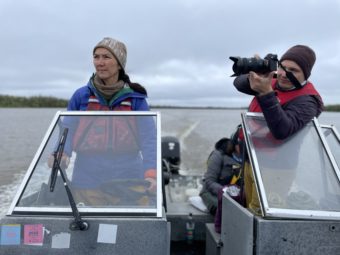
SEWARD PENINSULA, ALASKA — Ducks and swans flew overhead as Sylvester Ayek, 82, and his daughter Kimberly, 35, hauled rocks to anchor their small salmon net on the bank of a deep, tidal channel — 25 miles inland from the open Bering Sea coast.

Nearby on that July day, Mary Jane Litchard, Ayek’s partner, picked wild celery and set out a lunch of past subsistence harvests: a blue-shelled seabird egg, dried beluga whale meat and red salmon dipped in seal oil.

Then, as they waited for fish to fill the net, the family motored Ayek’s skiff up the channel, known as the Tuksuk, spotting birds and seals and passing family fish camps where drying salmon hung on racks. Soon, the steep channel walls gave way to a huge, saltwater lake: the Imuruk Basin, flanked by the snow-dotted peaks of the Kigluaik Mountains.

Ayek describes the basin as a “traditional hunting and gathering place” for the local Iñupiat, who have long sustained themselves on the area’s bounty of fish, berries and wildlife.

a man stands near a boat, tied to shore
Sylvester Ayek, an Iñupiaq hunter, fisherman and sculptor, prepares to set his salmon net off the bank of the Tuksuk Channel on the Seward Peninsula. (Berett Wilber for Northern Journal)

But despite a long Indigenous history, and a brief settler boom during the Gold Rush more than a century ago, a couple of weather-beaten cabins were the only obvious signs of human impact as Ayek’s boat idled — save for a set of tiny, beige specks at the foot of the mountains.

Those specks were a camp run by a Canadian exploration company, Graphite One. And they marked the prospective site of a mile-wide open pit mine that could reach deep below the tundra — into the largest known deposit of graphite in the U.S.

a woman holds up a blue egg
On a day trip fishing in the Tuksuk Channel, Mary Jane Litchard, 72, holds up a part of her family’s lunch: a hard-boiled murre egg. (Berett Wilber for Northern Journal)

The mine could help power America’s electric vehicle revolution, and it’s drawing enthusiastic support from powerful government officials in both Alaska and Washington, D.C. That includes the Biden administration, which recently announced up to $37.5 million in subsidies for Graphite One through the U.S. Department of Defense.

So far, the announcements from the project’s politically connected boosters have received far more attention than the several hundred Alaskans whose lives would be affected directly by Graphite One’s mine.

While opinions in the nearby Alaska Native villages of Brevig Mission and Teller are mixed, there are significant pockets of opposition, particularly among the area’s tribal leaders. Many residents worry the project will harm the subsistence harvests that make life possible in a place where the nearest well-stocked grocery store is a two-hour drive away, in Nome.

a woman pulls a salmon out of a net
Kimberly Ayek picks a salmon from her family’s net in the shallows of the Tuksuk Channel. (Berett Wilber for Northern Journal)

“The further they go with the mine, our subsistence will just move further and further away from us,” Gilbert Tocktoo, president of Brevig Mission’s tribal government, said over a dinner of boiled salmon at his home. “And sooner or later, it’s going to become a question of: Do I want to live here anymore?”

Despite those concerns, Graphite One is gathering local support: Earlier this month, the board of the region’s Indigenous-owned, for-profit corporation unanimously endorsed the project.

The Nome-based corporation, Bering Straits Native Corp., also agreed to invest $2 million in Graphite One, in return for commitments related to jobs and scholarships for shareholders.

The tensions surrounding Graphite One’s project underscore how the rush to bolster domestic manufacturing of electric vehicles threatens a new round of disruption to tribal communities and landscapes that have already borne huge costs from past mining booms.

two people on a boat, one points to something in the distance
Sylvester Ayek points toward the Kigluaik Mountains and the site of the Graphite One exploration project as his skiff bobs in the Imuruk Basin. (Berett Wilber for Northern Journal)
two people on a boat, with a fishing net
Sylvester Ayek and his daughter Kimberly set their gillnet in the Tuksuk Channel. (Berett Wilber for Northern Journal)

Across the American West, companies are vying to extract the minerals needed to power electric vehicles and other green technologies. Proposed mines for lithiumantimony and copper are chasing some of the same generous federal tax credits as Graphite One — and some are advancing in spite of objections from Indigenous people who have already seen their lands taken and resources diminished over more than a century of mining.

The Seward Peninsula’s history is a case in point: Thousands of non-Native prospectors came here during the Gold Rush, which began in 1898. The era brought devastating bouts of pandemic disease and displacement for the Iñupiat, and today, that history weighs on some as they consider how Graphite One could affect their lives.

a portrait of a woman, outside
Taluvaaq Qiñuġana, pictured in her home village of Brevig Mission, is opposed to Graphite One’s proposed mining project. The open pit mine would be built in the area of her family’s traditional harvesting grounds. (Berett Wilber for Northern Journal)

“A lot of people like to say that our culture is lost. But we didn’t just go out there and lose it: It was taken from us,” said Taluvaaq Qiñuġana, a 24-year-old Iñupiaq resident of Brevig Mission. A new mining project in her people’s traditional harvesting grounds, she said, “feels like continuous colonization.”

But other Indigenous residents of Brevig Mission and Teller say the villages would benefit from well-paying jobs that could come with the mine. Cash income could help people sustain their households in the two communities, where full-time work is otherwise scarce.

Graphite One executives say one of their highest priorities, as they advance their project toward permitting and construction, is protecting village residents’ harvests of fish, wildlife and berries. They say they fully appreciate the essential nature of that food supply.

“This is very real to them,” said Mike Schaffner, Graphite One’s senior vice president of mining. “We completely understand that we can’t come in there and hurt the subsistence, and we can’t hurt how their lifestyle is.”

a community sits between a mountain and the water
The Iñupiaq residents of the village of Brevig Mission depend on local harvests of fish, wildlife and berries. Some fear a planned graphite mine nearby could interfere with their way of life. (Berett Wilber for Northern Journal)

U.S. produces no domestic graphite

Graphite is simply carbon — like a diamond but far softer, because of its different crystal structure. Graphite is used as a lubricant, in industrial steelmaking, for brake linings in automobiles and as pencil lead.

It’s also a key component of the high-powered lithium batteries that propel electric cars.

Once mined and concentrated, graphite is processed into a powder that’s mixed with a binder, then rolled flat and curled into the hundreds of AA-battery-sized cylinders that make up the battery pack.

America hasn’t mined any graphite in decades, having been undercut by countries where it’s extracted at a lower cost.

China currently produces more than half of the world’s mined graphite and nearly all of the highly processed type needed for batteries. The country so dominates the supply chain that global prices typically rise each winter when cold temperatures force a single region, Heilongjiang, to shut down production, said Tony Alderson, an analyst at a price tracking firm called Benchmark Mineral Intelligence.

Some forecasts say graphite demand, driven by growth in electric vehicles, could rise 25-fold by 2040. Amid growing U.S.-China political tensions, supply chain experts have warned about the need to diversify America’s sources of graphite.

Last year’s climate-focused Inflation Reduction Act, written in part to wrest control of electric vehicle manufacturing from China, is accelerating that search.

For new electric cars to qualify for a $3,750 tax credit under the act, at least 40% of the value of the “critical minerals” that go into their batteries must be extracted or processed domestically, or in countries such as Canada or Mexico that have free-trade agreements with the United States.

That fraction rises to 80% in four years.

Graphite One is one of just three companies currently advancing graphite mining projects in the United States, according to the U.S. Geological Survey. And company officials are already marketing their graphite to global electric vehicle makers.

But when they presented their preliminary plans to Tesla, “they said, ‘That’s great, we are interested in buying them, but we would need to write 40 contracts of this size to meet our need,’” Schaffner, the Graphite One vice president, said at a community meeting this year, according to the Nome Nugget.

In response, Graphite One is now studying a mine that could be substantially larger than its original proposal.

a house on the water's edge, with mountains in the background
The Tuksuk Channel, which reaches inland to the Imuruk Basin and its surrounding tundra, is a vital area for harvests by residents of the nearby Iñupiaq villages of Brevig Mission and Teller. (Berett Wilber for Northern Journal)

It’s too early to know how, exactly, the mine’s construction could affect the surrounding watershed. One reason is that the level of risk it poses is linked to its size, and Graphite One has not yet determined how big its project will be.

While graphite itself is nontoxic and inert, the company also hasn’t finished studying the acid-generating potential of the rock that its mine could expose — another key indicator of the project’s level of risk. Stronger acid is more likely to release toxic metals into water that Graphite One would have to contain and treat before releasing back into the environment.

One fish biologist in the region has also said he fears the mine’s construction could negatively affect streams flowing out of the Kigluaik Mountains, though Graphite One officials disagree. The streams’ cool water, according to Charlie Lean, keeps temperatures in the shallow Imuruk Basin low enough to sustain spawning salmon — a critical source of abundant, healthy food for Brevig Mission and Teller residents.

Graphite One plans to store its waste rock and depleted ore in what’s known as a “dry stack,” on top of the ground — rather than in a pond behind a dam, a common industry practice that can risk a major breach if the dam fails.

But experts say smaller-scale spills or leaks from the mine could still drain into the basin and harm fish and wildlife.

“There is always a possibility for some sort of catastrophic failure. But that doesn’t happen very often,” said Dave Chambers, president of the nonprofit Center for Science in Public Participation, which advises advocacy and tribal groups across the country on mining and water quality. “There’s also a possibility there will be no impact. That doesn’t happen very often, either.”

salmon dries on racks outside
Freshly cut salmon dries on racks in Teller, a traditional Iñupiaq village on Western Alaska’s Seward Peninsula. Salmon are an essential food source for Teller residents, who otherwise must drive 70 miles on a gravel road to reach affordably priced groceries. (Berett Wilber for Northern Journal)
a man cuts up salmon on a rocky beach
Alfred Kakoona, 45, cuts up his morning’s catch of fresh salmon, a staple food for the Indigenous peoples of the Seward Peninsula, on the beach at Brevig Mission. (Berett Wilber for Northern Journal)

A way of life at stake 

There are no Teslas in Brevig Mission or Teller, the two Alaska Native villages closest to the proposed mine.

To get to the communities from the nearest American Tesla dealership, you’d first board a jet in Seattle. Then, you’d fly 1,400 miles to Anchorage, where you’d climb on to another jet and fly 500 more miles northwest to Nome, the former Gold Rush town known as the finish line of the Iditarod sled dog race.

A 70-mile gravel road winds northwest through tundra and mountains before dipping back down to a narrow spit on the Bering Sea coast. The road ends in Teller, population 235, where most residents lack in-home plumbing — let alone own electric cars.

If you need a bathroom here, you’ll use what’s known as a honey bucket.

Brevig Mission, population 435, is even more remote than Teller. It sits across a narrow strait and is accessible only by boat or plane.

a map of the Seward Peninsula shows where Brevig Mission and Teller are
(Berett Wilber for Northern Journal)

The region’s Indigenous history is memorialized in the 1973 book “People of Kauwerak,” written by local elder William Oquilluk. It documents the founding of Kauwerak, an Iñupiaq village by a sandbar near the Imuruk Basin’s innermost reaches.

The area was chosen, according to the book, for the same reasons it’s treasured now: abundant fish and birds, berries and moose, even beluga whales. Kauwerak became one of the Seward Peninsula’s largest villages before it was abandoned in the 19th century, as residents left for jobs and schools.

Whalers, then gold miners, brought profound changes to the Indigenous way of life on the Seward Peninsula, especially through the introduction of pandemic diseases. One outbreak of measles and flu, in 1900, is thought to have killed up to one-third of residents in one of the region’s villages. In Brevig Mission, 72 of 80 Native residents died from the 1918 Spanish flu.

Today, the miners and whalers are gone. In Teller, the population of 250 is 99% Alaska Native.

Four in 10 residents there live below the poverty level, and a typical household, with an average of three people, survives on just $32,000 a year, according to census data.

At the community’s main store, the shelves are completely barren of fresh fruits and vegetables. A box of Corn Chex costs $9.55, and a bottle of Coffee-Mate runs $11.85 — more than twice the Anchorage price.

Residents can buy cheaper groceries in Nome. But gas for the 70-mile drive costs $6.30 a gallon, down from $7 in July.

mostly empty coolers in a store
The main store in Teller lacks fresh produce and charges steep prices for groceries, making hunting and fishing essential for the village’s Iñupiaq residents. (Nathaniel Herz/Northern Journal)

The high cost of goods combined with the few available jobs helps explain why some Teller and Brevig Mission residents are open to Graphite One’s planned mine, and the cash income it could generate.

As Ayek, the 82-year-old subsistence fisherman, pulled his skiff back into Teller with a cooler of fish, another man was slicing fresh sides of salmon a little ways down the beach.

Nick Topkok, 56, has worked as a contractor for Graphite One, taking workers out in his boat. As he hung his fish to dry on a wood rack, he said few people in the area can find steady jobs.

“The rest are living off welfare,” Topkok said. The mine, he said, would generate money for decades, and it also might help get the village water and sewer systems.

“I’ll be dead by then, but it’ll impact my kids, financially,” he said. “If it’s good and clean, so be it.”

Topkok also acknowledged, however, that a catastrophic accident would “impact us all.”

Many village residents’ summer fishing camps sit along the Tuksuk Channel, below the mine site. Harvests from the basin and its surroundings feed families in Brevig Mission and Teller year-round.

“It’s my freezer,” said Dolly Kugzruk, president of Teller’s tribal government and an opponent of the mine.

Researchers have found all five species of Pacific salmon in and around the Imuruk Basin. Harvests in the area have hit 20,000 fish in some years — roughly 30 per fishing family, according to state data.

At a legislative hearing several years ago on a proposal to support Graphite One’s project, one Teller resident, Tanya Ablowaluk, neatly summed up opponents’ fears: “Will the state keep our freezers full in the event of a spill?”

buckets stacked outside
Some 30 miles outside Nome, supplies for Graphite One’s remote mining exploration camp wait at a staging area the company uses for its helicopters. (Berett Wilber for Northern Journal)

Gold Rush prospector’s descendants would reap royalties

Elsewhere in rural Alaska, Indigenous people have consented to resource extraction on their ancestral lands on the basis of compromise: They accept environmental risks in exchange for a direct stake in the profits.

Two hundred miles north of the Imuruk Basin, zinc and lead unearthed at Red Dog Mine have generated more than $1 billion in royalties for local Native residents and their descendants, including $172 million last year. On the North Slope, the regional Iñupiat-owned corporation receives oil worth tens of millions of dollars a year from developments on its traditional land.

The new Manh Choh mine in Alaska’s Interior will also pay royalties to Native landowners, as would the proposed Donlin mine in Southwest Alaska.

No such royalties would go to the Iñupiaq residents of Brevig Mission and Teller, based on the way Graphite One’s project is currently structured.

The proposed mine sits exclusively on state land. And Graphite One would pay royalties to the descendants of a Gold Rush-era prospector — a legacy of the not-so-distant American past when white settlers could freely claim land and resources that had been used for thousands of years by Indigenous people.

Nicholas Tweet was a 23-year-old fortune seeker when he left Minnesota for Alaska in the late 1800s. His quest for gold, over several years, took him hiking over mountain ranges, floating down the Yukon River by steamboat, walking hundreds miles across beaches and, finally, rowing more than 100 miles from Nome in a boat he built himself.

Tweet settled in Teller with his family, initially prospecting for gold.

As graphite demand spiked during World War I, Tweet staked claims along the Kigluaik Mountains, and he worked with a company that shipped the mineral to San Francisco until the war ended and demand dried up.

Today, Tweet’s descendants are still in the mining business on the Seward Peninsula. And they still controlled graphite claims in the area a little more than a decade ago. That’s when a Vancouver entrepreneur, Anthony Huston, was drawn into the global graphite trade through his interest in Tesla and his own graphite-based golf clubs.

News of a possible deal with Huston’s company arrived at one of the Tweets’ remote mining operations via a note dropped by a bush plane. They reached an agreement after months of discussions — sometimes, according to Huston, with 16 relatives in the room.

So far, the Tweet family, whose members did not respond to requests for comment, has received $370,000 in lease fees. If the project is built, the family would receive additional payments tied to the value of graphite mined by Graphite One, and members could ultimately collect millions of dollars.

Bering Straits Native Corp., owned by more than 8,000 Indigenous shareholders with ties to the region, recently acquired a stake Graphite One’s project — but only by buying its way in.

The company announced its $2 million investment this month. The deal includes commitments by Graphite One to support scholarships, hire Bering Straits’ shareholders and give opportunities to the Native-owned corporation’s subsidiary companies, according to Dan Graham, Bering Straits’ interim chief executive. He declined to release details, saying they have not yet been finalized.

As it considered the investment, Bering Straits board members held meetings with Brevig Mission and Teller residents, where they heard “a lot of concerns,” Graham said. Those concerns “were very well thought through at the board level” before the corporation offered its support for the project, he added.

“Graphite One is very committed to employing local workers from those villages, to being as transparent as possible on what the development is,” Graham said.

Graphite One officials say they have work to do to ensure the region’s residents are trained for mining jobs in time for the start of construction. The company had a maximum of 71 people working at its camp this summer, but Graphite One and its contractors hired just eight people from Teller and Brevig Mission. Sixteen more were from Nome and other villages in the region, according to Graphite One.

Company officials say they have no choice but to develop a local workforce. Because of graphite’s relatively low value in raw form, compared to gold or copper, they say the company can’t afford to fly workers in from outside the region.

Graphite One says it’s also taking direction from members of a committee of local residents it’s appointed to provide advice on environmental issues. In response to the committee’s feedback, the company chose not to barge its fuel through the Imuruk Basin earlier this year; instead, it flew it in, at an added cost of $4 a gallon.

Since Graphite One acquired the Tweets’ graphite claims, progress on the development has been slow. But now, escalating tensions with China and the national push to Americanize the electric vehicle supply chain are putting Huston’s project on the political fast track.

a group of people walk away from a helicopter
In Nome, U.S. Sen. Lisa Murkowski walks away from a helicopter that flew her to the Graphite One project, a mining exploration camp that the Canadian company is developing to build an open pit graphite mine. (Berett Wilber for Northern Journal)

‘We don’t have a choice’

In July, U.S. Sen. Lisa Murkowski boarded a helicopter in Nome and flew to Graphite One’s remote exploration camp overlooking the Imuruk Basin.

A few days later, the Alaska Republican stood on the Senate floor and brandished what she described as a hunk of graphite from an “absolutely massive,” world-class deposit.

a woman stands in an airport
U.S. Sen. Lisa Murkowski, R-Alaska, stands in the Nome airport, holding a bag with chunks of graphite she received at Graphite One’s exploration project. (Berett Wilber for Northern Journal)

“After my site visit there on Saturday, I’m convinced that this is a project that every one of us — those of us here in the Congress, the Biden administration — all of us need to support,” she said. “This project will give us a significant domestic supply, breaking our wholesale dependence on imports.”

U.S. Sen. Dan Sullivan, R-Alaska, U.S. Rep. Mary Peltola, D-Alaska, and GOP Gov. Mike Dunleavy have all expressed support for the project.

Graphite One has enlisted consultants and lobbyists to advance its interests, according to disclosure filings and emails obtained through public records requests.

They include Clark Penney, an Anchorage-based consultant and financial advisor with ties to the Dunleavy administration, and Nate Adams, a former employee of Murkowski and Sullivan who’s worked as a lobbyist in Washington, D.C.

Murkowski has said the mine will reduce dependence on foreign countries that lack America’s environmental and human rights safeguards.

“Security of supply would be assured from day one, and the standards for the mine’s development and operation would be both exceedingly high and fully transparent,” Murkowski wrote in a letter to the Biden administration in 2022.

The Defense Department, meanwhile, announced its grant of up to $37.5 million for Graphite One in July. This month, the company also announced it had received a $4.7 million Defense Department contract to develop a graphite-based firefighting foam.

In a statement, a department spokesman said the July agreement “aims to strengthen the domestic industrial base to make a secure, U.S.-based supply of graphite available for both Department of Defense and consumer markets.”

In Teller and Brevig Mission, Graphite One’s opponents have noticed how the electrical vehicle transition seems to be driving interest in the mine planned for nearby.

a man sits on a couch inside, with the TV on in the background
Gilbert Tocktoo is the president of the tribal government in Brevig Mission. In an interview at his home, he said he opposes the large graphite mine planned on state land near the Imuruk Basin. (Berett Wilber for Northern Journal)

As the project gathers outside political support, some village residents said that local attitudes have been shifting, too, in response to the company’s offers of jobs and perks.

Tocktoo, the chief of Brevig Mission’s tribal council, said resistance in his community has diminished as Graphite One “tries to buy their way in.”

The company awards door prizes at meetings and distributes free turkeys, he said. Two years ago, the company gave each household in Brevig Mission and Teller a $50 credit on their electrical bills.

The project, though, remains years away from construction, with production starting no earlier than 2029.

Before it can be built, Graphite One will have to obtain an array of permits, including a major authorization under the federal Clean Water Act that will allow it to do construction around wetlands.

And the project also faces geopolitical and economic uncertainties.

At least last year, Graphite One was tight on cash. It had to slightly shorten its summer exploration season because it didn’t have the money to finish it, company officials said at a public meeting this year.

And while Graphite One is counting on a partnership with a Chinese business to help set up its graphite processing and manufacturing infrastructure, the partner company’s top executive has said publicly that U.S.-China political tensions may thwart the transfer of necessary technologies.

Murkowski, in an interview at the Nome airport on her way home from her visit to Graphite One’s camp, stressed that the project is still in its very early stages.

The permitting process and the substantial environmental reviews that will accompany it, she added, will give concerned residents a chance to pose questions and raise objections.

“There’s no process right now for the public to weigh in. And it’s all so preliminary,” she said. “When you don’t know, the default position is, ‘I don’t think this should happen.’”

a portrait of a woman inside
Lucy Oquilluk is president of the tribal government of the Iñupiaq village of Mary’s Igloo. Though the Mary’s Igloo village site near the Imuruk Basin is now abandoned, the area is still an important place for tribal members to fish, hunt and gather food. Many of them live in the nearby community of Teller and maintain their own tribal government. (Berett Wilber for Northern Journal)

But opponents of the project in Brevig Mission and Teller say they fear their objections won’t be heard. Lucy Oquilluk, head of a Teller-based tribal government, said she feels a sense of inevitability.

“It just feels like we have nothing to say about it. We don’t have a choice,” Oquilluk said. “They’re going to do it anyways, no matter what we say.”

This story was produced by Northern JournalAPM Reports and Alaska Public Media as part of the Public Media Accountability Initiative, which supports investigative reporting at local media outlets around the country.

A new e-waste program is recycling tons of batteries from rural Alaska

During a 2022 training session, RBC’s John Kyte presented a check for $20,558 to Zender Environmental for the lead-acid batteries collected in 2021. The program expects another payment soon for last year’s recycled batteries. (Courtesy Responsible Battery Coalition)

The organizers of a new initiative that retrieves e-waste from across rural Alaska report they collected and recycled over 145,000 pounds of lead-acid batteries from 45 communities last year.

Backhaul Alaska is an idea from Sen. Lisa Murkowski, and now receives federal grant money from the Bureau of Indian Affairs, Department of Transportation, and Environmental Protection Agency to address the challenge of getting hazardous waste out of remote Alaska communities.

Reilly Kosinski works for Zender Environmental, a nonprofit that manages the backhaul program. He said waste management is uniquely challenging in much of the state.

“In Alaska many of our small communities are roadless,” Kosinski said. “They might only have access to a barge one or two times a year. And there’s just a lack of infrastructure to deal with waste in the same manner that folks in the Lower 48 do.”

Kosinski said Alaska has a special exemption to use Class III landfills, which are unlined and involve minimal mitigation, leaving the surrounding environment more susceptible. As the batteries break down, the toxic lead can seep into drinking water, or if they are burned, which Kosinski said is still common, the chemicals are released into the air.

“So it just makes it more important to kind of keep those potentially harmful things from going into the landfill in the first place.”

The program trains local residents to safely consolidate hazardous batteries and other e-waste, and then coordinates discounted backhaul shipments on cargo ships or planes. Kosinski said the waste is then delivered to certified recycling facilities in the Lower 48.

John Kyte, Communications Director for the Responsible Battery Coalition, a national organization supporting Backhaul Alaska, said lead acid batteries are 99% recyclable and the lead can be reused indefinitely.

“If you went out today to buy a brand new battery, regardless of where you buy it, it’s entirely possible that the lead in that battery could be 20, 30, 40, 50 years old,” Kyte said. “Lead is 100% recyclable.”

2022 was the first official year of the initiative, and Kosinski said it’s looking like they may collect even more e-waste this year.

For Alaskans in bigger cities looking to unload e-waste, Kosinski recommended services from Total Reclaim or Central Recycling Services in Anchorage or Green Star of Interior Alaska in Fairbanks. As for spent lead-acid batteries, he said most auto shops that sell car batteries will gladly take your old ones.

Haaland cancels leases in Alaska’s Arctic Refuge: ‘Climate change is the crisis of our lifetime’

A polar bear walks along the edge of Kaktovik, the only village within the Arctic National Wildlife Refuge’s coastal plain. (June 2018 file photo: Jeff Chen/Alaska Public Media)

Interior Secretary Deb Haaland has canceled all oil and gas leases in the Arctic National Wildlife Refuge, in a move designed to protect the region and reduce fossil fuel production.

“With today’s action, no one will have rights to drill in one of the most sensitive landscapes on Earth,” Haaland said in an online news conference Wednesday. “Climate change is the crisis of our lifetime. And we cannot ignore the disproportionate impacts being felt in the Arctic. We must do everything within our control to meet the highest standards of care to protect this fragile ecosystem.”

No company was close to drilling in the refuge, in northeastern Alaska. Two companies that bought leases during the Trump administration later gave them up. A state agency, the Alaska Industrial Development and Export Authority, still holds seven leases. But Haaland’s cancellation forecloses the possibility it might sell them to a company to develop them. Her announcement also seems aimed at dissuading any company from even thinking about drilling in the refuge, even as the department is planning its second legally required lease sale there.

Kara Moriarty, president of the Alaska Oil and Gas Association, said cancelling the ANWR leases sends a chilling message to the industry nationwide.

“It does not send a signal of stability or consistency, or that this administration believes in the future of oil and gas development in our country,” Moriarty said. “If you’re an investor in any federal area in America, you have to wonder, ‘What the heck?’”

She called it ironic that this announcement comes just as news emerges that more oil tankers are sailing through the Bering Sea, taking oil from Russia’s Arctic to China.

“The world demand for oil is not going away,” Moriarty said. “So if the Biden administration was really concerned about the climate, I don’t think they would want to make more regulatory changes in the state that does it better than anywhere else.”

The future of the ANWR leases has been in doubt since the start of President Joe Biden’s term, when he ordered the Interior Department to review them for “alleged legal deficiencies.”

“What we have found in our analysis is that the lease sale itself was seriously flawed, and based on a number of fundamental legal deficiencies,” Haaland said Wednesday.

Her department says the Trump administration failed to properly consider alternatives to drilling in the refuge and to completely quantify the greenhouse gas emissions that would result from producing oil, refining it and burning it as fuel.

In addition to canceling existing leases, the Interior Department also released a new draft Environmental Impact Statement intended to govern the next lease sale in the refuge, which Congress ordered must be conducted by the end of next year.

Haaland also announced a proposed rule to make protections on federal land to the west, in the National Petroleum Reserve Alaska, more durable. It closely follows the contours of previously announced protections on 13 million acres that were set aside as “special areas,” including Teshekpuk Lake. The NPRA rule doesn’t directly impinge on ConocoPhillips’ work on its Willow leases, acquired in the 1990s.

“The proposed rule would not impact valid existing rights,” said Laura Daniel-Davis, principal deputy assistant Interior secretary for Land and Minerals Management.

ConocoPhillips says it has already spent more than $900 million on preliminary work at Willow and plans to spend that much again on construction this winter, if it wins a legal challenge pending in U.S. District Court.

The Arctic policy announcements drew a barrage of praise from environmental groups while Alaska’s congressional delegation panned it.

“I am deeply frustrated by the reversal of these leases in ANWR,” said Congresswoman Mary Peltola, D-Alaska. “This administration showed that it is capable of listening to Alaskans with the approval of the Willow Project, and it is some of those same Inupiat North Slope communities who are most impacted by this decision.”

The proposed rule for the National Petroleum Reserve Alaska and the draft environmental statement for the Arctic Refuge are subject to public comment periods that begin soon. The lease cancelations are not. The Interior department says Haaland has the authority to cancel or suspend any oil and gas leases that were issued contrary to law or regulation. Her power to toss out the seven Arctic Refuge leases will likely be tested in court.

Site notifications
Update notification options
Subscribe to notifications