Energy & Mining

Contractor selected to build nuclear power plant at Eielson Air Force Base

Two F-35s, with an F-16 parked in the middle, at Eielson Air Force Base on April 21, 2020. (Sean Martin/354th Fighter Wing)

Federal officials have selected a contractor to install and operate a small, self-contained nuclear power plant at Eielson Air Force Base. The contract is subject to clearing regulatory hurdles, but if all goes according to plan, the microreactor will be up and running within five years.

Assistant Air Force Secretary Ravi Chaudhary announced the selection of a Silicon Valley-based firm as its prospective contractor for the Eielson microreactor during a Thursday meeting in Schaible Auditorium at the University of Alaska Fairbanks.

“I am super proud to announce the notice of intent toward selection of our first microreactor technology to Oklo Incorporated,” Chaudhary said.

The announcement marked a milestone in a process that began a nearly three years ago, when the Air Force announced its intention to site a microreactor at Eielson. The contract won’t be awarded until the process is completed and the federal Nuclear Regulatory Commission issues a license. But Oklo special projects senior director John Hanson says his company is ready to go.

“We’re extremely excited to be here,” he said. “We’re honored to be selected for this project, and really excited to get started.”

Eielson 354th Fighter Wing commander Col. Paul Townsend says base personnel also are enthusiastic about the pilot project.

“Team Eielson is happy to partnership with these individuals to move this forward,” he said in an interview after the event. “It’s an exciting time.”

Townsend said the microreactor will help the 354th, which flies and maintains advanced F-35 jet fighters, to accomplish its mission. He says the technology that’s led to development of the small, self-contained reactor serves as an example of the kind of innovation that Air Force Chief of Staff Gen. Charles Brown says is essential to maintaining military superiority in the 21st century.

“General Brown tells us ‘Accelerate, change or lose,’ and we’re definitely leaning forward to help accelerate change and bring a tremendous capability to the state of Alaska,” Townsend said.

Chaudhary emphasized the microreactor’s ability to provide reliable energy without producing climate-changing carbon emissions. He’s the assistant Air Force secretary who oversees of the service’s energy, installations and environment issues. He said Eielson was chosen for the pilot project in part because of its strategic location in Alaska, from which the two squadrons of F-35s can quickly get to trouble spots in the Indo-Pacific region and elsewhere.

“You have an energy source — local, within the installation — that allows you to get those two critical fighter squadrons in the air and executing their business, executing their mission,” he said.

Chaudhary says the 5-megawatt facility would provide energy resilience in the form of backup power for the base’s 72-year-old coal-fired heat and power plant. And because Eielson also buys electricity from Golden Valley Electric Association, the microreactor would allow the base to unplug from the grid in case the utility came under cyber-attack.

“So having redundant systems is critical to that mission,” he said.

Besides providing backup power, Chaudhary said it also will enable the Defense Department to learn how the system could be used at other installations. Eielson is the first U.S. military installation to get a commercialized and licensed microreactor. The pilot project was mandated in the 2019 National Defense Authorization Act. And he says it will benefit the state of Alaska.

“This will the first state that can actually hold a license,” Chaudhary said, “and that’s no small task, to hold a state and federal license for the execution and operation of a microreactor.”

But before it goes online, Oklo must complete the microreactor licensing process. Nuclear Regulatory Commission Safety and Licensing Project Manager Stephen Philpott says that likely won’t be done ‘til the end of 2026. The company could begin testing the facility the following year and unless problems arise, the system could begin operating in 2028.

Peltola, nearing one year in office, touts her support for Willow and other energy projects

U.S. Rep. Mary Peltola in the Alaska Public Media studio on April 4, 2023. (Matt Faubion/Alaska Public Media)

Congresswoman Mary Peltola emphasized her support for Arctic drilling and other Alaska energy projects in a call-in forum with constituents last week.

“I’ve worked with our senators Lisa Murkowski and Dan Sullivan, our labor unions and Alaskans from every region to get the Willow project approved,” she said, referring to ConocoPhillips’ new project in the National Petroleum Reserve. “This is the largest North Slope oilfield investment in decades, which will bring 2,000 jobs and billions of dollars of revenue for Alaska.”

Next week marks Peltola’s one-year anniversary in Congress. As a Democrat running for re-election in an oil-producing state, she’s setting herself apart from the mainstream of her party on energy. While Republicans, including opponent Nick Begich, aim to tie Peltola to high gas prices and conservation policies of the Biden administration, she used the largely scripted forum, billed as a tele-town hall, to highlight her pro-development views.

In addition to lauding Willow, Peltola also spoke of her support for Alaska’s Liquified Natural Gas export plan and smaller renewable energy projects for Alaska communities. Peltola said climate change is hitting Alaskans particularly hard, but she called out climate advocates who engage in what she views as hypocrisy.

“I take umbrage with some of these extreme environmental groups,” she said. “Because I don’t feel like they – many of the people in that movement – are willing to curtail any of their energy uses, whether it’s on their computer or in their car or plane trips, but they expect us to stop producing.”

Peltola’s office described the tele town hall as the congresswoman’s first use of this format. Among the callers was Peltola’s ninth grade English teacher, now living in Colorado, who talked about the importance of leadership.

ConocoPhillips says court case is likely do-or-die for Willow Arctic oil project

An exploration site at ConocoPhillips’ Willow prospect is seen from the air in the 2019 winter season. (Photo by Judy Patrick/provided by ConocoPhillips Alaska Inc.)

In documents filed Tuesday in Anchorage, international oil company ConocoPhillips said an ongoing federal court case is likely to make or break Alaska’s largest planned oil development in decades.

If Alaska District Court Judge Sharon Gleason cancels required federal approvals, “the Willow project is highly unlikely to proceed at all,” said Connor Dunn, vice president of Willow for ConocoPhillips.

Dunn’s statement came as ConocoPhillips filed a legal reply to several environmental groups who sued the federal government earlier this year and asked Gleason to overturn existing federal approvals as inadequate.

The plaintiffs include the Alaska Wilderness League, Sierra Club and Sovereign Iñupiat for a Living Arctic. After a similar lawsuit, filed in 2020, overturned a previous federal approval and forced regulators to restart their process, and new approval was granted this spring.

The federal government is opposing the environmental groups’ lawsuit and is backed by ConocoPhillips, the state of Alaska, the North Slope Borough, and a variety of companies and industry groups who hope to see the project developed.

ConocoPhillips said in this week’s filings that through July, it has already spent $925 million on Willow, and if allowed to proceed, it expects to spend another $903 million by the end of the winter 2023-2024 construction season.

As many as 1,200 people would be involved in direct construction, the company said, with another 600 offering support.

Willow is expected to hold as much as 600 million barrels of recoverable oil and would generate billions for the state of Alaska in the long term but would cost the state money during its initial years.

The environmental groups are scheduled to reply to ConocoPhillips and other defendants by mid-September, allowing Gleason to decide the case before the start of the winter construction season.

If the case isn’t resolved by then and ConocoPhillips can’t work this winter, there is a risk that the company could fail to meet the requirements of its land lease with the federal government.

Willow would be the first large project constructed in the National Petroleum Reserve-Alaska, and ConocoPhillips’ 30-year lease was signed in 1999.

Under the terms of the agreement, the first oil must flow by September 2029. Writing to Gleason, Dunn said that “timely first oil requires a highly integrated series of construction milestones from 2023 through 2029, and there are no opportunities to further compress the construction schedule that would not create major execution risk.”

It’s possible that the federal government allows a lease extension, he said, but that’s not guaranteed.

If Gleason overturns the existing approval altogether through what’s known as a “vacatur” order, it would likely cost ConocoPhillips at least two winter construction seasons, Dunn said, because of the time needed for federal regulators to redo the approval process.

“It could take years, depending on market conditions, to reassemble the right team to execute the project safely and efficiently,” Dunn said. “This is a real, practical consequence of a vacatur order, and it would weigh heavily against ConocoPhillips moving forward with a project that faces a risk of lease expiration.”

This story originally appeared in the Alaska Beacon and is republished here with permission.

Mat-Su Borough welcomes Alaska’s biggest solar farm

Chris Colbert(center left) and Jenn Miller(center right) of Renewable Independent Power Producers prepare to cut the ribbon on the opening of the new solar farm located in Houston, Alaska on Tuesday Aug. 29, 2023 (Adam Nicely/Alaska Public Media)

Alaska’s largest solar farm was unveiled on Tuesday in the city of Houston, about an hour north of Anchorage. The project owners gathered with local and state officials to ceremoniously cut a gold ribbon with a giant pair of scissors.

The woman holding the scissors was Jenn Miller, founder and CEO of Renewable Independent Power Producers. Her company broke ground on the 45 acre project last summer, and it’s now feeding power into the Mat-Su Borough electric grid.

Miller and her team also built the state’s second biggest solar array just north of Houston in Willow. Speaking under a tent on the rainy afternoon, she said that with this 8.5 megawatt farm, Alaska solar has reached a new scale.

“It’s not the first in the state, but I will say, it’s the first of a material scale,” Miller said. “It’s the first where we brought in outside investment. And with tying into the grid, you know, it’s a large enough scale that when it drops in and out, it will be noticed, it will be felt.”

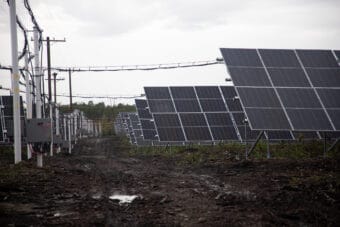
The Houston solar array covered in rain droplets. It was built with Alaska’s cloudy weather in mind, and still pencils out to save ratepayers money. (Adam Nicely/Alaska Public Media)

Matanuska Electric Association CEO Tony Izzo said the utility is actively trying to increase its renewable energy sources without increasing rates.

“This project from day one, and it was commissioned, provides energy to MEA members for less than our natural gas fired generation,” Izzo said. “In a meeting with some other representatives from Clean Capital a few months back, I think my message was, how fast can you build more of these things?”

Clean Capital is a national company that helped finance the project, and will be the long-term owner. Izzo says the Houston array could, at peak production, provide about 5% of the utility’s output. It’s expected to power about 1,400 homes.

As for the ironically rainy weather the day of the ribbon-cutting, Miller said the array was built with Alaska’s climate in mind.

“One of the things that’s unique to our solar design is that we actually oversize on the panel side, just because Alaska has so many cloudy days,” Miller said. “And so because panels have gotten so cost competitive, we’re able to kind of over-install on the panel size so that on cloudy days, we can boost our production, and it makes the project more economic overall.”

Miller said the Houston farm is currently feeding small amounts of power into the grid for testing, but it should be fully operational by next month. Her company is currently looking at building another large solar project on the Kenai Peninsula.

Wall Street Journal: Limited interest in Alaska LNG from Asian buyers

The Alaska Liquefied Natural Gas project has long promised to bring North Slope natural gas to Nikiski, for export to Asia. Optimism about the project among Alaska politicians has remained high, despite the long timeline and cost of the project. But last month, the Wall Street Journal reported that buyers in Japan and South Korea aren’t confident in the project, and don’t plan to make investments or sign contracts.

KDLL talked with River Davis, one of the reporters behind that Journal story.

Listen:

Riley Board: Could you start by telling me a little bit about what your job is and what you typically cover?

River Davis: I’ve been a reporter with The Wall Street Journal here in Tokyo, reporting out of Japan covering Japanese businesses, for the past five years. Most of the topics that I look at cover the automotive sector, and I also cover energy security and Japan’s energy transition.

Riley Board: And how did this particular story about the AK LNG project come to your attention?

River Davis: Well, we were hearing a lot from Japanese companies — and Korean companies as well — that they were being approached by some political figures and people in the business world in Alaska, basically pitching contracts and deals to these companies, asking if they wanted to sign up to take Alaskan LNG.

And so we started this project kind of very neutrally looking at sort of the trade offs that are involved in the project. The positives, of course, being this is a project that could help with energy security, and help Korea and Japan transition away from using Russian gas and oil. So that was kind of the positive energy security angle. Of course, on the other end, we were looking at climate issues. There’s been some backlash about the project going forward, particularly a new fossil fuel project going forward in 2023.

So that was the kind of stance we originally approached the story with. But once we did some reporting, we found that the story about how there wasn’t a whole lot of interest in the project out of Asia, which were kind of the main target customers for the gas projects. That became kind of the main angle that we discovered hadn’t been told yet.

Riley Board: Could you go into more detail about what sentiments you learned that people in those countries had about the project?

River Davis: So the sentiment, specifically out of Japan, I would say is that they felt that this project has been happening for a long time, and that it hasn’t had much progress. So for Japan, in particular, companies here, government officials say that they want natural gas quite soon; in the next couple of years is when they’re going to witness their worst pinch when it comes to supply. So the project’s timeline is a little bit too far out for their wishes. And also, because it has been kind of delayed for such a long time, they are a bit dubious about whether the project itself will actually get off the ground.

Of course, it’s a massive project, a massive investment. So those were just factors that they’re considering. It’s really important to companies here, that if they do indeed sign up for a contract to offhand gas, that a project moves forward, because they will give up other contracts elsewhere. So that security element I think, was a large kind of off putting factor for them.

Riley Board: Did these buyers have other options when it comes to getting natural gas on the timeline they’re looking for?

River Davis: They do. Of course, Alaska officials and others supporting the project would say that Alaska has a lot of benefits. Of course, for Japan and Korea, it’s just over a week to get natural gas shipped over here. And there’s no kind of choke points that the gas has to go through. That could be a potential security issue.

But on the other hand, Japan thinks that it can get gas from other kinds of secure projects. There’s a lot of new supply coming to market, you know, around 2027, 2028 out of the US, Australia, the Middle East. And so Japan sees it has a lot of options beyond just Alaska at this point.

Riley Board: In Alaska, politicians are still very publicly optimistic about this project. Lisa Murkowski voiced her optimism around here — she was visiting the Kenai Peninsula and expressing her optimism about the project as recently as last week. Why do you think that attitude is still prevalent over here, even as interest is waning in Asia?

River Davis: Yeah, I think, of course, it’s in the interest of people supporting the project to make sure that there’s still kind of some optimism about it going forward. They’re in the stage where they’re looking for investment in the project. So I think if there’s too much of kind of a dreary tone, that would be problematic.

I do also get the sense that out of South Korea and Japan, perhaps there’s a bit of…information hasn’t sort of traveled to Alaska in the way that perhaps it would in other situations. Talking to companies here, you know, they say, ‘we’re not interested in this project.’ But I’m not sure to what extent that kind of has been directly conveyed to people, you know, sitting locally in Alaska. Seems like there’s a bit of an information divide there.

Riley Board: Do you think your story was one of the first first ways that that information was maybe conveyed in the US?

I think there has been a decent amount of skepticism towards the project, because it has taken kind of such a long time to move forward. And it’s been eluding that final investment decision for some time now. So we did see other publications, you know, questioning whether it would be able to reach that final FID stage. But I think as a story that conveyed the voice of potential off takers of gas — that being Japan, Korea, other countries in Asia — this was sort of one of the first stories that I’ve seen to convey that specific angle.

Long-awaited Angoon hydro project can proceed, if funding can be found

The Thayer Creek Hydro project would use a 40-foot high dam to impound water over an area of 7 acres. (Kootznoowoo, Inc. image)

A new hydroelectric project on Admiralty Island has the green light — four decades after it was approved by Congress.

In late June, the U.S. Forest Service granted a special use permit for a small-scale hydro plant on Thayer Creek, near the town of Angoon. The local Alaska Native village corporation is now going after construction funding for the project, which is expected to fully replace costly diesel power.

The construction of a run-of-river hydro development in the Admiralty Island National Monument was authorized by ANILCA, the 1980 Alaska National Interest Lands Conservation Act.

The project is being propelled by Kootznoowoo, Inc., Angoon’s village corporation. It’s unusual for a Native corporation to build a public utility. Jon Wunrow, Kootznoowoo’s director of natural resources, believes the right people were in the room as ANILCA was being hammered out by the presidential administration at the time.

“My hunch is that the leaders from Angoon who went to D.C. and met with (President) Jimmy Carter to kind of broker this part of the deal probably had representation from the village corp,” Wunrow said. “And I think that’s maybe how they (Kootznoowoo) got named.”

Thayer Creek is about three miles from Angoon. Over the past few years, Kootznoowoo has used a $5 million grant from the Alaska Energy Authority to plan and engineer a dam, power plant, and utility tunnel back to town.

Wunrow says two major barriers remain.

“One is we still have to complete what’s referred to as SHPO 106, which is the heritage work to make sure that there aren’t any historical or cultural items of significance that will be disturbed in any way,” he said.

An archeological team from the Forest Service is on site doing that work this summer.

The second barrier could take more time.

“And then we need funding,” he added.

Wunrow says Thayer Creek is an “unfunded federal project,” authorized by Congress but with no money allocated to build it. Wunrow says this partly explains why Angoon never moved forward with the project – there was always an expectation that the federal government would follow through with the $30 million or so needed for construction.

Steadily rising fuel prices helped to change that attitude. Electricity in Angoon costs up to eight times more than in the Lower 48. The crunch motivated Kootznoowoo to take the initiative about three years ago to plan the project without federal support.

And then came President Biden’s Bipartisan Infrastructure Bill, which includes $1 billion for “Energy Improvements in Rural or Remote Areas.” The program is tailored to build energy resilience and affordability in communities of under 10,000 people.

Wunrow says this is Angoon’s shot to connect with funding that’s four decades overdue.

“This is really the first, and potentially the only funding of this size, specifically for rural areas to do renewable energy,” Wunrow said. “So it’s kind of got Thayer written all over it. We’re hopeful.”

If it comes to fruition, Kootznoowoo will own the Thayer Creek hydro project, but it will be operated by the Inside Passage Electric Cooperative – or IPEC – which currently supplies electricity to Angoon from diesel.

Affordable hydropower could revolutionize life for Angoon’s 500 residents. Thayer Creek’s 850 kilowatts would fully replace the existing diesel plant, which would be preserved as a backup. The total savings will be 250,000 gallons of fuel annually, worth about $1 million. The project would be built upstream of a natural salmon barrier, so no fish would be harmed.

“If we could just stabilize the cost of power, that would be a big win for Angoon,” Wunrow said. “But we’re also hoping it ushers in an era of electric motors: electric cars, electric boats, and heat pumps.”

Site notifications
Update notification options
Subscribe to notifications