Energy & Mining

Alaska lawmakers pitch ways to close budget gap from sales tax to cutting oil tax credits

Hundreds of people stood in line to checkout in Costco on Tuesday, March 17, 2020, in Juneau, Alaska. (Photo by Rashah McChesney/KTOO)

Falling oil prices have left a massive hole in Alaska’s budget, and lawmakers are scrambling to propose alternative revenue streams to close the deficit. A revenue forecast released last week estimated the state has a shortfall of more than $450 million heading into the next fiscal year.

Sen. Bill Wielechowski, an Anchorage Democrat, introduced a bill last week to increase oil tax revenue as a way to close the gap.

“It’s just really basic math — how are you going to make the math balance out? And it just doesn’t balance out at this point,” he said.

His bill, SB 114, would close the so-called “S-corp loophole.” That would require private corporations like Hilcorp to start paying the state corporate income tax of 9.4%.

The bill would also reduce oil tax credits and limit the expenses oil producers can deduct from their state taxes. Wielechowski estimates the bill could add more than half a billion dollars to state revenue each year. And, he said, “this is the year to do it.”

“We’ve got hundreds of teachers positions that are open, you’ve got hundreds of vacancies at the Marine Highway, you’ve got roads that aren’t being plowed,” he said. “I think people are really starting to see the impacts of not funding our government.”

House Majority members expressed doubts about the bill during a news conference on Tuesday. House Resources Committee Chair Tom McKay, an Anchorage Republican, argued increasing oil production — not taxes — is the solution to Alaska’s budget woes.

“By bringing forth oil tax increases, it does the opposite, it puts a chilling effect on investment,” McKay said.

McKay said the bill would create “uncertainty and instability” in the oil tax structure as ConocoPhillips’ recently approved Willow oil drilling project moves forward. According to his campaign website, McKay has worked as a petroleum engineer since 1980 for a number of energy companies, including Conoco.

Another bill, introduced Monday by Nikiski Republican Rep. Ben Carpenter, would create a 2% state sales tax.

Alaska has never had a statewide sales tax, and is among just a few states that don’t. The state also does not have a personal income tax, and is the only state to have neither. The largest proportion of Alaska’s revenue comes from oil.

Carpenter did not not respond to requests for an interview. But at a hearing Wednesday night, where he introduced his sales tax bill, he emphasized that it’s just one component of a larger plan.

“I don’t take this lightly, bringing forward a bill that would institute a sales tax on Alaskans,” he said. “If we were having a conversation that didn’t include a bunch of other components of a fiscal plan, I would not be sitting before you.”

More than 100 municipalities and boroughs around the state already have a local sales tax, between 1% and 7%, although Alaska’s largest city, Anchorage, does not have a local sales tax. The 2% statewide sales tax proposed by Carpenter would be collected on top of any local taxes. It would not make exemptions for groceries, medicine or other areas that have been exempted in previous sales tax bills, and in many other states.

This month, Carpenter also proposed a bill to reduce corporate taxes in Alaska, which he said discourages companies from doing business in the state. The bill would reduce the cap on corporate taxes from about 9% to 2%, and make rates the same for all companies, regardless of size. Carpenter said his bill would reduce the state’s revenue by about $300 million for the fiscal year.

Gov. Mike Dunleavy introduced a series of bills at the start of the year to set up a carbon sequestration industry in Alaska. The governor said carbon capture has the potential to bring “billions” of dollars to the state, but it’s unclear when it would start to generate revenue.
Judge likely to rule next week on halting Willow construction on Alaska’s North Slope

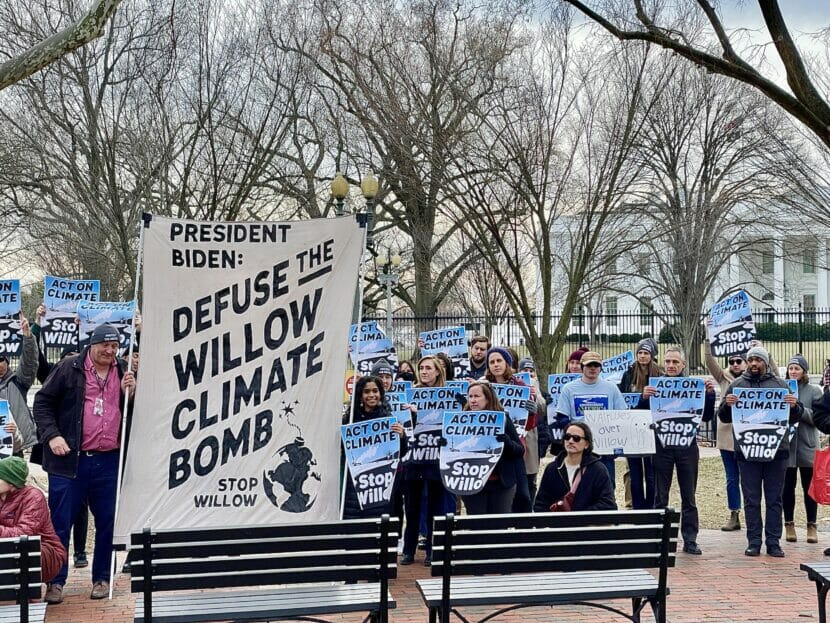
Protesters asking President Biden to rule against the Willow project outside the White House in January. (Liz Ruskin/Alaska Public Media)

A federal judge could issue a decision as early as next week to temporarily halt construction of Willow, ConocoPhillips’ controversial oil drilling project in the National Petroleum Reserve.

Two lawsuits, filed by environmental groups and an Inupiat advocacy organization, aim to overturn the Biden administration’s approval of Willow. The plaintiffs have asked for an injunction to halt construction until the case is decided.

U.S. District Court Judge Sharon Gleason said she’d try to have a decision on the injunction by April 3.

The Interior Department’s decision to allow three drill pads and 200 oil wells was a blow to climate advocates. It drew applause from ConocoPhillips, labor unions and many constituencies on the North Slope, as well as Alaska’s Legislature and congressional delegation.

The Legislature and the trio who represent Alaska in Congress have taken the unusual step of jointly filing an amicus brief, to offer their perspective to the judge.

“We are working hard to get the judge to hear our voices — literally collectively, tens of thousands, if not hundreds of thousands of Alaskans — to convince her that this project going forward, of course, abides by the law, but is strongly in the public interest,” U.S. Sen. Dan Sullivan told reporters Monday.

The public interest is a big factor the judge must weigh in deciding whether to grant an injunction, Sullivan said.

“In many ways, discerning the public interest is what elected officials do all the time,” he said. “And so we thought it was very important to have a brief from all the statewide elected officials in Alaska, that lay out what we see as the public interest, which is to deny this preliminary injunction.”

Trustees for Alaska attorney Bridget Psarianos, who filed one of the lawsuits, said the amicus — or friend of the court — brief does nothing to negate her claim that the administration failed to follow environmental laws in issuing the Willow decision.

“This is unfortunately emphasizing Sen. Sullivan’s blinders — that the state government and oil companies and our own congressional delegation from Alaska have — to the impacts that Willow would have on local communities and global climate,” she said.

Nationally, opposition to the project built rapidly in February and early March. Anti-Willow videos on social media garnered millions of views, and young voters in particular say they feel President Biden violated a campaign promise.

Biden said last week that he was inclined not to approve Willow but was advised that ConocoPhillips would sue and likely win.

The company has held the Willow leases since the 1990s.

Alaska legislators prepare to talk taxes after grim new oil revenue forecast

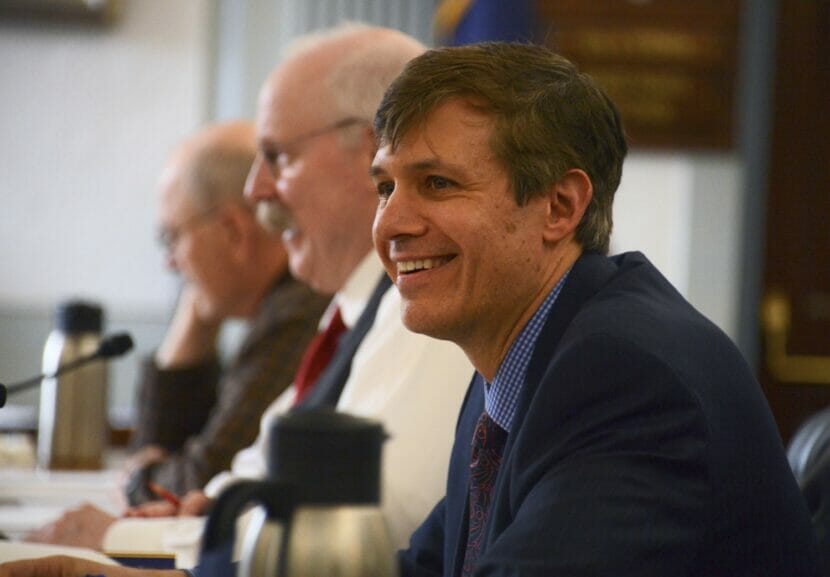
Sen. Bill Wielechowski, D-Anchorage, smiles during a meeting of the budget conference committee on Tuesday, May 17, 2022, in the Alaska State Capitol. (Photo by James Brooks/Alaska Beacon)

The Alaska Legislature is preparing to examine two new tax proposals after a state revenue forecast showed significant long-term budget deficits even with a sharply reduced Permanent Fund dividend.

One proposal, introduced Friday by Sen. Bill Wielechowski, D-Anchorage, would cut a popular oil production tax credit and close what he describes as a loophole in the state’s corporate income tax. The second proposal, expected as soon as Monday from Rep. Ben Carpenter, R-Nikiski, would create a state sales tax.

The sales tax bill has been scheduled for a hearing Wednesday night in the House Ways and Means Committee, which Carpenter chairs. The oil tax bill has been scheduled for a hearing Friday morning in the Senate Finance Committee.

“We have to fund our basic services,” Wielechowski said. “And that’s to the benefit of the (oil) industry as well. So if the industry doesn’t support this, and they have a better solution, I’m all ears.”

Budget deficits loom, even with a small dividend

Alexei Painter, director of the nonpartisan Legislative Finance Division, said on Friday that  under the state’s new revenue forecast, at present levels of spending and with a $2,700 Permanent Fund dividend, the state budget runs a deficit of about $560 million in fiscal year 2024, which starts July 1.

If legislators cut the dividend to $1,350 per recipient, there’s a $300 million surplus, but that doesn’t take into account a possible funding increase for K-12 schools or any other spending increases.

An education funding increase is likely to cost between $175 million and $260 million, based on different ideas under discussion in House and Senate committees.

The $1,350 dividend is based on a proposed new distribution formula under discussion in the Senate Finance Committee.

Called the 75-25, the formula pencils out if used next year, but projections show that it creates significant deficits in the long term — as much as $230 million by the end of the decade. Under the formula, a quarter of the annual draw from the Permanent Fund would go toward dividends, with the rest funding government.

The 75-25 is on the low end of several new dividend formulas under discussion in the Capitol this year, and some lawmakers are wary of going low because dividend reductions act as a regressive tax: Because all Alaskans receive the same dividend, it comprises a higher share of poor Alaskans’ incomes, so a reduction in its amount is a bigger hit to them.

“I don’t believe that only the people of Alaska should be hit by a $1.3 billion reduction in dividends. I think that we should consider other options and other players to balance out the state’s checkbook,” said Sen. Lyman Hoffman, D-Bethel, after hearing Painter’s figures.

Opinions differ on the best solution

It remains to be seen how the Legislature will address the issue. The state’s Constitutional Budget Reserve, its largest savings account, has a balance large enough to pay for a $2,700 per-person dividend this year, but if trends continue, it couldn’t do the same next year without consequences.

On its first day, Wielechowski’s proposal earned a mixed reaction, even among his colleagues in the bipartisan Senate majority.

Sen. Jesse Bjorkman, R-Nikiski, said he opposes Wielechowski’s plan.

“The bottom line for me is I’m not interested in taxing producers and people who work in order to give money to people who don’t work,” he said.

Bjorkman said he prefers another option, possibly a sales tax.

“I would be interested in supporting some kind of temporary seasonal sales tax or tax that allows our visitors to pay for many of the benefits that are provided to them when they come in and visit Alaska,” he said.

Sen. Löki Tobin, D-Anchorage and one of the strongest supporters of a proposal to increase K-12 school funding, said she wants to see data in Senate Finance before deciding whether the oil tax increase is the best approach.

“I think we’re starting the process now to figure out if this is the best way to go about it,” she said.

She said she’s unlikely to support a sales tax.

“All the research I’ve done about a sales tax shows it’s really regressive,” she said.

Wielechowski offers three-layered approach

The details of Carpenter’s sales tax bill won’t be released until Monday, and his office said he was not immediately available for an interview.

Wielechowski’s bill includes three main provisions:

  • Right now, the state gives oil producers a tax credit on each barrel of oil they pull from the ground. That credit would fall from $8 per barrel to $5, and companies would be limited on the amount of credits they can spend in a given year. That limit would be the amount they spend on capital expenses — drilling and construction, for example — each year. If they only spend $200 million on new drilling, that’s the amount they can deduct from their production tax payments in a given year. A limit doesn’t currently exist.
  • It would also change a provision in the state’s corporate tax structure. Companies like Hilcorp, which is privately owned, would no longer pay lower corporate income taxes than companies like BP, which was publicly owned and owned a significant share of Prudhoe Bay before selling to Hilcorp.
  • The third main part, called “ringfencing,” says that companies who receive tax credits can only use them on oil produced from facilities for which they received the credits in the first place. For example, if ConocoPhillips received $200 million in credits for work on its new Willow project, those credits could only be applied to production taxes levied on oil from Willow.

Wielechowski expects the change in the per-barrel credit to be worth between $400 million and $500 million per year. The change to the corporate tax would be worth $139 million per year, he said, and the value of the ringfencing provision will vary significantly based on the price of oil, Wielechowski said.

At present prices, it’s about a $30 million or $40 million per-year value; if oil averages $90 per barrel, it could be worth $750 million a year, Wielechowski estimates.

To become law, Wielechowski’s bill or Carpenter’s proposal would have to pass both House and Senate, then get the approval of Gov. Mike Dunleavy, who could veto the measure.

“For many in my caucus, the majority of folks prefer a sales tax over an income tax. And as far as taxation changes on the oil companies, I think you’re going to have a mixed bag there,” said Speaker of the House Cathy Tilton, R-Wasilla.

“If this bill goes to the House, put it on the floor. That’s all I ask,” Wielechowski said of the measure’s prospects there. “Give it an up or down vote.”

Dunleavy has previously said he opposes tax increases without a statewide referendum, going so far as to veto a minor tax increase on e-cigarettes last year.

Wielechowski said he has had “productive” discussions with the governor’s office about the proposal and hopes Dunleavy takes it seriously.

“I’ve been in conversations with the governor’s office. People understand that we’re at a point now where we’ve got to fund our schools, we’ve got to fund our roads, we all want to help the PFD. We can’t afford those things right now,” Wielechowski said.

This story originally appeared in the Alaska Beacon and is republished here with permission.

Alaska regulators hear testimony on ConocoPhillips’ 2022 Alpine gas leak

ConocoPhillips’ Alpine facility on the North Slope. Conoco’s Scott Jepsen says a new processing facility in NPR-A would be about the same size. (Photo by Elizabeth Harball/Alaska Energy Desk)

While ConocoPhillips faces national scrutiny over a future Arctic oil drilling site known as Willow, state regulators took testimony Thursday about an uncontrolled natural gas leak last year at Alpine, a developed oilfield about 30 miles away.

The company rerouted the gas through a waste disposal well within days of the 2022 incident, but it took more than three weeks to stop the leak at the source. ConocoPhillips employees repeatedly told the Alaska Oil and Gas Conservation Commission that gas was not detected beyond the gravel drilling pad, known as CD-1, and that no harm to people or wildlife was observed from the gas that emerged through the tundra and gravel.

The company said nothing like this has ever happened before in its 50-year history of operating in the region, and that it has learned lessons to prevent it from occurring again. But for opponents of development at Willow, the gas leak at Alpine represents a cautionary tale.

The Alpine leak worried residents in nearby Nuiqsut enough for them to evacuate. Nuiqsut Mayor Rosemary Ahtuangaruak said villagers remain concerned about the health impacts of emissions, particularly on pregnant women, infants and elders.

“This event gave our community members much concern,” she testified. “We want to fully understand to prevent this from happening with the new developments that will be nearby our community.”

The mayor asked for an alarm system to warn of future emissions.

The event started in late February 2022, when workers put fluids down the well to prevent freezing. The pressure built to unsafe levels, which wasn’t fully recognized for days, even after gas was detected at the surface of the pad 450 feet away from the well on March 4.

Some sections of the well were enforced with concrete, to prevent events like this. But the source of the leak was determined to be from an area 3,000 feet down, from a relatively shallow formation not previously known to contain much gas. Commissioner Jessie Chmielowski asked why the company doesn’t use more concrete.

ConocoPhillips’ chief Alaska well engineer, Erica Livingston, said the company relies on its well design.

“Do we have an adequate well design that addresses any kind of significant hydrocarbon zones or abnormally pressured geostrata, as is mandated by the regulation? If that required pumping more cement, we would. Absolutely,” Livingston said. “Or we would figure out a way to make the well designed adequate for what we have identified.”

Livingston said ConocoPhillips is now tracking pressure more closely but has not required alarms that would signal an event of this type.

“But again, we’re able to track that pressure and watch it much more closely than we had in the past,” she said.

The commission is considering the case for possible enforcement action, which could include fines. Commission Chair Brett Huber said the panel will issue a written decision. No date has been set for that report.

Willow protesters dog Biden as he touts his environmental achievements

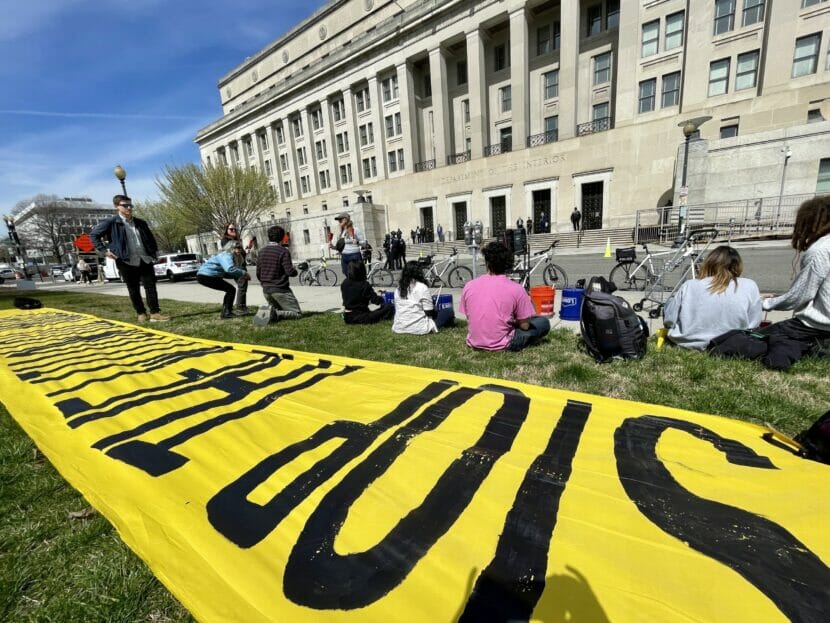
Climate protesters unfurled a “stop Willow” banner at the Interior Department’s headquarters, where President Biden was speaking. (Liz Ruskin/Alaska Public Media)

While climate activists unfurled an anti-Willow-project banner in front of the Interior Department headquarters near the White House Tuesday, President Joe Biden was inside, bragging about his environmental and climate record.

“My first year in office we protected more lands and waters than any American president since John Kennedy,” he said, to cheers in the agency’s auditorium.

He announced new monuments in Nevada and Texas, as well as a new marine sanctuary southwest of Hawaii that covers an area larger than all of Alaska.

But outside the building, the protesters weren’t impressed. They haven’t let up on Biden since last week’s decision approving Willow, ConocoPhillips’s plan to drill 200 oil wells in Alaska’s western Arctic.

They’ve launched a series of protests in Washington, D.C. that could undercut his message on climate change and alienate the young voters who supported his 2020 election.

Biden made action to reel in greenhouse gas emissions a central part of that campaign. His decision on Willow – the largest pending oil project on federal land – quickly galvanized opposition online, particularly among young people, who watched anti-Willow TikTok videos by the million.

Art student Nadia Nazar was an organizer of Tuesday’s protest at the Interior Department. (Liz Ruskin/Alaska Public Media)

So far, the in-person protests haven’t been of that scale, but the sustained focus could threaten to tarnish Biden’s legacy on climate.

“Biden keep your promise – stop Willow,” some 20 activists chanted Tuesday. They beat plastic buckets with drumsticks. For a backbeat, they played a recording of Biden’s voice on a loop, making promises in 2020 they say he broke.

“No more subsidies to the fossil fuel industry,” Biden said during a presidential debate. “No more drilling on federal lands. No more drilling, including offshore. No ability for the oil industry to continue to drill. Period.”

Baltimore art student Nadia Nazar is an organizer with a youth-led climate justice group called Zero Hour, part of a coalition she said organized the event at the Interior Department. She said they want Biden to feel the pressure when he makes future decisions on oil development, and to know that his re-election could be on the line.

“A lot of young people turned out and voted for him last election,” she said. “He made these promises to us. And the climate crisis is something that’s so important to not only us, but so many people here in the U.S.”

Protesters on Monday disrupted a presentation at a Washington think tank featuring White House climate advisor Ali Zaidi, and a group called Climate Defiance says it intends to blockade the White House Correspondents Dinner next month.

Even with a slimmer Permanent Fund dividend, low oil prices generate deficits in Alaska

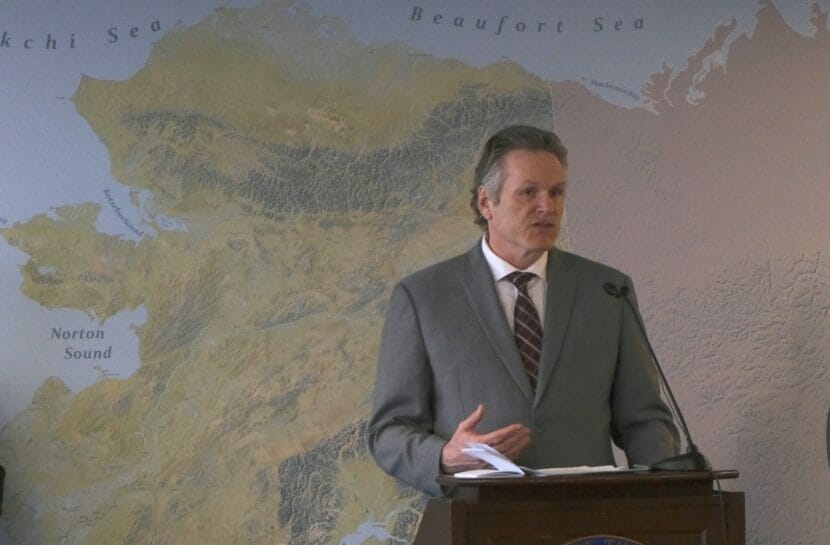
Alaska Gov. Mike Dunleavy speaks about the state’s spring revenue forecast on March 21, 2023, at the Atwood Building in Anchorage. (Photo by Sophia Carlisle/Alaska Beacon)

Lower oil prices have torn big holes in the Alaska state budget, the Department of Revenue said Tuesday, releasing new estimates showing a deficit of about $220 million in the fiscal year that ends June 30 and another deficit of about $240 million in the year that starts July 1.

State legislators have already agreed to spend from savings to fill the current deficit by spending from the state’s Constitutional Budget Reserve, they said Tuesday, but it’s not yet clear how they’ll address the deficit in the upcoming fiscal year.

Members of the predominantly Republican House majority coalition have already taken a major step to address the situation by proposing to cut this year’s Permanent Fund dividend from the amount proposed by Gov. Mike Dunleavy in December.

Under the governor’s original proposal for the budget that starts July 1, the deficit would be between $890 million and $920 million, depending on the estimate used. Alexei Painter, director of the nonpartisan Legislative Finance Division, and Neil Steininger, director of the governor’s Office of Management and Budget, each offered different figures.

On Monday, the House Finance Committee proposed a new budget draft that cuts the governor’s proposed $3,860 per-person dividend to about $2,700 per person. That drops the anticipated deficit to about $240 million.

That figure doesn’t include the estimated $250 million price tag of a proposed increase to the state’s per-student funding formula for K-12 schools, or any construction or renovation projects typically added to the budget by legislators annually. Those items were not included in the governor’s proposed budget and are not included in the House budget.

Rep. DeLena Johnson, R-Palmer and co-chair of the House Finance Committee, said on Tuesday that further actions will be forthcoming.

The new smaller revenue forecast, she said, “is the elephant in the room.”

Before lawmakers eat the elephant in fiscal year 2024, they’ll have to take care of the one in fiscal year 2023, which ends June 30.

Legislators typically include language in the budget that says any deficits will be automatically filled by the state’s Constitutional Budget Reserve, but the budget they approved last year lacks that language, instead saying that any deficits should be filled by a state savings account that’s easier to access, the Statutory Budget Reserve.

That account holds only about $20 million, Painter told the Senate Finance Committee earlier this year, not enough to cover the deficit.

Spending from the constitutional reserve requires three-quarters of the Senate and three-quarters of the House to agree.

The bipartisan Senate majority includes 17 members, and if all agree, that’s enough.

“I would expect that the Senate would support three-quarter vote access to the CBR not only in ’23, but in ’24,” said Sen. Bert Stedman, R-Sitka and co-chair of the Senate Finance Committee.

In the House, the majority coalition is only 23 members and not all members are required to vote together. That means the votes of the 16-person minority caucus are needed.

A bill proposed by Dunleavy to cover state costs through June, known as the “fast-track” supplemental bill, is making its way through the Legislature.

House Minority Leader Calvin Schrage, I-Anchorage, said that if the fast-track bill doesn’t change before the final vote — floor amendments are possible — the minority is prepared to support the Constitutional Budget Reserve vote.

“We’re going to do our due diligence to make sure that that’s tight and been buttoned up, but assuming it is, I tentatively intend to have our caucus support the CBR,” Schrage said.

Gov. Mike Dunleavy, speaking to reporters in Anchorage on Tuesday, said he doesn’t see any problems with using the CBR to cover the deficit this fiscal year.

The CBR contains only about $2 billion, and the state uses it to manage fluctuations in cash flow; if its balance drops too far, there could be problems, state accountants have warned.

When asked how the state will deal with the deficit in fiscal year 2024, the governor was equivocal. He said there will be discussions about cuts, discussions about new revenue, and for the moment, the issue is in the hands of the Legislature.

“And so the real process of hammering out this budget kind of begins now,” he said.

This story originally appeared in the Alaska Beacon and is republished here with permission.

Site notifications
Update notification options
Subscribe to notifications