Southeast commercial trollers will soon take a break from the king salmon harvest, but the final target this year remains anyone’s guess.
The Alaska Department of Fish and Game announced Tuesday (July 7) that the first king opening of the summer will close at midnight on Wednesday (July 8), after eight days of fishing.
Sitka’s ANB Harbor, home to many local trollers. (Greta Mart/Photo by KCAW)
That opening has been longer than many trollers expected. This year’s king salmon quota was the subject of a months-long dispute between Alaska and its neighbors to the south, including Canada, Washington and Oregon. Alaska challenged the pre-season forecast, which called for relatively low numbers of Chinook in Southeast. In the end, however, the state agreed to fish under the lower estimate, to remain in compliance with the U.S.-Canada Pacific Salmon Treaty.
Still, Fish and Game hasn’t released a final number for this year’s king salmon quota, so it’s impossible to know how many kings the fleet is targeting. Even fishermen are in the dark.
Exact numbers on how many kings have been taken so far won’t be available for a few weeks, while the Department tabulates fish tickets. But Fish and Game expects a second king opening for trollers in August.
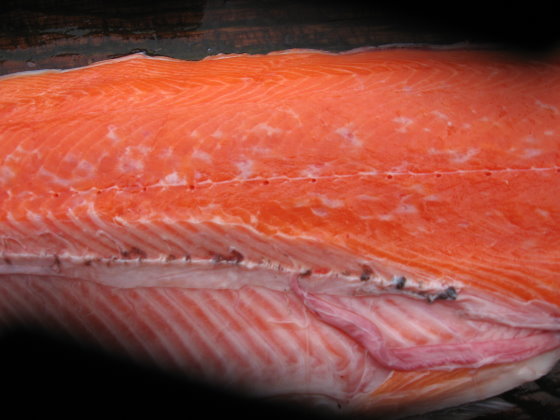
A severe case of ichthyophonus in a Yukon Chinook filet. (Photo courtesy of RapidResearch.com)
As Yukon salmon continue their summer runs, subsistence fishermen are expressing frustration about gear restrictions, closures, and now potentially infected fish.
When managers and fishermen met for their weekly teleconference Tuesday, they heard reports of discoloration and pus in chum salmon from callers in Pilot Station, Russian Mission and Fairbanks.
Stephanie Schmidt, summer season area management biologist for the Yukon for the Alaska Depart of Fish and Game, says the parasite ichthyophonus could be the culprit
“Folks here complaining about summer chums having white patches and pus sacs … A lot of these fish have pus in the meat, so that’s a bummer … Kind of little pockets of pus when you fillet the fish. That’ll be about the size of a pea or maybe a little smaller. And I know that in warm water, which is what we have right now, that ichthyophonus really grows rapidly if the fish is infected.”
Fish and Game says the pathogen is not harmful to humans, and Schmidt invites fishermen to submit samples for testing if they’re concerned.
The summer chum run is now estimated at 1.3 to 1.5 million fish, which is average but below Fish and Game’s preseason predictions. The first pulses are passing through Tanana, Koyukuk, and Kaltag, but many stragglers are still lingering in the lower river. Schmidt says that’s led to record numbers for commercial fishermen.
“There have been record catches of summer chum salmon with dipnets this year in district one and district two. To date, the dip net and beach seine commercial fishery in these lower districts have caught 185,700 summer chum salmon and they’ve released just over 8,000 Chinook salmon,” Schmidt says.
Meanwhile, subsistence fishing has been a mixed bag. Abundant chums on the lower Yukon have helped fishermen in Nunam Iqua to fill his racks. But fishermen upriver have struggled to meet their subsistence needs, citing plenty of activity but little production.
Fish and Game is continuing efforts to protect the kings through strategic closures, but Chinook numbers are still weak. More than 80,000 kings passed through Pilot Station by the end of June — about 20-thousand fish fewer than the historical average.
The possibility for incidental harvest of Chinook has been discussed and even allowed for short periods in areas with strong passages of chum. But the general call for immediate release, coupled with gear restrictions, hasn’t allowed for much.
Schmidt says it’s possible that king escapement goals will be reached this year, but conservative management strategies will continue to ensure that happens.
About 70 people gathered in Sitka’s Harrigan Centennial Hall to hear from Dale Kelley, of the Alaska Trollers Association. (Photo by Rachel Waldholz/KCAW)
Harbors emptied throughout Southeast this week as fishermen headed out for the beginning of the summer troll season. July 1 marks the annual start of the summer’s first king salmon opener — the most lucrative time of the year for many trollers. Signs point to a banner year for king salmon.
But Southeast fishermen say they’re not getting their fair share of those kings. The state of Alaska has been locked in a fight with its neighbors to the south over how many fish the fleet can catch.
For now Alaska seems to have lost, and that has led to calls to change the system.
It’s been an uncertain, unsettled spring for many Southeast salmon fishermen.
“It’s been real frustrating because nobody knows what’s going to happen, and usually by now, the quota’s been announced two months ago,” said Sitka troller Bert Bergman.
That would be the annual king salmon quota. Usually, fishermen have two numbers in hand before the summer season starts: an estimate of how many kings are out there and how many they’re allowed to catch. This year, with the season already underway, they don’t have either.
“Nobody knows how many fish we’re catching, or why the number’s low, or how we got this way,” Bergman said. “And basically we’ve had to guess, and dock rumors have ruled the day instead of reason and facts.”
That uncertainty came from the Pacific Salmon Commission, which implements the U.S. – Canada Pacific Salmon Treaty. Each year, the commission has to come up with an estimate of king salmon abundance, determine how many kings Alaska fishermen can catch, and decide how many will pass on to Canada, Washington and Oregon. This year the Commission deadlocked over those figures leading to months of wrangling. Days before the summer opening, fishermen weren’t sure they’d be fishing at all.
Finally, in late June, the Alaska Department of Fish and Game announced that it would open the summer king salmon fishery, and it would be managed assuming low king salmon abundance. But the state explicitly said it believes that estimate is wrong.
“I wouldn’t say that we chose this course of action,” said Charlie Swanton, Alaska’s representative on the salmon commission. He said Alaska was backed into a corner after representatives from the Pacific Northwest and federal government threatened to take the state to court.
But, Swanton said, it’s not the end of the conversation.
“It’s hardened my resolve to turn around and find some solutions, such that Alaskans get their fair share of the fish that migrate by our coastal communities,” he said.
Alaska believes the model used by the commission is deeply flawed. Last year was a huge year for king salmon in Southeast, and the winter troll fishery was also strong. Meanwhile, forecasts are calling for major returns to the Columbia River basin. All of that suggests a big year for Chinook, Swanton said.
But even though Alaska didn’t win any concessions this year, the commission has agreed to revisit its model before next year’s fishery.
Dale Kelley of the Alaska Trollers Association says that change can’t come soon enough.
“We’ve had 30 years of trying to pay for the sins of the south on habitat destruction,” she said. “We’ve cared for fish and repeatedly made sacrifices on behalf of our industry and the region just to rebuild runs that are through the roof.”
And now, she said, Alaskans should be benefitting from those rebuilt stocks. She said trollers don’t mind taking fewer fish in years of actual low abundance. But she warns that when the model isn’t reliable, it undermines the entire management system.
Though the Department of Fish and Game hasn’t announced a quota, Kelley fears Alaska sport and commercial fishermen will be allowed about 237,000 kings this year, down from nearly 440,000 last year.
“They’re just busting our chops with this quota, this up and down thing,” she said. “There’s no sustainability, no sense of security that they know what they’re getting year to year.”
Bergman said it’s clear the process is not working.
“I’ve never seen as many king salmon in the ocean as I’ve seen now, and I’ve got four generations of trollers in my family,” he said. “To not get part of that fish when we’ve made all the sacrifices to help rebuild the runs, and we help pay for the hatcheries, and then to not get some of that feels like we’ve been sold out by the southern states and the National Marine Fisheries Service and NOAA.”
But for now, he says, he’s got no choice. Whatever the quota is, he’s fishing it.
“I’m gonna just take a lot of ice and listen to the radio and see what happens,” he said.
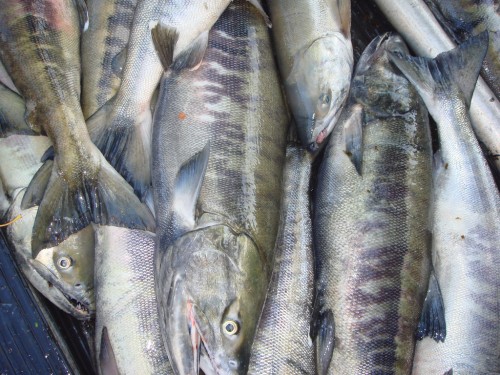
Chum salmon, which develop distinctive striping as they reach spawning maturity, have increased steadily in value over the last decade. (Flickr photo/Watershed Watch)
The Alaska Department of Fish and Game is still finalizing a plan to for the most recent cut to its budget, but Bristol Bay shouldn’t see too many more cuts, says Commercial Fisheries Director Jeff Regnart during a recent visit to Dillingham
During the special session in June, the legislature cut about $1.3 million in general fund dollars from Fish and Game’s budget for the new fiscal year, which started July 1, Regnart says. The Division of Commercial Fisheries will take the largest cut, about $850,000.
“We’ll have a package put together by mid-week next week,” Regnart says. “I can’t tell you whether or not it’s going to impact the bay. The bay has been hit pretty substantially already, with what we’ve done during the legislative cycle. There still might be a few tweaks here. But I don’t see anything significant.”
Regnart says the department was already planning on cuts to Bristol Bay management this summer based on earlier versions of the budget. That includes ending the count at the Nushagak sonar in July, so it won’t count pinks and chums in August.
“We’ll still manage, and we’ll manage based on the fisheries performance, but likely we’re gonna be more conservative, which means less opportunity probably, because if we’re not sure, we will err on the side of the fish,” Regnart says.
That will save the department about $90,000, but likely comes at a cost to the fishery, Regnart says.
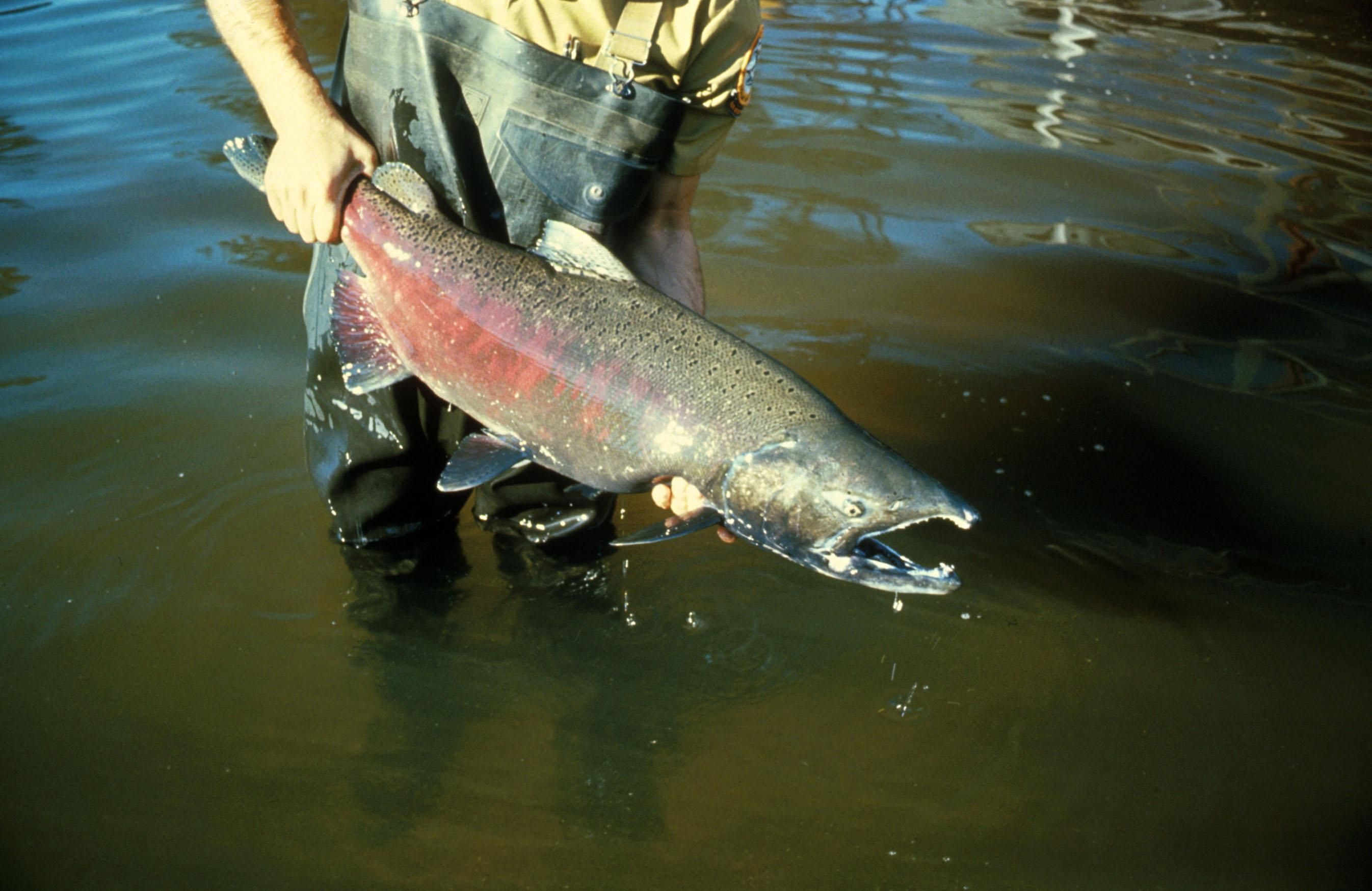
Chinook salmon, otherwise known as a king. (Photo courtesy U.S. Fish and Wildlife Service)
After fishermen pointed out what they thought was a change in the size of king salmon returning to the Copper River, researchers from Fish and Game looked at data from 10 Alaska rivers.
Fish and Game Regional Fisheries Management Coordinator Bert Lewis says they found that king salmon today are smaller than they were 30 years ago, which is as far back the size data they used went.
“Then we started to take a more detailed look at the data and found that the primary reason for this decline in size was a shift in the dominant age class of the fish returning to spawn.”
It’s not just a matter of younger fish swimming home. Lewis says the older fish also appear to be smaller now than they used to be.
The trend held true on all ten rivers studied — the Yukon, Kuskokwim, Kogrukluk, Kanektok, Goodnews, Deshka, Kenai, Copper, Unuk and the Nushagak.
The team doesn’t know why the fish are getting smaller, but Lewis says the fact that they’re all getting smaller helps narrow down the cause.
“It suggests that something is acting on them all in the same way. What are they all exposed to at the same time? The marine environment and we know that the marine environment has been changing.”
Lewis says the loss of big females could mean fewer chinooks in the future.
“The size of a fish is important, especially when we think about large females that come back, because they have many more eggs and their eggs are bigger, so they get better survival rates and they also use habitat where they spawn and lay their eggs in larger gravel substrate that is not available to smaller fish and that also increases the survival.”
Two groups of processors at odds over who can put the Marine Stewardship Council’s blue sustainability label on their fish appear to be at an impasse, says Chris Hladick, the state’s commissioner of commerce, community and economic development.
“This is gonna be July here, which is gonna be the height of the red salmon run in Dillingham, so I don’t think there’s gonna be any resolution to it at this point, not what I’ve seen,” Hladick said.
This spring, a group of ten processors including Trident, Leader Creek, North Pacific, Peter Pan, Icicle, Ocean Beauty and others asked to access the certification, which is held by the nonprofit Alaska Salmon Processors Association. Silver Bay heads up that organization; Copper River is also a member.
The MSC label is needed to sell salmon in certain European markets.
The two groups have been going back and forth about the terms under which the new group can join. The MSC sponsored mediation, but that failed, so the organization suggested binding arbitration.
They couldn’t agree on that, either, Hladick says.
“ASPA originally said they would do it, and then when only a portion of the Trident group agreed to do it, then ASPA pulled out,” Hladick said.
Hladick says the governor wants to ensure that there’s a market for Alaska salmon.
It’s not known what the next step is or who will make it now that the MSC’s suggestion has failed. But Hladick says over the next year or two he’ll work with the MSC on changes to the system to prevent a similar issue in the future.
“I’m going to be working with MSC to make sure this doesn’t ever happen again, that people don’t get shut out of the MSC certification program,” Hladick said.
Sorting that out could take a year or two.
Close
Update notification options
Subscribe to notifications
Subscribe
Get notifications about news related to the topics you care about. You can unsubscribe anytime.