A forest of trolling poles in Sitka’s ANB harbor, July 2015. (Photo by Rachel Waldholz/KCAW)
After just eight days in early July, the summer king salmon season for Southeast trollers is over.
The Alaska Department of Fish & Game announced Friday that there will be no second king opening in August. It will be only the third summer in fifteen years without an August opening.
The announcement ends a season that has been the subject of unusual controversy between Alaska its neighbors to the south, all of whom fish under the U.S.-Canada Pacific Salmon Treaty. Alaska argued that the preseason forecast vastly underestimated the amount of kings returning this year and asked for the right to catch more fish. But the state gave in under pressure from Washington, Oregon, and the federal government and agreed to abide by the lower estimate.
In the end, however, the fleet caught more fish — and faster — than would be expected under that lower number.
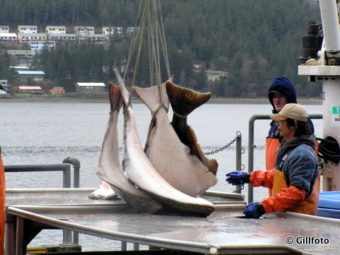
Given the preseason forecast, managers would have expected the fleet to catch about 7,000 to 9,000 kings per day, said Fish & Game biologist Pattie Skannes. But the fleet actually caught about 20,000 fish per day in July, for a total of more than 150,000 Chinook.
That maxes out this year’s harvest limit.
“It’s higher than what we anticipated,” Skannes said. “We went into the opening expecting that abundance would be down from last year, certainly…And obviously once people got out and fished, they found the abundance was actually quite good. So, the total harvest is a surprise. It’s higher than what we expected.”
But Dale Kelley, of the Alaska Trollers Association, said this result is actually precisely what the state and trollers predicted.
“I’m not at all surprised that we took that many fish in eight days,” Kelley said. “We’ve been saying and saying and saying again that there’s a massive abundance of fish out there, and that the quota was inappropriately low.”
The Department usually tries to reserve about 30-percent of the catch for August. Kelley said the lack of a second opening will affect fishermen and processors who usually deliver to fresh markets in August — or anyone who missed out in July.
“Heaven forbid you’re somebody that had a mechanical breakdown or a family emergency during the first opening because there’s not any other opportunity for kings until October,” Kelley said. “And kings are big money for us.”
Many trollers are now targeting coho or chum salmon, which bring in significantly less per pound.
Altogether, Fish & Game estimates that about 730 boats fished the July king opening, down from more than 800 boats last year. The price this year is relatively low. At less than $3 per pound, it’s almost a dollar below the five-year average. That may be because there is still inventory left over from last year’s monster summer run.
All numbers so far are preliminary. Fish & Game is still receiving fish tickets, and won’t have final numbers for about another week.
Fire in Little Jakolof Bay. (Photo courtesy of Jan Flora)
A fire destroyed a sailboat, part of a dock, and some equipment owned by the Jakolof Bay Oyster Company last night. There have been no reported injuries.
The fire started Sunday evening in Little Jakolof Bay, about 7 miles southwest of Homer on the south side of Kachemak Bay.
Johann Willrich was out on a porch at about 10 pm in Little Tutka, a neighboring bay. He says he saw black smoke that looked larger than a garbage fire, so he and other residents hopped in their boat to find out what was going on.
“I had the handheld VHF and someone was reporting that there was a boat that was on fire and the dock itself was on fire as well…Drove over toward Little Jakolof Bay and as soon as we turned the corner, we saw that the boat was fully engulfed and we got there just in time to see the mast fall over,” says Willrich.
Residents of the remote south bay often are the first responders to incidents, as it can take quite a while for fire departments or other official responders to travel from the larger Seldovia, or from Homer.
The dock and boat are property of the Jakolof Bay Oyster Company. Its owners declined to be interviewed but confirmed the losses.
Willrich says they tried to reach the boat that was on fire, but it was hard because of the farming operation.
“So there were oyster nets strung out all along the dock, a couple hundred yards in either direction. So it was very hard to even approach this burning boat,” says Willrich.
They were able to cut loose some equipment and another boat and tow them out of danger.
Bryan Barratt is the chief of the Seldovia Volunteer Fire Department. They responded just after 10 pm and tried to salvage as much as they could.
“Myself and one other city firefighter was able to get onto the dock and cut loose a raft with their processing equipment and their oyster-picking skiff and get those away from the fire. One of those rafts was on fire and we put that out and pulled it off to the side,” says Chief Barratt.
Barratt confirms there was significant damage to the dock and several floats, the boat sank, and quite a bit of equipment that was stored on the dock was also destroyed.
“I don’t think we’ll ever know definitively the cause but the fire originated in a shed that had a running generator in it that was on one of the floats that was across the dock from the sailboat. The fire originated in that building, burned that building, burned the adjacent floats, swept across the floats and caught the rigging and the sails on the sailboat on fire and then burned the boat,” says Barratt.
Steven Russell is the interagency coordinator for the Department of Environmental Conservation. They responded early Monday morning. He says there was no sheening on the water in the area and no known petroleum product spillage.
“Jakolof Bay area is a very sensitive area, not only environmentally speaking but commercially speaking to the extent of mariculture operations that are going on in that area. Certainly DEC will do anything we can to assist the responsible party and the Coast Guard in mitigating any environmental threat,” says Russell.
The full cost of the losses to their oyster operations are not known at this time.
Russian Orthodox and Old Believer boats lined up in the Dillingham boat harbor. (Photo by Molly Dischner/KDLG)
Even in the midst of an opener, with fish running, many Russian Orthodox crews place faith over fish. The colorful boats with the distinct dark tinted windows of the orthodox fleet are easy to spot in the harbor. They are taking a rest day to celebrate a religious holiday to remember the lives and sacrifice of Saints Peter and Paul.
Dennis Hannon sports the traditionally untrimmed beard most Russian Orthodox men wear. He fishes on the F/V Cruiser. He says in the Orthodox tradition, Sundays and holy days shouldn’t be used to make money.
“There are a lot of people that could use the extra pounds or the extra money but at the same time it will all come back to you in the end if, I guess, you believe,” Hannon says.
Hannon is up from Oregon for the season. Interwoven with the religious reasons is the desire to keep the Orthodox culture strong. He says a lot of the culture is already lost; this is one way to hang on.
“Being in the states you are exposed to so much of a different lifestyle … slowly religion would be lost,” Hannon says.
Most of the Orthodox men fish for Icicle Seafoods. Angela Christensen is the office manager for Icicle in Dillingham. She says the company doesn’t treat the Russians any different then say, the Seventh Day Adventists when they take Saturdays off. She says it just takes a little extra planning.
“We just make sure our tenders are well fueled,” Christensen says. “We usually have an extra, or just have a service tender standing by for just the extra traffic for when they come in and leave.”
Hannon and the rest of the crew on the Cruiser may not fish on religious holidays, but they’ll be ready to get the nets out again at midnight.
According to a recent NOAA study, Alaska shellfish hatcheries risk unsustainability by 2040 because of ocean acidification. Over the last week, we’ve heard how a hatchery in Oregon is dealing with changes in ocean chemistry and about groundbreaking genetic research on shellfish adaptability. But the big questions still remain- how far reaching will the effects be and can we mitigate them before it’s too late?
Throughout this discussion, there’s been an elephant in the room: wild stocks. Do wild coastal shellfish face the same 25 year end date that Alaskan hatcheries do?
“Yeah, I mean, I think that’s the million dollar question right there. Can organisms evolve quickly enough to compensate for that change?”
Gretchen Hofmann is a leading scientist in the field of genetic adaptability.
She’s found that certain strains of organisms do selectively favor the trait of acid tolerance from generation to generation.
“You know, if you look into the literature in other systems, you can find examples where rapid evolution has occurred. So, the answer for biology and living things is yes. But…”
The answer for specific breeds of living things is — we don’t really know yet.
That’s a concern for Alaskans, who have relied on particular types of clams and other shellfish for generations as a food source.
Jeremy Mathis is a NOAA oceanographer who worked on the study at the Alutiiq Pride Shellfish Hatchery in Seward.
“The measurements we made in the hatchery does cause some alarm for the natural environments because it’s the same water we’re seeing in the hatchery that’s all up and down the coast,” says Mathis.
Jeff Hetrick is the owner of Alutiiq Pride. Like many local residents, he’s noticed a serious decline in certain shellfish populations in southcentral Alaska.
“Oh, absolutely. I don’t think that we’re going to lose the wild stocks; you’ve basically lost the wild stocks. They’re really hard to come by. It’s difficult for us to even get the brood stock to produce in the hatchery. There’s a razor clam issue that people are aware of on the peninsula. But, especially in lower Cook Inlet and the Homer area, littleneck clams, butter clams, cockles, they’re hard to find. There’s been a decline now for the past decade,” says Hetrick.
Hofmann says some of the urchin divers she works with on the California coast have noticed similar years with very poor harvest numbers. She says there haven’t been enough studies to make a definite correlation with acidification yet, but it’s something scientists and locals are thinking about.
“It’s a pretty big concern, you know, because some of the things we learn about invertebrate biology is that, just the simple first beginning step of fertilization is pH sensitive. So, right there, if you have a species that has the sperm-egg interaction being affected by acidification, then right off the bat, no matter how many adults you have, you have fewer progeny going forward and therefore, really bad recruitment years,” says Hofmann.
“So, what we need to do now, is take our monitoring systems that we’ve installed in the hatchery and expand those out into these natural sites, so that we’re getting that same level of monitoring, that same level of environmental intelligence, so that we can answer that question,” says Mathis.
NOAA’s Pacific Marine Environment Lab in Seattle and the University of Alaska Fairbanks are doing just that. Not only do they plan to expand hatchery research to another site, possibly Ketchikan or Homer, they are also partnering for a new study.
Wiley Evans is heading out this week with a team of scientists to survey acidification parameters from Dixon Entrance in southern Southeast all the way to Kodiak Island.
“We’re doing measurements both continuously, as the ship’s moving from surface seawater flowing through the vessel, sort of in the same way that we are making measurements at Alutiiq Pride. And we’re also going to be making measurements at specific places where we profile the entire water column from the surface down to the bottom,” says Evans.
When that team disembarks in Kodiak, they’ll still leave some of their equipment on board to continue bringing in data on a different mission that will go up to the Bering Sea, over to Dutch Harbor, and back to Seattle.
Evans says they’re hoping to get a more comprehensive picture of current ocean conditions, so they can make more educated decisions on how to deal with acidification in the future. A future that could look much worse than today, says Hofmann.
“I think it’s a pretty big problem if you stand back and look at it for what it is,” says Hofmann.
It is a complex problem with regional factors that exacerbate it. In places like Alaska, carbon emissions speed up CO2-rich glacial melt. In places like Washington, Oregon, and California that are subject to seasonal upwelling, the newer top layer of oxygenated water now has more CO2 to begin with, so it can’t as efficiently counteract the deeper, older, CO2-rich water that comes to the surface.
On top of that, scientists have estimated that that water coming up is 30-50 years old, so from the 1960s-1980s. Imagine that many years from now when today’s water is what’s below the surface.
“We can’t get complacent and say well, we’ve done enough, it’s time to move on to the next crisis. This is something we have to keep right at the forefront and make sure that people understand that while we’ve learned a lot in the past few years, we’ve still got a long way to go in terms of understanding the long term implications of ocean acidification,” says Mathis.
Mathis says that’s why it’s crucial to do the work now, to salvage and protect what we can of the marine ecosystem for 2, 10, or 25 years down the line.
Diagram of upwelling which is a cycle of seasonal winds pushing newer oxygen-rich water off the surface of the ocean and older, nutrient and CO2 rich water rising up to take its place causing a lot of pH fluctuation. (Image courtesy of NOAA)
A recent NOAA study found that by 2040, Alaskan shellfish hatcheries may no longer be sustainable because of ocean acidification, unless serious mitigation efforts are put in place. We recently reported on a hatchery in Oregon that’s become a model for adapting to these different conditions. But the long term solution may actually lie in shellfish genes.
Evolution and resiliency are the buzzwords for a sustainable mariculture industry in Alaska, a state that is particularly vulnerable.
“And Alaska is going to be the test bed unfortunately for informing us for how the rest of the ecosystem will respond to ocean acidification,” says Jeremy Mathis, a NOAA oceanographer who worked on the recent study based at the Alutiiq Pride Shellfish Hatchery in Seward.
One short-term solution hatcheries are testing is injecting the acidic ocean water with carbonates that are needed for organisms like clams and mussels to develop hard shells.
But in the long term, Mathis says they may need to turn to genetics for answers.
“Ideally we can start looking at species that are more resilient to ocean acidification and adapting the commercial fisheries and commercial processing to animals that have that robustness to tolerate ocean acidification as opposed to the ones that are more vulnerable to it,” says Mathis.
That’s where scientists like Gretchen Hofmann come in. She’s a marine biology professor at the University of California, Santa Barbara.
“I work on marine invertebrates and sometimes fish and we study how they respond to their environment. We would call it environment-organism interactions and lately we’ve been interested in how these organisms will respond to future changes in ocean pH and ocean warming,” says Hofmann.
She’s a leader in what Mathis calls the emerging field of genetic adaptability.
“So it really just started with a conversation with oceanographers who were thinking about this and from there, we started to do experiments, and then we started to ask deeper questions about whether or not organisms could adapt to these changes in the ocean and even if there are already genotypes and strains of organisms that are able to handle a low pH condition,” says Hofmann.
She says the first experiments they did were a bit too basic for Mother Nature. They’d take species, put them in water with different pH, and see how they’d react. That didn’t reflect natural variations in ocean conditions.
“What we found was that there wasn’t just this straight line, no pH change, but that pH was going up and down sometimes quite dramatically,” says Hofmann.
Alaskan waters, for example, are very cold and have shifting pH depending on the seasons, fresh water inputs, and how much CO2-rich glacial melt is present.
From Washington to California, the coast is subject to a phenomenon known as upwelling, which is a cycle of seasonal winds pushing newer oxygen-rich water off the surface of the ocean and older, nutrient and CO2 rich water rising up to take its place. That means a lot of pH fluctuation.
So, Hofmann says they shifted their sea urchin research to take upwelling into account.
“And we formed the hypothesis to test that the adults from the place where there was a lot of low pH exposure would be genetically different from the wimpy ones that did not experience all that pH stress,” says Hofmann.
They found that the urchins from areas with upwelling had a different genetic signature from those who weren’t and their progeny, or babies, were more tolerant of acidic water.
“It was even more interesting because it looked like the trait of being able to tolerate that low pH, that was heritable,” says Hofmann.
She points to work being done in New Zealand, where different types of green-shelled mussels are being cross-bred to develop a new resistant and adaptive strain.
So, an Alaskan hatchery, for example, could choose to make the shift from some common species being raised now to ones that selectively favor that trait.
But it also may mean letting go of consumer preference for certain types of clams, mussels, and other shellfish that just don’t measure up.
“These are things that we should be taking a strong look at because it could be that there are other strains of shellfish that could be used that would be more successful in a mariculture setting. But, it is a very thorny issue and one that I think science could bring a lot of daylight to, I think, if we work together on it,” says Hofmann.
Hofmann says it’s important for industry and scientists to start partnering now, to get ahead of the game as much as possible.
“The first thing we have to do though is get carbon dioxide emission levels under control and then we can deal with the damage that has already been done through mitigation and adaptation strategies,” says Mathis.
Because, the problem will only get worse with each coming year.
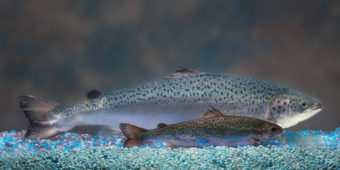
Chinook salmon, otherwise known as a king. (Photo courtesy U.S. Fish and Wildlife Service)
The Nushagak River is becoming one of Alaska’s premier destinations for king salmon sport fishermen. The king return to the Nushagak is proving stronger this year than last, and Fish and Game says they’re on track to meet the escapement goal. Sport fishing guides say the angling has only been average.
Years of experience has taught Nanci Morris Lyon that sweet spot for catching kings is a water temperature right between 52 and 54 degrees.
But hot weather in Bristol Bay has put the water temperatures well into the 60s.
“Between that and the bright light that tends to make all fish head to the bottom it’s definitely had an effect, I feel it’s had an major effect on what we’ve seen as far as the king catch this year.”
Lyon is the managing partner of the Bear Trail Lodge in King Salmon.
Her clients pay big money to catch kings on the Nushagak, one of the best king producing river in the world. Fish and Game manages to put 95,000 kings in the Nushagak River, and is on track to meet that goal this year. But that hasn’t translated into anglers landing kings in regular numbers.
“You know, we’ve been catching a lot more of the smaller fish. And for the numbers that they are seeing in the return at the sonar counter, we’re not seeing that kind of numbers, in relative percentages to past years, in the boat. So we are definitely not catching what I would say is a normal catch for sport fisherman.”
Matt Norman, manager of King Salmon Lodge, has been seeing the few bites from kings as well. He says a recent corporate group fishing for kings was less than satisfied.
“Boy, it was a real bust. We have 22 guests and I think if we caught three kings out of 22 people it was a good day.”
Norman says after that trip the organizer of the group told him that they loved the lodge and the food was great.
“But if we want to stand and not catch fish, we can do that on the Kenai without the airfare to King Salmon.”
That’s why Norman says he’s starting to book more guests to fish for silvers later in the season.
“August, knock on wood, has been a really good month. The last part of July through August for silvers has been pretty steady out here.”
He’s alright rebooked that corporate group to come back next August to fish for silvers instead of kings.
But Nanci Morris Lyon isn’t giving up on the Nushagak king run.
“These things are all very cyclical. So I am rather reluctant to say that I feel like it’s a doomed fishery or that we are seeing the end of it.”
Lyon says the Nushagak is a long ways from becoming like the poor king run on the Kenai.
“But I think it is something that needs to be watched. I think we need to be very conscientious and watch and see what our numbers do on some of our years that have more norms for the temperatures and weather, rather than this year.”
Lyon describes herself as an eternal optimist, which she says is a requirement to be a successful fishing guide. Her lines are cast for next year.
Close
Update notification options
Subscribe to notifications
Subscribe
Get notifications about news related to the topics you care about. You can unsubscribe anytime.