Fisheries

Next generation takes over fishing in Ekuk

Ani White pulls the net out of the water with her truck as her siblings start to pick out the fish. (Photo by Matt Martin/KDLG)
Ani White pulls the net out of the water with her truck as her siblings start to pick out the fish.
(Photo by Matt Martin/KDLG)

During the summer, the population of Bristol Bay explodes with people from all over the world. They’re looking to play a part in the largest sockeye return in the world. Many of these strangers crew on drift boats or work at a cannery. But there is one beach in the Nushagak Bay that remains a home to local family operations.

Ani White sprinkles rosemary, among other spices, over two whole chickens. She’s preparing dinner for her fishing crew. They’re all taking a quick nap before it’s time to pick the nets again.

“We eat pretty good around here. I like to cook, definitely,” said Ani.

Along with the chicken, fresh green salad and corn on the cob (is) the menu. Ani prepares the meal in one of the half dozen cabins her family owns on Ekuk beach. About 20 other families have similar cabins all along the beach.

There are a few close friends that fish along with Ani but it’s mostly a family operation. Ani is in her midtwenties and lives in Anchorage now but says it’s like a family reunion each summer at the small fish camp.

“During the year, we’re all at different places going to school and so we usually only come together at Thanksgiving, Christmas and then of course, in the summertime for Ekuk and fishing,” said Ani.

An American flag dons a fish camp cabin on Ekuk beach. (Photo by Matt Martin/KDLG)

Ani is the oldest child and has kind of taken over as head of the camp. Her father, John Bouker, is a pilot in Dillingham. He’s been fishing since the 70s but now that his children are older, for the most part, he lets them do all the work.

“My wife and I keep none of the money. It’s all for these kid’s college and their endeavors,” explained Bouker.

He flew over from Dillingham earlier in the day to drop off some supplies and fix the fridge. He says fishing on Ekuk is unique for Bristol Bay. With satellite TV and nightly steam baths, he says the fishing here is like a vacation, not really work.

“Out here you throw your net out like you see out front, we’re not sitting out in a boat beating around out there,” said Bouker. “Look at those boats beating around out there. That look like any fun? No, I did that when I was a kid, that’s no fun. Those guys ain’t having no fun.”

Ani leaves the chicken in the oven to cook. The tide is on the way out and it’s time to pull the nets. Heavy wind and rains greet this fishing family as they leave their cabins to retrieve their nets from the bay.

While most fishing in Bristol Bay involves around pulling a net over the stern or bow of a boat … Things are done differently here on Ekuk, no boats needed on this beach. A highway of trucks and four-wheelers move up and down the beach. Unlike set net sites on other beaches in Bristol Bay, the fisherman in Ekuk use pickup trucks and a pulley system to drag their nets up out of the water.

“Nikki, help Johna when it’s down here,” said Ani, directing the work from her truck. “She needs help. Somebody, one person.”

Fish picked out of the net find their way to the ice slush in the back of the truck. The crew then delivers the catch to the cannery down the beach. (Photo by Matt Martin/KDLG)
Fish picked out of the net find their way to the ice slush in the back of the truck. The crew then delivers the catch to the cannery down the beach.
(Photo by Matt Martin/KDLG)

Once the net is attached to the winch on the front of the truck it begins to back up and the net slowly slides out of the water. The beds of the trucks have to all be modified to hold a slush of sea water and ice. Their catch goes into that icy brine, and they drive it up to the cannery about a mile down the beach.

Like a lot of fisherman, Ani thought the season was going to be a dud but the late push changed that. She says this time last year they had already packed up all their gear.

“Yeah, we thought we weren’t going to get any fish and here we’re on more fish then we got last season so pretty happy about that,” said Ani.

With fishing out of the way, it’s time to eat that chicken.

“Oh yeah!” exclaimed Ani’s other sister, Nia Bouker, at the sight of the chicken.

“We don’t know if we eat better or if it just tastes better because we work all day,” said Nia.

John Bouker believes having his children do this work is about more than just fish or money. He says the summer fishing work has taught his children discipline and how to plan for the future.

“People don’t think about looking into the future,” said Bouker. “No plan. No plan you might as well be a piece of drift wood drifting around out in the bay. You don’t have a clue we’re you’re going. You’re taken where the current and the wind are going to take you. So you got to have a plan for your children, you know.”

Ani White has a plan. She plans on being back at Ekuk beach each and every summer.

“As long as there is fish, as long as the cannery is open, as long as there is some to buy my fish, I am going to be down here,” said Ani. “So definitely a lifelong Ekuk resident.”

After dinner, the crew heads off to the steam baths before bed. The tide turns early in the morning and another day of fishing will begin.

Mallott: U.S.-Canada commission won’t take up B.C. mines

Alaska Lt. Gov. Byron Mallott, center, holds a press conference Monday with B.C. Mines Minister Bill Bennett and Environment Minister Mary Polak. (Photo courtesy B.C. government)
Alaska Lt. Gov. Byron Mallott, center, holds a press conference May 4 with B.C. Mines Minister Bill Bennett and Environment Minister Mary Polak. Bennett will meet on transboundary mine issues with officials in Juneau Aug. 22-24. (Photo courtesy B.C. government)

Alaska critics of British Columbia mines probably won’t get any help from a cross-boundary panel they’ve asked to take on their concerns.

The International Joint Commission addresses U.S.-Canada water conflicts. Critics say it should take up the possibility that mines near the border will pollute rivers key to Southeast Alaska fisheries.

Lt. Gov. Byron Mallott says he spoke with officials during a recent trip to Washington, D.C.

“It was clear in my meetings with the State Department and the Canadian counterpart that they view this as a relatively local issue. [They said] that certainly the federal governments have a role, but essentially it is Alaska-B.C.,” he says.

Mallott heads up a multi-agency task force considering the state’s response to transboundary mine concerns.

He traveled to British Columbia in May to meet with provincial officials, as well as tribal and business leaders. One was Mines Minister Bill Bennett, who committed to a Southeast Alaska trip.

Mallott says that will be Aug. 24-26. He plans to school Bennett in regional economic and environmental issues.

“And to impress on him even more firmly the requirement that these transboundary rivers never have issues of downstream pollution and other degradation resulting from development on the B.C. side of the border,” Mallott says.

The lieutenant governor and his transboundary mines task force will also host meetings of tribal, fisheries, tourism and other groups Aug. 5-6 in Juneau.

He says those attending will discuss their concerns and help develop policy.

“It is hopefully the beginning of a conversation and a set of relationships that will allow stakeholders to have a meaningful and timely voice,” he says.

Mallott will also visit Whitehorse, the Yukon Territory’s capital, for a series of meetings next week. He says he and Yukon officials will discuss fisheries, energy and related resource issues.

He’ll also stop in Teslin, a Tlingit community about 100 miles east of Whitehorse, for its annual cultural celebration, called Hà Kus Teyea. 

2015 Marks a summer of flexibility for Kuskokwim subsistence fishermen

Marie Andrew was busy this July at her Napaskiak fish camp. (Photo by Ben Matheson/KYUKl)

Subsistence fishing is open indefinitely on the Kuskokwim River. But that hasn’t been the norm this summer, as the river underwent two management regimes —state and federal—and strict closures for two species. Lower river fishermen are adjusting to the new reality of Kuskokwim subsistence, where conservative management is now the status quo.

On a sunny Saturday after a four-hour subsistence opener, Joe Green and his two children shuttle salmon up the steep banks at the Bethel small boat harbor from the skiff to the back of their pickup.

These openers are critical for Green as he fishes for four families.

“This year we’re shooting for anything. The feds and the government shock you. They screw up everything for you. So we get what we can,” said Green.

On top of his chums, he caught just shy of a dozen red salmon and says he’ll be freezing fish for the first time this summer. It’s a summer of flexibility on the Kuskokwim. Unprecedented king salmon restrictions were followed up by more closures to protect a weak chum run, which so far at the Bethel Test Fisheryranks among the lowest in recent history.

Alissa Joseph works on the fisheries staff for Bethel’s Tribe, Orutsararmiut Native Council , and is traveling the river to talk with fishermen in fishing camps throughout the Bethel area.

“We don’t go to fish camps to look at their racks, we go to get their information and how they did. We don’t need to know how many fish they got. We just want to know how subsistence is going, how it’s working for them, and how we can be of assistance as advocates for them,” said Joseph.

The information goes to state and federal managers and the Kuskokwim Working Group.

Joseph was checking in on subsistence fishermen like Nicholai Evan. At his Napaskiak fish camp, his whole family is cutting and preparing caught in the opening. He normally catches 100 kings every summer. So far this year, he’s only caught 10. How he plans to make up the deficit?

“Caribou, moose, seal, geese, swans. My part of life is subsistence, I hardly go to the store, once in a great while,” said Evan.

Nearby David Nicholai reports that his family also got significantly fewer kings than normal—but it’s enough for them to get by.

“Enough, good enough for fish, there are lots of fish out there. Lots of chums, lots of reds, some king salmon,” said Nicholai.

Besides being large, rich and historically abundant, king salmon are also prized for their immaculate timing. They’re first, when the weather is clear and dry. But this point in the season, it’s clear that things have changed.

Under the roof of Marie Andrew’s drying rack, the Napaskiak resident is busy putting chums and reds up to dry. The Kuskokwim red salmon fortunately this year came on strong, and relatively late. But this time of year, Andrew is starting to see flies.

“During that smoky time, when the wild fire smoke was around there wasn’t that much, but lately I’ve seen lots, like today when the sun was out,” said Andrew.

She says that she’s typically done by now in a normal king year. Near Bethel, Sugar Henderson is looking forward to silvers. She says her family took part in the limited community permit system at the start of the year and was allocated a dozen kings.

“I normally do strips with my kings and dryfish with my silvers. But knowing I’d only get 12 kings I did all dryfish. And then with our pressure cooker, we figured we would try strips with silvers. Kind of backward,” said Henderson.

After several rocky years of poor king returns and the stop and go restrictions, Henderson has had to adapt.

“We’ve learned to adjust to what we get. I’m not one yelling and screaming ‘we need our kings, we need our kings’! We do need our kings, but I understand the fact they need to replenish, so we’ve just adjusted ourselves, our lifestyle, to what we could get,” said Henderson.

And as long as Kuskokwim salmon runs and regulations defy prediction, summer fishing plans will remain a moving target.

Homer’s deputy harbormaster, 3 others charged for stealing oysters

Oysters farmed in baskets on Prince Edward Island Canada. (Creative Commons photo by l santry)

Four Homer residents, including the deputy harbormaster and his wife, are being charged with criminal trespass and theft for stealing oysters from a farm on the south side of Kachemak Bay on the Fourth of July.

Oyster theft is not an uncommon crime around Kachemak Bay, an area with more than a dozen mariculture sites dotting its coastline.

On July 13, Alaska State Troopers received a call from an oyster grower in Jakolof Cove.

“The oyster farm had essentially pulled up a batch of its oysters and realized there weren’t nearly as many as there should have been,” says Megan Peters, a spokeswoman for the Troopers.

“They went back and they reviewed their security footage, because they do have security cameras around their operation. They noticed that on July 4 there was a group of four adults that did not have any type of permission to be there. Essentially, those individuals stole oysters from their oyster farm.”

Through images from the security tape, they were able to identify three of the four people as Homer Deputy Harbor Master Matt Clarke, his wife Rebecca and local resident Christine Kulcheski.

“And we made contact with the three people that they had identified. Those people did cooperate with us. Through our efforts, we were able to identify the fourth person that was involved and charges are also being pursued against that individual.”

The name of the fourth person has not been released yet.

The two Clarkes and Kulcheski are being charged with fourth degree theft and first degree criminal trespass.

The number of oysters and their monetary value has not been disclosed yet.

Deputy Harbor Master Clarke was contacted but did not wish to comment at this time.

Ekuk direct marketer cuts up a ‘butterfly fillet’

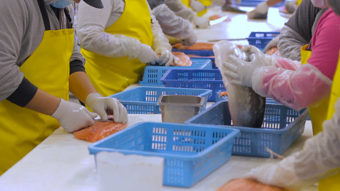
Friedman Family Fishery in Ekuk, south of Dillingham, may be the only processor in Alaska marketing butterfly salmon fillets. (Photo by Matt Martin/KDLG)

Small independent processors and direct marketing of sockeye is a growing trend among fisherman in Bristol Bay. One such business in Ekuk has a new take on the traditional frozen fillet. The Friedman Family Fishery is one of the few, if not the only, processor bringing a butterfly fillet to market.

Friedman has been fishing in Ekuk since 1989, twenty years ago he bought some property in the summer time fishing village and started a processing operation.

“It’s a really good thing I can realize full value of these fish by selling them to the public,” said Friedman.

Friedman started by taking only 100 pounds of fish back to his home in Baltimore in 1995 as an experiment and with that the Friedman Family Fishery was born. And Friedman says the business has taken off solely by word of mouth since then. This year he plans to send home 8500 pounds. Among the traditional salmon fillets, Friedman is packing up a more usually cut. He calls it the butterfly fillet.

To make a butterfly, take a regular fillet, make two diagonal cuts and then cut underneath those cuts so it comes off as one piece. Open up the flaps and you have a semi-round butterfly shaped chunk of meat.

“Which I think is a cool look when you put it on a plate next to some veggies or any other dish that you’re servicing,” said Devin Darrough, who cuts the butterfly fillet for Friedman. Darrough has been commercial fishing on Ekuk beach with his family since he was a child and introduced the butterfly cut to Avi. Darrough says he learned it from his father.

“Who he learned from his father Bob. And it is claimed that he come up with it but we think he got it from somebody else. But we give grandpa credit for the butterfly fillet,” explained Darrough.

These two master filleters met up when Darrough started dating Friedman’s daughter and now the family tradition of the butterfly cut has made into the list of produces Friedman will be selling to his east coast customers this year.

“I’ve never seen it on the market. I’ve only known about it because our family has done it and now Avi is selling it. So he’s the only one that I know of who actually sells it,” said Darrough.

Darrough says it’s his favorite was to eat salmon.

“I personally like to fry it up. I like to get it crispy. It cooks really (quickly) because it’s a thinner piece of meat,” said Darrough.

Friedman believes the butterfly will be popular with his clients. He says it’s an easy way to just have a single serving, something many of his customers are looking for.

British Columbia government withholds key mining permit

The proposed Morrison Mine  is near Lake Morrison, in the Skeens River watershed. British Columbia says its enviromental permit is not ready for consideration. (Image courtesy Pacific Booker Minerals)
The proposed Morrison Mine is near Lake Morrison, in the Skeens River watershed. British Columbia says its environmental permit is not ready for consideration. (Image courtesy Pacific Booker Minerals)

British Columbia officials are delaying permits for an open-pit mine near a river that flows into the ocean south of Ketchikan. They say Pacific Booker Minerals has not proved it can keep toxic water out of nearby waterways. The developer says it has.

The proposed Morrison project, owned by Vancouver-based Pacific Booker Minerals, is about 200 miles east of Ketchikan. The mine site is in the watershed of the Skeena River, which doesn’t flow through Alaska. But it enters the ocean about 50 miles south of the border.

Juneau mine critic Chris Zimmer works with Rivers Without Borders, an international organization. He says Alaskans catch fish out of the Skeena.

“If we see crashes in salmon populations in rivers like that it could affect Alaska fishing,” he says.

“So even the rivers that don’t flow right through Southeast Alaska are still pretty important to our own fisheries here,” he says.

Pacific Booker turned down an interview request and answered only half the questions submitted in writing. But its website, and documents filed with the province, provide insight.

The Morrison deposit was discovered by another company in the 1960s. Pacific Booker conducted exploratory drilling and began collecting information for its environmental permit about a dozen years ago.

The KSM, Red Chris and Galore Creek projects are among several planned for northwest British Columbia, near the Alaska border. (Map courtesy Seabridge Gold)
Other British Columbia mines and mine projects being watched by Alaska critics include the KSM, Red Chris and Galore Creek. (Map courtesy Seabridge Gold)

The company says it has identified deposits of copper, gold and molybdenum. The proposed open pit project, next to a lake, is within a dozen or so miles of two similar mines, which are closed.

Pacific Booker Minerals says it’s provided the information needed for British Columbia to issue permits required for construction to begin.

“PBM is committed to constructing and operating the Morrison mine in compliance with industry best practices, using proven technology and in full compliance with all permit requirements,” wrote Director Erik Tornquist in a June press release.

B.C.’s mines and environment agencies disagree.

“We haven’t said no. We haven’t said yes,” says B.C. Mines Minister Bill Bennett.

“We’ve said, ‘You’re heading in the right direction, but you have a lot more work you need to do before we can think about granting a permit’.”

Bennett says the company has not proved the project design is foolproof. The province needs more information showing its tailings storage ponds won’t leach polluted water into a nearby lake.

Earlier this month, his agency and B.C.’s environment ministry told Pacific Booker to take another three years gathering that and other information.

“We are the regulator. We tell the companies what they must do in order to earn their permits,” he says. “And if the company can’t afford to hire the experts, the scientists who provide the information, they do. And if they cannot afford to do that, then obviously, you don’t hear from then again.”

But they will. Pacific Booker quickly issued a press release saying it’s consulting with professional advisors “on the best method to address the issues raised.”

That could be legal action. The company sued the province after a 2012 permit application was rejected. That case went before British Columbia’s Supreme Court, which ruled in its favor and sent the issue back to the government.

Bennett says his agency will scrutinize permit applications for this, and other, mines that could affect Alaska fishermen.

Critics on both sides of the border doubt that will happen.

“How rigorous is that process going to be? Or could this mine somehow slip through and the concerns raised by B.C. over the past couple years not get addressed?” asks Rivers Without Borders’ Zimmer.

He points to similar mines he thinks are unsafe that won permits, such as the Red Chris in the Stikine River watershed.

Pacific Booker plans to use an earth-and-rock dam to contain tailings, waste rock from processing ore. That’s the same type of dam that collapsed last year at central B.C.’s Mount Polley.

“The B.C. permitting process is mine-by-mine. But right now, there’s no way really to answer the question, what happens if B.C. does put in a couple dozen of these mines over the next decade? What’s the overall long-term effects of that?”

The provincial government supports increased mine development and has added staff to speed the permitting process.

B.C. regulations require agreements with affected tribal groups, called First Nations in Canada.

Lake Babine Nation Chief Wilf Adam, in a recent letter to the mines minister, says “we have no working relationship or dialog” with Pacific Booker.

Leaders of the Gitxsan and Gitanyow First Nations sent a letter saying, “… this mine proposal poses a significant risk to our salmon fisheries and hence to our way of life.”


Site notifications
Update notification options
Subscribe to notifications