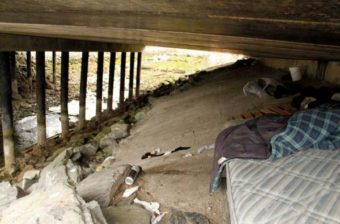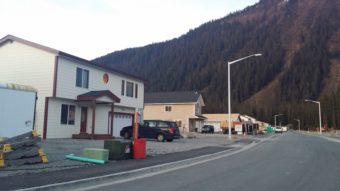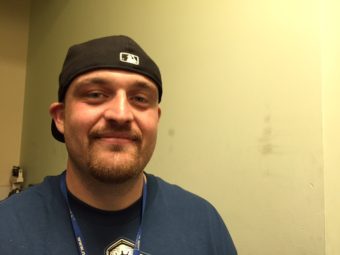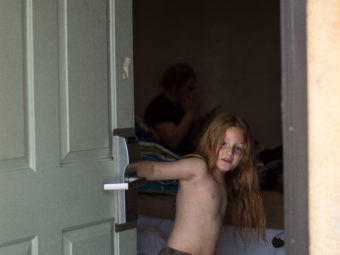
Homeless in Homer event – (Photo by Shady Grove Oliver/KBBI)
Community members from across the Kenai Peninsula packed the Homer Theatre earlier this month for the Homeless in Homer film screening and discussion panel.
The Homeless in Homer forum was the first of its kind.
“So, we went to Lead On! in November which is this giant, big conference that youth and our adult chaperones go to,” said Johnson. “We learn from all these great people and we sit down and come up with an idea that we want to address in our community. And we decided we wanted to address homelessness and that is where Homeless in Homer was conceived.”
When they came back to Homer, the students made a film highlighting youth, teen and student homelessness and the resources available to them.
Representatives from the R.E.C. Room, Haven House, the police department, several formerly homeless youth and others comprised the discussion panel after the movie. They all agreed on a few points – this problem is huge, not much is being done about it and it’s time for change.
Jane Dunn is the Homer area liaison for the Students in Transition program through the school district. She covers all schools from Ninilchik south.
She says she handles cases for 31 unaccompanied youth, or students who are not living with their guardians. She has 68 students total. And district wide, there are 246 students who are recognized as being homeless.
“That doesn’t mean there aren’t a lot more. I know that there’s a lot more that are not receiving services who are scared to come to me because they’re afraid of a label or something or nobody’s noticed they need help.”
Audience members and panelists spent more than an hour hashing out the issues that contribute to the severity of this problem.
For example, many homeless youth don’t get help because they aren’t living on the streets. They move from place to place each night, crashing with friends or where they can, and aren’t automatically identified as homeless.
Also, right now, there aren’t any dependable shelters for homeless youth. That’s according to Krista Schooley, who works with The Habitation in Soldotna.
“After three days, there’s nowhere on the Kenai Peninsula for any teens to go.”
There are also a number of factors that don’t have to do with shelter. Area food pantries aren’t open seven days a week, so kids may not have access to after-hours food for most of the week.
The list goes on and on. And up until now, the whole issue hasn’t really been talked about much.
During the community panel, someone in the audience asked the speakers what is being done to address it.
The answer? This is it.
Doug Koester, with the R.E.C. Room, says this is an incredible first step. And it’s important not to lose momentum now.
“I know you guys are all so into this issue and we need to push on from here. So, we really ask you to give us your email so we can get together as a group and take the next step because obviously this is just the beginning of it. Let’s keep it going and we’d love to see you all again at our next thing or at least on email so we can keep this tribe strong and help with this issue.”
For now, the Lead On! students are working with the Rec Room to collect school supplies and donations to go to local kids in need.
But that’s just a patch. Each speaker reiterated that this is the kind of problem that won’t be solved overnight. It will take the whole community coming together to help those who need it most and fix the problem once and for all.
Stella Dempsey lives in a tent in Fredericksburg, Virginia. She says she’s been homeless for years because of physical and mental health issues. States struggle to help people like Dempsey. (Photo by Rollie Hudson)
At the Micah Ecumenical Ministries, in the center of this quaint colonial town, Stella Dempsey sits in the waiting room, looking dejected. Ministry staffers offered her a bed at a shelter, but she says she can’t bear to go back. Still, she’s feeling desperate.
She is homeless and jobless and sleeps in a tent in the woods. She’s got cirrhosis of the liver, high blood pressure, diabetes and a bad back. Two months ago, she said, she almost died. Now, she’s run out of all her medications, from her bipolar meds to her insulin. She is not eligible for Medicaid under Virginia law.
“I have nothing until they give me disability,” the former waitress said, her eyes welling. “I’m hoping for help. I need food stamps, a clinic for my meds. … People look down on people who are homeless. They think we’re nasty and no good. But some of us can’t help it. If I could help it, trust me, I would.”
At first blush, Dempsey, 43, doesn’t fit the stereotype of the chronically homeless. She’s neatly dressed in flowered capris, her hazel eyes rimmed with eyeliner. But in Fredericksburg, as in other small towns, suburbs and rural corners of the country, the homeless are often hidden, out of sight and mind, hard to reach and hard to help, say people who work with the homeless.
This poses a challenge for states. The causes of homelessness in small towns are the same as in big cities: poverty, mental illness, inadequate housing, domestic violence and the psychological wounds of war, according to the United States Interagency Council on Homelessness. But rural areas are more likely to be poor, with limited transportation, making it that much harder for the homeless to get to a center that can provide counseling, a housing voucher or medical care.
A handful of states are making strides toward tackling the issue, although most of the work is done by nonprofits. Advocates say most states are not doing enough and that a different approach is needed to solve the problem of rural homelessness.
In big cities, you see the homeless virtually everywhere, sleeping under a bridge or in the park, pushing around overflowing shopping carts. The rural homeless live in the woods, in tents or in campers, in barns and ice sheds. They crash on a friend’s couch. Or they’re living in a shack with no heat, electricity or running water—usually not far from where they were born and raised. Many of them are employed or underemployed.
Often, they don’t come forward for help because they are ashamed, advocates say. And because they’re not easily spotted, or they’re not showing up for help at agencies, some advocates for the homeless argue that the rural homeless are being undercounted.
“There’s a lot of poverty in rural areas—and there are a lot of families that don’t have their own homes,” said Wendy Kinnear, regional coordinator for the state of Pennsylvania’s Education for Children and Youth Experiencing Homelessness program (ECYEH).
“My frustration is that this isn’t something that people talk about,” said Kinnear, who works with 10 rural counties in northwestern Pennsylvania to identify and assist homeless children and their families. “We don’t get the same funding and support. People are being undercounted—which means they’re not getting the services and funding that they can be tapping into.”
State Efforts
Some states have tried to find innovative ways to combat rural homelessness.
In Colorado, the Coalition for the Homeless runs a rural initiatives program, collaborating with 14 rural agencies to provide transitional housing, counseling, support, permanent housing and rental assistance.
This July, Virginia, which has a large rural population of nearly 2 million, will launch itsHousing Trust Fund to encourage affordable housing. The $8 million fund (for 2015 and 2016) allocates $1 million for a competitive homeless reduction grant, according to Kathy Robertson, associate director of homeless and special needs housing for the state.
In North Dakota, where homelessness has skyrocketed after the oil boom created a housing shortage, legislators created a Housing Incentive Fund, allocating $35 million in 2013 to encourage the development of affordable housing. But that fund was depleted within five months.
“We need market forces to drive housing costs down,” said Michael Carbone, executive director for the North Dakota Coalition for Homeless People. “But there’s a reluctance on the part of legislators to put money into affordable housing. They’re afraid it’ll overdevelop. But there’s no reason why a small town here should have Manhattan-level rents. It’s crazy.”
Continuum of Care
Most help for the homeless is funded by the U.S. Department of Housing and Urban Development (HUD), which goes to the states and then is distributed to local agencies. Population determines where funds are allocated. In rural areas, there are fewer continuums of care (CoC), local, community-based organizations that are responsible for coordinating aid for the homeless, usually with federal funding distributed by the states. Fewer CoCs means fewer homeless people are being served, Kinnear said.
HUD set aside $30 million for a competitive grant to tackle rural homelessness. But the agency didn’t get enough applicants to send money to rural areas, according to Ann Oliva, director of HUD’s Office of Special Needs Assistance Programs.
Most big cities have a well-developed infrastructure for helping the homeless, with dedicated funding for programs and an extensive network of providers, said Steve Berg, vice president for programs and policy for the National Alliance to End Homelessness. In more rural areas, there might be a program in town or a couple of shelters run by a church. One CoC could be responsible for handling vast swaths of a state, Berg said.
“There’s not really a system for dealing with rural homelessness,” Berg said. “The person at the local food bank might be trying to figure out what to do about homeless people. In some places there are shelters; in others, there are none.”
The bulk of state funding for its homeless populations goes to big cities, advocates say. Andrea Sheesley, of Pennsylvania’s ECYEH program, says that funding for homeless children in the region she serves as coordinator was cut by 75 percent last year, while funding in the big cities like Erie and Pittsburgh increased.
Many homeless people say that even when services are to be had, they are tough to access.
The local homeless agencies haven’t been much help, said “Alan,” who asked not to be identified for fear of being ostracized by the agencies in Fredericksburg. “They only help some people,” Alan said. “They have their favorites.”
He said he’s been homeless for two years, after a judge slapped him with $7,000 in court fees because he failed to make full child support payments after construction jobs dried up. He said he sold his truck and got rid of his apartment to pay the court fees. It was that or jail. “I told the judge, ‘You’ve now made me homeless.’ He said, ‘At least you’ve paid your child support. Don’t ever be late again.’ ”
Alan, 46, who has his own handyman business, said he has worked the whole while, paying $1,049 in child support each month. Because of that, he said, he’s had a hard time saving enough to cobble together the first month’s rent and security deposit needed for an apartment.
For now, he works during the day and sleeps under a church’s stairs at night. The pastor doesn’t mind, he said, as long as he’s gone by morning. “It’s amazing what you get used to,” he said.
A Tough Count
It’s hard to get a handle on just how many homeless people live outside big urban areas. Counting the homeless has always been tricky, and tracking methods vary among federal agencies.
When it comes to counting non-urban homeless populations, HUD bundles suburban and rural populations. By that count, roughly 28 percent of the nation’s homeless live outside big cities, according to HUD’s Oliva. Meanwhile, the National Alliance to End Homelessnessplaces the rural homeless population at 7 percent. It estimates that 14 out of every 10,000 people experiencing homelessness live in the country, compared with 29 out of 10,000 living in the city.
The rural homeless are more likely to be white. More women in rural areas are homeless, about 42 percent of the homeless population compared with 35 percent in cities, according to Oliva. In the country, you’ll see more homeless families than singles, and more youth under 18, she said.
For some of the homeless in the nation’s small towns and suburbs, it’s hard to find a shelter. But once they do, shelters can provide a way out.
Michael sits in the basement of St. George’s Episcopal Church in Fredericksburg, where, every Monday, the doors are thrown open for a “community dinner” where any and all are welcomed to get a hot bite to eat. Other days of the week, other churches in town return the favor.
“I am a disabled vet,” said Michael, 61, who preferred that only his first name be used because of his circumstances.
There was a time when Michael, who said he served in Vietnam, was doing just fine. He said he went back to school on the GI Bill, worked for years as a welder and a mechanic. He even bought a house. But somewhere along the way, he lost the house. He hurt his back, suffered from post-traumatic stress disorder and depression, and fell behind in his child support. His paycheck was garnished and suddenly he didn’t have the money for rent.
“I didn’t sleep under a bridge, in a bus station or in the woods,” Michael said. “I had places to stay.”
But to get the help he needed, to get on disability, he decided to enter the system. First, he signed up to stay at the local shelter so that he could be classified as “chronically homeless” and be eligible for housing assistance. The Micah center in Fredericksburg helped him find an apartment and a landlord who didn’t mind tenants with a history of homelessness, and it paid his first month’s rent and security deposit. Now, he volunteers at Micah, giving back what was given to him.
“Since I was able to establish my own place, I don’t have to be in that [homeless] clique anymore,” Michael said. “But I don’t forget where I come from.”
Juneau has a lack of affordable housing. The survey will help city contractors figure out how to solve that problem. (Photo by Justin Heard/KTOO)
The city is asking residents to take an online survey to help solve housing issues plaguing Juneau.
City Lands Manager Greg Chaney says Juneau has a lack of affordable housing, which is housing that costs 30 percent or less of a person’s income.
“Many people in Juneau are paying 40, 50 – sometimes even more than that – percent of their income for their housing,” he says.
The city contracted with czb LLC in January for about $72,000 to come up with solutions to Juneau’s housing issues.
“Not to tell us that we have a problem. We know we have a problem,” Chaney says. “What we need to know is, how can we get out of this? How, as a community, can we have an affordable housing supply that meets the needs of the residents and people who want to move here?”
The city chose the Virginia-based company over a Juneau firm to put out a housing action plan. Chaney says czb has a proven track record dealing with housing issues.
Part of the firm’s work is conducting an online survey. It’s on the city’s website and takes about 15 minutes to complete.
“For the average person, I think it’s going to seem kind of strange,” Chaney says. “It’s very academic. Some of the language is a little thick. I think they could’ve said the same thing with fewer words and shorter words. But if you just read it a couple times and you figure out what the question is, do your best to answer it.”
For example, one of the questions asks, “Under which conditions, if any, would you be willing to consider additional height/stories and density beyond current code requirements/allowances?” Here’s another: “The future of Juneau hinges on successive generations of residents and stakeholders regularly reaffirming their values and acknowledging what they inherited from prior generations, not in words, but in deeds, policies, and programs. In your words, what if anything do you think is most essential to continuing this legacy?”
Besides the survey, Chaney says czb has been conducting other research. It’s interviewed Realtors and lenders, city staff, developers, community organizations and property managers.
A view inside the tent at Lemon Creek Correctional Center as seen from a security monitoring screen. (Photo by Lisa Phu/KTOO)
Alaska’s prison population is the third fastest growing in the country, and the prisons are over capacity. The crowding problem is especially evident at Juneau’s Lemon Creek Correctional Center where half the female inmates live in a tent outside. Some of them actually like it, but it’s an indication of a problem one state senator is trying to fix.
“It kind of looks like a greenhouse from the outside,” says 29-year-old Lemon Creek inmate Catherine Fredrick. She lives in the tent. “It has bunks all in one row and we actually house more than the dorm does.”
The 20 by 30 foot curved roof canvas tent sits on a raised wooden platform. You can see it as you enter the grounds of the Lemon Creek Correctional Center and it really does look like a greenhouse. When I first visited the prison, I had no idea women, up to 20 of them at a time, were living there.
Catherine Fredrick at a prison event in the Lemon Creek Correctional Center gymnasium. Fredrick lives in the tent. (Photo by Lisa Phu/KTOO)
“It’s not as bad as it looks, you know. Sometimes it gets cold in the winter, but they allow for us to have an extra blanket if it’s really cold out. And in the summer, it’s hot,” Fredrick says.
That’s when they can open a window or decide to walk outside to get fresh air. Inside the prison, it’s different.
“You don’t open your own doors, it’s always keys open the doors, moving gates, you hear the clanking, you hear the keys rattling, you hear the bells going,” Fredrick says.
There is one big con with the tent, though. No running water. Two porta-potties sit outside between the tent and the entrance to the prison.
“The outhouse gets full quick when we have too many people, so you have to use the broom with a plastic bag on the end to push the poop down, and that’s kind of disgusting but we take one for the team,” Fredrick says.
Department of Corrections Commissioner Ronald Taylor admits the living situation isn’t adequate, especially without running water. But given the prison overcrowding situation, he says he doesn’t have much choice.
“As long as the housing issues are what they are, then the tent is going to be used for that as an overflow,” Taylor says.
It’s been used that way for more than 15 years. Men have stayed there before, but lately it’s been for women. Since 2002, Taylor says the number of female inmates in the state has been growing at a faster rate than males.
He says the state’s primary prison for women, Hiland Mountain Correctional Center in Eagle River, recently had a daily count of 441. That’s almost 50 people over capacity.
Taylor says overcrowding issues throughout the state prison system will continue to affect the situation at Lemon Creek.
“When we’re able to really manage our population to where that’s no longer an issue and we can consistently stay down below our numbers in terms of the overflow, then I think that we’re not going to utilize the tent for that,” Taylor says.
A December report from the state’s legislative audit division called the tent a weakness for security reasons. But inmate Veronica Parks comes back to the living standards issue. She lives in the dorm now, but remembers how she used to bang on the prison door for an hour before being let inside to shower.
“We shouldn’t be holding girls in here that we can’t put inside the building,” Parks says.
State Sen. John Coghill has introduced a bill that he hopes will ease the prison overcrowding issue and get more Lemon Creek inmates inside the building.
Sen. John Coghill, R-North Pole (Photo by Skip Gray/360 North)
His proposal would use electronic monitoring to keep nonviolent offenders and people awaiting trial out of prisons, while providing incentives for them to go to treatment programs. The bill would also cap the amount of time someone is in prison for a probation violation.
“We can’t afford another jail. Where would we build it and how would we build it when we don’t have the money?” Coghill says. “So that’s the pressure to keep us being creative, to give people avenues to succeed, hold them accountable and maybe jails isn’t the best way to do it.”
Coghill says he didn’t previously know about the tent at Lemon Creek, but he finds it troubling.
“Just because they’re in prison doesn’t mean they shouldn’t be treated with the best dignity we can treat them,” Coghill says.
But inmate Catherine Fredrick still says the tent is actually better than living inside the prison.
“Living in a tent is kind of like a privilege for the jail because you get the feeling of being outside, feeling of being home when you can open your window,” Fredrick says.
Of course, she says she’d rather be home with her 11-year-old son. But for now, she says home is where you make it.
Jan Miyagishima at the AHFC booth at the Juneau Home and Outdoor Living Expo. (Photo by Casey Kelly/KTOO)
More than half of all homes in Alaska were built in the 1970s and ‘80s.
That’s according to an Alaska Housing Finance Corp. report released last year that highlighted the need for improvements to the state’s aging housing stock.
AHFC offers a variety of loan and rebate programs aimed at home renovations and energy efficiency upgrades. Corporation officials were in Juneau over the weekend to talk about some of those programs at the Southeast Alaska Building Industry Association’s Home and Outdoor Living Expo.
Amelia Harmon just moved to Juneau from Michigan and is considering buying her first home. She’s been looking online to get a sense of the market before she starts to shop for real.
“A lot of them look like they need some work, but that’s just from the outside,” she says of the homes she’s seen thus far. “I don’t know what they look like on the inside. I don’t like to judge a book by its cover.”
Harmon and her mom came to the Juneau Home and Outdoor Living Expo to get a better idea of what’s available. She says she wants something not too pricy, but also doesn’t want to put a lot of money into a fixer upper.
“Not a home that needs too much renovations and have to put more work into it than what you paid for,” she says.
Harmon stops at the Alaska Housing Finance Corp. booth, where there’s big sign with a floral print couch on it that says, “The 70s called. They want their house back.”
Jan Miyagishima, director of mortgage operations at AHFC, says most homes in Alaska are in the 35-year and older range.
“Doesn’t sound like it’s really old if you compare it to the East Coast. But the homes are getting dated,” Miyagishima says. “If you don’t keep up your home, it will decrease in value.”
Alaska Housing offers three renovation loan programs. Homeowners can get up to $312,750 in remodeling financed by having a full appraisal done on their property. Those looking to refinance their mortgages can qualify for a package that allows them to recoup money spent on improvements over the previous year and get an additional loan up to $50,000. Finally, there’s a purchase renovation loan that allows buyers to pay for up to $50,000 worth of upgrades through their mortgage loan.
Miyagishima says all three programs require a bid from a qualified contractor for the work to be done.
“This is allowing people to get the kitchen that they want, the bathroom upgrades,” she says.
AHFC does not actually loan money itself. Instead, it works with lenders like banks and credit unions to offer home financing to Alaskans. The state-backed corporation is like Fannie Mae or Freddie Mac, in that it buys loans from these lenders, and packages them into mortgage-backed securities that are sold to private investors.
Alaska Housing also operates the state’s home energy rebate programs, which can be used in conjunction with any of its renovation loans. These programs allow homeowners to get an energy rating to identify any issues. The rebate helps pay for the cost of improvements.
“The average rebate’s right around $7,000,” says Jimmy Ord, AHFC energy programs manager.
“Most Alaskans put in somewhere around $12,000,” he says. “So there’s a good investment from the homeowner and the state in the project.”
Alaska Housing also offers energy rebates for new home construction. But in recent years, Ord says the state has averaged fewer than 2,000 new homes per year. That’s why the heavy push to improve existing housing.
“Most of the infrastructure is already in place, so we have to look at how we’re going to move that infrastructure into the next generation,” he says.
Harmon, the potential home buyer looking to lay down roots in Juneau, says right now she’s more concerned about finding the right price than she is with renovations.
“It’s more expensive up here than where I’m from down in the lower 48,” she says. “But Michigan doesn’t have the views and the stuff that Alaska has to offer.”
And she says it’s good to know that options are available should she need upgrades for whatever home she decides to buy.
Close
Update notification options
Subscribe to notifications
Subscribe
Get notifications about news related to the topics you care about. You can unsubscribe anytime.