Housing

Juneau Assembly commits to Housing First project

Housing First
This concept drawing by MRV Architects shows the proposed Housing First project in Juneau. The facility would be built in Lemon Creek on land donated by Tlingit-Haida Regional Housing Authority.

The Juneau Assembly has officially committed $1.5 million to a Housing First project aimed at helping the chronically homeless.

The group behind the project hopes the Assembly’s pledge of support will increase its chances of getting a grant from the Alaska Housing Finance Corp. to pay for the bulk of construction costs.

The Assembly adopted a resolution with the commitment Monday without objection. The project also will get a small financial contribution from the theater company producing “A Lifetime to Master,” a play about understanding homelessness in Juneau.

Mary Ellefson, Flordelino Lagundino, Shona Strauser
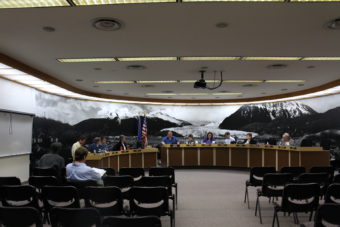
Playwright Mary Ellefson, Generator Theater Company producer Flordelino Lagundino and director Shona Strauser at the Juneau Assembly meeting Monday. (Photo by Jeremy Hsieh/KTOO)

Generator Theater Company’s Flordelino Lagundino told the Assembly half the proceeds from Sunday’s show at McPhetres Hall will be donated to the Housing First project.

“And I really feel like it’s an important story, these stories are really important for all of us to hear,” Lagundino said.

Initially, the proposed facility would have 32 efficiency apartments, a commercial kitchen and clinic space. Another 22 apartments could be added at a later date, along with office space for social service nonprofits. Phase one is estimated to cost about $6.8 million. The whole thing would be about $9.1 million.

The Juneau Housing First Collaborative has been working on the project for the better part of two years. It’s based on a model that’s been used successfully in other communities, including Anchorage and Fairbanks. It says that if you give a homeless person a permanent, stable place to live it increases their chances of getting out of homelessness and improving their lives.

The Glory Hole Soup Kitchen and Emergency Homeless Shelter is the lead agency for the project. Tlingit-Haida Regional Housing Authority has donated land near its headquarters in Lemon Creek where the project can be built.

Potential sources of the city’s $1.5 million contribution include tobacco tax revenue, the city’s budget reserve and unspent cash that rolls over between fiscal years.

Jeremy Hsieh contributed to this report.

Juneau Assembly pledges to support Housing First project

Housing First
This concept drawing by MRV Architects shows the proposed Housing First project in Juneau. The facility would be built in Lemon Creek on land donated by Tlingit-Haida Regional Housing Authority.

The Juneau Assembly last night unofficially committed $1.5 million to help fund a Housing First project in the capital city.

Supporters hope the project – which would be the third of its kind in Alaska – will provide a stable place to live for about 30 chronically homeless people. They also hope it eventually will house nonprofits and social service agencies to help individuals out of homelessness.

Housing First proponents say if you give a homeless person a permanent, stable place to live, it’s easier to address what’s causing them to be on the streets in the first place. Whether it’s lack of income, drug or alcohol addiction, mental health issues, or something else, studies have shown the approach reduces the amount of time and money spent on expensive emergency services for the homeless.

But Mandy O’Neal-Cole with the Juneau Homeless Coalition says that’s not the best reason to support it.

“There are a lot of economic reasons to make this happen, but there are more human reasons to make this happen,” O’Neal-Cole told the Juneau Assembly Committee of the Whole.

The homeless coalition is one of several groups that have been working on a Housing First project in Juneau for the better part of two years. O’Neal-Cole works for AWARE, Juneau’s domestic violence and sexual assault prevention nonprofit.

“It’s a lot of people with a lot of different agendas. And the fact is that we all came together with this similar agenda to recognize that this is bigger than any one of us,” she said. “It’s more about all of us and what our responsibilities are to the people who need the most help.”

The Glory Hole emergency homeless shelter recently agreed to be the lead agency for the project, and Tlingit-Haida Regional Housing Authority agreed to donate land next to its offices in Lemon Creek where the facility could be built.

“We know this model works in other cities and we’re absolutely certain it’s going to work here in Juneau,” said housing authority president and CEO Ricardo Worl.

Members of the Juneau Housing First working group ask the Juneau Assembly to support their project. From right to left: Paul Voelckers of MRV Architects, Mandy O'Neal-Cole from the Juneau Homeless Coalition and AWARE, Glory Hole Executive Director Mariya Lovishchuk, Tlingit-Haida Regional Housing Authority president and CEO Ricardo Worl, Bruce Denton with the Glory Hole board of directors, Scott Ciambor with the Alaska Coalition on Housing and Homelessness, and Norton Gregory with the Juneau Affordable Housing Commission and THRHA. (Photo by Casey Kelly/KTOO)
Members of the Juneau Housing First working group ask the Juneau Assembly to support their project. From right to left: Paul Voelckers of MRV Architects, Mandy O’Neal-Cole from the Juneau Homeless Coalition and AWARE, Glory Hole Executive Director Mariya Lovishchuk, Tlingit-Haida Regional Housing Authority president and CEO Ricardo Worl, Bruce Denton with the Glory Hole board of directors, Scott Ciambor with the Alaska Coalition on Housing and Homelessness, and Norton Gregory with the Juneau Affordable Housing Commission and THRHA. (Photo by Casey Kelly/KTOO)

The proposed building would be constructed in two phases, with 32 efficiency apartments, a commercial kitchen and clinic space built in the first phase. Another 22 apartments as well as office space for social service nonprofits would be part of phase two.

The group estimates it needs $6.6 million to build phase one and $9.1 million to do both phases.

Glory Hole Executive Director Mariya Lovishchuk says they hope to get the project started with a $3.5 million Special Needs Housing Grant from the Alaska Housing Finance Corp. That money is in this year’s state budget, but Lovishchuk says it’s unlikely to be available again for the foreseeable future, given the state’s projected deficit of more than $3 billion.

“The time for this project is really now,” Lovishchuk said.

Anchorage and Fairbanks already have Housing First projects, which Lovishchuk says also bodes well for this being Juneau’s year to receive funding.

The Special Needs Housing Grant application is due Feb. 20.

The Assembly Committee of the Whole last night asked the City Manager’s office to prepare a resolution pledging $1.5 million for the project. While the Assembly still needs to vote to approve the resolution at its first regular meeting of 2015, members left little doubt that the vote would be just a formality.

“You have your commitment,” said Assemblywoman Karen Crane.

The Housing First group is also hoping to get funding for the project from the Rasmuson Foundation and other charitable organizations.

The facility is expected to cost about $870,000 a year to operate. More than half of the projected operating costs would come from AHFC vouchers, rental income and the Juneau Community Foundation.

St. Vincent de Paul to build 41 affordable housing units for seniors

St. Vincent de Paul general manager Dan Austin looks out onto the land where the new senior housing facility will be built. (Photo by Lisa Phu/KTOO)

Juneau nonprofit St. Vincent de Paul and partner agency Seattle-based GMD Development have been awarded $9 million in tax credit financing from the Alaska Housing Finance Corporation. The award will allow the agencies to build 41 units of affordable housing in the capital city for low income seniors.

Thomas Smith is 70 years old and lives in St. Vincent de Paul’s transitional housing for people getting out of homelessness. He’s excited about the new senior living facility.

“Because that means within two years, I can move out of this room and move into my own apartment with a kitchen,” Smith says. “I’m really a good cook and I love my kitchen but I don’t have that here. I have to use a communal kitchen across the way.”

Smith has Parkinson’s disease and other medical conditions that necessitate a wheelchair. He takes eight daily medications. Between social security, senior benefits and general assistance, Smith makes about $1,100 a month. He can’t afford Juneau’s housing prices.

“The rents are so high. I would have to give up eating in order to move into, say, an apartment that cost $750 a month,” he says. “The bills I need to pay for and the medications I have to buy that Medicare will not pay for – it’s very difficult to get by from month to month.”

Dan Austin is general manager of St. Vincent de Paul. He says Smith would be one of the first people to move into the new facility. Austin says some people spend up to four years on the waiting list for the organization’s current 24-unit senior housing.

“The only turnovers here are when somebody goes to the nursing home or somebody passes away,” Austin says.

The percentage of Juneau’s population age 65 and older has doubled in the last 10 years. Seniors now make up 10 percent of the city’s overall population. A recent Juneau Senior Housing and Services Market Demand Study found that in next two decades, seniors will make up 20 percent of the city’s population.

Austin sees that growth reflected in St. Vincent de Paul’s shelter.

“Over the last five and 10 years, we’ve seen the percentage of seniors who are homeless looking for some place to live increase exponentially,” he says.

The new facility will be a mix of studio, one-bedroom and two-bedroom units with commercial space on the ground floor. The retail space will house the St. Vincent de Paul thrift store. The complex will be built on a lot adjacent to the nonprofit’s current property near the airport.

The target population is low to moderate income seniors. Austin has been working on the project for 10 years and is happy to see it come into fruition. He hopes to break ground late next summer.

“Having worked here for 20 years and watching this organization grow from 10 units of homeless apartments for homeless families to an organization that now owns and manages 124 units throughout this town, what that means to me is, it’s not 124 units, it’s a 124 families that have a decent place to live,” Austin says.

St. Vincent de Paul also plans to renovate two existing housing facilities in Juneau and one in Haines. Once those projects and the senior facility are done, the organization will own and manage about 200 units in the capital city.

Norton Gregory says every unit and every house built in Juneau is a step in the right direction. Gregory sits on the Juneau Affordable Housing Commission. He says the 41 units will target a population the commission sees as one of the most vulnerable.

“We have a lot more seniors that are aging out of the workforce and unfortunately they may not be able to afford to live in our community without these subsidized rental units, so to give them more options is definitely going to make an impact on our community,” Gregory says.

St. Vincent de Paul’s new senior housing facility is expected to be complete by fall of 2016. The project was named the Home Run by a board of directors member who said to Austin, “‘If we get this, man, we hit the home run.’ So that’s what it is. For St. Vincent, it’s a home run.”

Austin says Juneau needs many more home runs.

St. Vincent de Paul to build 41 affordable housing units for seniors

St. Vincent de Paul general manager Dan Austin looks out onto the land where the new senior housing facility will be built. (Photo by Lisa Phu/KTOO)

Juneau nonprofit St. Vincent de Paul and partner agency Seattle-based GMD Development have been awarded $9 million in tax credit financing from the Alaska Housing Finance Corporation. The award will allow the agencies to build 41 units of affordable housing in the capital city for low income seniors.

Thomas Smith is 70 years old and lives in St. Vincent de Paul’s transitional housing for people getting out of homelessness. He’s excited about the new senior living facility.

“Because that means within two years, I can move out of this room and move into my own apartment with a kitchen,” Smith says. “I’m really a good cook and I love my kitchen but I don’t have that here. I have to use a communal kitchen across the way.”

Thomas Smith has lived in St. Vincent de Paul's transitional housing for one year. (Photo by Lisa Phu/KTOO)
Thomas Smith has lived in St. Vincent de Paul’s transitional housing for a year. (Photo by Lisa Phu/KTOO)

Smith has Parkinson’s disease and other medical conditions that necessitate a wheelchair. He takes eight daily medications. Between social security, senior benefits and general assistance, Smith makes about $1,100 a month. He can’t afford Juneau’s housing prices.

“The rents are so high. I would have to give up eating in order to move into, say, an apartment that cost $750 a month,” he says. “The bills I need to pay for and the medications I have to buy that Medicare will not pay for – it’s very difficult to get by from month to month.”

Dan Austin is general manager of St. Vincent de Paul. He says Smith would be one of the first people to move into the new facility. Austin says some people spend up to four years on the waiting list for the organization’s current 24-unit senior housing.

“The only turnovers here are when somebody goes to the nursing home or somebody passes away,” Austin says.

The percentage of Juneau’s population age 65 and older has doubled in the last 10 years. Seniors now make up 10 percent of the city’s overall population. A recent Juneau Senior Housing and Services Market Demand Study found that in next two decades, seniors will make up 20 percent of the city’s population.

Austin sees that growth reflected in St. Vincent de Paul’s shelter.

“Over the last five and 10 years, we’ve seen the percentage of seniors who are homeless looking for some place to live increase exponentially,” he says.

The new senior housing will sit on a 1.3-acre parcel of land. In the summer, Austin says it's surrounded by grass and fireweed. (Photo by Lisa Phu/KTOO)
The new senior housing will sit on a 1.3-acre parcel of land. In the summer, Austin says it’s surrounded by grass and fireweed. (Photo by Lisa Phu/KTOO)

The new facility will be a mix of studio, one-bedroom and two-bedroom units with commercial space on the ground floor. The retail space will house the St. Vincent de Paul thrift store. The complex will be built on a lot adjacent to the nonprofit’s current property near the airport.

The target population is low to moderate income seniors. Austin has been working on the project for 10 years and is happy to see it come into fruition. He hopes to break ground late next summer.

“Having worked here for 20 years and watching this organization grow from 10 units of homeless apartments for homeless families to an organization that now owns and manages 124 units throughout this town, what that means to me is, it’s not 124 units, it’s a 124 families that have a decent place to live,” Austin says.

St. Vincent de Paul also plans to renovate two existing housing facilities in Juneau and one in Haines. Once those projects and the senior facility are done, the organization will own and manage about 200 units in the capital city.

Norton Gregory says every unit and every house built in Juneau is a step in the right direction. Gregory sits on the Juneau Affordable Housing Commission. He says the 41 units will target a population the commission sees as one of the most vulnerable.

“We have a lot more seniors that are aging out of the workforce and unfortunately they may not be able to afford to live in our community without these subsidized rental units, so to give them more options is definitely going to make an impact on our community,” Gregory says.

St. Vincent de Paul’s new senior housing facility is expected to be complete by fall of 2016. The project was named the Home Run by a board of directors member who said to Austin, “‘If we get this, man, we hit the home run.’ So that’s what it is. For St. Vincent, it’s a home run.”

Austin says Juneau needs many more home runs.

Juneau Housing First project inches closer to reality

The Glory Hole
The Glory Hole, Juneau’s emergency homeless shelter and soup kitchen, will lead the effort to build a Housing First project to serve the capital city’s chronically homeless population. (Photo by Casey Kelly/KTOO)

Juneau is getting closer to becoming the third community in Alaska with a Housing First project to provide the chronically homeless with housing. Organizers told the Juneau Assembly on Monday that the project is moving from the concept stage to the design stage.

The Glory Hole Emergency Shelter and Soup Kitchen has taken the lead role in planning a Housing First project in the capital city. Scott Ciambor is chair of the Alaska Coalition on Housing and Homelessness and one of the volunteers leading the effort to build the project.

Scott Ciambor and Mariya Lovischuk describe their plans for a Housing First project in Juneau on Monday. (Photo by Jeremy Hsieh/KTOO)

“Right now we are basically transitioning from kind of a theoretical project to an actual development of a project,” Ciambor said.

In recent decades many communities have turned to the Housing First model to address chronic homelessness. The idea is that if you give people a permanent, stable place to live, it’s easier to address why they’re on the streets. Anchorage and Fairbanks have had success with Housing First projects, and the Juneau group has been in the planning stages for about two years.

In addition to the Glory Hole becoming the lead agency, Ciambor said Tlingit-Haida Regional Housing Authority has offered several parcels of land and Juneau-based MRV Architects has produced a series of conceptual drawings.

Ciambor said there are two things the city could provide to make the project a reality.

“Community support, plus community resources,” he said. “You know, what real resources is the community providing to get an affordable housing project done?”

On average, he said it takes eight funding sources to build an affordable housing project. The municipality has an Affordable Housing Fund, and Ciambor said it could secure additional money from the state’s Community Development Block Grant Program. The Housing First group is also hoping to set up a dedicated fund with the Juneau Community Foundation to raise money for the project.

One potentially significant source of funding is the Special Needs Housing Grant program from the Alaska Housing Finance Corp. Glory Hole Executive Director Mariya Lovischuk said the deadline to apply for one of those grants is Feb. 20.

“We will need to figure out a site by that point,” Lovischuk said. “We will need to figure out where most of the capital funding will come from.”

Lovischuk said facility will likely serve about 40 people, and operating costs could total about $950,000 a year.

The Assembly heard the project update as part of its annual retreat on Monday. Among the other topics: How to encourage more housing in general.

One option to avoid high housing costs in Juneau: Live on a boat

Houseboats Aurora Harbor
Houseboats in Aurora Harbor (Photo by Kayla Desroches/KTOO)

Juneau has some of the highest housing prices in Alaska. According to the  state Department of Labor, the average single family home costs $349,000 dollars in the capital city. A typical rental unit is more than a thousand dollars a month.

One way to combat the high cost of housing is to rent a slip on the docks for a houseboat or a live aboard.

Carrie Warren and her three children live in Aurora Harbor. She’s originally from Washington state, but has lived in Alaska on and off for 20 years. In 2013, she moved to Juneau from Tenakee Springs. As soon as she came to town, she started looking for housing and found a houseboat that suited her needs.

“I chose it because I could actually own it. There are not very many things in Juneau that you can purchase for 50,000 dollars or less.”

Warren says the seller financed the boat for her, and she paid it off in about a year and a half.

She says harbor fees add up to around $200 a month, plus a little extra for utilities. The city’s Docks and Harbors department provides power, water, outhouses and a sewage pump-out. Warren says cooking can be a challenge.

“I have a Dickinson stove that doesn’t work,” she says. “It’s not hooked up. And even if it did, that’s mostly for heat. You can’t bake on it. I mean, you can heat water. I can make a mean pumpkin pie in my toaster oven. I don’t have a microwave. Electricity is hard because you can’t have too many things happening at once. You blow your breaker.”

Warren is a single mother who home-schools her kids and the boat is about 200 square feet. She says sometimes it’s a challenge to make sure the family gets along in such a small area. Warren’s older son plays upright bass and her daughter French horn and they need to arrange individual practice times.

“Our space and boundaries are different than most people’s, and rather than sit around and whine about it, you just suck it up,” Warren says.

Katie Spielberger is Warren’s neighbor. She lives in a houseboat with her partner and a cat.

“A couple of our neighbors have seen the cat and have come by with an extra can of cat food or half a container of kitty litter that they found in the free bin,” she says.

Spielberger works for the state and has been in Juneau for about nine years. She compares living on a boat to the tiny house movement, in which architects design homes that are less than 400 square feet. She says living in a small area has made her more creative.

“It’s kind of nice to have that challenge to simplify things and it feels very rewarding when you actually can live in such a small space and have everything you need,” Spielberger says.

She hangs as much as she can on walls, takes advantage of all available space and rents a storage unit. Spielberger says living on a houseboat provides the best of Juneau at an affordable price.

“It feels very much of this place,” she says. “You don’t feel like you’re living in a house that could be anywhere. The views surrounding a boat in any harbor in Southeast Alaska, I think are gorgeous and hard to beat except at some very nice land property.”

In addition to houseboats, some people in Juneau have live-aboards.

“There’s a live-aboard vessel which is just your normal boat that somebody might live on,” explains Harbormaster Dave Borg. “And then we do have some houseboats designated specifically just as a houseboat. They generally don’t have any mode of power.”

Borg says there are nine houseboats in Aurora, three in Douglas Harbor, two in Harris Harbor, and nearly 140 live-aboards. Monthly moorage fees are $4.20 per foot.

Warren says there are unique problems with houseboats, but they’re mostly in-line with other homeowner concerns.

“When it’s real windy, it’s a little freaky. You know, I worry about things like my canvas blowing away, but you know, I think any homeowner when it’s stormy and yucky has those same kinds of worries. Anybody who’s living in a not super insulated home has those same kinds of worries,” says Warren.

And she says it’s more affordable than other housing alternatives.

Site notifications
Update notification options
Subscribe to notifications