Marijuana

House passes bill to seize federal lands

To say Alaska has a complicated relationship with Washington, DC, would be an understatement. The federal government spends billions in the state, but it also owns millions of acres of land in Alaska and often manages those lands in a way that is not to the liking of the state’s leaders. Now, lawmakers are moving legislation to seize those acres, with a few exceptions.

“The bill requires that the federal government turn over the lands held by the federal government except for lands that are in private ownership, lands used for military or naval purposes or military reservations, and land that was a national park on January 1 of 2015,” said Rep. Steve Thompson, a Fairbanks Republican, while carrying the bill on the House floor.

If the bill becomes law, Alaska could lay claim to nearly 170 million acres of federal land within the state. But there may be a slight problem: The federal government may not feel legally obligated to comply with the bill.

“The Constitution says it’s illegal,” said Rep. Andy Josephson, an Anchorage Democrat. “The Supreme Court reading the Constitutions says it’s illegal. The lawyers we pay in the Terry Miller building say it’s illegal. And our past attorney general says it’s illegal.”

Josephson cited a memo, drafted by the Legislature’s legal department, that plainly said as much. He also pointed to unintended consequences, like the state unintentionally seizing United States post offices and interfering with the delivery of mail.

“Now, some people will say, ‘Andy, this is hyperbole, and you’re overdramatizing this,’” said Josephson. “I’m just reading the words. I don’t mean to overdramatize it. I really don’t. It’s just what the words call for.”

Other opponents, like Rep. Les Gara of Anchorage, argued that the bill should not be a priority at a time when the state is facing a fiscal crisis. In Utah, such legislation is expected to cost $2 million to litigate.

“We’re facing a $3.5 billion budget deficit. We don’t have the money to litigate a bill that is 100% unconstitutional,” said Gara.

When a similar bill passed in Arizona, its Republican governor vetoed it because of its questionable legality.

But defenders of the bill pointed out that Alaskans still should be able to take the battle to court, if they want to. Referencing the Declaration of Independence, Wasilla Republican Wes Keller argued that the state had grounds to pursue the land seizure policy.

“It’s never unconstitutional to fight what’s rightfully yours,” said Keller. “That’s just part of the fundamentals of the pursuit of happiness — it’s ours, we can fight for it, whether we’re talking 5.5 acres, a million acres, or more.”

Anchorage Republican Gabrielle LeDoux noted that the state has defied the federal government by legalizing marijuana, and the federal government has not yet interfered.

“I suspect that at least some of the lawyers might say that the pot initiative was unconstitutional, and yet we’ve done that. Colorado has done that. Several other states have done that,” said LeDoux. “And guess what? The federal government blinks. If enough states do it, and enough states say what they want, and say we’re going to take it — we just might get what we want.”

The bill passed 27 to 11, on caucus lines. It will now be sent to the Senate.

Anchorage Democrats offer ‘emergency fix’ for Alaska’s oil tax system

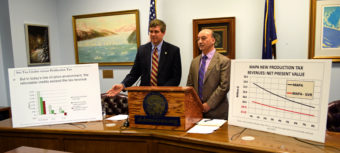
Sen. Bill Wielechowski and Rep. Les Gara present their proposed oil tax fix. (Photo by Skip Gray/360 North)

With just three weeks left in the legislative session, a pair of Anchorage Democrats are offering what they describe as an “emergency fix” to Alaska’s oil tax system.

Sen. Bill Wielechowski and Rep. Les Gara say they would like to see the tax floor raised from 4 percent to 12.5 percent and certain credits ended in order to bring in more revenue to the state.
The state’s oil tax structure has been debated exhaustively ever since the TransAlaska pipeline came online. Last year, a referendum to repeal the tax legislation pushed by former Gov. Sean Parnell failed narrowly.

At a press conference on Tuesday, Wielechowski argued that adjusting the oil tax system was fundamentally different from efforts to weaken marijuana legislation, noting that the state Constitution has separate rules for referenda and initiatives. He added that the current regime has been given enough time since the referendum to work.

“It’s a failed system. It’s something that needs to be fixed. And I would respectfully say it’s apples and oranges,” Wielechowski said.

Last week, Gov. Bill Walker told the Associated Press that he has no current plans to revisit the oil production tax.

Senate passes pot bill, without concentrates ban

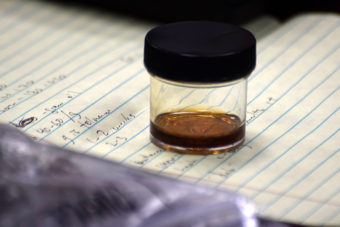
A sample of marijuana hash oil, sits on the testifier’s desk in an Alaska House Judiciary Committee hearing, March 6, 2015. The committee had asked law enforcement officials to give them a “show and tell” about the drugs and associated paraphernalia. (Photo by Skip Gray/360 North)

When Alaskans voted to regulate marijuana, a discrepancy was created where possession of small amounts of the drug was legal and where possession of larger amounts meant higher level felonies. The Alaska Senate has passed a bill to bridge the gap. And in the process, they rejected a controversial effort to preemptively ban marijuana concentrates.

Sen. Pete Kelly, a Fairbanks Republican, presented his amendment using images of marijuana candies and buildings consumed in fiery infernos.

“What drug is smoked in a glass apparatus using a propane torch to heat metal elements so the drug can be instantly vaporized allowing large quantities to be inhaled in a single hit? What drug is highly manufactured using volatile flammables and occasionally explodes in neighborhood labs?” asked Kelly, rhetorically.

Kelly likened the making of marijuana concentrates like butane hash oil to the manufacture of meth, and said that children would die if his amendment did not pass. While Kelly would have liked to have banned concentrates immediately, his measure was written to go into effect in two years — which is the soonest that legislators can fundamentally alter a ballot initiative, according to the state Constitution.
He argued that people were voting for legalization of the “leafy stuff,” not the sale of pot brownies, candies, and other forms of concentrates.

“If people knew what concentrates are, they would never ever vote for that,” said Kelly. “I’m convinced of that.”

Many members of the Senate disagreed. Sen. Lesil McGuire, an Anchorage Republican, pointed out that with 53 percent of the vote, the marijuana initiative was more successful than any single candidate for statewide office. She argued that the debate over whether concentrates should be allowed was a key issue of the campaign.

“What I believe is that the people, in the plain language that was presented to them, saw a definition that included the word ‘concentrate,’ saw a definition that included the word ‘compound,’” said McGuire. “There were 40 hearings across the state. There were eight of them held by the lieutenant governor alone just on this particular subject. And in almost every one of those hearings, it devolved into a debate over concentrates.”

Kelly’s amendment ultimately failed 14 to 6. The vote was an unusual one, with many Republicans voting against their colleague’s proposal.

An amendment that would have de-listed marijuana as a controlled substance also received considerable debate before ultimately failing. Supporters of the measure argued that because alcohol is not a controlled substance under Alaska law, marijuana should not be treated as one either, according to the initiative.

The marijuana crime bill, when considered in full, passed 17 to 3, with a bloc of Anchorage Democrats opposing it over the controlled substance language. It will now be considered by the House.

Haines pot grower proposes cannabis exchange

In Haines, the borough assembly has decided to wait until the state finalizes legislation before taking any action on local rules on marijuana use and sales. But some residents aren’t waiting on the legislature.
Dean Lari’s phone has been ringing constantly since he posted an ad on the Haines community website titled “Cannabis Exchange.” In it, he says, “with Measure 2 we now have a great and legal way to exchange marijuana strains.”

Lari sees the Cannabis Exchange as a way to get pot growers and smokers together to share experiences.

“I just saw this as a way to break the ice and say ‘hey people we don’t have to hide indoors, we don’t have to look when the cops drive by, we don’t have to spray air freshener when they open the door.’”

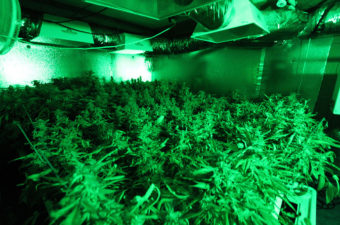
Lari, who goes by the nickname ‘Bear,’ grows six plants in his own home. You can tell when you walk in the door — the smell of marijuana permeates the place. Lari’s son is in the kitchen, trimming one of the plants. Lari shows me the small, brightly lit room where he grows a strain of pot called “Querkle.”

“I average about maybe three quarters of an ounce or maybe an ounce of usable pot (per plant),” he says.

Lari says he smokes about an ounce of pot a week for medicinal reasons. He also uses it in smoothies. With six plants, Lari says he’s only able to provide pot for himself and one other medical marijuana user.

Lari thinks a cannabis exchange could help inform people who have negative views of marijuana.

“I want people that don’t smoke, people that don’t get high that are scared — come and see with your own two eyes,” he said. “You could take a drink, take a bite or take a hit. You’re not gonna die from it. But then you could speak from experience.”

Lari says there wouldn’t be any money involved with exchange.

“If you bring a couple of nugs, I’m gonna give you a couple of nugs. We’re just trading pot, we’re just exchanging pot.”

What about people who don’t have pot? “I’ll give you a nug,” Lari says. “I don’t mind sharing a joint with you.”

Lari says he’s consulted a lawyer to make sure this kind of exchange is legal. Juneau District Attorney James Scott said in an email that he couldn’t answer whether the exchange would be legal until the close of the legislative session. Haines Police Chief Bill Musser didn’t comment on the legality of it, but referred KHNS to the state statute.

“I’m not waiting for the legislature, I can assure you of that,” Lari said. “Because what I want to do has nothing to do with retail sales, it has nothing to do with wholesale growing. I’m community-oriented, non-profit.”

Lari sees a cannabis exchange as a precursor to something bigger. He wants to start a community garden where people pay for plots to grow their own marijuana plants.

Lari calls Haines the “pot-smokingest town” he knows. He says the approximately 63 percent of Haines voters that supported Measure 2 shows that.

“That means that every single person in this community has somebody in their circle of people they love that are smoking pot.”

Lari says in the week since he posted the cannabis exchange ad, the response has been “huge” and “unbelievable.” He says he’s heard from a number of people who are interested in learning more about growing their own marijuana plants.


Alaska Senate delays vote on pot legislation

A sample of marijuana hash oil, sits on the testifier’s desk in an Alaska House Judiciary Committee hearing, March 6, 2015. The committee had asked law enforcement officials to give them a “show and tell” about the drugs and associated paraphernalia. (Photo by Skip Gray/360 North)

The Alaska Senate has delayed a vote on its signature marijuana bill after saying they need more time to consider an amendment that would largely ban concentrates.
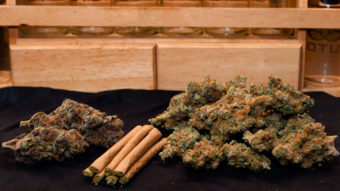
Sen. Pete Kelly, a Fairbanks Republican, said a “drafting issue” with his amendment caused the hold-up. The measure gives marijuana concentrates – like hash oil and edibles – the felony treatment, but includes an exception for concentrates meant for medicinal use. Because the Constitution bans the Legislature from tampering with ballot initiatives for two years after they go into effect, the ban on concentrates would not start until 2017.

Kelly says he’s offering the amendment now to send a message to the nascent marijuana industry.

“To have them spend money on display cases and processing and all that stuff – inventory, only to have it be illegal two years from now,” Kelly said. “This way it says, before you even start investing, this particular part of your business is going to be illegal. I just didn’t think it was far to the people who might be investing.”

This is Kelly’s second attempt to ban concentrates through the marijuana bill. The measure was briefly adopted during the committee process, but was removed after an outcry that it went against the spirit of the initiative.

Bruce Schulte is with the Coalition for Responsible Cannabis Legislation, and he lobbies on behalf of the marijuana industry. He describes the amendment as a “preemptive repeal” of the ballot measure.

“I would liken it to a legislative timebomb. They’re going to set this bomb in statute, and they’re going to light a two-year fuse on it,” Schulte said. “And they’re trying to guarantee that a legitimate marijuana industry will not develop. It cannot because nobody is going to go into business when they know that their entire business model is going to crumble on February 24, 2017.”

The amendment, and the full marijuana bill, is scheduled for a vote on Monday.

Senate bill keeps marijuana as a controlled substance

When the Alaska Senate votes on its primary marijuana bill later this week, the version they will consider treats marijuana as a controlled substance.

The body voted 16 to 4 on Wednesday to adopt a version from the Finance committee that keeps marijuana listed as a drug that can be abused, instead of a version crafted by the Judiciary committee that removed that language from the books.

A bloc of Democrats opposed the move. Sen. Bill Wielechowski argued that it was contrary to the intent of the initiative.

“Are you regulating marijuana like alcohol when you treat it as a controlled substance?” asked Wielechowski. “No. Clearly not.”

But Sen. Anna MacKinnon, an Eagle River Republican, defended the move.

“Marijuana remains a controlled substance at a federal level. [former Deputy] Attorney General [James] Cole in his memos directing states with guidance on how to implement strategies to protect their people in regulating the issue of marijuana has the item listed as a controlled substance,” said MacKinnon.

The Senate will take amendments and vote on the content of the bill on Friday.

Site notifications
Update notification options
Subscribe to notifications