Two days after Gov. Bill Walker filed a bill to create a marijuana control board and a day after the drug became legal in the state, state senators are offering legislation setting terms for that board.
The 25-page bill was offered by the Senate Judiciary Committee on Wednesday. It would require marijuana retailers and growers to be licensed by the state, instead of just getting business registrations. They would have to be an Alaska resident for at least one year before they can apply, and would need to go through fingerprinting and background checks.
The legislation also addresses the packaging and advertising of marijuana products. It requires retailers to keep the drug in child-safe containers, and limits them from marketing marijuana in a way that would be “enticing to minors” but without defining what that means. It also requires edible marijuana products to be sold in serving sizes that have a maximum of 10 milligrams of THC — the active chemical in the drug.
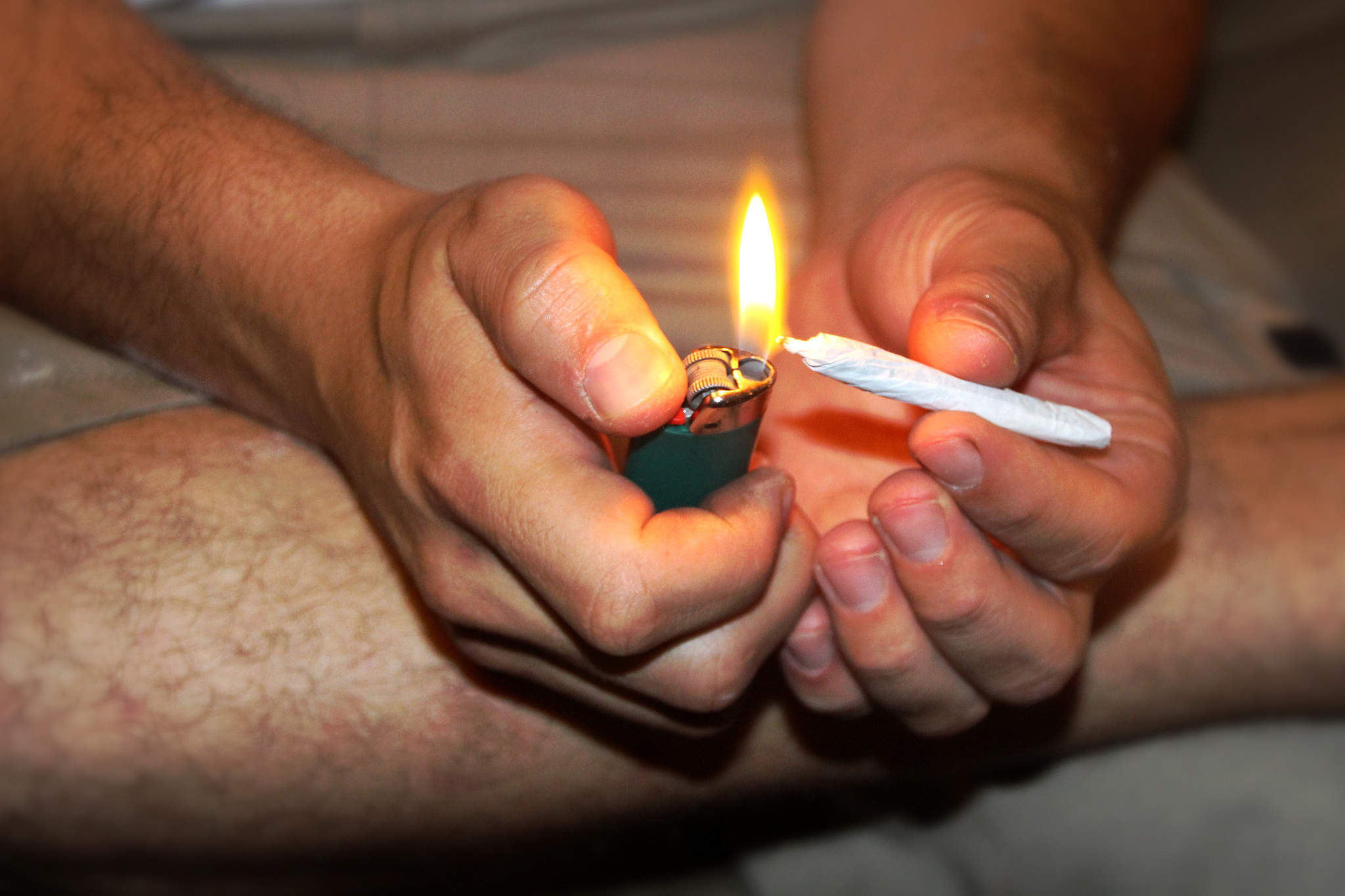
Leaders of the Alaska Cannabis Club share a joint at their medical marijuana dispensary in Anchorage. On Tuesday, Alaska became the third state in the nation to legalize recreational marijuana use. Mark Thiessen/AP
Alaska’s voter initiative making marijuana legal takes effect Tuesday, placing Alaska alongside Colorado and Washington as the three U.S. states where recreational marijuana is legal. The new law means people over age 21 can consume small amounts of pot — if they can find it. It’s still illegal to sell marijuana.
“You can still give people marijuana, but you can’t buy it — or even barter for it,” Alaska Public Media’s Alexandra Gutierrez reports. “So, it’s a pretty legally awkward spot. That probably won’t stop people from acquiring it, though.”
While marijuana is legal in three states, it’s actually been legalized in four. Oregon passed an initiative similar to Alaska’s that takes effect in July. Another measure adopted by voters in Washington, D.C., has been blocked by Congress.
The ballot measure that was adopted in November allows Alaskans to possess marijuana harvested from up to six plants on private property. For now, that’s the biggest change in the state’s pot practices.
“There are no stores yet, but black market sales are still illegal,” Gutierrez adds. “The state is now crafting regulations for marijuana retailers, and the stores will be licensed and operational by next year.”
The many questions that surround legalization in Alaska prompted the Alaska Dispatch News to run a story urging its readers to be “highly informed.” In Anchorage, police have posted a “Know Your Grow” page.
Since November, local and state governments have been trying to clarify legal questions such as how much pot a person can possess (and in what form) and the places where consumption will be off-limits.
Also coming into play next year will be the legalization of commercial farms.
On Monday, Alaska’s Gov. Bill Walker filed legislation to create a marijuana control board, similar to the body that controls alcohol sales.
Copyright 2015 NPR. To see more, visit http://www.npr.org/.
Read original article-Published February 24, 2015 7:12 AM ET
With Alaska’s new legal marijuana law going into effect today, the Juneau Assembly has passed an ordinance that defines “public place” for the purpose of enforcing a ban on open consumption.
Streets, sidewalks, parks and places of business are explicitly off limits for people looking to partake in Juneau. The definition also includes, but is not limited to, city-owned parking lots, schools, playgrounds, correctional facilities and common areas of public and private buildings.
Ballot Measure 2, approved by voters in November, said people 21 and older should be allowed to buy, sell, grow and use recreational pot in Alaska. It also said consumption in public would be banned, but failed to define what “public” means.
The Assembly last night unanimously approved the ordinance defining public in Juneau.
State officials are trying to come up with a “public place” definition as well.
The ordinance allows the Juneau Police Department to issue citations to people caught consuming marijuana in public. A first or second violation comes with a $100 fine. Three or more citations could result in mandatory court appearances. But Police Chief Bryce Johnson said that provision would likely be enforced only when officers know someone is a chronic offender.
“The way they do it with alcohol — which is what we’re looking at kind of copying here — is they usually just write the citation for the open container,” Johnson said. “And in order to go back and find out if they’ve already got the convictions, it does take a little while to do that. And that usually does not happen. So we write a lot of people a citation who have multiple convictions, who would have qualified for the graduated fine, but we didn’t know it in the field.”
City Attorney Amy Mead said a judge can levy a fine of up to $500, but the goal is not to get more money.
“The policy reason behind it is to make it a more burdensome process for the person being cited,” Mead said. “No one likes to go to court and appear in front of a judge. That’s the reason why you apply a graduated schedule. So if they continue to violate the same law over and over and over again, eventually you want them to have to go face the judge, instead of just write a check.”
The ordinance also amends the city’s traffic code to prohibit marijuana consumption while driving a vehicle. Drivers also are not allowed to let their passengers use pot. A first violation comes with a $200 fine, a second violation is $300, and three or more violations could result in a court appearance.
Economic development plan adopted, NOAA Task Force report accepted
The Assembly approved an ordinance adopting the Juneau Economic Development Plan last night. The plan becomes part of the Juneau Comprehensive Plan, and Assembly members will look at ways to tackle the broad initiatives it lays out for strengthening and improving the local economy.
Members also accepted a report from the city’s NOAA Task Force, which looked at ways to attract more federal fisheries research jobs to the capital city.
The Assembly also gave the OK to the city’s Lands and Resources staff to negotiate a land swap with Christ Evangelical Lutheran Church that could open up about 150 acres of city property on Pederson Hill to residential development.
Just one day before marijuana possession becomes legal in Alaska, Gov. Bill Walker has filed legislation to create a marijuana control board.
The board would handle the regulation and licensing of marijuana retailers. It would be independent of the Alcoholic Beverage Control Board, but the groups would share the same staff within the Department of Commerce, Community, and Economic Development.
Advocates for the marijuana industry have asked that the two substances be regulated separately to reduce potential industry conflicts.
The governor filed the bill on Monday. Walker has already included $1.5 million in his budget for the cost of regulating marijuana.
Marijuana possession becomes legal on February 24, because of an initiative passed by voters in 2014. Under the ballot measure’s implementation timeline, marijuana retailers are not expected have licenses until 2016.
Additional charges likely won’t be filed against a couple that police say had restrained their 5-year-old grandchild by taping her legs and holding her in a makeshift cage.
Police went to the home of 46-year-old Eric Riley and 52-year-old Penny Riley last week because officers had been told that the 5-year-old was restrained at night. Police report that they found the girl in a large clothes hamper turned on its side with a gate wired to the front. Police also say the girl’s legs were restrained, using tape and straps.
Assistant District Attorney Ben Hofmeister said there’s nothing in Alaska’s criminal statutes that applies to those circumstances.
“I don’t think it’s so much that people don’t think this it’s a horrific situation, it’s just there’s not a specific charge for this. (Ketchikan Police Department) was aware of that as well,” he said.
While police were at the Rileys’ home last week for the welfare check, officers say they noticed a marijuana grow operation. A later search warrant led to the seizure of 52 plants plus processed marijuana. The Rileys face felony drug charges; and charges of contributing to the delinquency of a minor for allegedly exposing the children to the marijuana operation
The Rileys were released on bail of $1,000 each following their arraignment last Wednesday. Their next scheduled court hearing is 1 p.m. Friday in Ketchikan District Court.
On Tuesday, Ketchikan police officers conducted a welfare check at a Woodside Drive home after getting a tip that her grandparents allegedly restrained a little girl at night.
Deputy Chief Josh Dossett said officers arrived at the home and found the girl, approximately 5 years old, in what he described as an improvised cage.
“It was a large-size clothes hamper put on its side with a gate,” he said. “The gate was wire-tied to the front of the hamper.”
Dossett said officers found that the girl’s legs also were restrained, using tape and straps.
Police called the state Office of Children’s Services, and that agency sent caseworkers to remove the girl from the residence.
While there, police located what they say was a marijuana grow operation. Dossett said they obtained a warrant, and seized about 54 marijuana plants, plus processed marijuana.
“I don’t have the amount of just the processed,” he said. “The total on the marijuana on the plants and the (processed) I believe was about 3 pounds.”
Police charged 46-year-old Eric Riley and 52-year-old Penny Riley with fourth-degree misconduct of a controlled substance and contributing to the delinquency of a minor.
Dossett said information about the child’s restraint has been sent to the District Attorney’s office for review and possible additional charges.
Close
Update notification options
Subscribe to notifications
Subscribe
Get notifications about news related to the topics you care about. You can unsubscribe anytime.


9(MDEwMjQ0ODM1MDEzNDk4MTEzNjU3NTRhYg004))