Marijuana

Marijuana Town Hall: Sitkans offer ideas on cafes, kids

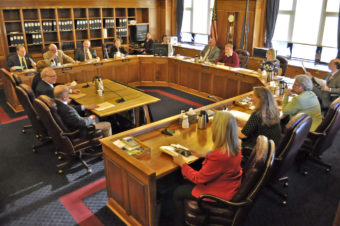
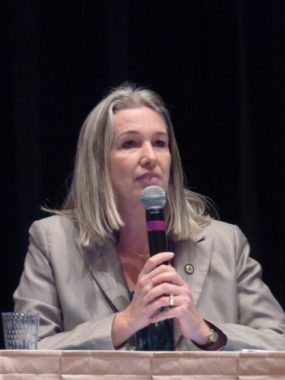
Municipal attorney Robin Koutchak (far right) speaks as the audience gathers for Sitka’s Marijuna Town Hall. “How far do we want to go,” she asked. “Do we want police to say ‘Drop the brownie’?” (KCAW photo/Robert Woolsey)

The City of Sitka wants to have some regulations in place by the time the public use of marijuana becomes legal in Alaska on February 24.

At a Town Hall Meeting Monday night residents had the chance to offer their opinions on where and if marijuana should be used in public places in the community.

And as you might expect with a controversial topic like marijuana, there were opinions to spare.

A draft of Sitka’s first-ever marijuana ordinance is scheduled to go before the assembly at their next regular meeting on January 27. The recreational use of marijuana becomes legal in Alaska on February 24.

The statewide ballot proposition passed by voters last November defines public consumption, but doesn’t define public space.

That leaves all communities — not just Sitka — scrambling to come up with rules governing where it is legal to smoke — or ingest — marijuana.

Municipal attorney Robin Koutchak has already drafted an ordinance for marijuana. It’s based on Sitka’s existing rules covering where it’s legal to drink.

“So the starting point for the statute for alcohol is: You can’t consume alcohol outside of a building in the area zoned central business district. You can’t consume alcohol on any public street, alley, sidewalk, municipally-operated harbor walkway — things like that. We’re looking at the same thing for marijuana.”

And this is just the first step. Alaska’s statute opens the door to the commercialization of marijuana in 2016. City planner Scott Brylinsky recently attended a conference sponsored the Colorado Association of Chiefs of Police. He returned with some specific ideas about where Sitka should go next.

“Prohibit the home production of THC extracts using flammable gases or solvents. To prohibit marijuana-infused products which resemble commercial products — especially those which would be attractive to children. And to inhibit the gray-market: To limit the number of plants like Boulder and Denver have done.”

Brylinsky said that there had already been 30 home explosions — some fatal — in Colorado as a result of people attempting to extract THC from marijuana plants.

Brylinsky, Koutchak, school superintendent Mary Wegner, and police chief Sheldon Schmitt comprised the panel for the Town Hall Meeting.

Sitkans last November approved the marijuana legalization initiative by a 70-30 split. Koutchak said these numbers were driving her office toward creating regulations, rather than an outright ban, which was proposed in Anchorage and then dropped following the election.

About 75 residents attended the meeting. Koutchak said she felt that they represented opinion along a spectrum between the anti-marijuana propaganda film “Reefer Madness,” and the devil-may-care attitude of Cheech & Chong.

Resident Bobbi Daniels didn’t want the city to presume too much from the election results.

“Voting yes because the government’s job is not being a nanny, and what people do in the privacy of their own homes is their own business is hugely different than voting yes because you’re okay with recreational marijuana use. And I’m just hoping that you come down pretty heavy-handed on the definition of public use, because it will be a lot easier to lighten up those restrictions on down the road than it will be to tighten them up when the genie is out of the bottle.”

Health advocate Andrea Thomas said she voted yes on the ballot initiative because she felt it was wrong to keep sending people to prison. But, now that marijuana will be legal, she wanted to focus attention on another demographic.

“I think something we should keep in mind is How Do You Prevent Kids From Starting? There’s a lot of research on that and one is high price. High price and the social norm of it’s not acceptable. So I think not allowing it in any public place — bars, clubs — people can have it in their homes, their private yards. But I think public places should be out.”

Thomas’s position on kids had traction with the rest of the audience, but there was a difference of opinion on whether marijuana should be limited to homes. Attorney Denton Pearson said there were rules in Utah at one time for alcohol that might be a model for marijuana.

“In order to buy a mixed drink over the counter in Utah, you had to be a member of a private club.”

Pearson said that visitors could buy temporary memberships by producing proper identification. There were supporters for this idea — and a similar one called the “Amsterdam” model — in the audience.

Attorney Robin Koutchak wanted to find out how many.

“Could we have a show of hands? How many people in the room tonight would be in favor of Sitka having a private marijuana club, or allowing private marijuana clubs? There’s about 75 people in here and I’m not even going to begin counting hands, because it’s clearly a majority.”

It was Koutchak last summer who first suggested to the Sitka assembly that the marijuana initiative — if passed — represented a revenue opportunity. Several people at the Town Hall spoke in favor of taxing marijuana to support the rehabilitation of people suffering from drug addiction.

There’s also the possibility of taxing marijuana to support schools. Resident Robert Hattle, a nurse and board member of KCAW, thought this was a problem.

“We need money for schools, but I think there’s a real ethical disconnect there. We’re encouraging parents to use marijuana so we can afford the schools. I want parents home helping kids do homework, spending quality time with them — not paying taxes on marijuana.”

The attention on schools brought fisherman Eric Jordan to the microphone. He wondered aloud about an issue that did not get much attention during the legalization debate.

“Do we have comprehensive drug education programs as part of our health education programs? How are we going to be dealing with this? We’re going to be facing a world where instead of it’s illegal and we’re going to ignore it — how are we going to prepare our students?”

Superintendent Mary Wegner said Sitka Schools had never ignored drug issues. The district had routinely participated in studies of high-risk student behaviors, and had a good idea — across all demographics and achievement levels — of what students were doing.

But there was a significant gap.

“We do not have a K-12 health curriculum. So we may have to take a look and see what we can do to beef things up.”

As public meetings go, Sitka’s marijuana town hall was cordial. Residents seemed eager to embrace this new freedom responsibly. There was even humor, thanks to local fisherman and author Ron Rau, who contradicted police chief Sheldon Schmitt’s assertion that law enforcement would crackdown on drivers impaired by marijuana. He compared pot smokers to someone who gets behind the wheel after drinking.

“They get in the car and they want to see how fast it will go. How fast can we take that curve? Someone in the back will be saying Faster! Faster! Take kids that have been smoking — they’re doing 25 in a 45 mph zone! And someone in the back is saying Slow Down! Slow Down!”

Municipal attorney Robin Koutchak anticipated that this would be the first of many similar meetings as Sitka shaped its marijuana laws. Mayor Mim McConnell thanked the crowd for turning out, saying “We’ll work through this and see where we go.”

With focus on budget, social issues may be left behind

A tense mood turns jovial as the Alaska House Finance Committee prepares to adjourn after discussing Senate Bill 49 and House Bill 173; similar bills that would restrict Medicaid payment for abortions. (Photo by Skip Gray/Gavel Alaska)
A tense mood turns jovial as the Alaska House Finance Committee prepares to adjourn after discussing Senate Bill 49 and House Bill 173; similar bills that would restrict Medicaid payment for abortions during the last session. (Photo by Skip Gray/Gavel Alaska)

When the Legislature gavels in on Tuesday, there are a few things it must deal with. There’s the multi-billion dollar deficit the state faces. There’s also work to be done on Alaska’s marijuana laws, after voters decided to legalize and regulate the drug in November. This full agenda means other controversial subjects may take a backseat. Lawmakers expect bills on social issues, like abortion, to get less attention than last cycle.

When Republicans took control of both chambers of the Legislature two years ago, social conservatives viewed it as a win. Legislation restricting Medicaid payments for abortion, a long-standing priority for them, finally got hearings and was even signed into law before being enjoined by the courts.

But even though the composition of the Legislature is mostly the same, advocates for anti-abortion measures — like waiting periods and clinic regulations — aren’t expecting to get as much traction, due to the attention on the state’s budget.

Jim Minnery is the president of Alaska Family Action.

“It’s just one more session with just one more reason to put our issues on the backburner,” says Minnery. “We’re sort of the ugly stepchild in the room when it comes to issues down in Juneau. I mean even our allies sometimes have a hard time charging the hill.”

Beyond a climate where lawmakers are more focused on fiscal issues, leadership of some of the committees that traditionally address abortion bills has changed in a way that is less friendly to such legislation.

One of the Senate’s more moderate Republicans, Lesil McGuire, has taken over the Judiciary committee. She takes the reins from Sen. John Coghill, a socially conservative Republican from North Pole, who sponsored the Medicaid abortion bill and shepherded it through the Senate.

With the Health committees, both the House chair — Homer Republican Paul Seaton — and the Senate Chair — Sitka Republican Bert Stedman — have voted against legislation restricting abortion access.

Over the past 20 years, all but one bill concerning abortion has been sent to Judiciary, to Health and Social Services, or both. The one exception was legislation to create a “Choose Life” license plate.

Senate President Kevin Meyer says that trend will likely continue if an abortion bill is introduced this session.

“That seems like the appropriate places,” says Meyer.

Minnery sees that as an obstacle to abortion legislation moving forward.

“Certainly I can’t say we were pleased with Seaton and Stedman being given those chairs, because they’ve shown a repeated resistance to advancing our legislation,” says Minnery.

Planned Parenthood Votes Northwest is also looking at the committee chairs, but from the opposite policy perspective.

“We’re tracking who these committee chairs are,” says Jennifer Allen, a policy director with the group. “We haven’t seen them in action yet, so we don’t know what that’s going to look like. But again, we will simply keep talking to them about why they should be setting aside any anti-abortion bills and addressing the real issues that affect Alaska women’s health.”

House Health Chair Paul Seaton says would like to hold hearings on all bills assigned to his committee, no matter the subject matter. But he says that the Legislature’s biggest fight over abortion — how the term “medically necessary” should be defined for the purposes of Medicaid reimbursement — has already played out.

“On that issue particularly, there’s already been a bill on that. There’s already been regulations which are being challenged in court,” says Seaton. “So I think that’s already probably progressed as far as that’s going to be.”

But the way Medicaid treats abortion could get attention from the Legislature in another way, because of the nebulous status of that law. Last year, a judge issued an injunction against the law, which allows Medicaid reimbursements only in cases where a woman’s life or “physical health” is seriously at risk, after Planned Parenthood challenged its constitutionality.

Medicaid expansion is a top priority of Gov. Bill Walker, who campaigned heavily on the issue. The socially conservative lobby, led by Jim Minnery, is opposing the proposal on the grounds that it could expand abortion coverage.

So far, none of the early bills that have been filed address abortion, though there is legislation supported by social conservatives that would change the makeup of the state’s judicial council. Sen. John Coghill is working on bills to regulate abortion, but says that dealing with the state’s fiscal problems will come first.

Senate President Kevin Meyer agrees.

“Well, they won’t be a priority but that’s not to say that they won’t get through the process, get on the floor, and still get passed this year,” says Meyer.

If an abortion restriction bill makes it through the Legislature, it may put Walker in a difficult situation. Walker personally opposes abortion, and sought support from Alaska Family Action earlier in his political career when he was registered as a Republican. When he abandoned his party affiliation and merged his ticket with Democrat Byron Mallott, Walker said he would not advance an anti-abortion agenda and, at one point, stated he would veto anti-abortion bills before later rescinding that statement.

Minnery says Alaska Family Action hopes to “rekindle its relationship” with Walker.

Pot moratorium signals local zoning in October

medical marijuana grow operation
Flowering cannabis plants under green light in an air-conditioned, indoor hydroponic grow operation in Oakland, Calif. (Creative Commons photo by Rusty Blazenhoff)

Aspiring pot entrepreneurs in Juneau can tentatively expect to have local zoning and land use rules that address legal operations in October.
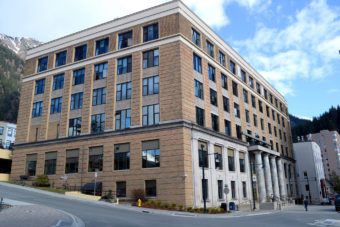
The Juneau Assembly adopted a moratorium Monday that gives city planners and officials until Oct. 19 to get the rules in place.

That’s sooner than the one-year moratorium first proposed, which would have put the deadline in February 2016. That’s about the same time a state agency must begin accepting applications from prospective marijuana businesses.

Giono Barrett, who wants to start a pot farm, told the Assembly that isn’t enough time to be ready to file an application with the state on day one.

“Zoning is a big issue big for us as well, as a farm. We want to know where we can prospectively look into property and know that when we apply with the state we have everything that we need in a row. So it does actually prolong our situation quite a bit when having to wait that long to figure out where the city is at with zoning,” Barrett said.

Assemblyman Jesse Kiehl set the October date by amendment. He picked the date because it was 6 months from the scheduled adjournment of the Alaska Legislature, which is expected establish a regulatory board and tinker with the November initiative that legalized pot in the state.

“We as a city aren’t gonna know what those looks like until the legislature is done on the 19th of April,” Kiehl said. “And I think that gives our Planning Commission and the Assembly a little time, but not a whole lot of time, to come up with a full set of zoning regulations for this activity in our community.”

Barrett was one of eight people to speak up during the public hearing on the ordinance. They were all against the moratorium or said it was too long. No one spoke in favor of it. The critics included a University of Alaska Southeast student, an elementary school teacher, a lawyer, a bartender and a restaurateur.

The end date of the moratorium isn’t necessarily fixed, noted Assemblywoman Karen Crane.

“If this helps the business community in the interim, fine. But we still have the ability to look at that date. We may be able to move it up even further, who knows. But we can look at it after the legislative session again, and if we have to, change it,” Crane siad.

Separately, the Juneau Assembly heard critical public testimony on an ordinance intended to treat secondhand marijuana smoke like secondhand tobacco smoke, essentially banning it from all workplaces.

Again, no one testified in favor of the ordinance. Several people pointed out that it appeared redundant with the initiative, which states pot is illegal to consume in public.

City Attorney Amy Mead noted that “public” wasn’t defined, leaving gray areas, like cabs, tour buses and workplaces as potentially legal places to light up.

The Assembly moved the ordinance back to committee for more work.

In first batch of early bills, no big ticket items

April 3, 2014
The legislature gavels in on Jan. 20. (Photo by Skip Gray/Gavel Alaska)

In a little over a week, the 29th Legislature will gavel in. In preparation, lawmakers have released the first batch of bills they plan to consider.

How is the Legislature’s workload shaping up?

The number of pre-filed bills is actually pretty standard. 59 bills and 4 proposed constitutional amendments were released today, which is comparable to the number of early bills filed in the past few sessions. A lot of are bills from the last Legislature that, for whatever reason, just didn’t make it across the finish line — like a bill that would regulate smoking in restaurants, bars, taxis, really any public or semi-public indoor space.

The thing that stands out to me, though, is that unlike the last Legislature, we’re not seeing any ambitious infrastructure bills in this early release. Last cycle, we had early bills to let the state build a small-diameter gasline on its own, or let the state move forward on the development of a bridge over the Knik Arm. Many of the bills offered this go round don’t even look like they’ll need a fiscal note to determine how much they could cost the state.

That’s almost certainly by design. With the state looking at a multi-billion dollar shortfall, any bill that isn’t going to be zero cost will face an extra level of scrutiny.

So, are most of these bills small-bore then?

That depends on your definition. A lot of them do seem to be pretty narrow in scope, like a bill to create a Great Alaska Earthquake Remembrance Day and legislation to exempt Alaska from daylight savings time. There’s one bill that caught my eye that would prohibit the manufacture or sale of cosmetics containing plastic beads — like those exfoliating body washes. (Apparently they’re nearly impossible to deal with when they end up in the water supply.)

But there are some pre-filed bills that tackle important issues even if they don’t cost money . Legislation known as Erin’s Law deals with the problem of child sexual abuse, and has a good shot of passing this Legislature. It nearly made it through last year, but was held up in what looked like a legislative game of chicken between the House and Senate, where the respective bodies wouldn’t advance legislation until the other side did what it wanted. It also didn’t help that it was originally introduced by a member of House’s Democratic minority, as minority bills often have a hard time of moving through the Legislature.

Now, two separate versions of the Erin’s Law bill have been introduced, one by the Democrat, Rep. Geran Tarr, who pushed for it last time, and one by House Majority Leader Charisse Millett. Because who introduces it matters, having a Republican in leadership push for it increases its odds of getting through.

Can you tell us about the constitutional amendments that are being introduced?

Well, an amendment to change the structure of the judicial council has been introduced again, by Fairbanks Republican Pete Kelly. That amendment would have added more public members to the board and weakened the influence of the attorney representatives. It made it all the way through the committee process and was even scheduled for the floor, but it was ultimately pulled after it didn’t have enough votes from senators who were concerned it could politicize the way justices are selected.

There’s also an amendment that would strike the definition of marriage as being between a man and a woman from the Alaska Constitution. Gay couples are already allowed to be married because of a circuit court decision last year, but this would clean the language up from the Constitution.

What we’re not seeing is any amendments to create dedicated funds for, say, transportation. There’s also no revival of an amendment to let public funds go to private schools. Of course, just because these things haven’t been filed yet, doesn’t mean they can’t come later.

Another batch of early bills will be released next week. Is there anything in particular you’re watching out for?

Well we know that the Legislature plans to deal with marijuana. Rep. Bob Lynn has said he wants to introduce legislation to keep marijuana retail sales far from school, and Sen. Lesil McGuire has said she’s thinking of legislation to create a marijuana control board. But the only bill released today that has anything to do with marijuana is one dealing with industrial hemp.

Because there’s a strict implementation timeline for the marijuana regulation initiative that passed this year, the nascent marijuana industry in this state will be keeping an eye on how quickly the Legislature decides to take up the issue.

Juneau Assembly considers moratorium on legal pot shops

Voters approved the legal the production, sale and use of marijuana for Alaskans over 21 years old in the Nov. election. (Creative Commons Photo by Brett Levin)
Voters approved the legal the production, sale and use of marijuana for Alaskans over 21 years old in the November election. (Creative Commons photo by Brett Levin)

One of the reasons Giono Barrett moved to Alaska almost seven years ago was because the state already has pretty lax marijuana laws. The 1975 Ravin v. Alaska ruling by the state Supreme Court allows residents to possess a small amount of pot for personal use. Barrett, a 33-year-old Minnesota native, says he’s already growing marijuana with his brother in a house they share in Juneau.

“Right now, it’s six plants. I’m sticking to the guidelines Alaska has stated,” he says.

And he insists it’s all for personal use.

“I really don’t want to get in trouble,” he says.

But Barrett says he is looking forward to the day he can legally sell pot. In November, Alaska voters approved recreational marijuana for people 21 and older. The new law doesn’t take effect until next month, and after that it’ll take another nine months for the state to enact regulations governing commercial retail and grow operations. Still, Barrett and his brother have signed on to a reality TV show chronicling their operation.

Giono Barrett
Giono Barrett and his brother are already growing pot in Juneau. (Photo by Casey Kelly/KTOO)

He’s not currently working, and says they’re putting all their efforts into expanding what they grow now. Eventually, he says, they want an outdoor cannabis farm to supply retailers around the state. They’d offer tours to capitalize on Juneau’s visitor industry and help others grow marijuana, something he says they already do now.

“You can grow cannabis. It is a weed, it’ll grow,” Barrett says. “But it’s really hard to grow in a quality form.”

But the Juneau Assembly plans to pump the brakes on Barrett’s dream grow operation. Two ordinances on Monday’s Assembly agenda would restrict – at least temporarily – legal pot in the capital city. The first is a 12-month moratorium on land use permits for marijuana-related businesses. The second would add toking up to the city’s ban on indoor smoking in workplaces.

“Right now in Juneau you can have a greenhouse with a retail sales counter in any type of neighborhood in town,” says Juneau Assemblyman Jesse Kiehl.

“So, think about quiet little residential neighborhoods where we don’t allow bars and liquor stores,” Kiehl says. “You would be able to come in and get a permit to open up a marijuana greenhouse and retail sales counter there.”

The city’s law department tells the Assembly that any permits granted now would likely be grandfathered if restrictions were adopted later. Kiehl says the moratorium is intended to give the city time to figure out where and when pot-related businesses should be allowed to operate. It would expire before the state starts to issue business licenses for legal marijuana enterprises, and it’s not a blanket ban on sales like a proposal before the Anchorage Assembly last month.

Kiehl himself supported the ballot measure legalizing recreational marijuana.

“Voters in the state of Alaska passed this initiative,” he says. “Voters in Juneau voted for it by a very strong margin. And what the people voted to do, I think, the Assembly now needs to implement.”

He does think the 12-month moratorium might be longer than the city needs to figure out its zoning issues, and says if that’s the case he’d support a shorter timeline.

As for extending the city’s indoor smoking ban to include pot, Kiehl says he’s not interested in seeing Juneau overrun by hash bars. But mostly, he says, the measure is designed to protect the health of employees.

“Some people just need a job,” Kiehl says. “And your job shouldn’t come with a contact buzz.”

The Assembly will take public comment before voting on the measures. Even though he says he understands the desire to be cautious, Barrett plans to speak against the moratorium.

“We don’t want to send a message to other communities, and say ‘Hey, you can just stall this out,'” Barrett says. “The message here needs to be that we need to keep moving forward, and we can work through all this stuff.”

He says potential marijuana entrepreneurs want to work within the rules established by the city. But the longer it takes to set up those rules, the more uncertainty it creates.

Muñoz details new bills, priorities for upcoming legislative session

Rep. Cathy Munoz (R-Juneau). File photo.

The budget deficit and marijuana regulations will take center stage during the upcoming legislative session says Juneau Rep. Cathy Muñoz.

Muñoz hopes Gov. Bill Walker will submit his amended budget well before the Feb. 18 deadline. She says Juneau is well taken care of in the capital budget with full funding for continued work on the State Library, Archives and Museum. But, she adds, lawmakers will need as much time as possible to address a $3.5 billion deficit.

“I will be paying close attention to the impact of budget cuts to make sure that there’s not disproportionate impact to one community compared to another community. We’ll be looking for equitable distribution of those reductions,” Muñoz says.

Muñoz will oversee budgets for the Department of Environmental Conservation and the Alaska Court System.

When not tackling the budget, lawmakers will likely spend much of their time debating how to regulate marijuana. While voters approved a ballot measure in November to legalize cannabis, the details of how to do that were left to be resolved.

“I think there’s going to be a lot of focus on the content and packaging issues. Also, enforcement will be a big point of discussion,” Muñoz says.

Muñoz, a Republican, will introduce several bills this session, including one to add sexual orientation to the state’s anti-discrimination laws.

Another bill Muñoz will introduce would allow residents with unforeseen medical conditions to still qualify for a Permanent Fund Dividend if they’re out of the state for too long. Currently , residents who require out-of-state medical care can stay eligible with an extension, but that extension isn’t as generous as for students or military.

Muñoz says she’s also working on a bill to help expand affordable housing by addressing how municipalities assess property taxes on new subdivisions. She says important issues for her office include the new healthcare plan for State of Alaska employees and the Tulsequah Chief Mine.

Site notifications
Update notification options
Subscribe to notifications