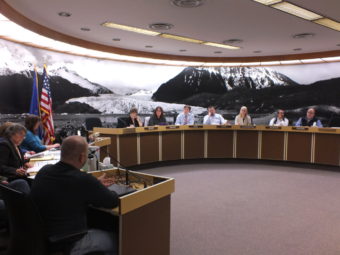
Alcoholic Beverage Control Board director Cynthia Franklin met with her board members on Thursday in Centennial Hall. She discussed problems she foresees in how the state will execute legalized marijuana. (Photo by Kevin Reagan/ KTOO)
The state’s Alcoholic Beverage Control Board director has given recommendations to the agency’s board members on how to improve the rollout of marijuana regulation in the coming months.
During her trip to Colorado last month, Board director Cynthia Franklin realized Alaska won’t face the same problems in its marijuana regulations.
“What we were able to see a lot in Colorado were Colorado’s problems,” Franklin says. “Alaska’s problems are going to be different from Colorado problems.”
During a public presentation to the agency’s five-member board on Thursday, Franklin outlined potential problems she foresees when marijuana becomes legal Feb. 24.
Franklin says the manufacture of edible products is an issue in Colorado. She says the state first allowed edibles with 10 milligrams of THC per serving—a dose she says is too high for first-time users.
“We don’t have those on the shelves. We’re starting from zero. It’s my opinion that if we’re starting from zero and we know that five milligrams is a start-lo, go-slow amount, we should pick five,” Franklin says.
Franklin says Alaska’s legal definition of edibles should exclude pre-made food or drinks that have been infused with marijuana. For example, she says a package of Haribo gummy bears sprayed with marijuana concentrate should not as count as an edible product. However, edibles made from scratch would be legal. It’s this lack of distinction in Colorado’s definition of edibles that Franklin says is problematic.
“Colorado has regulated itself into that giant grey market loophole. We do not have to go there,” Franklin says.
Board member Ellen Ganley says the definition of edibles should be discussed when the agency begins drafting the state’s marijuana regulations.
“I think the edible issue is one we really have to work out. The way Colorado manufacturers have been taking recognizable candy and adding THC…I think we’ve got to think long and hard about that,” Ganley says.
The ABC Board has until Nov. 24, 2016 to set regulations for the sale and manufacturing of marijuana. The legislature has the authority to establish a marijuana control board at any time to assume responsibility for regarding marijuana. Franklin says creating another agency would be a waste of resources.
“It doesn’t make a lot sense to have new officers, new licensing staff, a new director, a new board and new agents all at once. It sounds a little bit like a recipe for disaster,” Franklin says.
Franklin proposes hiring six staff members to handle marijuana regulation. She says the agency’s budget is essentially in the “red” and that they’ll work with the state’s Department of Commerce, Community and Economic Development to find additional funding.
The ABC Board will meet again on Feb. 24 to begin the nine-month process of drafting regulations.
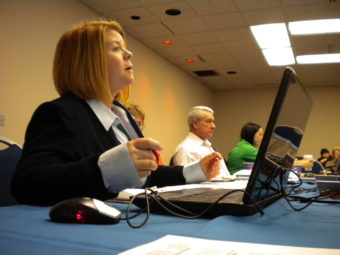
Sean Purvis, who’s exploring the idea of starting a marijuana-related business, testifies at the Juneau Marijuana Committee’s first meeting. (Photo by Casey Kelly/KTOO)
About 30 people attended the first meeting of a committee formed by the Juneau Assembly to grapple with Alaska’s soon-to-be legal marijuana industry.
Last night’s short agenda mostly called for setting goals and deciding when the committee should meet moving forward.
Assemblyman Jesse Kiehl was elected chair. He asked committee members to start thinking about what issues the group will need to tackle in the coming months.
“My first request is that committee members start flagging things for all of us to consider as a group,” Kiehl said. “As you see them, as they occur to you, let’s start a brainstorm list.”
The committee is expected to deal with land use issues, regulating where and when legal marijuana businesses can operate in Juneau. In January, the Assembly set an Oct. 19 deadline for city officials to figure out local planning and zoning rules.
Members are expected to stay abreast of developments on the state level, where legislators are working on broader regulations governing legalized pot. The group also may look into conflicts between state and federal law, which still considers marijuana illegal. Some members said they would look to communities in Washington and Colorado, states that already have legal marijuana businesses.
Even though it wasn’t on the agenda, the committee took public comments, mostly from pot supporters, who thanked members for taking on the issue. Mendenhall Valley resident Sean Purvis told the committee he’s planning to tour legal pot operations in Washington state.
“I expect to glean a lot of information from these folks down in Washington,” Purvis said. “They plan on opening their books to me. If there’s anything I can share with you guys when I get back, I’m more than happy to do it.”
The committee includes four Assembly members and three Planning Commission members. Besides Kiehl, the Assembly members are Mary Becker, Maria Gladziszewski and Debbie White. The Planning Commissioners are Mike Satre, Gordon Jackson and Bill Peters. Meetings are planned for the second and fourth Thursdays of every month.
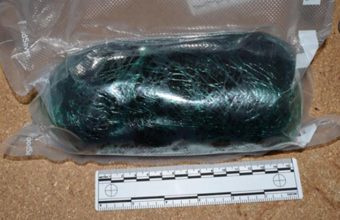
Juneau police seized 4.7 kilograms of heroin in 2014. This picture shows one kilo seized in September. (Photo courtesy Juneau Police Department)
The Juneau Police Department seized more heroin and methamphetamine last year than in 2013, but seizures of illegally trafficked prescription drugs were down.
JPD, working with state and federal law enforcement, seized 4.7 kilograms of heroin and more than 3.6 kilos of meth last year, according to the department’s annual drug statistics report released Friday. That’s seven times as much heroin and nearly five times as much meth as the previous year.
Lt. Kris Sell says the amount of hard drugs on the street probably didn’t change. But officers were able to take bigger chunks of the supply thanks to some high profile busts.
“If you looked at just the numbers, you would think, ‘Oh my goodness, heroin has just exploded in Juneau in 2014,'” Sell says. “And that’s not what we’re seeing on the streets, but we are seeing that we’ve interdicted a lot more heroin.”
The street value of all the methamphetamine seized in Juneau last year was $635,000. (Photo courtesy Juneau Police Department)
Sell says police made more meth busts early in 2014, but numbers tapered off toward the end of the year.
She says heroin is cheap right now. A tenth of a gram sells for about $100.
Prescription drugs are more expensive, leading to fewer illegal users.
Sell says the department saw a 75 percent decrease in seizures of Oxycontin, Oxycodone, Hydrocodone and Vicodin.
“It’s so expensive now,” she says. “The price of those has gone up with supply and demand. So people have just gone to heroin.”
The street value of all illegal drugs seized in Juneau last year was more than $5.7 million – up from nearly $2 million in 2013. Police also seized more than $109,000 in cash during drug investigations.
All told, JPD’s drug unit handled 105 cases, charged 37 people with 48 crimes, and made 38 controlled buys in 2014.
But Sell says the drug stats only show part of the picture.
“Thefts and check forgeries and shoplifting, so many of those crimes are tied to drugs,” she says.
Painting a better picture of Juneau’s drug problem is why this year’s report includes information on overdoses for the first time. Sell says medical privacy laws can make getting those numbers difficult. But as near as the department can tell, there were 19 overdoses last year, including four from heroin and four from meth.
She says members of the public requested that information be included in the report.
“There’s a lot of rumor about overdoses and how many people are overdosing on what, and that seemed to be a yardstick that the Juneau public wanted,” Sell says.
Walt Sisikin with the National Council on Alcoholism and Drug Dependence and the Juneau Alcohol Safety Action Program says treatment providers see a lot of the same people struggling with addiction over and over again. He says treatment works best when people follow up an inpatient or residential program with outpatient therapies.
“In other words, you go ahead and keep seeing a counselor, you go ahead and work your program in the sense of going to AA meetings or NA meetings, you find yourself a sponsor,” he says.
This will be the last year marijuana is included in the JPD drug report. Voters legalized recreational pot in November and the new law takes effect later this month.
But Sell expects JPD to be just as busy dealing with marijuana related issues, including driving under the influence and underage use.
When recreational marijuana becomes legal in Alaska later this month, pot smokers in the capital city will not be able to toke up inside bars. Private clubs might be allowed later, but for now those are off-limits too.
That’s because the Juneau Assembly last night unanimously voted to amend the city’s indoor public smoking ban to include pot, despite objections from some marijuana advocates.
Of the five people to testify on the ordinance, three were opposed and one had questions.
Ben Wilcox said the city should have designated establishments for pot consumers, arguing it was for their safety and the safety of the public.
“They have bars to consume their alcohol. They need a place to consume this now legal substance, with people who can legally and responsibly serve them and control their behavior,” Wilcox said. “Make them not walk in front of a bus, just like we do with people consuming alcohol when they have a little too much.”
Ben Wilcox testifies to the Juneau Assembly against adding smoking pot to the city’s ban on indoor public smoking. (Photo by Casey Kelly/KTOO)
But anti-smoking activist Michael Patterson, who has chronic obstructive pulmonary disease, urged the Assembly to keep marijuana smoke away from the general population.
“I don’t have a lot of bad feelings about it, you know, but I don’t smoke it myself and I really don’t want to be subjected to it,” he said.
The statewide initiative voters passed in November already outlaws public consumption of marijuana. The local ordinance makes it explicit that smoking pot is not allowed inside public places in Juneau, where smoking tobacco was already banned.
Deputy City Attorney Jane Sebens said municipalities across Alaska are waiting for state officials to write regulations governing the commercial sale and recreational use of marijuana. That includes a better definition of “public place” than the one in the initiative. Sebens argued that adding pot to the public smoking ban was a measured approach, saying it carves out a narrow definition of public places to be used for now.
Assemblyman Loren Jones added that until state regulations are in place, the city won’t know what it can and can’t allow as far as private clubs and other legal marijuana establishments.
“It’s still illegal to sell, it’s still illegal to transport for sale, it’s still illegal to offer for sale,” Jones said. “And until the state comes up with their regulations, we won’t know what we’re allowed to do versus what the state’s going to take control of.”
The marijuana initiative goes into effect Feb. 24. The Assembly has formed a special committee to deal with legal pot issues. It will hold its first meeting later this month.
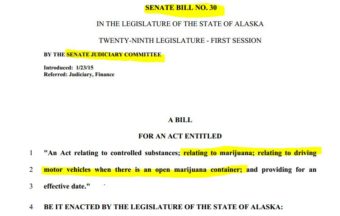
Senate Bill 30 has a deadline of February 24 in order to meet the requirements of Ballot Measure 2.
Republican Senator Lesil McGuire of Anchorage has introduced the first large-scale bill regulating marijuana like alcohol in Alaska. The measure includes fine points that lawmakers, police, and the public need to adapt November’s Ballot Measure 2 into a legal framework.

Senate Bill 30 lays out a new, more specific definition of marijuana that includes derivatives like hash oil, as well as byproducts like hemp. McGuire says the bill is the first of three that will come out of the Judiciary committee.
“It decriminalizes marijuana in the case of 21-year-old Alaskan adults using marijuana for recreational and medicinal uses,” McGuire said, for, “up to one ounce.”
The legal defense for transport of marijuana is defined, as well, something the 1975 Ravin decision did not cover even after sanctioning personal use.
McGuire’s bill comes as government bodies across the state are mobilizing on measures to create boundaries for legal marijuana use that will be clear to both the public and police. Under SB-30, for example, you cannot drive with “an open marijuana container,” which is further defined as everything from paraphernalia to a broken seal on packaging. Similarly, there is a mechanism for ticketing open consumption—something the city of Anchorage is currently considering.
Myron Fanning is deputy chief for the Anchorage Police Department, and said a big concern in implementing the new laws is squaring local rules with those being drafted by the Legislature.
“One of the big challenges is telling my officers what they can and can’t do,” he explained. Fanning was part of a delegation the city of Anchorage sent to Colorado for a recent conference on what has been learned a year in to its legalization.
Deputy Clerk Amanda Moser also attended, and thought the conference helped officials learn about different strategies to address many of the unanticipated issues arising from legalization.
“One of my main take-aways from the conference was we don’t have to re-invent the wheel here in the municipality of Anchorage,” Moser said after the delegates presented to an Assembly committee looking into commercialization. “We can take what Colorado has done over the last year, what’s been successful, what hasn’t been successful, and use that as we begin to write our regulations.”
SB-30 will be introduced to a joint hearing between the Senate and House Judiciary committees on Monday.
Sahra Shaubach in the room she and volunteers extensively rehabbed inside the basement of the 225 E. 5th Ave property, holding a poster from the The Eagle, a renown Baltimore leather bar. (Photo by Zachariah Hughes, KSKA)
Alaska has a tightening kink community made up of people living alternative lifestyles that range from discomfort with mainstream society to unconventional sex practices. But they have struggled to find spaces in which to gather. Now, after a lengthy tenant dispute and thousands of dollars worth of property damage, the Alaska Center for Alternative Lifestyles–ACAL– is ready to open it’s doors.
“Our stairwell, when we finish staging, will be full of pride-flags from across the lower-48,” explains Sahra Shaubach as she shows off the staircase leading into the 2000 square-foot basement she rents in downtown Anchorage, formerly the site of the Kodiak bar. ”Those will include Bear pride-flags, and GBLT pride flags, of course the Leather pride flag, the Trans pride flag and so on and so forth.”
ACAL is meant to solve a years-long problem of where people interested in unconventional sex can get together for events.
”You name it, we’ve rented it,” Shaubach explains. ”We’ve done this out of restaurants after they’ve closed, we’ve done this out of convention halls, we’ve done this out of hotels–we’ve rented entire floors of hotels and done theme rooms. We’ve rented basements, we’ve rented empty houses. And we’ve been doing it with the respect of the greater community in Anchorage, I believe. We haven’t had anyone call the cops and say ‘Oh my god the perverts are screaming next door.’”
“Kink community” is the umbrella term covering everything from bondage and leather aficionados to erotic artists and exotic hula-hoopers. Though Alaska’s kink community is dwarfed by cities in the Lower-48, it is far more widespread than the uninitiated may realize. In the last two decades, different groups like The Northern Lights Dungeon Society and Alaska Dark Realms organized coffee meet-ups and dinners nicknamed “munches.”
“It was just amazing to realize that people across the board–young, old, fat, ugly, educated, not, your doctors, your lawyers, your school teachers, your single mothers, your college students–everybody shows up to those munches,” Shaubach recalls from when she began getting involved eight years ago. ”If you saw us sitting at a restaurant–20, 25, 30, 40 of us–you would have no idea we are Alaska’s alternative community. We look like the people you’d see at Fred Myers.”
Shaubach pounced on the opportunity to rent out the basement in the old Kodiak, even though it meant cleaning up years of broken furniture, trash, and remnants of people crashing when they had nowhere else to go. Upon seeing the space for the first time in two years, the landlord wept. Shaubach and volunteers organized “work frollicks”–a borrowed Amish term–to haul trash, paint, clean, and disinfect the industrial kitchen on the top floor. It took months, but the results are impressive. The rambling chambers of the basement are primed for activities: a tiny stage surrounded by tables, studded leather straps to hang donated art, and “playrooms” holding a few daunting apparatuses.
“There’ll also be a large padded table here that also has a cage that goes underneath it,” Shaubach explained, pointing inside her favorite room. It was filled with supplies and equipment, including an X-shaped St. Andrew’s Cross and wooden stocks affixed to a spanking bench.
“Forgive me if this is a little bit suburban,” I asked, “but what is the table and what are the cage for?”
“Umm,” Shaubach paused, a smile spreading over her face, ‘there’s so many options for a table and a cage!”
Alaska’s kink community numbers in the hundreds, and is committed enough that Shaubach can finance the costs of rent and upkeep by collecting membership fees.
“It’s like having a Sam’s Club Card,” said Shaubach, “you don’t get the groceries for free, but you definitely get a discounted rate for being a member.”
$120 s a year buys access to the space, along with priority rates on workshops and educational events on eclectic topics like knot-tying.
ACAL was set to open in December, but a high–profile tenant dispute disrupted those plans. The top-floor was leased to Charlene Egbe, who runs the Alaska Cannabis Club, and was evicted last week. By the time Egbe and her business partners vacated the premise the top floor was a mess, documented extensively by a local blogger with an interest in the case, who has since publicly archived photographs documenting the state of the property. The kitchen was filled with trash and flat-screen TVs, fixtures, and furniture were gone.
Egbe says that she and associates poured money and time into improving the space beyond its condition from when she first signed the lease.
“We’re disappointed that our former landlord continues to attempt to assassinate the character of the Alaska Cannabis Club,” Egbe said by phone. “We are taking legal action against our former landlord, and other parties involved, for defamation of character, amongst other things.”
Shaubach is not eager to dwell on what happened, or on the pending civil case. Instead, she is planning more work frollicks to get the ACAL space ready in the weeks ahead. She knows where she’ll put a small library and has already picked a name (The Back Door) for the modest boutique that will sell leather accouterments. Mostly, she’s ready for the Alaska Center for Alternative Lifestyles to finally become a gathering place.
“We’ve built this center, and created it with a vision of our community having a place to foster our foundations and elevate our education past what we’ve already done. And we just need a home,” Shaubach said, a sad note creeping into her voice. “We need a place that’s safe, sane, secure so that we can practice what it is that we do.”
The Center’s public premier is slated for the first Friday in February.
Close
Update notification options
Subscribe to notifications
Subscribe
Get notifications about news related to the topics you care about. You can unsubscribe anytime.