Marijuana

Update: JPD makes arrests in stabbing, assault incidents

Update | 4:25 p.m. Jan. 4, 2015

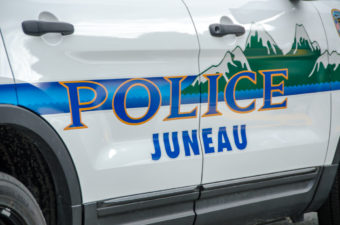
Juneau Police have made an arrest in last night’s stabbing incident. Lt. Kris Sell says Joshua Paul Feak, 26, has been arrested for felony 2nd degree assault. He’s being held at Lemon Creek Correctional Center.

Original post:

It was a busy weekend for Juneau Police.

One man was arrested early Saturday for allegedly assaulting officers who were responding to a report that he was trying to fight with a cab driver downtown. JPD also is investigating an early morning stabbing Sunday in the Mendenhall Valley.

Officers had to use a taser on Jackson Lee Benedict Buchanan, 28, who allegedly picked a fight with a cab driver and a bystander on Front Street at about 1 a.m. Saturday. Police say Buchanan spat on officers, assaulted them and was warned before being tased. A press release says he continued to fight and thrash after being put into a patrol car before being strapped to a gurney and transported by ambulance to Bartlett Regional Hospital.

Buchanan was later lodged at Lemon Creek Correctional Center and charged with five misdemeanors, including assault, assault on a police officer, criminal mischief, harassment and disorderly conduct.

About 3 a.m. Sunday police received a call from Bartlett’s emergency room that a 17-year-old boy was there with two stab wounds. The boy is expected to recover, but one of the wounds collapsed a lung.

Police say in a release that the victim and another teenage boy were walking on Tongass Boulevard after leaving a nearby house party when two older men approached them and asked for marijuana. After the teens said they didn’t have any pot, a fight allegedly broke out between the two parties during which the 17-year-old was stabbed.

Police say a suspect has been identified and an investigation is continuing.

Walker plans to stick to marijuana implementation schedule, but other delays still possible

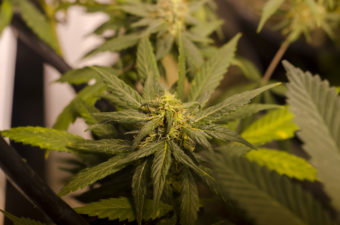
Voters approved the legal the production, sale and use of marijuana for Alaskans over 21 years old in the Nov. election. (Creative Commons Photo by Brett Levin)

After considering a delay in legal marijuana sales, Gov. Bill Walker has confirmed that implementation of rules regulating the drug should meet the schedule approved by voters.
At a Fairbanks Chamber of Commerce event earlier in mid-December, Gov. Bill Walker made a crack about how he wished he could delay the work of marijuana regulation for four years. During campaign season, back when he was still a candidate and the fate of a marijuana ballot measure was yet to be decided, Walker spent little time talking about the initiative except to say he opposed it. Now obligated by voters to do something about it, Walker told the Fairbanks audience he would like to delay some parts of the marijuana initiative by 90 days.

But in a press release on Tuesday, the governor announced he plans to stick to the schedule set by the initiative, with marijuana business licenses available by May of 2014. According to those tasked with the work of implementation, making that deadline is still going to be tight.

“There’s very little leeway or room in that timeline,” says Cynthia Franklin, director of the state’s alcoholic beverage control board

That board is working with the Department of Revenue and the Department of Commerce, Community, and Economic Development to come up with an implementation plan. At a recent meeting with governor, participants concluded that is possible to meet the terms of the initiative. It’s just not a guarantee.

“When you actually go look at the process for meeting those deadlines, really, everything has to go right. What we were pleased [about] when we had the meeting with the governor’s office is that everyone is on board with making everything go as right as possible.”

The marijuana initiative gets added to the books on February 24, and the law will basically go into effect in stages. Possession of the drug outside the home will become legal at that point, but the state legislature will be given the chance to set some of the terms governing commercial operations. Then, a regulatory board has until November 24 to craft its own rules for the industry. Those rules then go to the Department of Law for legal review. It won’t be until next February until marijuana ventures can submit licensing applications.

While that sounds like a long time, Franklin says there are plenty of opportunities for hold-ups, and a lot of that depends on what the Legislature decides to do with the new marijuana policy. Lawmakers could just let the existing alcoholic beverage control board manage the cannabis industry, but they could also create a separate marijuana control board to govern it. Initiative proponents have supported this idea to prevent regulatory power struggles between the alcohol and marijuana industries, and bill to create such a board is already being drafted by Senate judiciary chair Lesil McGuire, an Anchorage Republican.

Franklin says if the legislature goes that route, and serves it with a new agency, it will be impossible to meet the initiative’s deadlines.

“There is no question in my mind that if the legislature creates a separate marijuana control board and a separate marijuana control agency — and that agency has to be hired and put in place and put somewhere physical, and they all have to learn and understand their new jobs, and then they have to work with their brand new board in their brand new industry creating brand new rules from scratch — they will not meet those deadlines,” says Franklin.

Bruce Schulte represents a marijuana industry trade group, and while he’s not as emphatic as Franklin, he doesn’t totally disagree.

“I don’t know that it would be impossible, but certainly it would take up valuable time if a new board is to be created,” says Schulte.

That leaves the members of his group — the Coalition for Responsible Cannabis Legislation — in a bit of a bind. Schulte says they like the idea of marijuana and alcohol being regulated separately, but they also want to see implementation happen as quickly as possible. Constitutionally, the Legislature cannot weaken or undo an initiative for two years. But because so much of those two years need to be spent on rule-making before retailers can sell the product, Schulte is worried that leaves the new marijuana law in a vulnerable spot.

“Optimistically, the first stores would be open by August, maybe September, of 2016,” says Schulte. “So, at that point, you’ve got barely six months to establish a track record and to generate some revenue and prove that it can be done responsibly before the legislature then has the opportunity to shut the whole thing down.”

Schulte thinks it’s possible to create a separation between alcohol and marijuana regulators while still meeting the initiative timeline. He says that could be done by establishing an independent marijuana board, while keeping it in the same agency as the ABC board and having it share the same staff.

“I think that would be a compromise,” says Schulte.

If the legislature opts not to create any sort of marijuana control board, the ABC board will be granted regulatory authority over the drug by default.

Adair-Kennedy turf vandal sentenced

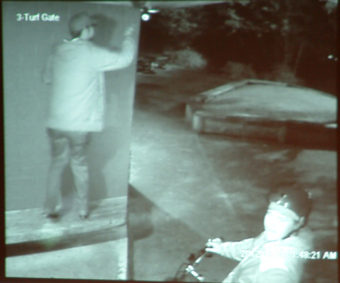
Still of security camera footage that prosecutors say shows Ryan Martin (left) and Ashley Johnston (right on bicycle) at Adair-Kennedy Memorial Park before the arson on June 19th. Photo by Matt Miller/KTOO News
Still of security camera footage that prosecutors say shows Ryan Martin (left) and Ashley Johnston (right on bicycle) at Adair-Kennedy Memorial Park before the arson on June 19th. (File photo by Matt Miller/KTOO)

The third and final defendant implicated in the Adair-Kennedy Memorial Park arson case was sentenced in Juneau Superior Court on Thursday, two and half years after the vandalism delayed taxpayer-funded efforts to replace the field’s artificial turf.

Ryan Martin received a three year suspended imposition of sentence and 180 days in jail as a special condition of the sentence.

Now 26 years old, Martin was one of three people accused of jumping the fence at Adair-Kennedy in June 2012 and setting fire to turf laying supplies and equipment. Charges of felony arson and misdemeanor criminal trespass and furnishing alcohol to a minor were dismissed in September when Martin changed his plea to a felony criminal mischief charge.

Co-defendant Dillon West pled guilty to a misdemeanor charge of criminal mischief and was ordered to serve 90 days in jail with 80 days suspended. He was ordered to pay restitution and write a letter of apology, and he was allowed to do 80 hours of community work service in lieu of jail time.

Co-defendant Ashley Johnston went to trial and was convicted on felony criminal mischief and misdemeanor criminal trespass charges. Her 150 day sentence that included a three year suspended imposition of sentence is currently stayed or on hold pending appeal.

Martin did not say anything during Thursday’s sentencing except a single “No, sir” when the judge asked if he had any last words before imposing sentence.

Martin’s defense attorney Jim Corrigan said a felony conviction on his record would prevent him from returning to the military or becoming a teacher. Corrigan said Martin voluntarily wrote an open letter of apology to the people of Juneau. Corrigan said Martin wasn’t compelled or ordered to do it.

“I humbly seek your forgiveness for my actions which resulted in property damage at Adair-Kennedy Memorial Park on June 19, 2012,” said Corrigan on behalf of Martin.

“I regret my ill-advised and insensitive behavior. I regret the impact on the residents of Juneau as well as on my family,” Corrigan continued reading. “I further want to apologize to the members of Capital City Fire/Rescue that responded to Adair-Kennedy Memorial Park. Additionally, I apologize to Shaw Sportexe and its employees for the delay my actions caused and for the additional time these men and women were away from their families. I hope for the opportunity to once again to earn the trust of the community I call home. I’m proud to be from Juneau. In the future, I’ll make certain my actions in Juneau make it a better place to live.”

Corrigan also said that Martin has already pre-paid about $5,000 toward his expected share of the $26,615.20 restitution.

Ryan Martin
Ryan Martin leaves the courtroom Dec. 18, 2014 after his sentencing for a charge related to the Adair-Kennedy Memorial Park arson case. (Photo by Matt Miller/KTOO)

Assistant District Attorney Amy Williams argued against suspended imposition of sentence because of the serious of the offense and because Martin was the oldest defendant indicted for starting the fire. She argued for a sentence of 24 months with 20 months suspended, or four months to serve in prison followed by three years’ probation.

Williams said Juneau residents are lucky to have trails and other quality recreational facilities that are funded by tax dollars.

“If we have to pay a little more so that we can get those things in return – and certainly among them is the services that Parks and Rec provides – then I’m happy to do that,” Williams said.

But Williams said such crimes force all Juneau taxpayers to pay more than what is really needed for such services.

“There is no social value for the conduct that Mr. Martin engaged in. Zero,” Williams said. “So everyone of us has to pay a little bit more to make up for what was a senseless, stupid, drunken act against the community.”

Former City and Borough of Juneau Parks and Landscape Superintendent George Schaaf said the general obligation bond that funded the improvements and the replacement of the Adair-Kennedy field is a debt that’s paid by everyone in Juneau whether they rent or own their own home.

“It’s a property tax that we all pay in one way or another,” Schaaf said.

Schaaf said they installed cameras at Adair-Kennedy Memorial Park since the arson was only one in a string of instances of vandalism at the facility.

“It was a constant demoralizing factor for myself and also the teams, and the players and coaches who use that field,” Schaaf said. “It really did have a tremendous impact on the players. When people found out that this happened, they really couldn’t believe that after the voters of Juneau voters had approved a million dollar project to give our youth a field that would be worthy of state championships, that before it was even completed someone would even attempt to destroy it.”

Still of security camera footage that prosecutors say shows Ryan Martin (left) trying to disable a camera and Ashley Johnston (right on bicycle) at Adair-Kennedy Memorial Park before the arson on June 19th. Photo by Matt Miller/KTOO News
Still of security camera footage that prosecutors say shows Ryan Martin (left) trying to disable a camera and Ashley Johnston (right on bicycle) at Adair-Kennedy Memorial Park before the arson on June 19th. (File photo by Matt Miller/KTOO)

Superior Court Judge Philip Pallenberg noted Martin’s previous military service in imposing suspended imposition of sentence, but he said he didn’t want to minimize Martin’s role and his intentions, or minimize the offense and its seriousness to the community.

“When there is an act of vandalism, it makes the next act of vandalism that much more likely,” Pallenberg said. “They kind of feed on each other and bring us all down.”

Since Martin has been a father to two school-age kids, Corrigan asked for a delay to report to prison until after the holidays. Judge Pallenberg ordered Martin to report to the Lemon Creek Correctional Center no later than Jan. 2nd. It will be the Alaska Department of Corrections – not the judge – which determines whether Martin serves the 180 day sentence either in jail or with electronic monitoring. He may be required to enroll in a 90 day inpatient substance abuse treatment program.

The three year probationary period started on Friday, Dec. 19th, the day after his sentencing hearing, and he is prohibited from possessing firearms, and possessing or consuming marijuana or alcohol while on probation.

If Martin makes it though the three years without violating his probation, then the conviction and sentence will be set aside. Martin could then properly claim that he was not convicted of a felony, although – technically – the internal court record of his case will not be completely expunged.

Just before his sentencing on the Adair-Kennedy arson case last week, Martin was charged with misconduct involving a weapon and as a convicted felon in possession of a firearm. If convicted of that crime, then it could mean additional jail time.

In addition to Schaaf and a few others, Thursday’s sentencing hearing was attended by Martin’s mother and retired police officer Kim Horn, and CBJ Fire Marshal Dan Jager who investigated the crime.

NYC Police Deaths: Details On Suspect; Rift Between Mayor And Police

New York Police Commissioner Bill Bratton says tensions in the city are at their worst since the 1970s. Bratton spoke two days after Ismaaiyl Brinsley shot and killed two police officers in New York. Brinsley had been arrested at least 19 times and reportedly tried to hang himself last year.

The tragic shooting has also exposed fault lines in the relationship between Mayor Bill de Blasio and the city’s police department.

Here’s a rundown of news we’re seeing about this story, beginning with NPR’s report from WNYC’s Brigid Bergin:

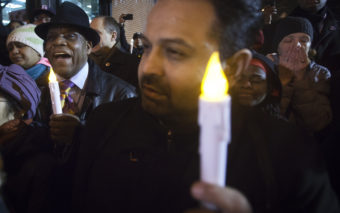
Officers Wenjian Liu, 32, and Rafael Ramos, 40, are being mourned in Brooklyn and beyond. The New York Times notes that Liu was married just three months ago, and Ramos was a good dad and neighbor who had once planned to be a chaplain.

Police leaders around the country are advising officers to wear bulletproof vests — and to “avoid making inflammatory posts on social media,” the AP reports.

Commissioner Bratton tells NBC’s Today show, “Who would’ve ever thought, déjà vu all over again that we would be back where we were 40 some-odd years ago? I think this one is a little different though in the sense that [there are] social media capabilities to spread the word constantly.”

On the question of whether de Blasio owes police an apology for the way he handled the Eric Garner case, Bratton tells NBC: “I don’t know that an apology is necessary. One of the things, a concern at the moment is this issue is really starting to go down partisan lines Republican/Democrat. This is something that should be bringing us all together not taking us apart.”

Garner, who was arrested for selling single cigarettes last July, died after a police officer put him in a chokehold.

“It is an attack on all of us. It is an attack on everything we hold dear,” de Blasio said of Saturday’s violence.

Brinsley, 28, had numerous run-ins with police, New York Chief of Detectives Robert K. Boyce says, for offenses ranging from robbery to disorderly conduct.

Brinsley posted on an Instagram account before the shootings: “I’m putting wings on pigs today. They take 1 of ours, let’s take 2 of theirs.”

That post showed Brinsley was in Brooklyn; The Baltimore Sun reports that soon after it was posted, Baltimore County police contacted Brooklyn police and faxed a “wanted” poster of Brinsley, saying: “He is currently believed to be in the New York Area, possibly the Brooklyn area. Suspect is armed with a 9 mm handgun and has posted pictures of the handgun on Instagram saying that he will shoot a police officer today.”

Police from New York and Baltimore County, Md., are still waiting to speak to Shaneka Nicole Thompson, 29, whom Brinsley shot before traveling to New York Saturday. Thompson is reportedly in critical but stable condition.

On Saturday, some officers showed their anger at the mayor by turning their backs on him as he walked past. “There’s blood on many hands tonight,” police officer union president Patrick Lynch told reporters. “That blood on the hands starts on the steps of city hall in the office of the mayor.”

Member station WNYC’s Brigid Bergin gives us this context: “As a candidate, de Blasio promised to bring reform to the NYPD. And as mayor he’s started to do that, ending low-level marijuana arrests and beginning a wholesale retraining of the department. At the same time, officers have been working with an expired contract and negotiations with the city are at an impasse.”

Copyright 2014 NPR. To see more, visit http://www.npr.org/.image
Read original article – Published December 22, 2014 9:51 AM ET
NYC Police Deaths: Details On Suspect; Rift Between Mayor And Police

Two Of Colorado’s Neighbors Sue State Over Marijuana Law

Nebraska and Oklahoma say Colorado's marijuana law is unconstitutional, in a challenge to the law in the Supreme Court. Earlier this month, visitors from Texas smell marijuana at the Breckenridge Cannabis Club. Brennan Linsley/AP
Nebraska and Oklahoma say Colorado’s marijuana law is unconstitutional, in a challenge to the law in the Supreme Court. Earlier this month, visitors from Texas smell marijuana at the Breckenridge Cannabis Club. Brennan Linsley/AP

Saying that Colorado’s law legalizing recreational marijuana use is unconstitutional and places a burden on them, Nebraska and Oklahoma have filed a lawsuit against the state with the U.S. Supreme Court.

Marijuana was made legal in Colorado after the state’s voters approved an amendment in 2012. Its first recreational dispensaries opened at the start of this year.

But officials in Nebraska and Oklahoma say Colorado’s pot law has become a destabilizing force in their states, where their legal systems are struggling to enforce the federal ban on marijuana. They believe Colorado isn’t doing enough to keep pot from leaving the state.

From Nebraska, Grant Gerlock of NET News reports:

“The two border states say Colorado’s law legalizing marijuana violates federal law, which still bans the drug. They want the Supreme Court to strike it down.

“Nebraska Attorney General Jon Bruning says since Colorado legalized pot, police and courts on the border have been strained by an increasing number of marijuana cases.

” ‘While Colorado reaps millions from the production and sale of pot,’ Bruning says. ‘Nebraska taxpayers have to bear the cost. We can’t afford to divert resources to deal with Colorado’s problem.’

“In a statement, Colorado Attorney General John Suthers said he would defend the law. First, the Supreme Court has to decide whether to take up the case.”

In Colorado, Marijuana advocate Mason Tvert tells Colorado Public Radio’s Ben Markus that by filing the lawsuit, Nebraska and Oklahoma “are on the wrong side of history.”

Copyright 2014 NPR. To see more, visit http://www.npr.org/.
Read original article published DECEMBER 18, 2014 9:23 PM ET

‘Cromnibus’ Spending Bill Passes, Just Hours Before Deadline

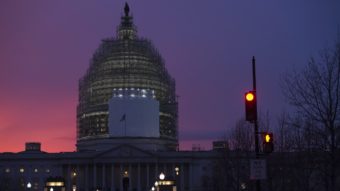
A massive federal spending bill finally won the House’s approval Thursday night, less than 3 hours before a midnight deadline that threatened a federal shutdown. The measure’s fate had been in doubt after it narrowly survived a rules vote earlier in the day. The final tally was 219-206.

Faced with uncertainty over Congress meeting its deadline to approve a bill, the House’s leadership scheduled a vote on both the long-term spending bill and a stop-gap continuing resolution. It passed a two-day resolution in order to give the Senate time to consider the spending bill.

The $1.014 trillion spending measure has been criticized for easing rules on campaign finance and the banking industry. But its supporters say it’s also a bipartisan deal that would fund most of the U.S. government until next October.

Rep. Gerry Connolly, D-Va., called it a “hold your nose vote.”

The final tally for the spending bill was starkly different from that in an earlier procedural vote.

Around mid-day, no Democrat voted in favor. But after the final vote was called shortly after 9 p.m. ET, more than 30 Democrats voted for the spending bill. In contrast, more than twice as many Republicans voted against it in the final tally than had earlier in the day.

Disagreement over the bill forced the final vote to be delayed for hours Thursday. It also created unlikely alliances: The White House joined with House Speaker John Boehner to rally support for the measure, most House Democrats agreed with a small group of Republicans – including Rep. Michele Bachmann – that the bill should be rejected.

You can read the bill, broken down by government agency, on the House Appropriations Committee site.

The legislation was nicknamed “cromnibus” because it combines the traditional sweeping scope of an omnibus spending bill with a continuing resolution (CR). While it would fund most of the government until the next financial year, the Department of Homeland Security would only be funded through February, in a move that seeks to limit President Obama’s recent executive actions on immigration.

Another part of the measure would vastly increase the maximum amount of money a contributor can give to a political party.

“Right now a person can give just under $100,000 a year to a party through its various committees,” NPR’s Ailsa Chang reports on All Things Considered. “And under this bill, that cap goes up to almost $800,000.”

Shortly after noon Thursday, the bill squeezed by in the rules vote, 214-212, after Republican leaders, including Speaker John Boehner and Chief Deputy Whip Patrick McHenry, walked the floor to bolster support, NPR’s Juana Summers reports.

After no Democrats voted in favor and more than a dozen Republicans defected to vote against, the House was adjourned so Boehner could organize his support.

Rep. Nancy Pelosi spoke out against the bill in the House earlier Thursday, sharply criticizing it for altering rules in the Dodd-Frank financial reform law to let banks place both standard accounts and accounts that handle riskier derivative trades under the protection of the Federal Deposit Insurance Corp.

“I was so really heartbroken … to see the taint that was placed on this valuable appropriations bill from on high,” Pelosi said. She told her colleagues that anyone voting for the legislation would be putting their name next to what she called “a ransom” and “blackmail” that would profit Wall Street.

Discussing the opposition, Boehner said the provisions were “agreed to in this bill on a bipartisan, bicameral agreement. So while some members may have objected to this issue or that issue, nobody did this unilaterally. We’ve done this in a bipartisan fashion, and frankly it’s a good bill.”

Others have criticized the bill for containing provisions such as one that seeks to block Washington, D.C.’s bid to legalize the recreational use of marijuana — as more than 65 percent of the federal district’s voters decided to do last month.

The Hill tells us who voted with the Democrats against the spending measure earlier Thursday:

“The 16 Republican defectors were Reps. Justin Amash (Mich.), Michele Bachmann (Minn.), Dave Brat (Va.), Mo Brooks (Ala.), Paul Broun (Ga.), Louie Gohmert (Texas), Paul Gosar (Ariz.), Tim Huelskamp (Kan.), Walter Jones (N.C.), Jim Jordan (Ohio), Steve King (Iowa), Raúl Labrador (Idaho), Thomas Massie (Ky.), Bill Posey (Fla.), Matt Salmon (Ariz.) and Steve Stockman (Texas).”

Copyright 2014 NPR. To see more, visit http://www.npr.org/.
Read original article published December 11, 2014 2:29 PM ET
Site notifications
Update notification options
Subscribe to notifications