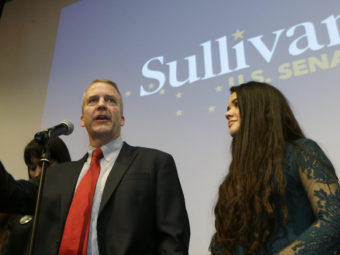
Republican U.S. Senate candidate Dan Sullivan greets supporters on election night in Anchorage. The as-yet-undecided race between Sullivan and Democratic incumbent Sen. Mark Begich was the hottest in the state. Ted S. Warren/AP
It’s a record most Alaskans might wish they could give back: The Center for Public Integrity calculates that KTUU TV in Anchorage ran more U.S. Senate ads this cycle than any other television station in the country — 12,300 in all.
Those Senate spots made up the bulk of the 13,400 political ads since January. KTUU General Manager Andrew MacLeod says 2014 was the the station’s busiest year ever. By contrast, off-year 2013 was relatively light.
Besides gubernatorial and U.S. Senate primaries, the election year also brought out advertisers for key ballot measures, including those for legalizing recreational marijuana, raising the minimum wage, and empowering he legislature to block a controversial mine near the Bristol Baby Fisheries Reserve (they all passed).
But the hottest battle was the Nov. 4 face off between Democratic Sen. Mark Begich and Republican challenger Dan Sullivan. By Thursday it was still undecided, with Sullivan holding an 8,000-vote lead and Begich holding out until some 20,000 uncounted ballots can be tallied.
The Sunlight Foundation reported late in October that all those advertisers spent $120 per voter –- more than triple the figure for any other Senate race.
Even so, Tuesday’s turnout was about 15 percent lower than Sunlight projected. On Thursday, the online Alaska Dispatch calculated that overall spending by the candidates, party committees and outside groups came to about $225 per voter.
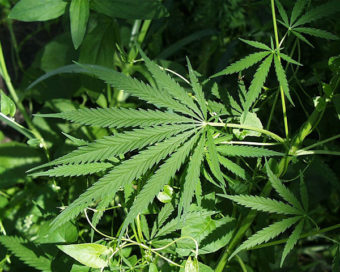
Voters approved ballot measure 2 Tuesday. The measure makes legal the production, sale and use of marijuana for Alaskans over 21 years old. Washington DC and Oregon approved similar measures.
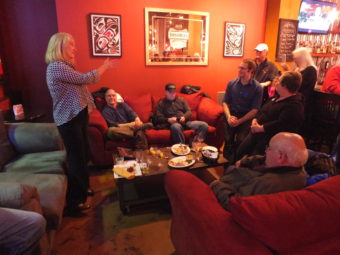
Supporters laid out the plan for how the initiative will move forward Wednesday. 90 days after the vote results are certified, the initiative becomes law and marijuana use will no longer be a crime. A nine month rule making process follows.
Campaign spokesman Taylor Bickford says this nine-month process will enable Alaskans on both sides of the legalization campaign an opportunity to weigh in on how the law should be implemented. Bickford says that will help Alaska avoid making mistakes that other states, like Washington, may have made when they wrote rules on the front end of their legalization push.
“We’ll have more flexibility in coming in to those decisions. Which I think ultimately is good because we’ll have the ability to learn from what’s happening in those states over the course of the next year as opposed to if we had all of that written in at the beginning of the initiative, there would have been less flexibility, you would have been stuck with some of those decisions,” Bickford said. ”It also gives Alaskans from various stakeholder groups, the opportunity to engage in the process and to have a role in the process and I think that’s going to be incredibly important.”
Bruce Schulte with the Coalition for Responsible Cannabis Legislation said CRCL is a group of business leaders from across Alaska who see the new law as the start of a legitimate industry.
“Just as the name would imply, the goal really is to work with the legislature and their control board and all of the other various groups on the rule making process, so at the end of the rule making period, we’ve got a set of rules that make sense, that address all the concerns that folks have and allow a legitimate marijuana industry to thrive in the state,” Schulte said.
Bickford says if the state does not set it’s own regulations within the nine-month window, regulatory authority would then be transferred to municipalities to implement the measure as they see fit.
Sen. Kevin Meyer addresses the Alaska Senate, Feb. 10, 2014. (Photo by Skip Gray/Gavel Alaska)
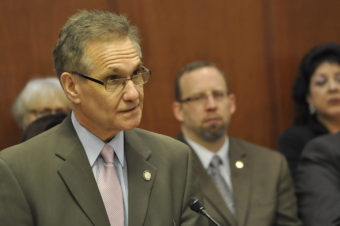
The Republican Senate Majority has named a new president. Sen. Kevin Meyer of Anchorage will be taking the reins from Wasilla’s Charlie Huggins. Huggins will take the position of rules chair.

The new organization is otherwise much like the old. Sen. John Coghill of North Pole remains the majority leader, and a number of committees are keeping the same chairs with a few notable exceptions. Sen. Anna Fairclough of Eagle River was promoted a co-chair position on the Senate finance committee, while Sen. Mike Dunleavy of the Mat-Su was made chair of the education committee. Dunleavy was a member of the education committee last legislature, and sponsored a constitutional amendment that would have allowed public funds to be used at private schools.
Republicans picked up one Senate seat on Tuesday, with Mia Costello taking over the seat vacated by Democrat Hollis French, giving them 14 out of 20 seats in the state senate. The caucus currently includes all 14 Republican members, 13 of which were present for a press conference held at the offices of a construction industry trade association. Anchorage Sen. Lesil McGuire, who previously held the influential position of rules chair, was absent from the media availability.
The last Senate majority included two Democrats whose districts covered areas off the road system. Dennis Egan of Juneau and Donny Olson of Golovin were not invited to Wednesday’s organization meeting.
“We are having discussions the minority, but whether or not they want to join us or we want them to join us has not been resolved yet,” says Meyer.
With the election just a day behind them, Meyer says the caucus is still working out its legislative priorities. But the state’s gloomy revenue outlook is an issue the organization plans to address.
“We all know what oil prices are doing and we know that what we budgeted for and we know we’re going to have a deficit,” says Meyer. “And so we’re focused on budget sustainability and how we can make gradual reductions in our budget while at the same time keep the economy strong and keep jobs and keep people employed.”
Legislators may also have to deal with the question of marijuana legalization — whether they want to or not — thanks to the passage of Ballot Measure 2. Rules Chair Charlie Huggins says he was perplexed that the initiative passed and that Alaska could see some legislative “speed bumps” but would not elaborate further.
The Senate Republicans also demurred on the question of Medicaid expansion. While the governor’s race is too close to call, unaffiliated candidate Bill Walker holds a narrow lead, and he has said that his first act as governor would be to accept the federal expansion for 40,000 Alaskans.
Senate President Kevin Meyer says it’s too early to say what the Legislature’s role will be with Medicaid. He says the caucus is generally willing to work with Walker if he wins election.
“You know, it doesn’t matter to us who the governor is,” says Meyer. “We’re going to work together with the executive branch, and we’re going to do what’s best for the state of Alaska.”
The Republican House Majority plans to hold its organization meeting on Thursday.
Senate Majority Leadership Positions
President: Sen. Kevin Meyer (R-Anchorage)
Majority Leader: Sen. John Coghill (R-North Pole)
Rules Chair: Sen. Charlie Huggins (R-Wasilla)
Finance Co-Chair- Sen. Pete Kelly (R-Fairbanks)
Finance Co-Chair – Sen. Anna Fairclough (R-Eagle River/East Anchorage)
Resources Chair – Sen. Cathy Giessel (R-Anchorage)
Community and Regional Affairs Chair – Sen. Click Bishop (R-Fairbanks)
Education Chair – Sen. Mike Dunleavy (R-Wasilla)
Judiciary Chair – Sen. Lesil McGuire (R-Anchorage)
Health and Social Services Chair – Sen. Bert Stedman (R-Sitka)
State Affairs Chair – Sen. Bill Stoltze (R-Chugiak)
Transportation Chair – Sen. Peter Micciche (R-Soldotna)
Labor and Commerce Chair – Sen. Mia Costello (R-Anchorage)
Legislative Council Chair – Sen. Gary Stevens (R-Kodiak)
Alaska Sen. Mark Begich, with his wife Deborah Bonito, visited Sitka on June 26. Southeast voted for Begich over Sullivan on Tuesday. (Rachel Waldholz/KCAW News)
Sen. Mark Begich would be headed back to Washington, D.C., had the rest of Alaska voted like Southeast.
Bill Walker would have solidly won the governor’s race. And Forrest Dunbar probably would have squeaked by, depending on absentee and questioned ballots.
Of course, that’s not what happened statewide. But it’s how Southeast residents – as a whole – cast their ballots.
About 57 percent of Panhandle voters chose Democrat Begich over Republican Dan Sullivan. That’s not counting write-ins and small-party candidates.
Independent Bill Walker had a similar Southeast lead over Republican Gov. Sean Parnell.
Democrat Forrest Dunbar won the region’s ballot count over Republican Congressman Don Young, but by fewer than 300 votes.
Results differed by community and precinct. For example, Ketchikan and Wrangell ballots favored Sullivan, Young and Parnell.
Southeast also voted strongly for all three ballot measures: legalizing recreational marijuana, raising the minimum wage and requiring legislative approval of large-scale mining in Bristol Bay. Those results, at least, matched the statewide outcome.
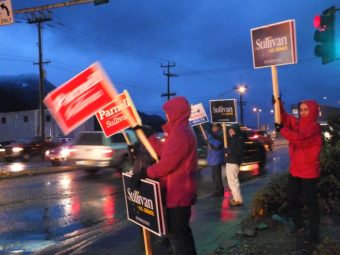
Republican sign wavers at 10th Street and Egan Drive in Juneau try to get the attention of evening commuters on Election Day. Capital city voters broke toward Democratic candidates in Alaska’s Congressional races. (Photo by Matt Miller/KTOO)
While it appears Democrat Mark Begich will lose his U.S. Senate seat to Republican challenger Dan Sullivan, Begich beat Sullivan in both state House districts that include Juneau. The one-term incumbent got more than 51 percent of the vote in House District 34, which encompasses the Mendenhall Valley and north end of Juneau’s road system. Begich got more than 66 percent of the vote in House District 33, which includes downtown Juneau, Douglas Island, Haines, Skagway, Klukwan and Gustavus.
Democratic candidate for U.S. House Forrest Dunbar also won both Juneau districts, despite losing statewide to Republican Congressman Don Young.
Juneau voters backed the independent ticket for governor. Bill Walker and former capital city Mayor Byron Mallott beat Republican incumbent Sean Parnell and his running mate, Anchorage Mayor Dan Sullivan, in both Juneau districts.
Juneau is down with legal marijuana. More than 67 percent of voters in District 33 and more than 57 percent in District 34 said yes to Ballot Measure 2, which makes the drug legal for people 21 and older and calls for a system to tax and regulate its use.
Ballot Measure 3 to raise the minimum wage and Measure 4 to require legislative approval of large-scale mining in the Bristol Bay region also passed by wide margins in both Juneau districts. All three initiatives were approved statewide as well.
Voter turnout statewide was 44.8 percent on Tuesday. It was almost 10 points higher in District 34. But only 43.8 percent of registered voters cast ballots in District 33.
The downtown Juneau No. 1 precinct had the lowest turnout in House District 33 at 31.9 percent. The highest turnout was in Klukwan, near Haines, at 53.1 percent.
The Lynn Canal precinct had the highest turnout in District 34, with 46.8 percent of registered voters casting ballots. The lowest turnout was at the Mendenhall Valley No. 1 precinct at 32.9 percent.
All results from Tuesday’s election are unofficial until certified. As of Wednesday, the Division of Elections had yet to count more than 23,000 absentee ballots received by Tuesday. Thousands more absentee ballots were still outstanding, but many of those may not be returned.
Juneau Rep. Cathy Muñoz celebrates her successful re-election bid with supporters on Election Night at Coho's Bar and Grill in downtown Juneau. (Photo by Kayla Desroches/KTOO)
Juneau Sen. Dennis Egan and lieutenant governor candidate Byron Mallott share a laugh at a Tongass Democrats get-together at Silverbow Bakery on Election Night. (Photo by Kayla Desroches/KTOO)
George McGuan makes an early appearance at Silverbow Bakery before heading to Mi Casa in the Mendenhall Valley, which served as his campaign headquarters. (Photo by Lisa Phu/KTOO)
All three of the capital city’s state lawmakers handily won re-election Tuesday. Sen. Dennis Egan and Reps. Cathy Muñoz and Sam Kito III all got at least 60 percent of the votes counted in their respective races on Election Day.
Egan, the Democratic incumbent in Senate District Q, won 71 percent of the vote to 28 percent for Republican challenger Tom Williams.
It’s the first time Egan has faced an election challenge since being appointed to the Senate in 2009 by then-Gov. Sarah Palin. He says having an opponent makes it easier to talk issues.
“I’m very proud of my campaign, because we didn’t do anything that was negative. We were all positive,” Egan said.
For the past two legislative sessions Egan has caucused with the Republican-led Senate Majority. While the makeup of the new Senate is still unknown, he says he hopes the body will return to the bipartisan majority that existed prior to 2013.
“I would love to return to a bipartisan coalition,” he said. “I think (Kodiak Republican Senator) Gary Stevens did a great job. I’m not knocking what (Senate) President Charlie Huggins did. But (the bipartisan majority) just seemed to work smoother.”
Williams went to Africa for the last two weeks of the campaign, and was unavailable to comment.
Supporters of Republican Rep. Muñoz cheered at Coho’s Bar and Grill in downtown Juneau after results showed her winning House District 34.
Muñoz beat Democratic challenger George McGuan, 62 percent to 38 percent. She heads to Anchorage today to attend organizational meetings for the 2015 legislative session.
“The first caucus meeting is of the coastal and bush caucus,” Muñoz said. “There are 10 members from around coastal Alaska that meet on a regular basis that have common interests and we want to first understand the positions that each of us want in the new organization.”
For the past two sessions, Muñoz was the only member from Southeast Alaska on the House Finance Committee. While that’s an important role, she says she may explore taking a position of leadership in the House majority.
“I’ve been asked to consider co-chairman of Finance or Speaker of the House of Representatives. But those are big positions and I’m more than happy to serve in my current position as finance committee member,” Muñoz said.
No matter what role she plays, Muñoz says declining oil prices will be a major focus for the upcoming legislature.
Across town, McGuan spent most of his election night at Mi Casa in the Mendenhall Valley, which served as his campaign headquarters.
McGuan says he got a lot of raised eyebrows campaigning for Muñoz’s seat, but he also got support.
“More of the people who I interact with on a regular basis, the typical working type people were really happy to see at least a choice and then also a lot of people identified with me,” McGuan said. “If I could’ve done anything better I think it would’ve been spend more time out door-knocking. But I just couldn’t take time off of work because we’re raising a family and I gave it my all.”
Kito won the seat he was appointed to in January after longtime Juneau Rep. Beth Kerttula resigned to accept a fellowship at Stanford. The Democrat took 75 percent of the vote. His challenger, Republican Peter Dukowitz, took nearly 24 percent.
Kito said his priorities in the next legislative session will be to fully fund education and universal pre-kindergarten. During the upcoming session, he thinks major issues will be the Alaska National Guard scandal, dealing with declining oil revenues and the budget, and marijuana legalization.
“There will be a necessary response to the marijuana initiative, trying to put statutes together to initiate the legalization of marijuana and I suspect that will take a fair amount of work,” Kito says.
Dukowitz said he’s looking forward to finishing some projects he’s put off during the campaign. He’s not sure he’ll run for public office again, but he’s not ruling it out.
“I would like to say, ‘Yes, I’ll start running tomorrow,’ but I think with the demographics here it’s going to be tough,” Dukowitz says.