Marijuana

Pro-marijuana campaign has trouble finding public support in Juneau

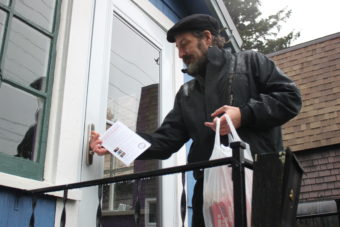
Yes on 2 volunteer Ben Wilcox leaves a door hanger on a house a few days before election. (Photo by Lisa Phu/KTOO)

Voters decide tomorrow whether Alaska should legalize and regulate the recreational use of marijuana, something Washington and Colorado have already done.

In the capital city, campaigns for both sides of the issue have been small, and the pro-legalization side is having a hard time finding public support.

On a rainy Thursday lunch hour, Norm Stamper and Ben Wilcox are walking around the Flats knocking on some doors. After a few empty houses, a woman answers the door.

“Hello. We’re here with the Yes on 2 campaign just handing out some literature and hoping to remind you to vote and if you have any questions or concerns with the initiative, we’d be happy to answer them,” Wilcox says.

“OK, well great,” the woman says.

“Do you support the initiative?” Stamper asks.

“I do actually,” she says.

Norm Stamper, retired Seattle police chief, spent a week in Alaska advocating for marijuana legalization. (Photo by Lisa Phu/KTOO)
Norm Stamper, a retired Seattle police chief, spent a week in Alaska advocating for marijuana legalization. (Photo by Lisa Phu/KTOO)

Stamper is a retired Seattle police chief, part of a non-profit organization of current and former police officers, lawyers and judges called Law Enforcement Against Prohibition.

Before Juneau, Stamper also visited Fairbanks and Anchorage, where he did some door knocking. Most people weren’t home, but he did talk to about a dozen people.

“We had only one no. The others were yeses or ‘I’m thinking about it.’ One described it as kind of a ticklish proposition,” Stamper says.

Wilcox is a volunteer with the Campaign to Regulate Marijuana Like Alcohol. He’s been a bartender in Juneau for 20 years.

“I’ve never had a problem with anybody in my bar that I know is consuming marijuana. I can have that guy sit here for eight hours. This guy who’s drinking tequila – within two hours, he’s a problem,” Wilcox says.

Of the hundreds of campaign signs posted throughout the capital city, hardly any say, “Yes on 2.” The campaign doesn’t have any paid staff in Juneau. It has less than a handful of local volunteers. One of them says she can’t go public for fear of losing her state job.

Wilcox says fear stops a lot of people in Juneau from publicly supporting marijuana legalization.

“Unfortunately, people that I’ve talked to that I know consume, that I know partake in this substance are afraid to come out. They don’t want people in public to know this. They’re afraid,” Wilcox says.

Wilcox says there’s no backlash for people who oppose Ballot Measure 2.

“People that come out on the side for can lose their job. They can face harassment from police officers, they believe. Peers, family members, church. All those things can come back to bite them just for saying a positive thing on this front,” Wilcox says.

Except for a small office in Anchorage, Yes on 2 efforts around the state have been at a grassroots level. The same is true of The Big Marijuana. Big Mistake. Vote No on 2 campaign. Spokeswoman Hillary Walker says it has volunteers around the state, including a handful in Juneau.

“We have a coordinating committee spread all over the state that met weekly via teleconference. We had different outreach throughout the state with different volunteers manning that,” she says.

But as far as Walker knows, there’ve been no events in Juneau.

The Yes on 2 campaign has consisted of handing out signs and door hangings. When Wilcox does try to organize an event like a sign waving, hardly anyone shows up.

“For me, mostly it’s personal contact. Anybody I can talk to. Being a bartender in town, I know a lot of people visually,” Wilcox says.

While walking down West 12th Street knocking on doors, Wilcox comes across a man he’s served over the years.

“We’re doing some canvassing,” Stamper says.

“I may not be interested,” the man says.

“No?”

“What are you canvassing for?” the man asks.

“Yes on 2. Legalize and regulate marijuana like alcohol,” Wilcox says.

“No need to talk to me,” the man says, turning away.

“OK. Thank you for your time,” Stamper says.

“Enjoy your day,” Wilcox adds.

Wilcox and Stamper spent early Thursday evening at The Hangar on the Wharf hoping to talk to opponents of Ballot Measure 2. But Wilcox says the dozen or so people who did stop to talk had already voted or were planning to vote yes.

In the last hours before election day, Wilcox just hopes people will be more open about how they feel.

Marijuana measures In Oregon, Alaska reflect lessons learned In Washington

Alaska isn’t the only state considering whether to legalize and regulate recreational marijuana. In the Pacific Northwest, Oregon also has the question on the ballot.
Some legalization advocates use Colorado’s pot law as an example, but Alaska and Oregon’s ballot measures are more like Washington state’s law.

There are plenty of different approaches to legalizing recreational marijuana, but for starters, there are basically two options on the menu: Colorado and Washington. So which one is more appealing to our neighbor states?

Colorado is seen as having moved quickly to implement its law, and has been refining it with regulations as it goes. The effect is either nimble or reckless, depending on one’s point of view. Washington is seen as the slower one, moving either carefully or ponderously, depending again on one’s take. These may be oversimplifications, but they are informing the political realities in states considering legalization.

“Here in Oregon, I think most people realize Washington has been a success,” said Anthony Johnson, chief petitioner of Oregon’s Measure 91.

“The Washington experience may provide a better model for Alaska than Colorado,” said Tim Hinterberger, chair of Measure 2 in Alaska.

Regulate Like Washington, But Tax It Differently

Both measures share some features with Washington’s: Each empowers the state liquor commission to set most of the rules. They create licenses for growers and retailers, and both ban consumption in public.

But the two states break from Washington in key ways, too. Take the tax structure: Washington taxes marijuana at about 44 percent of the cost. Both Oregon and Alaska would instead slap a flat excise tax on each ounce of pot: $35 in Oregon and $50 in Alaska

Both say the more modest tax will help keep prices low enough to compete with black-market dealers, and avoid the sticker shock confronting Washington buyers paying three to five times more for a gram of legal recreational pot than they would pay a medical dispensary or a dealer.

And Alaska’s Time Hinterberger said the flat tax is more predictable.

“One good thing about having a fixed tax per ounce rather than, say, a percentage of the retail cost is that people wouldn’t have to guess how revenues might decline as the price decreases,” he said.

‘A Staggering Amount Of Weed’

Opponents say the low taxes are a drawback, which could encourage “leakage” of product to unauthorized users or other states. Josh Marquis is the district attorney for Clatsop County, a border county in northwest Oregon, and the volunteer spokesman for Oregon’s No on Measure 91 campaign. He pointed to other ways his state’s measure strays from Washington’s approach.

In Washington, for instance, adults over 21 can buy and possess up to an ounce of marijuana.

“In Oregon you can have eight ounces. And you can possess a pound of edibles, and 72 ounces of marijuana liquids, and you can possess an ounce of oil, and you can grow four plants per household. We’re talking about a staggering amount of weed,” he said.

And there’s nothing in Oregon’s — or Alaska’s — measure that explicitly bans products that may appeal to children, as Washington does.

“‘Pot tarts,’ gummy bears, things that are clearly designed to attract children. I mean, that’s what Joe Camel’s all about,” Marquis said.

‘Colorado As The Boogeyman’

Colorado has gotten lots of ink for its loose regulation of  edibles, but it recently moved to restrict them even more than Washington does. And it is worth noting that Washington’s tight regulations on edibles were not in the initiative either, but came rather from the Liquor Control Board’s rules. Both Alaska and Orgeon’s measures would allow their regulators to make similar rules.

Still, the perception remains that Colorado is the Wild West, compared with slow and steady Washington. Opponents of legalization in their states point to Colorado as the cautionary tale.

“The opposition doesn’t mention Washington that often, and tends to hold up Colorado as the boogeyman,” said Johnson of Oregon’s Measure 91. “I think that’s come about because Washington has taken such a deliberative, thoughtful approach.”

The target on Colorado may have more to do with how far along it is rather than how permissive. But it seems clear that backers in Alaska and Oregon are more willing to associate their measures with Washington’s law than with Colorado’s.

And that makes sense, said Oregon’s Johnson: All three northwestern states share some political DNA, and similar attitudes about pot.

“Alaska actually legalized person use in the ’70s. Oregon was the first state to decriminalize small amounts in 1973. Oregon and Washington both were early medical marijuana states in 1998,” Johnson said. “We’ve all been states that have been at the forefront of marijuana law reform.”

Polls show close contests in both Alaska and Oregon. But if both measures were to pass, the northwestern states would cement their status as the most far-reaching outpost of pot country in America.

Tanana youth speak out against sexual assault, marijuana legalization

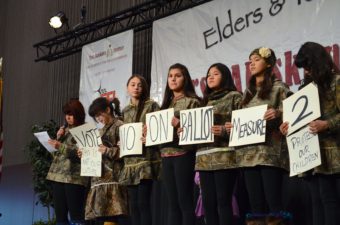
Tanana 4-H members on Tuesday asked Elders and Youth Conference participants to oppose marijuana legalization. (Photo by Jennifer Canfield/KTOO)

The Tanana 4-H club returned to the Elders and Youth Conference Tuesday, following up on their emotional presentation at last year’s conference. The group’s message is still the same: they don’t always feel safe or cared for and they want that to change, but now they’re also taking a stand against marijuana legalization.
During last year’s presentation, each 4-H member told the audience that they’d been molested, abused, or neglected and that they were tired of it. The youth shocked the unsuspecting audience.

An encore presentation during the Alaska Federation of Natives convention a few days later brought overwhelming support and praise for the group and thousands of dollars in donations.

Those donations brought the group back this year. This time, First Alaskans Institute, which hosts the conference, was more prepared for the intense feelings that the 4-H presentation might stir. A volunteer counselor in the audience was available to anyone who needed to talk.

One 4-H member, 17-year-old Ashley, identified herself as a victim of sexual abuse. She listed off statistics about Alaska’s high rate of sexual abuse and domestic violence and she chided adults for not doing more to protect children from it.

“If you experience sexual abuse you need to report it, but what difference does that make? They still send abusers back to villages to prey on us. They don’t change; they’re still a sick, twisted person,” Ashley said. “This is our time to come out and speak. I challenge every one of you to stop keeping this a secret and protect our children to save our future.”

The kids talked about how their families have been affected by things like rape, domestic violence and substance abuse. A few took the opportunity to speak out against ballot measure 2, which would legalize the use and sale of marijuana.

Big Marijuana Big Mistake spokeswoman Kristina Woolston talks to Tanana 4-H members after their presentation. (Photo by Jennifer Canfield/KTOO)

“Hi my name is Linda, I’m 15 and I’m against legalizing marijuana. I may be young but I’m already sick of the negative effects the marijuana has (had on) my community. It has destroyed my village, we have crime and outstanding teen usage.”

As the legalization initiative is written, if voters approve legal pot there is nothing stopping people from bringing it into villages. When it comes to alcohol, communities can choose to allow importation but ban sales or they can completely ban it altogether. With marijuana, only incorporated municipalities have local control over retail sales, villages have none. The law will allow for legal possession of up to one ounce of marijuana and up to six plants. The Alaska Federation of Natives will consider a resolution Saturday opposing ballot measure 2.

Group leader Cynthia Erickson said that a few months after the kids returned from last year’s conference, she asked them if they thought anything had changed in their village of Tanana. They said nothing had. A few months later in May, a Tanana man shot and killed State Troopers Sgt. Patrick Johnson and Gabe Rich. The kids looked up to the troopers and were devastated.

“But I said all of you are changing, don’t get discouraged,” Erickson said. “It took 50 years to get this dysfunctional. Seven kids can’t walk on stage and expect a change overnight. But you are changing. You won’t drink and do drugs with a baby in you. You won’t molest. You won’t rape. You are the change; we are the ones we have been waiting for. By one child changing it changes a whole village. One healthy child does make a difference.”

Tanana 4-H members wore Alaska State Trooper patches on their kuspuks in honor of two troopers who were killed by a Tanana man in May. (Photo by Jennifer Canfield/KTOO)

After the presentation Erickson said that the 4-H kids were starting to get a sense of how they impact others around the state. Some got to travel to Bethel and Ruby to meet and talk with peers going through the same struggles. Erickson wondered if kids outside of Tanana might also benefit from getting some weight off their chests.

“I asked the kids how many of you would sign up today to go and take the stage with us at AFN. We have seven of you that will come and blast your village’s ass out of the water, they stand up and clap, ‘where do we sign up?’ It’s really empowered the youths’ voices.”

The Tanana 4-H club will again take the stage this year at the AFN convention. The group is scheduled to present Thursday after the Elders and Youth Conference report is delivered.

Editor’s note: We’ve omitted Ashley’s last name because she’s a minor and did not use it on stage.

AFN drafts resolutions supporting Begich and Walker, opposing marijuana legalization

The Alaska Federation of Natives Board of Directors met Tuesday to finalize resolutions that will be voted on by delegates Saturday. (Photo by Jennifer Canfield/KTOO)

Alaska’s largest Native organization will vote on candidate endorsements Saturday morning. The Alaska Federation of Natives Board of Directors has drafted two resolutions that will be heard on the final day of the AFN convention in Anchorage.
The resolutions call for the re-election of Sen. Mark Begich and the endorsement of Bill Walker for governor and Byron Mallott for lieutenant governor. Mallott is a former president of AFN.

Resolutions are typically decided with a voice vote. Roll call votes, however, are not unheard of. In that case, regional caucuses will discuss the resolution with their delegates and a caucus leader will then cast the vote on behalf of each group.

AFN’s co-chairs Tara Sweeney and Ana Hoffman are on opposite sides when it comes to the senate race. Sweeney is the co-chair for the Sullivan campaign. Hoffman has been actively involved in Begich’s campaign.

Sullivan made an unscheduled appearance during a Board of Directors executive session meeting Tuesday. He reportedly received a cool reception. Despite the preference for Begich, board members were urged by delegates to not make endorsements and instead draft resolutions for them to vote on.

The final list of resolutions includes several measures that, in some form or another, have been voted on at previous conventions. One resolution calls for stronger protection of tribal subsistence resources. Another asks for subsistence priority over commercial and sport fishing and hunting.

Delegates will also vote Saturday on resolutions to oppose marijuana legalization, reduce Chinook and chum salmon bycatch in the Bering Sea pollock fishery, and support juvenile justice reform during the 2015 legislative session.

A recap of Monday’s marijuana legalization hearing


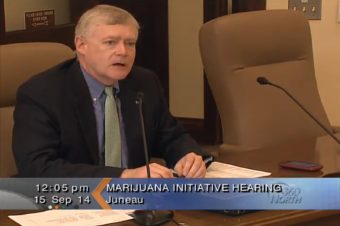
Lt. Gov. Mead Treadwell held a public hearing Monday in the Capitol on the marijuana legalization initiative. It’s part of a series of hearings his office is holding around the state before the Nov. 4 election.

I live tweeted from the hearing in the Capitol as @GavelAlaska. Here’s a recap via Storify.

More Gavel Alaska coverage of initiative hearings is available at 360north.org.

Conservative coalition forms to support marijuana legalization

This spring, the Alaska Republican Party came out against an initiative that would regulate marijuana like alcohol. Now, some conservatives are formally declaring their support for Proposition 2.

Talk radio host Eddie Burke is part of the three-person outreach team.

“When you start breaking down those liberty and freedom issues, that’s when people understand it’s nothing to do with smoking or not smoking or whether you’re going to use it or not use it,” Burke said. “It has to do with government making decisions for you that they shouldn’t.”

But the initiative opposition group Big Marijuana Big Mistake is responding that they have even more support from the conservative movement.

Spokesperson Kristina Woolston, says that on top of having the backing of political figures like former Gov. Frank Murkowski, they’re also getting endorsements from the major Republican organizations.

“The Alaska League of Republican Women voted to support the No on 2 campaign, and they also made a financial contribution,” Woolston said. “The Republican Party has supported [us], and also Republican candidates have also lined up to support the No on 2 campaign.”

Hardly any elected officials have taken public stances in support of the marijuana initiative – there’s Democratic congressional candidate Forrest Dunbar and Democratic state legislator David Guttenberg, and that’s about it. No Republicans running for office have explicitly said they’ll vote for the initiative.

But while the marijuana initiative hasn’t gotten much public support from the state’s elected leaders, the few public polls done on the question show a tight race with most giving the initiative the edge.

Pollster Marc Hellenthal thinks when it comes to marijuana, some people may publicly take a position they think matches the social norms even though they might vote the other way. That could be especially true for officeholders.

“Public figures don’t want to get branded as a druggie and so they’re somewhat reluctant to lend their name, even though they may be very supportive,” Hellenthal said.

Of course, the only way to find out if the public sentiment matches the private one is to wait for the election returns on Nov. 4.

Site notifications
Update notification options
Subscribe to notifications