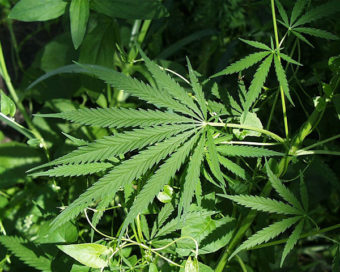
Marijuana

Anti-marijuana group asks Anchorage officials to pull pro-initiative advertising

(Photo provided by Campaign to Regulate Marijuana Like Alcohol)

The group Big Marijuana Big Mistake is taking issue with pro-marijuana initiative bus ads, and they’re asking the Municipality of Anchorage to intervene.

On Monday, the first pro-marijuana ads of the campaign season started rolling around on city buses. They show a pint glass of beer, a tumbler of hard liquor, and then a cannabis leaf with the word “safer” written over it.

Then, on Wednesday, a bright red sticker was added, reading “Our opponents AGREE!” Those stickers were inspired by a comment Big Marijuana Big Mistake spokesperson Tom Tougas made at a recent debate in Soldotna.

TOUGAS: When you think of this initiative, and you say, ‘marijuana is safer than alcohol,’ and I don’t disagree with that …

That audio was released on Friday by the Campaign to Regulate Marijuana Like Alcohol, a group that’s sponsoring a ballot initiative to do exactly that. They saw it as a major concession to one of their key arguments, and thought it would fit well into their bus campaign.

Big Marijuana Big Mistake doesn’t agree. The marijuana opponents sent a letter to the People Mover Administration on later that afternoon asking that the red stickers be removed, calling them a “gross misrepresentation” of the anti-marijuana position.

Deborah Williams, the deputy treasurer of Big Marijuana Big Mistake, says that Tougas’ comments were taken out of context, and that he’s subsequently refuted them. (In a press release issued by the campaign on Thursday, Tougas stated “I believe that marijuana is a dangerous drug and am disappointed at this effort to misrepresent what I said.”) Williams adds that to suggest her group believes marijuana is safer than alcohol is “simply untrue.”

“They did not check with the coordinating committee of Big Marijuana Big Mistake,” says Williams. “If they had, they would know that the opposition does not agree with that, period, end of story. The signs need to come down because they represent a clear misstatement of fact.”

(Photo provided by Campaign to Regulate Marijuana Like Alcohol)

Big Marijuana Big Mistake did not check with their rivals about voluntarily removing their stickers before going to the municipality. But even if they had, the Campaign to Regulate Marijuana Like Alcohol thinks it’s on more than solid ground with the stickers. Taylor Bickford is a spokesperson for the initiative, and he says it’s inappropriate for Big Marijuana Big Mistake to “engage in an effort to censor” their campaign.

“We wouldn’t be in this position if they hadn’t made the statements they made in a public setting,” says Bickford. “That’s ultimately what all this is based on. They actually accused us of lying and fabricating the statement. And that’s why we decided to release the audio, so that the public understands that this is a statement that was made by one of their spokespeople. It was not a lie. It was not fabricated. It happened.”

As the letter was sent Friday afternoon, the People Mover Administration did not respond to Big Marijuana Big Mistake before the close of the business day. The marijuana initiative will appear on the ballot November 4.

Complaint filed against anti-marijuana campaign

Marijuana
(Wikimedia Commons Photo)

Sponsors of a marijuana regulation initiative have filed a complaint against their opposition, alleging that Big Marijuana Big Mistake has violated disclosure rules.

At issue is whether the owners of the anti-marijuana group’s public relations firm are serving in volunteer capacity and whether the firm’s time is being properly accounted. Kristina Woolston, a majority owner of Northwest Strategies, has identified herself as a volunteer for Big Marijuana Big Mistake when serving as a campaign spokesperson, and her time working against the initiative has not been disclosed in any campaign finance reports.

Chris Rempert, a sponsor of the Campaign To Regulate Marijuana Like Alcohol, believes the anti-marijuana group is using that as a tactic to paint the initiative sponsors as outsiders.

“It’s very clear that they are willfully misrepresenting themselves to the public, to the media, and to election regulators because they think that will benefit them,” says Rempert.

Alaska law requires initiative campaigns to disclose their expenditures within a 10-day time frame, and the Alaska Public Offices Commission requires any sort of commercial services provided by volunteers to be documented as campaign contributions.

Northwest Strategies started working for Big Marijuana Big Mistake in mid-April, and the campaign’s first independent expenditure report was filed on May 27. None of the campaign’s independent expenditure reports make any note of Woolston’s volunteer time.

Woolston believes that the APOC complaint is a “distraction,” and that initiative sponsors are using it to divert attention from the $500,000 in funding they’ve received from the Washington, D.C.-based Marijuana Policy Project.

Woolston says she identifies herself as a volunteer because she is not a salaried employee of Northwest Strategies.

“Yeah, well, this isn’t my job. I mean the work that I do is volunteer,” says Woolston. “You know, I don’t work for Northwest Strategies. I work for Chenega Corporation. I understand the ownership issue, but it’s a family business. And really, they’re grasping here.”

The connection between Big Marijuana Big Mistake, Northwest Strategies, and the Chenega Corporation is a bit of a tangle.

The Chenega Corporation employs Woolston as their vice president of government relations, and it gave $25,000 to the Big Marijuana Big Mistake campaign using Woolson as a contact. Big Marijuana Big Mistake is also a client of Northwest Strategies, which Woolston and her husband Tim own. According to the expenditure reports that have been filed to date, Northwest Strategies has done $24,150 in work for Big Marijuana Big Mistake, with $19,150 of that amount yet to be paid.

Woolston says that when she identifies herself as a volunteer, she’s representing herself as an executive at the Chenega Corportation not as an owner of Northwest Strategies. She adds that Northwest Strategies has a $7,500 a month contract with Big Marijuana Big Mistake, but the amount covers hard costs only and she is not personally profiting from it.

“My husband and I both volunteer our time,” says Woolston. “Yes, we do have an agency that has a very small contract — really a drop in the bucket if you want to talk about numbers and what the opposition is being paid.”

But the Campaign to Regulate Marijuana Like Alcohol takes issue with that logic.

“You can’t say you’re giving something away for free and then charge for it,” says Taylor Bickford, a spokesperson employed by the pro-initiative campaign.

Woolston says she still plans to identify herself as a volunteer when campaigning against the marijuana ballot initiative.

In fight over marijuana, alcohol becomes taboo

While alcohol is usually a fixture of most political fundraisers, there will be no wine or cocktails at events focused on the marijuana initiative.

The opposition group Big Marijuana Big Mistake is hosting its first fundraiser Tuesday, and the only beverages available will be “delicious lemonade, sparkling waters, all kinds of fun pop and soda,” says Deborah Williams.

Williams is the former Democratic Party Chair, and she’s co-hosting the event alongside former Govs. Frank Murkowski and Bill Sheffield. Because the ballot initiative they’re fighting would allow the sale of marijuana, organizers decided weeks ago that they should make the event substance free.

“Former Rep. Alyce Hanley recommended that we make this event alcohol-free, and we all enthusiastically agreed,” says Williams.

But the group didn’t originally make it clear that their event was going to be dry. On Tuesday morning, sponsors of the marijuana initiative sent out a press release advising people who attend the fundraiser to “exercise caution” if offered alcohol because it is “more harmful” than marijuana. The Campaign to Regulate Marijuana Like Alcohol also pointed out that Murkowski received nearly $20,000 in political contributions from the beverage industry during his last decade in the U.S. Senate.

Williams believes the attack was uncalled for, and described implication of hypocrisy and the comments on Murkowski as “nasty.”

But Chris Rempert, who is the political director for the pro-marijuana campaign, still believes the criticism of his opponents is merited, even if they’re not serving hard drinks at their event.

“Alcohol is frequently a major part of political events, and since their invitation was touting refreshments and since the event was being hosted by an alcohol friendly governor like Murkowski, we felt it was important to convey the message,” says Rempert.

For their part, the Campaign to Regulate Marijuana Like Alcohol does not plan on serving alcohol at any future events they host.

For Seattle cops, marijuana biz is business as usual

The first marijuana retail shops are opening up in Washington this week. It’s the last big piece of a citizens’ initiative passed in 2012 that regulates the drug like alcohol. With Alaska voters considering a similar ballot measure this fall, here’s a look at how Seattle law enforcement is dealing with the new policy.

Seattle Hempfest is like stoner Lollapalooza … if Lollapalooza weren’t already friendly to stoners. Every year, musicians, actors, activists, and a quarter-million attendees come out to express their support for legal marijuana.

Seattle PD handed out these chips at Hempfest with stickers reminding users of the rules. (Alexandra Gutierrez/APRN)
Seattle PD handed out these chips at Hempfest. (Alexandra Gutierrez/APRN)

Last summer was the first time attendees who had the drug on them weren’t necessarily breaking state law, and the Seattle police department was ready for it.

“We basically crashed that party,” says Whitcomb. “We gave out a thousand bags of Doritos with little informational stickers on them.”

Sgt. Sean Whitcomb handles public affairs for the department, and he still has one of the baggies on his desk nearly a year later. He gets a kick out of the do’s and don’ts plastered on the chips.

Don’t give, sell, or shotgun weed to people under 21. Don’t use pot in public. You could be cited, but we’d rather give you a warning. Do’s: Do listen to ‘Dark Side of the Moon’ at a reasonable volume. Do enjoy Hempfest.

Since Washington voters passed a marijuana initiative, possession crimes are a thing of the past. If you’re an adult, you can buy, hold, and smoke marijuana without running afoul of the law.

In a lot of places, this would be revolutionary from a policing standpoint. But in Seattle, not so much. The city stopped prosecuting minor drug crimes a decade ago, and Whitcomb says the passage of the initiative wasn’t a drastic change for his department.

“Yeah, not that big of a deal for us, because we already triage to go after those criminal events that are going to be jeopardizing people’s well-being.”

In the year since the initiative passed, Seattle’s violent crime rate has gone down two percent, while the total crime rate is up a single point. Whitcomb doesn’t say either of these shifts have anything to do with marijuana legalization. If anything, he thinks the lack of major movement on crime stats shows that Seattle hasn’t become a stoner paradise or gone to hell in a hemp-woven hand-basket.

“You are not going to be walking into a giant green haze of smoke. Seattle hasn’t really changed that much with the passage of I-502.”

But Whitcomb says that even if legalization opponents’ worst fears haven’t come to life, he gets where they were coming from.

“There was some reasonable fear that there might be increases in crime events. People had been concerned that there would be more underage use, people we concerned that there would be more dealing that had been driven underground. So, we wanted to make sure that we were letting people know what the changes were in law,” says Whitcomb. “And guess what: Kids have been smoking pot for years. They will continue to smoke pot for years. And it’s still a misdemeanor.”

Not every police officer within the Seattle PD is on board with the Department’s attitude, though. Last month, Seattle public radio station KUOW reported that two detectives left the media unit over disagreements involving marijuana legalization.

In Alaska, some law enforcement officials are also raising concerns. Last month, the Alaska Association of Chiefs of Police announced it would take $6 million to train officers to recognize marijuana crimes like driving under the influence. That number does not factor in money lost from drug forfeiture on the cost side of the balance sheet. But it also doesn’t take into account money not spent processing minor drug crimes or the potential of increased tax revenue for departments, savings touted by marijuana advocates.

AACOP Executive Director Kalie Klaysmat is generally wary of the measure, and of some of the positive news from Washington and Colorado.

“Anything that anyone is telling you there is purely anecdotal,” says Klaysmat. “It’s purely their sense of things, and that may or may not be accurate.”

Klaysmat’s preferred course of action would be to wait at least another election cycle to let the legalization experiment play out in other states.

“I mean it might not change the fact that we are going to have costs,” says Klaysmat. “But I think everybody would feel a lot better about it being able to have hard data from other states who have done it, rather than be in this world of speculation where one side is saying, ‘Oh, everything will be wonderful,” and the other side is saying ‘We’re not so sure.’”

Back in Seattle, the city’s former police chief thinks the experiment is playing out pretty well.

Norm Stamper meets me at a downtown coffee shop, and the only drug anyone seems to be consuming is caffeine. He served as a cop for 34 years, with six of those in charge of Seattle’s police department. Now, he’s involved with the group Law Enforcement Against Prohibition.

Stamper says he first started taking issue with anti-marijuana laws after getting a call where he had to kick a door in to arrest a high 19-year-old from his own home.

“That was my ‘a-ha’ moment,” says Stamper. “I would now spend three hours processing that arrest. I would have to inventory the soggy remains of his stash. I would have to write a case report, a narcotics impound report, and an arrest report. So, I was no longer available during those three hours to the men and women and children of my assigned area, my police beat.”

Stamper’s not surprised that some Alaska police chiefs are worried about training costs, and he even points out that a quarter of those surveyed don’t anticipate any problems. So far, he hasn’t really seen any in Seattle.

“The sky is still above us. You do not see crazed druggies accosting people on the streets or running naked down Fifth or Fourth Avenue,” says Stamper. “Life continues much as it has.”

Colorado Approves Financial System For Marijuana Industry

Colorado lawmakers have voted to create the a financial system for the state’s burgeoning legal marijuana industry.

After Colorado legalized pot in 2013, it still had no financial mechanism for legal marijuana businesses. Washington has also approved the sale of marijuana for recreational purposes.

Just last week, the legislature had set aside the plan.

The Associated Press says:

“The vote on Wednesday would create a network of uninsured cooperatives meant to give pot businesses a way to access basic banking services.

“The plan seeks to move Colorado’s marijuana industry away from its cash-only roots. The U.S. Treasury Department’s has tried to assure banks they can serve the pot businesses under certain conditions without running afoul of federal law, which considers pot illegal. But most banks still refuse to work with pot businesses, saying the rules aren’t clear.”

As NPR’s Eyder Peralta reported in March, Colorado made $3.5 million in taxes and fees from legal pot in January, the first month of legal sales.

Copyright 2014 NPR. To see more, visit http://www.npr.org/.image
Read original article – Published May 07, 2014 8:27 PM ET
Colorado Approves Financial System For Marijuana Industry

Marijuana Banking Bill Shelved In Colorado

Partygoers listen to live music and smoke pot on the second of two days at the annual 4/20 marijuana festival in Denver, last month. While the sale of marijuana is legal in the state, a legal finance mechanism is still in doubt. Brennan Linsley/AP

It’s OK to sell pot in Colorado, but there’s still nowhere but the mattress to legally stash the proceeds.

That’s the continuing problem for legal marijuana dealers in the state, who are caught between the state’s legalization of cannabis and federal laws that still classify it as a controlled substance.

Colorado had been crafting a plan to address the issue, but the proposed law was scotched late Thursday. It would have allowed state-licensed marijuana businesses, which can’t legally access the regular banking system, to create a financial co-op, something akin to an uninsured credit union.

Republican state Rep. Kevin Priola, who sponsored an amendment to table the measure, says lawmakers need to “take some time to have this properly vetted.” But representatives from both parties expressed reservations about the legislation.

Time magazine notes that in February:

“The Justice and Treasury departments issued guidance suggesting that banks could offer basic services to marijuana dealers, but financial institutions remain wary. Consensus is growing that it will take an act of Congress to change the situation.”

Besides Colorado, where pot was legalized in 2013, the state of Washington has also approved its sale for recreational use. Washington faces the same problems concerning the financial end of the business.

As The Two-Way’s Eyder Peralta reported in March, Colorado made $3.5 million in taxes and fees from legal pot in January, the first month of legal sales.

Copyright 2014 NPR. To see more, visit http://www.npr.org/.image
Read original article – Published May 02, 201410:06 AM ET
Marijuana Banking Bill Shelved In Colorado
Site notifications
Update notification options
Subscribe to notifications