Marijuana

Legislators prepare for marijuana regulation

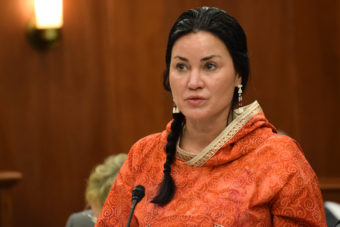
Sen. Lesil McGuire addresses the Alaska Senate, April 19, 2014. (Photo by Skip Gray/Gavel Alaska)

With an initiative to treat marijuana like alcohol now certified, lawmakers are preparing for the issue to come up this legislative session.

Sen. Lesil McGuire, an Anchorage Republican who will chair the Senate Judiciary Committee, commissioned a legislative report examining the costs and logistics of marijuana implementation. It lays out what authority the Legislature has when regulating the drug, and includes an estimate that the state will net between zero and $3 million from marijuana commercialization in the first year. As regulation costs go down and the marijuana industry matures, sale of the drug is expected to bring in over $20 million in annual tax revenue by 2020.

When it comes to marijuana legislation, McGuire says the number one goal for her is to “implement the voters’ will.”

“The idea that the Legislature would come in and try to subvert the public will, in my opinion, is off the table,” says McGuire.

The marijuana initiative stipulates that the Legislature can create a body like the Alcoholic Beverage Control Board to regulate the sale of the drug. If the Legislature does nothing, the alcohol board could end up responsible for marijuana.

McGuire plans to file a bill that would allow the substances to be managed separately.

“For one, ABC is overburdened as it is. They have a lot of issues that they’re already taking on as a board,” says McGuire. “And number 2, there is a perceived conflict of interest.”

McGuire says the marijuana and beverage industries could end up competing, which would make it harder for them them be regulated by the same group.

McGuire, who voted for the initiative, says her bill may regulate marijuana advertising and drug safety issues. She also plans to look at the interplay between state and federal law.

“I think this is going to be the most challenging issue we will have to face,” says McGuire. “It’s still illegal under federal law to consume marijuana. So what happens when someone who lives in rural Alaska is transporting that marijuana via their boat?”

In the House, Anchorage Republican Bob Lynn has already announced he plans to file a bill preventing marijuana retailers from operating near schools, churches, and parks. McGuire says multiple marijuana bills are likely to be combined in one omnibus bill.

The marijuana initiative was modeled after similar ballot measures in Washington and Colorado, and it passed with 53 percent of the vote.

Anchorage assembly member pushes for pot ban in municipality

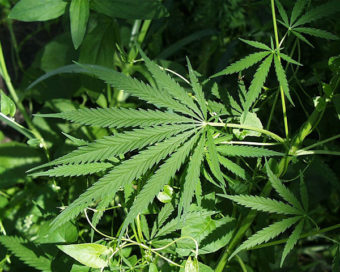
Marijuana plant. (Photo courtesy Pixabay)

The Anchorage Municipality may use its leverage as the state’s population center to influence how laws on commercial marijuana take shape in the year ahead.

Anchorage Assembly member Amy Demboski is behind a proposed ordinance that would ban the sale and cultivation of marijuana in the city. Nation-wide pot is in legal limbo: voters in states and cities are opting for legalization, but the at the federal level it’s still a controlled substance. Those inconsistencies could get very tangled when it comes to entities like banks and highways, which operate locally but have federal standards. Like, say, if you use a federal highway to deposit cash you made selling commercial marijuana, are you or your bank breaking federal laws on money laundering and illegal transport? See how quickly this get’s tricky?

Demboski believes its prudent to let other communities in Alaska test the waters on commercialization first:

“To me this is just a wait-and-see approach. In no way is this advocating for a ban on personal use of marijuana at all,” Demboski said. “All I’m saying is before we get into a commercialized industry that’s still federally illegal, we need to understand and make sure there’s no federal impacts when it comes to millions of dollars in transportation dollars.”

Because of its population, Anchorage is the largest potential market in the state for regulated marijuana, and Demboski thinks leveraging that influence can help residents and the city set better terms in the implementation phase.

“I think by opting out now what it does is it gives the citizens of Anchorage the opportunity to really be a loud voice in the development of these regulations,” Demboski said. “I think you’ll see the marijuana industry, I think you’ll see the state regulators come to the city of Anchorage and say ‘what is it you’re concerned about’ as we move forward, and ‘what is it that Anchorage needs in order to move forward with this potential industry.’”

But not everyone agrees that a local ban is a wise strategy. Proponents of the Ballot 2 initiative that passed this November say Demboski’s ordinance ignores the will of the majority of voters.

“For the Anchorage Assembly to consider opting out now is, we think, irresponsible and wildly premature,” Demboski said.

Bruce Schulte is spokesman for the Coalition for Responsible Cannabis Legislation. Given that under the state’s timeline for implementation it will be another 15 months before commercial terms are set and permits accepted, no one knows yet what the rules will look like.

“Because those governing bodies have no more information to work from than the voters did on November 4th,” Schulte said.

Schulte and his organization are not pushing for every community in the state to allow pot. He says Ballot Measure 2 specifically includes the option for local bans, the same way many communities across Alaska have voted to go dry or damp. But Schulte says what’s at stake is making an informed decision on what exactly is being banned, and what “wait-and-see” actually means.

“Local communities have the option to opt out, and it’s expected that some will. If they feel that marijuana is overly burdensome, well they have that right,” Schulte said. “As does the municipality of Anchorage. We just feel that it’s irresponsible to do so now. We think the prudent this is do is wait and see what the state-wide regulations look like before making that determination.”

Demboski’s ordinance, which is co-sponsored by Assembly member Dick Traini, will have a public hearing during the Assembly’s regular meeting on December 16th.

Marijuana entrepreneurs face special business burdens

Rep. Dana Rohrabacher, R-Calif., one of the most outspoken Republicans for federal marijuana reform. (Photo by Liz Ruskin/APRN)

With the passage of Proposition 2 this month, Alaska joins Colorado, Washington, Oregon and the District of Columbia in legalizing marijuana. While the state figures out how to regulate marijuana commerce, several federal laws sit as roadblocks to the business of cannabis.
Alaskans who hope to operate marijuana businesses will have to defy U.S. drug law, of course. But they’ll also face other federal rules they’re likely to find severely inconvenient and perhaps crippling to their enterprise.

One problem is a bit of tax code called 280E. This provision, enacted in the 1980s, prevents narco-traffickers from deducting business expenses, and the IRS enforces it against state-licensed pot businesses, too. Taylor West, deputy director of the Denver-based National Cannabis Industry Association, says it means marijuana businesses can’t deduct costs like rent and payroll when they file their tax returns.

“What that results in is businesses paying an effective tax rate or somewhere around 70-75 even 80 percent on their net profit,” she said.

It’s crushing to small businesses, West says, even though a few legitimate deductions remain.

“So oddly enough,” she said, “one of the things that a cannabis dispensary, for instance, can deduct is the cost of buying the marijuana.”

Another big impediment for pot entrepreneurs is the banking rules.  Banks typically refuse to allow marijuana businesses to open accounts, out of fear that they’ll be implicated in money laundering or other federal crimes. West says some members of her industry trade association have found ways around it.

“But the majority at this point are still having to operate entirely in cash, without the benefit of any sort of safety or accounting ease that comes from having a checking account,” she said.

Earl Blumenauer, a congressman from Oregon says, regardless of how you feel about legalizing marijuana, it’s not a good idea to force these businesses out of the banking system.

“Restricting them from having bank accounts, is absolutely insane, unfair and unwise if you care about money laundering, tax evasion or just theft,” he said at a press conference last week at the Capitol.

Blumenauer, who represents part of Portland and its eastern suburbs, is pressing for a raft of bills that would ease federal restrictions on marijuana, but the most pressing are the tax code and the banking rules.

“We need congress to act on two serious problems, not just for those states that have legalized adult use but for 23 states and counting that have legalized medical marijuana,” he said.

Blumenauer says a coalition of about 180 House Democrats and 50 Republicans supports liberalizing federal marijuana law. One of the visible Republicans is Congressman Dana Rohrabacher of California.

“My message to my fellow Republicans is ‘Wake up and see where the American people are,’” Rohrabacher said.

Rohrabacher, from conservative Orange County, says Republicans should join him to support principles like personal liberty and limited government, or just raw politics.

Alaska Congressman Don Young is already on board. He co-sponsored a Rohrabacher bill to block federal prosecution of people who buy or sell marijuana in compliance with state laws. Spokesman Matt Shuckerow says Young supports a state’s right to determine the nature of criminal activity within its borders. But one of the biggest impediments to marijuana commerce may be congressional indifference. The leaders of both parties, in the House and the Senate, haven’t made federal marijuana reform a big priority.

Some communities investigating local option to ban marijuana

Though the final count is still pending, unofficial results show Alaskans voting “yes” to legalizing marijuana in last week’s election. But the road to a legal and regulated marijuana market is months away, and communities who still want to keep the divisive drug out are looking at doing so the same way many currently ban alcohol: the local option.
Unalakleet was one of several rural communities that said “no” to ballot measure 2. A village of fewer than 700 residents, 53 percent voted against legalizing marijuana.

“Our community is family oriented. We care for our children and we don’t want the exposure [to] marijuana. Life is hard enough as it is, and we don’t need a … people just don’t need another problem. It’s not a good scene,” says Joel Oyoumick, a pastor at the Unalakleet Covenant Church.

Oyoumick says residents were dismayed to see ballot measure 2 succeed—even as it found strong support in rural areas, more so than it did statewide. In the Norton Sound neighborhood, it passed with a strong 57 percent “yes” vote—significantly better than the 52 percent “yes” votes across the state

But Unalakleet is one of many communities across Alaska that currently keeps alcohol out by using the local option … and it’s something that some are considering when it comes to keeping marijuana out, too.

Cynthia Franklin is the director of the Alcoholic Beverage Control Board, the group tasked with setting up Alaska’s laws for growing, selling, and buying marijuana—just as it does now for alcohol.

“There’s several options to local option, right? The way that alcohol is regulated, the local options range from a complete ban of alcohol to a damp community to a wet community,” Franklin says.

But while the local option allows for communities to completely ban the sale and importation of alcohol, that won’t be possible with the new marijuana laws. Franklin—who was a prosecutor before heading up the ABC board—says Alaska’s courts ruled back in 1975 that possessing small amounts of marijuana is protected in the state constitution.

“The Supreme Court in Ravin versus Alaska said that every Alaskan, wherever they live in Alaska, has a constitutional right of privacy in possession of up to 4 ounces of marijuana in their own home,” Franklin says. “So it’s not possible for a local community to completely ban possession of marijuana.”

But each community, town, or city could hold a vote to put in place “local option” laws forbidding *other parts of the legal marijuana business—including banning the sale, cultivation, or importation of the drug, even if it was legally bought elsewhere in the state.

Even strong advocates for legalizing marijuana—like Taylor Bickford, the public spokesperson for the Ballot Measure 2 effort—says leaving the decision up to locals was part of the plan all along.

“Communities throughout the state will have the option of banning the commercial marijuana industry, if that’s what they choose to do,” Bickford says. “That was the point of Ballot Measure 2, was to end prohibition and put decision making power back in the hands of local communities.”

Franklin with the ABC Board says the state’s marijuana laws are still taking shape. From the day the election is officially certified—likely near the end of the month—the board will have nine months to craft a full regulatory system before the first legal marijuana sales take place. Franklin says there’s some freedom to that process, but any laws will have to stay true to what voters approved on the ballot.

“We’re walking a tightrope, because the idea is to find a place where you write regulations that take into account public safety and public health, and some control measures, at the same time without violating the intent of the initiative,” Franklin says.

But Joel Oyoumick—the pastor in Unalakleet—says, regardless of local option or state legalization—he and others are wary of legal pot in their community.

“We don’t like the effects of anything illegal. It’s still federally illegal,” Oyoumick says. “Just because the state’s approved it is not … it’s not right.”

Franklin says it will be up to communities in the coming months to organize their own votes on weather or not they’ll use the local option to keep marijuana on the legal blacklist.

How will legal marijuana work in rural Alaska?

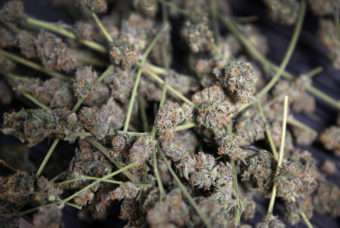
Marijuana is stored in bins for trimming and packaging in preparation to be sold retail at 3D Cannabis Center, in Denver. Brennan Linsley/AP

Early next year, Alaskans will be able to legally buy, transport, and use small amounts of marijuana. The initiative will not be law until three months after the vote is certified, and the state has more time to come up with rules for marijuana sales.

In the meantime, there are still many questions about how legal marijuana would work in rural Alaska. Municipalities have the option to ban the sale of marijuana, but they can’t restrict transportation or possession. The campaign to oppose marijuana had its base in rural Alaska, and named Akiak’s Mike Williams as its chairman. He says he’s disappointed in the results.
“The villages need to take a look at what they can do, at the local level, the tribal level, and continue to pursue making sure that our communities are healthy,” Williams said.

Many questions remain on the law enforcement aspect of legal marijuana, but it’s clear that Alaska’s large rivers remain under federal law, which prohibits marijuana.

Chief Petty Officer Kip Wadlow, a Coast Guard spokesperson, says his agency’s crews are responsible for federal navigable waterways, including the transportation corridors of the Kuskowkim and Yukon rivers.

“They are federal law enforcement agents so if they encounter people who are in violation of federal drug laws, we do have the authority to seize the illegal drug and possibly take that person into custody depending on the amount and what the situation was,” Wadlow said.

The Coast Guard would follow up with other law enforcement. Wadlow emphasizes that the Coast Guard’s other top concern is making sure people are not boating under the influence of drugs or alcohol.

The law doesn’t restrict employers’ ability to outlaw drug use. Williams says that’s a tool that may expand in the coming months.

“Maybe it would be time for mandatory drug testing to all of the employees in schools and community organizations,” Williams said.

Bethel voters were split on the vote to legalize the possession and use of marijuana, with 52 percent voting against legalization, and 48 percent for the ballot measure. It passed statewide with those percentages flipped: 52 percent for, and 48 percent against.

Alaska Station Sets Dubious Record: Most Senate Campaign Ads

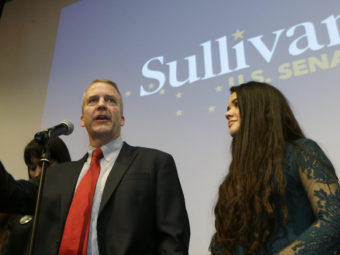
Republican U.S. Senate candidate Dan Sullivan greets supporters on election night in Anchorage. The as-yet-undecided race between Sullivan and Democratic incumbent Sen. Mark Begich was the hottest in the state. Ted S. Warren/AP

It’s a record most Alaskans might wish they could give back: The Center for Public Integrity calculates that KTUU TV in Anchorage ran more U.S. Senate ads this cycle than any other television station in the country — 12,300 in all.

Those Senate spots made up the bulk of the 13,400 political ads since January. KTUU General Manager Andrew MacLeod says 2014 was the the station’s busiest year ever. By contrast, off-year 2013 was relatively light.

Besides gubernatorial and U.S. Senate primaries, the election year also brought out advertisers for key ballot measures, including those for legalizing recreational marijuana, raising the minimum wage, and empowering he legislature to block a controversial mine near the Bristol Baby Fisheries Reserve (they all passed).

But the hottest battle was the Nov. 4 face off between Democratic Sen. Mark Begich and Republican challenger Dan Sullivan. By Thursday it was still undecided, with Sullivan holding an 8,000-vote lead and Begich holding out until some 20,000 uncounted ballots can be tallied.

Besides the candidates and the party committees, the Wesleyan Media Project tracked 22 outside groups buying TV time for the race. It estimates they aired more than 58,000 ads.

The Sunlight Foundation reported late in October that all those advertisers spent $120 per voter –- more than triple the figure for any other Senate race.

Even so, Tuesday’s turnout was about 15 percent lower than Sunlight projected. On Thursday, the online Alaska Dispatch calculated that overall spending by the candidates, party committees and outside groups came to about $225 per voter.

Copyright 2014 NPR. To see more, visit http://www.npr.org/.image
Read original article – November 06, 2014 5:51 PM ET
Alaska Station Sets Dubious Record: Most Senate Campaign Ads
Site notifications
Update notification options
Subscribe to notifications