Marijuana

City of Ketchikan looks for ways to stifle marijuana black market

Ketchikan’s Marijuana Advisory Committee is considering whether to allow licensed home-based grow operations in order to undercut the black market.

Borough Planning Director Chris French said at a assembly meeting Monday that if someone did want to start a small home-grow business, there are some limits already in borough code.

For example, any home-based business can’t use more than 30 percent of the space in a residence.

“You certainly couldn’t do any retail sales out of it, because that’s prohibited as a home occupation,” French said. “So, you’re really limiting it to primarily a cultivation facility. For example, you wouldn’t be able to get a license through the state, most likely, to do any manufacturing there, just because of the type of equipment you’d have to have.”

French notes that enforcing a permit process for home-based retail grow operations could be challenging, because they’d look similar to personal-use grows.

Committee Chairman Glenn Thompson says he’d like to look into the idea further. He says the main point is to keep the drug away from kids.

“Officially, you can say we’re not going to have home occupations, but the practicality is if you have grow operations in someone’s home, and somebody has some extra and says, ‘Here, give me 10 bucks,” that’s just simply going to happen,” Thompson said. “My whole take on this from the start has been, we want to eliminate the black market as much as possible.”

The committee also talked about the possibility of a government-owned marijuana retail store. However, committee members were concerned about potential repercussions for local government since marijuana remains illegal on the federal level.

The committee didn’t make any decisions Monday. Members say they want to get a better idea of the regulations that the state comes up with before deciding what to do on a local level.

Alaskan voters decided last fall to legalize marijuana. It’s been legal for personal use since February, and state officials are working on how to regulate commercial operations.

Local governments can enact their own regulations, as long as they’re not less stringent than what the state establishes.

Pot For Parasites? Pygmy Men Smoke Out Worms

An Aka man smokes hemp while hunting in the Central African Republic. Veronique Durruty /Gamma-Rapho via Getty Images
An Aka man smokes hemp while hunting in the Central African Republic.
Veronique Durruty /Gamma-Rapho via Getty Images

Compared to other cultures around the world, Americans are big stoners.

About 40 percent of Americans say they’ve tried marijuana at some point in their lifetimes, a large survey found. That rate was the highest reported across 17 countries, and it’s nearly 10 times higher than the global average.

But when it comes to reefer madness, nobody can top the Aka — a group of traditional hunter-gatherers in the Congo Basin.

About 70 percent of Aka men regularly use marijuana, scientists at Washington State University in Vancouver reported last month in the American Journal of Human Biology. By contrast, only about 6 percent of the women partake of the drug.

Many of the Aka men think of cannabis as a performance-enhancing drug, says anthropologist Edward Hagen, who led the study. “They say, ‘It keeps me warm, it gives me strength.’ ”

And others say, they just — well — have a “desire” for cannabis.

But Hagen thinks THC, the main mind-altering ingredient in pot, may serve the Aka men a secondary purpose: It could help get rid of intestinal worms.

On average, the more THC byproduct that Hagen’s team found in an Aka man’s urine, the fewer worm eggs were present in his gut.

“The heaviest smokers, with everything else being equal, had about half the number of parasitic eggs in their stool, compared to everyone else,” Hagen says.

Of course, this result is a simple correlation. Hagen doesn’t know if the THC in the men’s system is actually keeping the parasitic worms at bay. And taking a few pills is a much easier way to get rid of intestinal worms.

“This is just the first word on this idea, not the last” he says. “We’re trying to see if this topic is something to look into further.”

THC — and nicotine — are known to kill intestinal worms in a Petri dish. And many worms make their way to the gut via the lungs. “The worms’ larval stage is in the lung,” Hagan says. “When you smoke you just blast them with THC or nicotine directly.”

Traditional groups in the Congo Basin smoke a variety of psychoactive substances, including tobacco and motunga — a plant found in nearby forests.

“They dry the leaves on a fire,” Hagen says. “We smoked it while we were there. Motunga has the same effect as a cigarette: You get a slight buzz.”

The Aka also make a tea with motunga leaves, Hagen says. “Drinking that tea has been shown to kill intestinal worms.”

Copyright 2015 NPR. To see more, visit http://www.npr.org/.
Read Original Article – Published JUNE 23, 201512:24 PM ET

Colorado Supreme Court Says Employees Can Be Fired For Marijuana Use

Brandon Coats works on his computer at his home in Denver in December 2012. (Photo by Ed Andrieski/AP)

Now that marijuana use is legal in Colorado, can employees be fired for lighting up a joint in their free time?

That was the question before the Colorado Supreme Court this term and on Monday it came to a conclusion: Yes, you can get fired.

The case was brought by Brandon Coats, who sued Dish Network after it fired him for using his “state-licensed … medical marijuana at home during nonworking hours.”

Coats said when Dish Network fired him, the company violated a state law that bars an employer from firing any worker over any “lawful” outside-of-work activity.

The court decided that the definition of “lawful” was broader than state law. It concluded:

“The term ‘lawful’ as it is used in section 24-34-402.5 is not restricted in any way, and we decline to engraft a state law limitation onto the term. Therefore, an activity such as medical marijuana use that is unlawful under federal law is not a ‘lawful’ activity under section 24-34-402.5.”

In other words, Coats was legally fired.

Copyright 2015 NPR. To see more, visit http://www.npr.org/.
Read Original Article – Published JUNE 15, 201511:00 AM ET

Petersburg shoots down tax breaks for farmers, marijuana growers

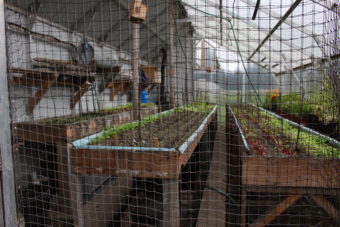
A greenhouse at Farragut Farm on the mainland north of Petersburg (KFSK file photo)

Petersburg’s assembly Monday voted down a property tax exemption for farm buildings. The measure would have applied only to property owners that make more than 10 percent of their income from growing plants or raising livestock. However, assembly members were concerned about setting a precedent or giving the tax break to future marijuana growers.
The ordinance would have exempted structures used to grow or store crops or livestock. The borough estimates only one or two existing business might have qualified, costing the municipality under 100 dollars year in lost tax revenue each year.

Assembly member Jeigh Stanton Gregor initially brought the idea before the assembly but said he couldn’t support it as written. He said he liked the idea of promoting agriculture but did not want the tax exemption to apply to marijuana grow operations.

“Agricultural activity for food processing is low profit margin and a grind to say the least, I really like the idea of supporting that,” Stanton Gregor said. “Marijuana production is a high profit margin business. And the way the state has it lined out like it is right now, marijuana would be included in this. And based on that information, I cannot approve the ordinance.”

The measure passed its first reading in January by a 6-0 vote before the assembly decided to postpone the second reading. Assembly members at the time wanted to wait until the state came out with regulations on marijuana businesses before going forward with the tax exemption.

The ordinance would have put the issue on the local ballot this October. However, it got no support at this month’s meeting and failed in second reading 6-0. Only mayor Mark Jensen was not at the meeting.


Marijuana use on the rise for Alaska’s pregnant women

About one in 14 Alaska women are using marijuana while pregnant and that number appears to be going up. That’s based on the state’s pregnancy risk monitoring survey which is a randomized mail and phone questionnaire hundreds of new moms complete a year.

The survey offers a glimpse into the lives of Alaska women who consume pot while pregnant. For instance, we know that these women tend to be younger, under 24. Kathy Perham-Hester coordinates the survey.

“It would tend to be an Alaska Native woman versus women of other races. There’s a higher proportion of women who have had at least part of their prenatal care paid for by Medicaid. So they might be lower income,” she says.

The data also points to where these women live.

“Proportionally more in the northern region of the state and the southeast region of the state,” Perham-Hester says.

PRAMS, or the Pregnancy Risk Assessment Monitoring System, has been surveying women in Alaska since the 1990s. Forty other states also have similar programs. It’s funded by the Centers for Disease Control and Prevention. The latest data is from 2002 to 2011. Over that span, the percentage of women who consumed pot during pregnancy more than doubled. But one question it didn’t include was “Why?”

“You know, we did not ask any question like that. So no, I’d have to say I’m not aware of that,” she says.

Juneau mom, 26, smoked pot about two times a week when she was pregnant. She’s married with a baby boy.

“Everybody comments on his alertness and how he just smiles and laughs. He’s only two months old but he’s very smart. I mean sure, everybody says that about their baby,” she says.

We’re withholding her name because she fears she could lose her job this summer working in the tourism industry. She says she didn’t experience any nausea while she was expecting. But she did have painful cramps.

“So I would smoke to get rid of those ’cause you can’t really take any other medication for it, which worked for me because I could go swimming or I could go on walk,” she says.

Juneau mom is 26, married and has a two month old baby boy. (photo by Elizabeth Jenkins/KTOO)
Juneau mom is 26, married and has a two-month-old baby boy. (Photo by Elizabeth Jenkins/KTOO)

She says she didn’t really start smoking pot until she was in college. And now smoking it recreationally is more conducive to her lifestyle.

“I enjoy marijuana a lot more than alcohol. Like, don’t get me wrong, a cold beer on a great sunny day like today is amazing. Especially if you can be on top of a mountain. Nothing beats that. But I’m kind of done binge drinking and partying hard on the weekends,” she says.

Instead, Juneau mom likes to do yoga — high. She’s interested in living a “healthy lifestyle” and doesn’t smoke tobacco. She pays for private health insurance and enjoys spending time outdoors. She says before getting pregnant, she used cannabis medically to soothe her fibromyalgia.

“Smoking marijuana like, really helped me get over that hump because I didn’t have to be on Xanax and Cymbalta all those crazy mind-altering drugs. So that’s kind of when I really started,” she says.

But smoking pot prenatally wasn’t a decision she says she came to lightly. She did her own online research. The Alaska Department of Health and Social Services recently issued a fact sheet on marijuana use during pregnancy and breastfeeding, outlining some of the risks.

“Well, there’s a lot that we don’t know about marijuana in terms of harms or possible benefits. But right now I think the data points to harms,” says Dr. Jay Butler, the chief medical officer for the department.

He says THC, the active ingredient in marijuana, can enter the bloodstream of a developing fetus or nursing infant.

“There are a number of epidemiological studies that suggest that exposure to marijuana early in life, particularly heavy use, may affect brain development and intellect. Is it proof of causation? Not necessarily. But I think the data are strong enough there’s reason to be concerned,” he says.

“So to me the data wasn’t really solid. It didn’t provide enough evidence to really go with that,” says Juneau mom.

She says before she made the decision to smoke pot while pregnant, she needed advice from one more person.

“Before I made the choice to do it, I asked my mom. And she actually admitted that she did while she was pregnant with me and my siblings. So that kind of made it a little bit more OK after the other research I had done. I could talk to her about it and she told me her experience. And I was like, ‘Well, I came out normal.’ At least, I think. So it can’t be terrible,” she says.

If a medical expert feels like a child has been born drug-effected, an investigation can be launched by the Office of Children’s Services. Juneau mom thinks that’s why more women don’t talk about it, they’re afraid.

“You hid when you smoked or you kept it private. So why would you ever want to speak about it to someone who might blow the whistle on you?” she says.

Since she started breastfeeding, she says she’s stopped smoking pot regularly for now. The Alaska Department of Health and Social Services says, with changing attitudes toward marijuana, there are concerns the number of women smoking pot while pregnant could continue going up.

Regulatory board will take first look at new marijuana regs

The state Alcoholic Beverage Control Board is expected to review possible regulations for the new marijuana industry.

The board is scheduled to meet Thursday in Anchorage to discuss marijuana regulations.

When voters in November approved a ballot issue legalizing limited recreational marijuana, they also directed the board to develop regulations for commercial and retail marijuana sales and cultivation.

The agenda also includes an update on the timeline for drafting the rules.

In February, the board made an emergency regulation defining the public places where marijuana is prohibited. It will consider making that rule permanent on Thursday.

A new five-member marijuana control board that shares staff and resources with the alcohol board is expected to take over the regulatory work eventually. By mid-day Wednesday, there were 89 applicants for the board.

Site notifications
Update notification options
Subscribe to notifications