Marijuana

Alaska may be first state to allow marijuana cafes

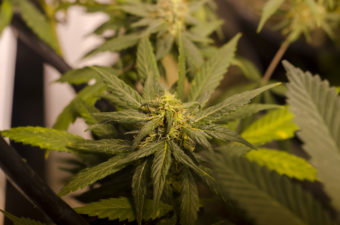
Voters approved the legal the production, sale and use of marijuana for Alaskans over 21 years old in the Nov. election. (Creative Commons Photo by Brett Levin)
(Creative Commons photo by Brett Levin)

Alaska is on track to be the first state in the nation to allow recreational use of cannabis at venues similar to a bar or a cafe.

In its Friday meeting, the state’s Marijuana Control Board adopted an amendment creating a permit option that will allow for on-site consumption. The measure opens the door for commercial marijuana retailers to set up areas where patrons can use marijuana products.

Theresa Collins owns Anchorage business Pot Luck Events, which won a victory with the board’s ruling on the measure, as well as another amendment lifting a ban on marijuana clubs.

“We’re hoping to work with the Legislature, the Marijuana Control Board,” Collins said by phone after the vote, “to make sure people have safe, responsible places to consume cannabis.”

The board also removed caps on the potency of refined products like oils and concentrates, though it left limits in place for edible products.

Taken together, pro-cannabis and industry advocates say the raft of amendments passed during Friday’s meeting are an accurate reflection of the public’s will. In more than 500 pages of written comments over the rule drafting process, many complained of overly restrictive regulations coming from the state’s regulatory body.

Collins says many of the changes finalized by the board are closer to what she and other proponents of last year’s Ballot Measure 2 had in mind when they supported a commercial cannabis market.

“I’m ecstatic,” Collins said. “And it’s my birthday.”

The Marijuana Control Board regulations will now go to the Department of Law for review, and then on to the Lieutenant Governor for final approval, barring any major actions by state legislators during the upcoming session.

Though the state has the power to set general rules, cities and towns can opt out of approving licenses, similar to current local option laws on alcohol.

Juneau Assembly adopts marijuana zoning

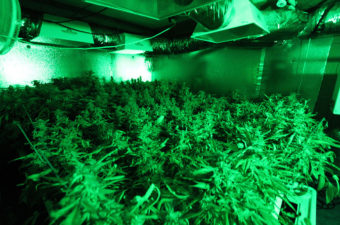
medical marijuana grow operation
Flowering cannabis plants under green light in an air-conditioned, indoor hydroponic grow operation in Oakland, Calif. (Creative Commons photo by Rusty Blazenhoff)

The Juneau Assembly has established zoning for marijuana cultivation, processing and retail.

Pot entrepreneurs will be able to grow their crop in some low-density neighborhoods, outside the city’s urban service boundary. That includes parts of North Douglas, Thane and out the road.
Margo Waring, who lives on North Douglas, testified that she was concerned about the scale of commercial grow operations.

“We’re not looking at your backyard raised veggie bed. This is an indoor industrial activity,” Waring said.

Grow facilities, in the designated D1 areas, are limited to under 500 square feet or about the size of a two-car garage. Residents will be able to voice concerns with the city on a case-by-case basis if issues come up.

Assemblymember Debbie White said by establishing zoning, existing marijuana businesses can come into the light. Pot entrepreneurs will be able to apply for conditional use permits by the end of the year.

“The fact is, then we get to tax for sales,” White said. “And if you think cultivation is not already happening in residential areas, the fact is it’s already there.”

The assembly also enacted a 1,000-foot buffer for marijuana processing facilities around registered neighborhood associations in rural reserve areas.

Retailers will be able to set up shop in parts of downtown, Lemon Creek and by the Juneau airport. Also, in rural reserve areas, which is basically everything off of the road system, plus parts of North Douglas and out the road.

The state is proposing a 500-foot buffer around all schools, youth centers, and churches.

Ketchikan to consider temporary ban on pot sales

A Ketchikan woman who runs a drug testing company and is a member of the local substance abuse task force says marijuana retail sales should be banned in her community.

Renee Schofield was opposed to legalization of marijuana when it was a statewide ballot issue in fall of 2014. The initiative approved by voters does allow communities to opt out, a rule that’s similar to other states that have legalized cannabis. Schofield made her comments at a Monday meeting of the Ketchikan Marijuana Advisory Committee.

“In Colorado, 144 out of 180 counties have opted out. And Oregon is following much the same rule,” she said. “We’re just not ready. We don’t have the infrastructure. We don’t have the planning.”

Terrance Robbins, also of the Substance Abuse Task Force of the Ketchikan Wellness Coalition, told the committee that a proposed $10 excise tax would not generate enough revenue to pay for the cost to society as a result of readily available marijuana. He also noted that people can legally grow their own pot, and he questioned how much demand there would be for retail marijuana in Ketchikan.

Three other people also spoke against allowing retail marijuana in the community. Two people spoke in favor. One was Ralph Mirsky, who proposed the $10 excise tax, which he says should be earmarked for student travel related to public school activities.

Mirsky says he’s a former law-enforcement officer, and he doesn’t advocate using substances recreationally, but he has experienced one benefit of marijuana.

“I had cancer almost 12 years ago. Chemotherapy was horrendous,” Mirsky said. “I had to go underground to get marijuana to calm my vomiting, my nausea, to get my appetite back. It works.”

Mirsky says he dealt with the law enforcement side of marijuana as well, and he believes legal retail trade would reduce the black market.

The committee — which includes representatives from the Ketchikan Gateway Borough Assembly, Ketchikan City Council, Saxman City Council and Ketchikan School Board — previously voted to recommend not banning retail marijuana. 

Despite that vote, committee member Alan Bailey asked that the next meeting agenda include discussion of temporarily banning retail sales of marijuana.

During discussion of the proposed excise tax, members agreed that they would write down their thoughts on how much of a tax they believe is reasonable and where they believe the revenue should be spent, and send that information to the borough clerk’s office. The issue will be on the next Marijuana Advisory Committee meeting agenda.

Would you live next to a pot garden?

A zoning ordinance that allows growing commercial marijuana in low-density neighborhoods is heading back to the Juneau Assembly for public testimony.

It allows marijuana cultivation in D-1 residential areas, zoned for one house per acre.

Rural reserve areas would be zoned for pot cultivation, manufacturing and retail. That’s basically everything off of the road system, plus parts of North Douglas and out the road.

On Monday, a couple of members from the public weighed in at a worksession meeting. James Barrett, who’s interested in marijuana business, said the more the market is restricted, the less opportunity there is for economic growth.

“So  I feel like maybe there’s some things we can do. Maybe we can take some risks. Maybe we say, ‘Hey, let’s give it a try,’” he said. “Let’s let the cannabis people, the responsible ones, give them a shot. Maybe they can do a little part for our economy.”

Barrett said it was also a way the city could attract young entrepreneurs.

But for Marjorie Menzi the issue hit close to home. Menzi lives on Thane Road in a D1 area. She said she was concerned about the pungent smell and glare from greenhouse grow lights.

“We should not be discriminated against because we have lower density or we’re outside the urban service area. We have people with children living in our areas,” Menzi said.

The state is proposing a 500-foot buffer around schools, day cares and childcare facilities.

Assemblymember Karen Crane agreed with Menzi’s points. She said the idea that the assembly treats neighborhoods differently is accurate, and the problem wasn’t going to go away.

“As we have more and more development outside the urban service area, we are going to come up against this area more and more and I think it’s one we need to take a look at,” Crane said.

Crane attempted to get the ordinance sent back to city planners, but the motion failed. The city is trying to figure out zoning before a moratorium expires at the end of the year. After that, pot entrepreneurs will be able to apply for conditional use permits.

The public will get another to chance testify at the next assembly meeting Nov. 9.

Local marijuana regs set for public hearing

The Juneau Assembly wants public comment on an ordinance that will define the marijuana business in the capital city. It specifies where marijuana can be grown, processed and sold.

Assemblymember Karen Crane said the Juneau Planning Commission spoke about wanting to preserve neighborhoods.

“But they only preserve neighborhoods inside the urban service area,” Crane said. “They have left open action in neighborhoods outside urban service area, and I think there needs to be more discussion about this.”

The city has a moratorium that expires at the end of the year on marijuana businesses. After that, pot entrepreneurs will be able to apply for conditional use permits. Crane said she’d like to hear more input before the deadline.

“I know there’s a lot of pressure to make these decisions but this decision, I’d like to have some more discussion on — instead of being pushed into making it right now,” Crane said.

The public gets a chance to weigh in at the next assembly meeting on Nov. 9.

Oregon Partakes: Recreational Pot Becomes Legal Thursday

Oregon welcome sign at Hells Canyon. (Creative Commons photo by Staplegunther)

At the stroke of midnight, it became legal for Oregon dispensaries to sell marijuana to anyone over 21 years old. The state has also been allowing residents to wipe old pot charges from their criminal records.

Oregon becomes the third U.S. state to legalize recreational marijuana sales, joining Colorado and Washington.

From the Northwest News Network, Chris Lehman reports for our Newscast unit:

“For the past three months, adults could grow or use marijuana in Oregon, but until now there was no place to legally buy it, unless you had a medical marijuana card. That’s changing – with more than 230 medical marijuana dispensaries being given the go-ahead by Oregon lawmakers to sell pot to the general public.”

As of today, Oregon residents can buy dried marijuana, along with seeds and immature plants, Lehman reports for NW News. A wider range of products, including edibles, will go on sale in 2016.

In recent weeks, Oregon has also allowed residents who have faced marijuana charges in the past to expunge them from their records. While that provision (which involves a five-page form) applies to low-level offenses, The New York Times reports that in 2016, “more serious felony marijuana convictions of the past, like manufacturing, will be eligible for record sealing as well.”

Oregon voters approved Measure 91 last November; the legislation takes effect after it was tweaked by the Legislature over the summer.

Those tweaks set today as the start of legal sales; they also changed how Oregon will tax marijuana, shifting from producers to the retail level.

Under the new law, cities and counties can vote to bar marijuana producers and retailers from operating there – in some cases, until a local election can be held to decide the issue. According to the Oregon Liquor Control Commission, 24 cities and 9 of the state’s 36 counties have enacted bans.

Copyright 2015 NPR. To see more, visit http://www.npr.org/.
Read Original Article – Published OCTOBER 01, 201511:21 AM ET
Site notifications
Update notification options
Subscribe to notifications