Marijuana

Marijuana businesses’ launch depends on Legislature acting

Voters approved the legal the production, sale and use of marijuana for Alaskans over 21 years old in the Nov. election. (Creative Commons Photo by Brett Levin)
(Creative Commons photo by Brett Levin)

Marijuana businesses are scheduled to open in June, after the state issues licenses. But there’s a hitch – the state won’t issue licenses until the Legislature passes a bill that allows for national criminal background checks, among other provisions. And that bill is currently in limbo.

The Alaska Marijuana Control Board has put the brakes on issuing licenses until it can do national criminal background checks on applicants.

State Alcohol and Marijuana Control Office Director Cynthia Franklin said that’s because the Legislature requires background checks for licensees. But it hasn’t passed a bill that’s been proposed that would allow Franklin’s office to do these checks. She’s hopeful that lawmakers will pass the bill soon.

“I truly cannot believe that the Alaska Legislature would hold this tool hostage and prevent … marijuana licensing from occurring, by enacting a statutory requirement and then not giving us the statutory language to meet that requirement,” she said.

The versions of the bill passed by the House and Senate differ over two provisions of the legislation that have nothing to do with background checks.

Wasilla Republican Representative Cathy Tilton opposed marijuana legalization. But as chairwoman of the House Community and Regional Affairs Committee, Tilton crafted the House version of the bill, House Bill 75. Her version would have required Unorganized Borough communities to opt out of allowing commercial marijuana businesses – mirroring state law for boroughs and municipal governments.

The Senate changed the bill to require Unorganized Borough communities to opt in. Tilton said she wants a conference committee to resolve the differences between the Senate and the House.

“Our goal was to be able to provide the communities with the tools that they need to implement whatever they want to do, at the local level, and that is why it was a good bill to me – to be able to allow those things to happen,” Tilton said.

The other provision that’s prompted differences would limit the number of marijuana plants residents could grow for personal use – some legislators would like it to be up to 24 plants, while others prefer a household limit of 12, with no more than six per adult. Tilton said she’s fine with the lower limit.

“I do feel that that is a reasonable number — especially if you’re looking at generating any kind of a legitimate commercial industry,” she said.

The legislative delay is a concern for those who want to launch their business in the coming months.

Sara Williams, chairwoman of the Matanuska-Susitna Borough’s marijuana advisory committee, has been frustrated with the holdup. She’s hoping her retail business Midnight Greenery will open in downtown Anchorage in September.

“I’m very hopeful that the Legislature can look forward to the future and realize that here we have a revenue stream,” she said. “We have an opportunity in a budget crisis to create jobs and create a revenue stream.”

Another bill could affect the Marijuana Control Board’s ability to issue licenses. House Bill 337, sponsored by Anchorage Republican Representative Gabrielle LeDoux, would allow the state to collect taxes on those who exceed the legal maximums for possessing and growing pot.

LeDoux said the bill would treat marijuana the same as alcohol. The bill also contains a provision that requires businesses that sell marijuana to post a bond. They would forfeit the bond if they don’t pay taxes.

Franklin said her office is ready to prepare the control board to issue licenses – but waiting for the Legislature to act hasn’t been the only challenge. Her office has fewer workers than those in other states that have legalized marijuana, and they’re answering a flood of questions from the public.

“You really just could not amp up the pressure any more than it is amped up on this staff,” Franklin said. “But that being said, they’re doing an amazing job. And we are … moving forward, and we’re on time.”

Representative Charisse Millett, an Anchorage Republican, is confident that once the background check bill goes to conference committee, the differences will be ironed out. But with the Legislature busy with other major legislation, it’s not clear when the bill will be sent into conference committee – or whether the licenses will be issued on time.

Supreme Court Denies Marijuana Suit From Colorado’s Neighboring States

More than a year after Nebraska and Oklahoma sought to sue Colorado over the carry-over effects of that state’s law making recreational marijuana legal, the U.S. Supreme Court has denied the two states’ complaint.

The court did not explain its decision, with which Justices Samuel Alito and Clarence Thomas disagreed. Thomas wrote a five-page dissent in which Alito joined (a reminder: the court is currently at eight members).

Citing the Supreme Court’s constitutional role in handling disputes between states, Thomas said that Nebraska and Oklahoma’s claims of “significant harms to their sovereign interests” should have been allowed to proceed, and should not have been denied without explanation.

The two states began legal proceedings months after Colorado began allowing marijuana dispensaries to start selling pot for recreational use at the start of 2014.
As the Two-Way reported, “officials in Nebraska and Oklahoma say Colorado’s pot law has become a destabilizing force in their states, where their legal systems are struggling to enforce the federal ban on marijuana. They believe Colorado isn’t doing enough to keep pot from leaving the state.”

The neighboring states had claimed their criminal justice systems were being put under stress because of Colorado’s new law.

Reacting to today’s news, Nebraska Attorney General Doug Peterson said he’s disappointed. He also said the high court’s denial doesn’t mean that Colorado’s “unconstitutional facilitation of marijuana industrialization is legal” — and Peterson added that he’ll be looking at possible steps “toward vindicating the rule of law.”

On the other side of the issue, Mason Tvert, the director of communications for the Marijuana Policy Project, called the case meritless.

“States have every right to regulate the cultivation and sale of marijuana, just as Nebraska and Oklahoma have the right to maintain their failed prohibition policies,” said Tvert, who’s based in Denver — and who helped lead his state’s marijuana voter initiative. “Colorado has done more to control marijuana than just about any other state in the nation.”

Copyright 2016 NPR. To see more, visit http://www.npr.org/.

Commercial pot grows on North Douglas still a go

medical marijuana grow operation
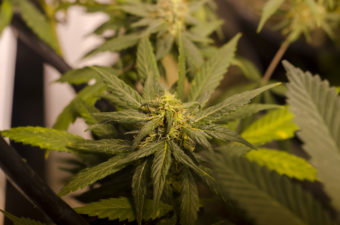
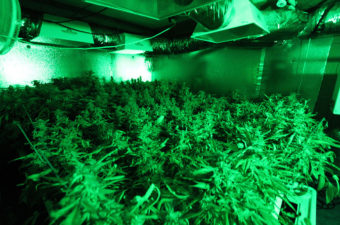
Flowering cannabis plants under green light in an air-conditioned, indoor hydroponic grow operation in Oakland, California. (Creative Commons photo by Rusty Blazenhoff)

The Juneau Assembly voted 7-2 on Monday night not to reopen discussion about zoning for commercial marijuana grows in low-density neighborhoods. That means the permitting process will proceed for potential grow houses like Paul Disdier and June Hall’s Fireweed Factory on North Douglas.

Back in November, the assembly outlined zoning rules for marijuana businesses. In some low-density neighborhoods, like North Douglas, grow houses up to 500 square feet could be permitted.

That sparked one petition opposed to neighborhood grow houses and one in support. 

Assemblymember Loren Jones, who’s also on the state marijuana control board, said the assembly has tried to deal with the issue as best it could.

Loren Jones
Loren Jones

“We have come to, from what I think is a fair solution in this community,” Jones said. “And the conditional use permit will be a process by which both the planning commission and the assembly will make some determinations about what is going to be allowable and what is not.”

While zoning is unlikely to change, Jones did say that the assembly plans to work on a new ordinance next week that could set additional requirements for marijuana operations, such as municipal licensing, limiting hours of operation, buffer zones and odor control.

You can listen to my conversation with Assemblymember Loren Jones here:

The Juneau Planning Commission is scheduled to consider Fireweed Factory’s conditional use permit — the commission’s first for a marijuana operation — on March 22.

North Douglas retirees seek backyard grow house, spur dueling pot petitions

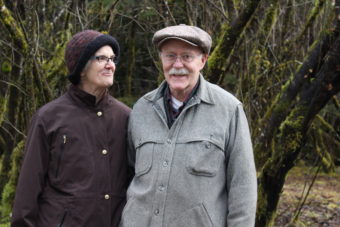
June and Paul Disdier hope to start their marijuana business in their backyard. (Photo by Elizabeth Jenkins/KTOO)
June Hall and Paul Disdier hope to start their marijuana business in their backyard on North Douglas. (Photo by Elizabeth Jenkins/KTOO)

The Juneau Assembly voted back in November to allow limited cultivation on parts of North Douglas and other low-density areas. After one red public notice sign went up at the end of a driveway, it caught some in that neighborhood off guard.

Paul Disdier and wife June Hall have lived at their North Douglas home for over 40 years. Paul’s a retired painter and state employee. June was an art teacher at the University of Alaska Southeast. They say they built a good life here, raised kids. In retirement, they were looking forward to starting something new.

“The size of this building? It’s just going to be a little bit bigger than a one car garage. And that’s about the size of it,” Disdier said. “You know, I’ve said it again, but it’s one eighty-seventh of an acre. We have an acre and a half here.”

Paul and June are building a commercial marijuana facility on their property. At least, they’re trying to. The maximum size allowed in the low-density area is 500 square-feet. They haven’t completed the city permitting process yet. They want the Fireweed Factory to be a family business that will eventually supply their off-site retail store.

They say some of their closest neighbors are OK with it. But they realize not all of the neighbors on North Douglas are.

Before we get to that, let’s go back to how the couple started growing marijuana. It started in the mid-’70s, after the Alaska Supreme Court ruled in Ravin v. the State. That decision made it legal to grow pot for personal use, which Paul and June did. Now, they say it’s helped them with arthritis and the other ailments of aging.

“I just had a knee replaced and wasn’t making no progress as long as I was taking Oxycodone,” Disdier said. “Got off of that and starting making pills out of marijuana.”

So after the Juneau Assembly outlined commercial marijuana zoning, they thought home would be the perfect spot to start the business.

“Since living on North Douglas always seemed to be a place where, you know, you could take advantage of a large residential lot where you had privacy,” Hall said. “And I guess we thought maybe neighbors wouldn’t be as upset as they seem to be.”

Merry Ellefson said she didn’t realize marijuana legalization meant “fighting” to keep her neighborhood “free of industrial cultivation.”

Ellefson, along with a group of other neighbors, submitted around 137 names to the Juneau Assembly. It’s a petition that asks the city to ban commercial marijuana grows in low-density neighborhoods, like theirs. The names were collected from all over Juneau.

Ellefson has lived in North Douglas for 23 years. She said she’s not ideologically opposed to someone growing commercial marijuana, but it doesn’t mix with residential areas.

“I think it’s an issue, like I said, of, we’re not growing tomatoes. And I think that a marijuana cultivation is just that. I’m a coach, a coach at the high school. I’ve coached Nordic skiers. I have a child,” Ellefson said. “I don’t think that it’s conducive to a healthy community where we all pass by on our bikes.”

A member of the state marijuana control board thought Juneau may be the only municipality in Alaska to allow commercial marijuana growth in neighborhoods. But in February, the Skagway Assembly also adopted an ordinance allowing it in low-density neighborhoods.

For Ellefson, the decision flies in the face of Juneau’s city code to “provide a healthy, safe, and pleasant environment” for residents.

The city has two commercial marijuana cultivation permits to consider: the Disdier's and Rainforest Farms, which could be in Lemon Creek.
A red sign outside Paul Disdier and June Hall’s home announces their intent to obtain a conditional use permit to start a commercial marijuana grow. (Photo by Elizabeth Jenkins/KTOO)

The petitioners are concerned about bright grow lights, the smell and a possible uptick in crime for the all-cash business.

“Personal use: that’s people’s choices. Industrial and commercial belongs in industrial areas,” Ellefson said.

It’s unknown how many 500-square-foot grow houses could eventually crop up in North Douglas. And Ellefson said she’s worried about the zoning tearing the community apart.

“We’re putting in a shop after 23 years of trying to stay out of the rain, and a neighbor came over and wondered if it was going to be a commercial cultivation site,” Ellefson said. “And I don’t know, it’s just that sort of suspicion. What are you doing? Having to be aware of what’s going on in your neighborhood. It shifts the energy and it shifts the connectivity.”

June Hall and Paul Disdier haven’t broken ground yet. They’re waiting to see if their permit gets approved. Recently, an online counter petition supporting commercial marijuana business on North Douglas received 118 endorsements.

And the couple said a lot of neighbors have approached them to show solidarity. They’ve even received cards.

“We’ve been really encouraged. We couldn’t have kept going, honestly,” June Hall said.

After a long pause, Paul Disdier added:

“Without our friends. You know, they’re helping us out. We know a lot of people in this town. We’re honest people, honest business people,” he said, his voice cracking.

They said their facility will be self-contained. Smells won’t emanate next door. There are no noisy generators. You won’t even be able to see the lights.

Quiet retirees may not be what you imagine when you think of pot entrepreneurs.

“But I think we’re typical. My husband and I. And I think the people out here on North Douglas are like us. They’re not scary, lurking individuals,” Hall said.

They hope, when the novelty wears off, the neighbors won’t worry as much about what’s going on in other people’s yards.

In the mean time, the Juneau Assembly has reopened discussion about marijuana zoning in neighborhoods. It plans to meet as a committee of the whole on the topic at 6:30 p.m. Monday. The Juneau Planning Commission will consider the Fireweed Factory’s conditional use permit March 22.

Editor’s Note: A previous version stated: “A member of the state marijuana control board said Juneau may be the only municipality in Alaska to allow commercial marijuana growth in neighborhoods.” In February, the Skagway Assembly also adopted an ordinance allowing it in low-density neighborhoods. The story has been updated to reflect the changes. 

For Pot Tourists, The Trip Is More Likely To End In The ER

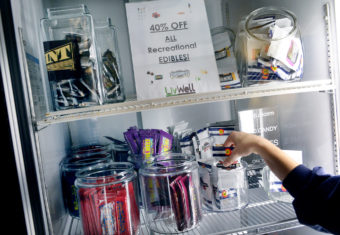
A budtender prepares an edible sale for a customer at LivWell Broadway in Denver. Craig F. Walker/Denver Post via Getty Images
A budtender prepares an edible sale for a customer at LivWell Broadway in Denver.
Craig F. Walker/Denver Post via Getty Images

A lot of visitors to Colorado figure they might give the state’s good ganja a try. But they might not be prepared for the effects. When it comes to bad weed trips, out-of-staters have been doing much worse than Colorado residents and are going to the ER more often since recreational sales of marijuana began in 2014.

The number of out-of-state residents who ended up in the emergency room for cannabis-related reasons nearly doubled from 2012 to 2014, according to an analysis of emergency department visits in 100 Colorado hospitals. By contrast, the number of Colorado residents visiting emergency rooms for cannabis increased about 40 percent in those two years, according to the study published in the New England Journal of Medicine on Wednesday.

There are marijuana-specific tours, like those run by My 420 Tours, but many of these visitors seem to be in Colorado for other reasons, says lead author Dr. Howard Kim, an emergency medicine physician and a postdoc at Northwestern University. “I remember some business travelers who were in Denver on business, and after the meeting ended, they decided to try some marijuana edibles. Then they ended up cutting to the ER.”

Kim was finishing his residency in Colorado when he did the study. A lot of the people ending up in the ER where Kim was finishing his residency had classic signs of marijuana intoxication. “People can be anxious or agitated or even have brief psychotic episodes like hallucinations and delusions,” he says. “Patients can have a very fast heart rate or gastrointestinal problems like vomiting.”

It’s not clear why Colorado residents are doing better than the visitors, but Kim thinks it probably has to do with better understanding of marijuana and its side effects. “Right now, I think it’s just an awareness gap.” he says. “The Colorado Department of Public Health and Environment has done a great job. But it’s not as easy to educate the entire population of potential visitors to Colorado.”

Adam Curtis, who owns a cannabis dispensary called The Giving Tree of Denver, says “All my employees have a copy of the Good To Know,” These are pamphlets and notecards that the Colorado Department of Health and Environment distributes to marijuana retailers as part of a state public health education campaign.

He thinks that sellers have been doing a good job of educating the customers, and the three retailers, including The Giving Tree if Denver, Shots contacted all said they provide literature from the department of health including the Good To Know materials.

Curtis advises first-time recreational users to take half the 10 milligram recommend dosage of THC. He speculates that people ending up in the ER are going above that dosage against the recommendations on packaging or by marijuana sellers.

Part of the trouble is that some people consuming marijuana edibles might not realize it takes some time to get high. “They don’t feel anything, then they take another one, and when the effect finally kicks in – now they have the effect of multiple products,” Kim says. It may also be that marijuana has become more potent and some smokers may not realize that. Future bud tourists should be getting more help. In the past year, Colorado health officials have been establishing responsible vendor programs that train “budtenders” or cannabis sellers to give reliable information about dosing and side effects.

Copyright 2016 NPR. To see more, visit http://www.npr.org/.
Read original article –  February 24, 2016 5:12 PM ET

Juneau Assembly bans use of butane, propane for refining pot for personal use

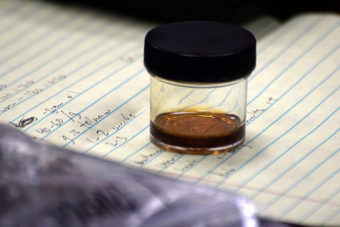
A sample of marijuana hash oil, sits on the testifier’s desk in an Alaska House Judiciary Committee hearing, March 6, 2015. The committee had asked law enforcement officials to give them a “show and tell” about the drugs and associated paraphernalia. (Photo by Skip Gray/360 North)
A sample of marijuana hash oil in the Alaska House Judiciary Committee, March 6, 2015. Law enforcement officials were holding a “show and tell” about drugs and associated paraphernalia. (Photo by Skip Gray/360 North)

The Juneau Assembly outlawed certain marijuana refining methods for personal use Monday night in a 5-3 vote.

Using methods based on butane and propane are not permitted. The concern is that flammable gases used to make hash oil could cause fires or explosions.

Approved methods include water-, alcohol- and food-based extraction, which could create marijuana infused butter, olive oil or liquor.

On Feb. 23, the Juneau Planning Commission will consider two North Douglas property owners’ commercial grow application. The commission is the gatekeeper for the conditional use permit they need to operate.

Site notifications
Update notification options
Subscribe to notifications