The Juneau Assembly approved new guidelines for a city pot license on Monday. Those seeking to cultivate commercial marijuana will have to apply for the $250 license, in addition to the state’s.
It’s part of the assembly’s attempt to streamline the conditional use permit process and establish new guidelines for marijuana businesses.
Commercial pot grows are zoned for industrial areas and some low-density neighborhoods, like parts of Thane, North Douglas and out the road. Lisa Cone, a North Douglas resident, testified that she wasn’t happy about the possibility of living next to a grow operation.
“We’re at the point where we have to sort of put up with what’s going on at North Douglas. Even though all the neighbors that we’ve spoken with are in disagreement about what’s going on,” Cone said. “But I feel strongly that individuals who are growing out there need to live on their properties.”
The new guidelines say a person must live on site if they are cultivating commercial marijuana in a neighborhood. That could be the owner or a tenant. Grow houses must be set back 25 feet from the property line.
Two people testified that the shifting regulations could discourage new business. They said some of the regs were based on antiquated fears. But Assemblymember Kate Troll said that wasn’t the case.
“We want to proceed with this. I feel that we aren’t driven by ‘Reefer Madness’ in assuming that everyone’s a bad hippy for those previous days,” Troll said.
The assembly approved the city marijuana licensing ordinance and changes 7-2, with Assemblymembers Mary Becker and Jerry Nankervis voting no.
The board tasked with regulating Alaska’s nascent marijuana industry has approved draft regulations for how customers will be allowed to consume pot they buy in certain retail stores on site.
The proposed rules, which will go out for public comment, call for retail stores that will be permitted to have on-site consumption to have the consumption area cordoned off from the rest of the store by a secure door. Items purchased to be consumed at the store could not be removed from the premises. Regulators likened it to bars, where patrons are not allowed to-go cups for beers they don’t finish.
There would be transaction limits, and stores would have to monitor patrons for overconsumption. Gimmicks such as contests involving use of marijuana or pot as prizes would be prohibited.
Retail pot shops have yet to be licensed in Alaska.
A bill with big implications for alcohol and marijuana has sailed out of the House Judiciary Committee without opposition.
Senate Bill 165, sponsored by Sen. Peter Micciche, R-Soldotna, deals primarily with reforming the rules around alcohol consumption for minors and adults younger than 21.
The bill changes the minor consuming alcohol violation under Title 4, making it a $500 penalty, similar to a parking ticket. That fee can be reduced as low as $50 if a person completes a treatment program within six months of the judgment, which supporters of the bill say is a more effective way of dealing with youth substance abuse than the current system.
The rule change would also keep a young person’s name from appearing on the state’s CourtView website, which Micciche said in earlier testimony can devastate a young person’s life.
Judiciary Chair Rep. Gabrielle LeDoux, R-Anchorage, calls the change a significant improvement.
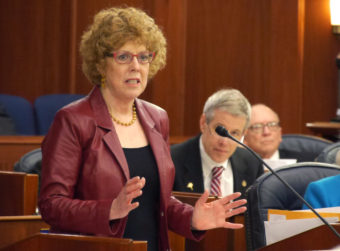
Rep. Gabrielle LeDoux, R-Anchorage, wraps up debate on House Bill 126 relating to a code of military justice, Feb. 3, 2016. (Photo by Skip Gray/360 North)
“As someone who once upon a time had teenage children, I always was kind of perplexed by some of the insanity in our alcohol regulation relating to minors,” LeDoux said in closing remarks. “This fixes a lot.”
Many Title 4 laws haven’t been updated since 1980, according to Chuck Kopp, aide to Sen. Micciche.
Another part of the legislation clears a roadblock currently faced by residents hoping to start cannabis businesses across the state. It authorizes the Department of Public Safety to run criminal background checks on applicants for commercial cannabis permits, which are currently under review by the state’s Alcohol and Marijuana Control Office.
Public health officials as well as members of the alcohol industry, who are often on opposing sides of regulatory debates, have both spoken in support of the measure.
Proponents are optimistic it will pass this session.
Tim Cullen, founder of Colorado Harvest Company, has had trouble keeping a bank account for his marijuana business. (Pew Charitable Trusts)
DENVER — Tim Cullen’s marijuana business brought in millions of dollars last year, but he’s had a hard time finding a bank to take the money. He’s cycled through 14 checking accounts in six years. Recently, he said, a bank shut down all his personal accounts, including college savings for his 3-year-old daughter.

Federal law prohibits banks and credit unions from taking marijuana money. So here in Colorado, everyone involved with the state’s legal cannabis industry has a banking problem. Businesses can’t get loans, customers have to pay in cash, and state tax collectors are processing bags of bills.
Some community financial institutions have become more open to serving the cannabis industry since the U.S. Treasury and Justice departments said they won’t go after institutions that keep a close eye on their clients and report suspected wrongdoing, such as funding gang activity.
But the big banks refuse to touch the industry, and banking challenges are only going to grow as legal marijuana expands. Nationwide, sales hit $5.4 billion in 2015, according to The ArcView Group, an analysis and investment firm that specializes in the legal cannabis industry.
Twenty-three states allow medical use of marijuana and four also allow recreational use. Voters in Arizona, California, Massachusetts and Nevada may legalize adult use this fall, and Vermont’s Senate recently approved a bill that would do so.
States are looking to Colorado — which legalized medical marijuana in 2000, and adult use in 2012 — for answers to the banking problem, but the state has few to offer. “We don’t truly think we’ll see a solution unless there’s a federal solution,” said Andrew Freedman, Colorado’s director of marijuana coordination, who’s also known as the state’s pot czar.
An Unbanked Industry
Cullen has been an unofficial spokesman for Colorado’s cannabis industry ever since he bumped into a CNN camera crew while picking up one of the state’s first retail marijuana licenses, he said. It helps that he’s a clean-cut former high school biology teacher who designed his stores with his mom in mind.
“We wanted to look like Restoration Hardware,” he said while walking through the main Denver location of Colorado Harvest Company, the marijuana growing and retail business he founded in 2009 and co-owns. That means wood paneling, edibles laid out in glass cases like chocolates, and a scent in the air that’s more reminiscent of a day spa than a college dorm.
But even Cullen’s squeaky-clean operation makes banks uneasy. The company’s current account, with a credit union, only covers basic services such as direct deposit for the company’s 70-odd employees and sending tax payments to the state, Cullen said.
An ATM sits in the corner of each of his three stores, because his business can’t process credit or debit card payments (credit card companies, like banks, may refuse to touch marijuana money). Every day an armored car swings by to pick up the day’s revenue — all cash — and takes it away to be deposited.
About 40 percent of Colorado cannabis businesses lack bank accounts altogether, according to the office of U.S. Rep. Ed Perlmutter, a Democrat who has pushed to improve banking for the cannabis industry. State officials would not comment on that number.
Freedman said a growing number of marijuana businesses seem to be obtaining bank accounts, judging by the declining share of tax revenue that businesses are paying in cash. But the services they’re able to access are limited and costly — “which means a lot of people prefer to keep as much as they can in cash,” he said.
All the cash floating around makes cannabis businesses targets for crime, Freedman says. Since Colorado fully legalized marijuana in January 2014, the Denver Police Department haslogged over 200 burglaries at marijuana businesses, as well as shoplifting and other crimes.
The loose cash also makes it harder for the state to track businesses’ finances to make sure they are obeying the law and paying their taxes. And in order to get a bank account, some businesses will funnel their cash through a shell company, Cullen said. “It starts to look a lot like money laundering.”
As Cullen’s experience shows, accounts can also be tenuous. Sometimes, a financial institution will change its mind about taking marijuana money. Or it might learn of a client’s ties to the marijuana industry. Mark Goldfogel, a consultant, said his bank closed accounts he’d held for 14 years after he revealed who his marijuana clients were.
Not Much States Can Do
Colorado’s attempts to solve the problem have shown other states how few options they have.
In May 2014, lawmakers authorized a new class of financial institution called a cannabis credit co-operative, which wouldn’t have to acquire and maintain deposit insurance. But no such institutions have been formed so far, partly because the Federal Reserve isn’t likely to approve them.
Later that year, lawmakers authorized a credit union for the cannabis industry. But the Fed denied the credit union access to a master account, which is necessary for transferring money, and the National Credit Union Administration refused to insure its deposits.
“Even transporting or transmitting funds known to have been derived from the distribution of marijuana is illegal,” the Federal Reserve Bank of Kansas City said during a court case the credit union brought and recently lost.
Without a master account, the credit union can’t fully function, said Mike Elliott, head of the Marijuana Industry Group, a trade association in Colorado. “It can be a vault. But we don’t need a vault,” he said.
Officials in other states that allow marijuana have run up against the same barriers. Tax officials in California have floated the idea of a state-run bank, for instance, as have officials inAlaska. But such an institution would still have to use federal wiring services, said George Runner of the California State Board of Equalization.
California already has trouble collecting taxes on medical marijuana, Runner said. “We’ve had folks come in with hundreds of thousands of dollars” in cash to make a payment. Other than increasing security at tax collection offices, there’s not much his office can do about it.
The cannabis industry’s banking problems would vanish if Congress were to take marijuana off the federal government’s list of most dangerous drugs. Last November, U.S. Sen. Bernie Sanders of Vermont, who is running for the Democratic presidential nomination, became the latest lawmaker to propose the change.
But that’s a remote possibility. Perlmutter has introduced a bill — twice — that would take a smaller step, and stop federal regulators from penalizing financial institutions for serving the cannabis industry. He hasn’t been able to get a hearing, let alone move the bill out of committee.
Perlmutter and his allies in Congress are now trying to cut off funding for federal enforcement actions against banks and credit unions that serve cannabis businesses.
Finding a Way
The Fed and other regulatory agencies have made it clear that states can’t create new financial institutions for the cannabis industry. But because the Obama administration has indicated that it will look the other way when existing institutions serve cannabis clients, businesses like Cullen’s do have some options.
Vermont’s Department of Financial Regulation has researched the services available to the state’s four medical marijuana dispensaries and found some good news. The state’s largest credit union serves one dispensary and says it would serve more. Although the credit union doesn’t offer marijuana businesses much more than depository accounts, federal regulators confirmed the accounts are insured.
Vermont state Sen. Joe Benning, a Republican who co-sponsored the Senate proposal to legalize marijuana for adult use, said the state’s financial institutions should be able to handle the cannabis industry’s expansion — at least initially. “You’re not going to have to be bringing in wheelbarrows full of cash to make deposits,” he said.
In other states, new services have emerged to eliminate cash transactions. In Washington and Oregon, an intermediary company called PayQwick electronically transfers money between marijuana growers, sellers, customers and their financial institutions. PayQwick also files all the paperwork the Treasury Department requires, taking a burden off banks.
Tax collection offices are doing what they can to manage cash collections. Offices in Oregon and Colorado have invested in extra security, such as safety glass and security cameras; businesses are also hiring security guards to help them make their deposits safely.
Auditing cash-only cannabis businesses is tough, but not impossible. In Colorado, the Department of Revenue relies on the state’s system for tracking legally grown and sold marijuana plants, Freedman said.
Still, the situation is far from ideal for businesses or for states. It’s temporary, too; nobody knows how the next president will enforce federal marijuana policies.
While Colorado waits for Congress to act, state officials will keep meeting with bank and credit union boards and explaining the nuances of federal law, Freedman said. That slow, institution-by-institution campaign may be states’ best hope for getting marijuana money off the streets.
“I think it’s going to get better. It certainly couldn’t be worse,” Cullen said of the cannabis industry’s banking problem. He takes the sunny view that as more states legalize the drug, it will become something federal lawmakers will no longer be able to ignore.
Hundreds of people across Alaska are trying to figure out how to sell pot. Just over a month ago, the state opened up the permit process for businesses hoping to grow, process and sell cannabis products. Applications continue to pour in.
As part of an ongoing series, KSKA’s looking at one prospective businesswoman, Jane Stinson of Enlighten Alaska, LLC, to find out what that application process is like.
(Photo courtesy Jane Stinson)
“That’s Mason, and that’s Bailey,” Stinson said, pointing to two barking dogs as she opened the door to her South Anchorage home.
Stinson shows me what would be a beautiful granite kitchen counter if it weren’t buried under heaps of paper, page after page of her application to open a retail cannabis shop.
“It’s where I do it all,” Stinson said.
She’s been working on the application for nine months. It is not a simple process. Pulling up the state’s website for navigating the permit application, Stinson shows fields and tabs asking for information that officials with the state’s Alcohol and Marijuana Control Office want to know as they weigh whether to grant business permits.
“They ask a lot of questions about security, safety,” Stinson explained. “They cover the entire gamut of any business that would go into retail or manufacturing, they are collecting all the data that they need to make a decision.”
That data gets really specific. The state wants to see that plans are in place for how cannabis products are handled, all the way down to protocols for transporting the product. One of the biggest components is all the security services prospective owners have to line up as they figure out a business plan.
“That’s the interesting part. All these ancillary businesses and the ones who are actually going to be touching the plant are all trying to figure it out together,” Stinson said. “There are a lot of businesses that are cropping up to support those needs.”
Though the application is complicated, Stinson thinks it’s fair, and that the state has done a good job with it.
As of March 30, 177 cannabis applications have been formally initiated with dozens more started. Business locations stretch from Ketchikan to Nome. The highest concentration, however, is in the retail and industrial zones within the Anchorage bowl.
Five completed applications are under review by the state office right now – all of them for grow operations between Fairbanks and Soldotna. The state is prioritizing permits for growers, so they can get started producing legal cannabis for shops like Stinson’s to sell a few months later.
It’s like authorizing farmers to plant their crops before letting any supermarkets open. Which puts Stinson in the position of planning a retail business without knowing the products that’ll be on the shelves.
“We are really anxious,” Stinson said. “Truly we just have no idea what can be done out there, where the expertise is, who knows what, and who’s gonna produce the best product.”
It’s a lot of risk to shoulder with so many major factors still unknown. The fee to apply with the state is $1,000, and then if Enlighten Alaska is approved, it’ll be another $5,000 for the permit itself. All of that pales in comparison to what Stinson and her partners have spent so far on things like legal fees and real estate.
“We’ve invested over $50,000 already, just preparing for this,” Stinson said. “It’s a lot.”
This is just for state approval. Locally, the municipality of Anchorage will also need to approve the business plan and sign off. The city won’t start assessing applications until they’re approved and passed along by the state office. Deputy Clerk Amanda Moser said the municipality’s permit application will be basically a “copy and paste” version of the state’s, and won’t require much additional work.
The process involves meetings with community groups near the business site. Stinson recently made her first presentation to the Spenard Community Council during a special meeting.
“It went very well, it was very well received,” she said. “It just gets easier every day, I mean it really does, because you just talk about it more and more and people get more comfortable with it.”
As Stinson and her business partners get ready for more community council meetings, she’s optimistic they’ll get through the technical hurdles.
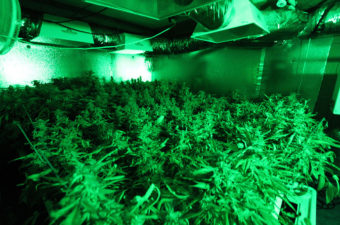
Flowering cannabis plants under green light in an air-conditioned, indoor hydroponic grow operation in Oakland, California. (Creative Commons photo by Rusty Blazenhoff)
The Juneau Assembly is in the process of streamlining conditional use permits for marijuana businesses and establishing new guidelines. Assemblymember Maria Gladziszewski raised concerns over an ad that recently popped up on Craigslist, boasting two acres of “land available for marijuana cultivation” for rent.
“And when we saw people on Craigslist saying, ‘Get in the green rush. Come to North Douglas or out the road and put a shed on the property.’ That was not what was discussed in the marijuana committee,” Gladziszewski said.
North Douglas is a low-density neighborhood where zoning allows commercial marijuana cultivation. The state already requires marijuana business owners be Alaska residents. But now, an amendment to Juneau’s land use code clarifies — when it comes to neighborhoods — they must also live on site. Although, if the owner approves, this would not stop a renter from starting a commercial grow operation.
Marijuana entrepreneurs may also be required to apply for a pot business license in addition to the state’s. The city license would give the municipality more local control if businesses fail to comply with city laws.
The assembly voted 6-3 on Monday to lower the licensing cost from $450 to $250. The assembly will reopen the discussion again on May 2 with public testimony.
Close
Update notification options
Subscribe to notifications
Subscribe
Get notifications about news related to the topics you care about. You can unsubscribe anytime.