Marijuana

McGivney’s Sports Bar coming to downtown


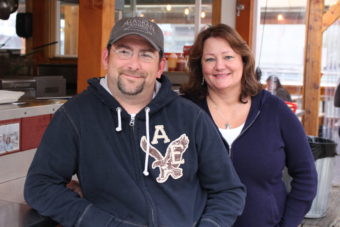
David McGivney and Tracy LaBarge sit outside their other establishment, Tracy's King Crab Shack. (Photo by Elizabeth Jenkins/KTOO)
David McGivney and Tracy LaBarge sit outside their establishment Tracy’s King Crab Shack. (Photo by Elizabeth Jenkins/KTOO)

One of  Juneau’s restaurant empires is continuing to expand, now with another downtown location, a Lemon Creek seafood processor and even a possible foray into marijuana.

When the Goldbelt Hotel was sold, the new owners didn’t want to take over the restaurant. So they approached seasoned restaurateurs Tracy LaBarge and David McGivney.

The interior of Coho’s Bar and Grill has been completely gutted, and along with the changes, a fresh identity: McGivney’s.

“It’s the name nobody can pronounce,” Tracy LaBarge says with a laugh. “It’s Dave’s last name.”

If it sounds familiar, it’s because there’s already a McGivney’s in the valley. That location will remain open and the downtown branch will boast more of what those customers love: sports memorabilia and TVs to watch the game.

“The good part for the downtown location is its bigger space,” said Dave McGivney. “One of the things we tend to hear continuously since we opened the valley location is there’s just not enough room, space-wise. So it’s actually triple the size.”

Back when Floyd Mayweather boxed Manny Pacquiao in the fight of the century, the valley McGivney’s screened the match for 50 bucks a head and sold out. With a bigger location, the pub can host more events and it might fill a gap. Major League Soccer used to be shown at Silverbow but the bakery recently sold and it’s unclear if it’ll continue with the tradition. McGivney’s, however, has plans to screen the sport.

“I played soccer for 10 years when I was younger,”McGivney said. “Our slogan is ‘Every game. Every day.’ And I try to hold true to that and if anybody ever comes in our location, McGivney’s Sports Bar and Grill, that game will be on.”

The business partners say the food will feature an embellished McGivney’s menu with staples, like poutine and short ribs.

“Shepherd’s pie is going to be there. Some of the old traditions. Burgers. Our gyros. But there will be more.” he said.

The downtown McGivney's will be triple the size. (Photo by Elizabeth Jenkins/KTOO)
The downtown McGivney’s will be triple the size of the valley location. (Photo by Elizabeth Jenkins/KTOO)

They’re tight-lipped about what else they’ll be serving. The menu is being finalized and they might have increased ingredient options.

The pair recently purchased a fish processor, Horst Seafood. Plans are in the works to supply their other restaurant, Salt, with hard-to-find items.

“We will look into more exotic seafood, like sea cucumbers, geoduck and herring roe,” he said. “Different things that our chef Lionel likes to experiment with. Plus, we have some other products we want to try.”

Between their string of restaurants, McGivney and LaBarge will employ about 160 people. They credit their success to taking calculated risks, a skill they’re interested in adapting for another growing industry in Alaska: marijuana.

“You know at the end of the day, business is business. In regards to what product you’re selling, it doesn’t really matter,” he said.

For now, that product is a sports pub.

LaBarge and McGivney acknowledge other Juneau restaurant owners are doing the same: opening multiple locations and building their own empires.

“I mean, there’s always a friendly competition, I think, but that’s never been what we’re about,” LaBarge said. “I think there’s room for everyone. I think there’s a lot in this community to offer and I’d like to see more businesses come out. Not just restaurants but other types of business because I think it brings more people out in the end.”

McGivney’s Sports Bar and Grill is expected to open in the Goldbelt Hotel sometime in November.

Juneau Assembly extends pot business moratorium

The Juneau Assembly voted Monday to extend a moratorium on permitting marijuana establishments in Juneau. There were no dissenting votes and no one from the public testified.

The ordinance extends the moratorium to Dec. 31 and gives the city more time to adopt new land use regulations following last fall’s successful ballot measure to legalize marijuana.

When Pets Do Pot: A High That’s Not So Mighty

Hard to resist. But if they're marijuana edibles, not such a treat. James A. Guilliam/Getty Images
Hard to resist. But if they’re marijuana edibles, not such a treat.
James A. Guilliam/Getty Images

“What’s wrong with you, buddy? What’s wrong?” a man says to his dog in a video uploaded to YouTube last month. The pup moans pitifully and trips over himself. He’s having trouble blinking. He gazes into nothingness; his eyes are a deep, black abyss. He’s wobbling on his paws. The man’s words dissolve into laughter. He knows the dog is high as a kite after thieving a potent marijuana brownie.

It’s a sad state that’s becoming increasingly common.

The Pet Poison Helpline, a 24-hour pet poison control center, has seen a fourfold increase in calls concerning pets experiencing marijuana intoxication over the past three years. The most dramatic rise has been over the past 12 months.

“Over the past year alone, we’ve had double the marijuana exposures,” says Dr. Ahna Brutlag, senior veterinary toxicologist at the Pet Poison Helpline.

The American Society for the Prevention of Cruelty to Animals has seen a similar increase. In 2014, the ASPCA’s poison control centers received calls on about 539 cases of animals accidentally consuming cannabis, up from 320 in 2013.

“What’s worrying to us is the severity of cases now,” says Dr. Heidi Houchen, a veterinarian at Northwest Veterinary Specialists in Clackamas, Ore. “We still see the classic case: red eyes, wobbly, urinating on themselves, a little twitchy … but they can progress through the sedate, leaning, urine-dribbling stage to becoming completely comatose or absolutely rigid. They’ve come in and had seizures. They can come in a panic, really sensitive to noise and touch. They can pass away.”

Part of the problem is that pets are sneaking away edible cannabis products. “If a brownie is sitting on the coffee table, that dog is going to eat it whether it has marijuana or not. I think the enticement and the opportunity for a pet is greater [with edibles],” Brutlag says.

That poses a special danger for gluttonous pets. “It’s not just going to eat one brownie; it’ll eat the whole pan,” Brutlag says. “The dose of what a dog would ingest relative to a human would be much greater.”

Dogs and cats might also be more susceptible to marijuana intoxication than humans. “Every species metabolizes drugs differently,” says Dr. Stacy Meola, an emergency veterinarian at Wheat Ridge Animal Hospital in Wheat Ridge, Colo.

In 2012, she reported on the deaths of two dogs from marijuana intoxication, in a study that tracked increased numbers of dog intoxications in Colorado. Still, she says, serious complications and deaths are rare. The dose it takes to kill an animal like a dog or cat far outstrips the dose it takes to begin acting stoned. “The two we saw die had other confounding factors, like eating chocolate as well,” says Meola. (Chocolate, especially dark chocolate, is toxic to dogs.)

And problems with marijuana are still far less common than toxicity from things like over-the-counter medications, insecticides and rat poison, pet poison control centers say. All of those can kill animals far more easily than pot.

It’s possible that emergency animal care centers and poison hotlines are getting more cases simply because more states have decriminalized marijuana possession. “The stigma is being dissolved, people are just more forthcoming that their pet is getting into marijuana,” Brutlag says. And she thinks it’s also the case that as more states legalize medical and recreational marijuana, the drug is becoming more ubiquitous in people’s homes.

That raises the risk for poisonings, Houchen says, no matter what form the plant is in. Pets will munch on edibles or graze on stashes of dried buds without prejudice. “I’ve heard of animals getting into growing operations and eating so much that they’re defecating undigested plant material,” says Houchen.

That kind of unchecked ingestion of marijuana can potentially be very dangerous. “Once you bring marijuana into the house and it’s available, it should be kept up and away from the pets just as the kids,” Houchen says. “If you want to use it, you have a medical license or whatever reason, great, but now do due diligence.”

Angus Rohan Chen is a reporter and radio producer living in New York City. He has a dry wit and no hobbies. Please be his friend on Twitter @angRchen.

Copyright 2015 NPR. To see more, visit http://www.npr.org/.
Read Original Article – Published SEPTEMBER 04, 201510:02 AM ET

Should Juneau set a hard limit on how many pot shops can operate?

Carole Triem explains a slide about the supply and demand for marijuana retail stores. Triem, who's educated in economics and public policy, wrote a white paper on the topic. (Photo by Jeremy Hsieh/KTOO)
Carole Triem explains a slide about the supply and demand for marijuana retail stores. Triem, who’s educated in economics and public policy, wrote a white paper on the topic. (Photo by Jeremy Hsieh/KTOO)


Should there be a hard limit on how many retail pot shops can operate in Juneau?

A panel developing Juneau policies governing marijuana businesses wrestled with that question on Thursday.
The city planning department and most of the Juneau Marijuana Committee members said no, don’t set a limit. Let the state’s soon-to-be-written regulations, local zoning restrictions and the free market sort out the number.

(Photo by Jeremy Hsieh/KTOO)
Debbie White

“I think government spends enough time telling business how to be business,” said committee member and Juneau Assemblywoman Debbie White. “And with the licensing fees, the initial investment, the zoning, we’ve built enough road blocks.”

One of the latest road blocks the Alaska Marijuana Control Board is proposing is a 500 foot buffer around schools, recreation and youth centers.

White’s sentiment was echoed by Assemblywoman Maria Gladziszewski, and planning commissioners Mike Satre and Dennis Watson.

(Photo by Jeremy Hsieh/KTOO)
Mike Satre

“I think trying to put a further cap on that, not letting the free market work may kill this altogether,” Satre said.

“You’re kind of creating an inadvertent monopoly,” Watson said. “I’m just not comfortable with capping private enterprise. I think it’s a mistake.”

Assemblyman Jesse Kiehl chairs the committee. He was an outspoken supporter of the campaign to legalize marijuana in Alaska, but was in the minority on the retail shop limit question.

“The one thing you can never do is put the genie back in the bottle,” Kiehl said. “If we were to undershoot on a number of licenses and find that demand was not met, that the black market was alive and well, it would be entirely within our power to increase the number of licenses available.

(Photo by Jeremy Hsieh/KTOO)
Jesse Kiehl (Photo by Jeremy Hsieh/KTOO)

“But … once you got somebody with a business running, and they have a premises, and employees and stock on the shelves, extinguishing their license to operate is not just a tough thing to do, it’s kind of a rotten thing to do, to somebody who’s invested blood, sweat and tears — not to mention cash — into it. So I am very reluctant for us to take an unlimited approach to this new industry.”

Kiehl said it’s reasonable to follow the rhetoric of the legalization campaign: regulate pot like alcohol, which means limiting the number of marijuana stores according to population.

Carole Triem, a local who’s educated in economics and public policy, wrote a report for the committee at Kiehl’s request attempting to rationalize a number. Triem crunched data from the census, drug use surveys and commercial marijuana regulators in Colorado and Washington state.

She came up with an estimate for the minimum number retail stores needed to serve Juneau’s marijuana users. By her math, Juneau needs a minimum of six to satisfy legal demand. If there’s fewer than that, the economics push pot sales back to the black market, where tax revenue is lost and pot becomes more accessible to minors.


The marijuana committee didn’t settle whether to limit the number of stores. Several members said they wanted more information or to wait and see more complete regulations from the state marijuana board.

“It will put the City and Borough of Juneau and I think members of the public interested in starting marijuana businesses in a rough spot if we delay all our decisions until we know what the state’s going to do,” Kiehl said. “That said, doesn’t do us a lot of good to make decisions and have them taken away from us, so anyone who would like to cut that Gordian Knot, please bring your knife.”

The state marijuana board has been meeting and writing draft regulations arduously to hit a Nov. 24 deadline. The Assembly’s moratorium on accepting land use applications for commercial marijuana activity expires Oct. 19, which the committee recommended extending.

Correction: An earlier version of this story misspelled Maria Gladziszewski’s last name.

Marijuana regulators run low on time and money

Marijuana plant. (Photo courtesy Pixabay)

The group setting up Alaska’s rules for commercial marijuana is on pace to finish regulations by a Nov. 24 deadline, but just barely.

The Marijuana Control Board is running out of time and money as it builds the framework for legal sales.

The board’s five members spent two full days discussing line after line of new marijuana rules with state regulators, lawyers and members of the public. It is not glamorous work developing what could be described as the nitty-gritty particulars of industry regulation. The second day – all eight hours – was dedicated to just one topic area.

“And that was basically licensing and fees,” said Bruce Schulte, chair of the Marijuana Control Board, and one of the two appointees representing industry concerns. “It’s all the process and parameters around the licensing and renewals.”

Schulte concedes that the Board’s schedule of holding public meetings that share chunks of new draft rules, then switching over to redrafting with public input is not particularly straightforward, though so far it has been expedient.

“It’s very confusing,” Schulte said, “I have to make notes myself.”

And it’s not just complex, it’s time-consuming. The board got through just one of the three topics it was scheduled to address Tuesday. To make up for that, they agreed to convene again before their planned September meeting. In spite of it, the Board has not fallen behind.

“We just had so much public comment to get through on all three of these articles, it was probably optimistic to think we would finish them all,” Schulte said. “But it’s not a problem: we’re still on track.”

Meetings, however, cost money, and that is creating some unexpected issues.

The Board is supposed to reflect statewide interests, and as such its members reside statewide: from Bethel to Juneau to Fairbanks. While teleconferencing is an option, Board members say it does not work well: it’s slow, they miss out on important facial cues, and one of them can only call in–video isn’t available for him. But the amount of money set aside by Legislators is firmly set.

“The budget covered the cost for five meetings in a fiscal year,” said Cynthia Franklin, Director of the Alcoholic Beverages Control Board, which oversees its marijuana counterpart. “This is requiring extra meetings. We did not build that into the budget.”

The newly added meeting will be at the end of August. Schulte thought it was so important he even offered to pick up the extra expenses himself, using air miles. Ultimately, it is likely to be digital.

The state’s latest round of draft regulations is open for public comment on the DCCED website.


Juneau’s Loren Jones appointed to state marijuana board

Loren Jones is on the Juneau Assembly.
Loren Jones

Gov. Bill Walker has appointed Juneau Assemblyman Loren Jones to the state’s new Marijuana Control Board.

The body is tasked with developing regulations covering aspects of marijuana cultivation, processing and commercial sale. Board members represent the public health and public safety sectors, the marijuana industry and rural Alaska.

A press release says Jones was appointed to the public health seat for his long history in the substance abuse and mental health fields. He has also served as the director of the Alaska Division of Alcoholism and Drug Abuse, which is now part of the Division of Behavioral Health.

The rest of the five-person board is made up of men from Anchorage, Fairbanks, Bethel and Soldotna:

  • Peter Mlynarik of Soldotna fills the public safety seat. Mlynarik has been the chief of police in Soldotna since 2012 and spent over 20 years with the Alaska State Troopers.
  • Mark Springer from Bethel was appointed to the rural seat. He’s a Bethel City Council member and is active with the Alaska Municipal League.
  • Bruce Schulte from Anchorage fills one of the industry seats. Schulte has been a spokesman for both the Campaign to Regulate Marijuana Like Alcohol and the Coalition for Responsible Cannabis Legislation.
  • Walker appointed Brandon Emmett from Fairbanks to the other seat representing the marijuana industry. He’s the executive director for the Coalition for Responsible Cannabis Legislation and is actively involved with a Fairbanks borough marijuana work group.
Site notifications
Update notification options
Subscribe to notifications