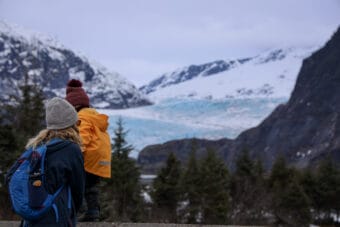
Visitors brave the rain as they head back to their cruise ships in Juneau on Monday, Sept. 30, 2024. (Clarise Larson/KTOO)
A storm moving through Southeast Alaska is causing high winds and waves for the outer coast and inner channels Monday and will continue into Tuesday. That’s causing at least one cruise line to cancel some port calls in the region.
Meteorologist Nathan Compton with the National Weather Service Office in Juneau says waves of 5 to 6 feet were expected in inner channels like Icy Strait and Stevens Passage near Juneau as wind speeds increased Monday.
“We’re currently already seeing storm force winds with occasional dust up to hurricane force in particular, Cape Decision has seen gusts up to 67 knots, which is very, very high,” Compton said.
Cruise Line Agencies of Alaska confirmed that Holland America Line decided to keep its Eurodam and Koningsdam cruise ships ported in Juneau overnight and into Tuesday evening. Both ships have capacities of more than 2,000 passengers.
The Norwegian Bliss also arrived in port Monday. As of the afternoon, it was still scheduled to leave later in the evening.
High Wind Warnings are in effect for the southern panhandle and Baranof Island.
Compton says rain will be heavy at times Monday night into Tuesday, but it’s not expected to cause major hazards.
“It’s not the typical atmospheric river that would cause any sort of flooding concerns,” he said.
Wind and rain will continue Tuesday before decreasing Wednesday.
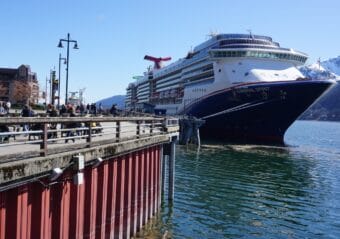
The Majestic Princess berths in Juneau’s harbor on July 24, 2024. (Clarise Larson/KTOO)
Imagine one day a week in the summertime when there are no large cruise ships floating in the harbor, no tourists bustling down the docks and no buses driving people to the Mendenhall Glacier.
If Proposition 2 is passed by Juneau voters this fall, that could become a reality.
The proposition, known as Ship Free Saturdays, asks voters whether to ban all cruise ships that carry 250 or more passengers from visiting on Saturdays and on the Fourth of July as soon as next summer. Throughout the spring, supporters gathered over 2,300 signatures to get it on the ballot.
Advocates for the proposition say enough is enough and the reins need to be pulled on the growth of tourism, but opponents say the financial and legal implications could hurt the local economy.
Who’s for it, and who’s against it?
Karla Hart is a longtime activist against tourism growth in Juneau. She was at the forefront of getting the proposition on the ballot.
“Ship-Free Saturdays would give us a relief,” she said during a recent forum. “Every week we will have one day of a pause. We can breathe, we can do things in our homes without helicopter noise. We can go out in the community and not be diluted by all the people who are here who aren’t from here.”
Karla Hart speaks to a crowd at a forum in support of the Ship-Free Saturday ballot proposition downtown on Wednesday, Sept. 4, 2024. (Clarise Larson/KTOO)
According to data provided by the city, Juneau’s cruise passenger volume has more than tripled in the last three decades.
At the forum, Hart and other residents like Steve Krall said the growth of tourism has drowned them out. Krall said they simply want one day a week during the summer to get a break from it.
“What would we do if we had Saturdays? We’d actually live our lives like we used to, like we hoped to,” he said. “I used to be able to launch a kayak from downtown. I’ve got a sailboat, I could sail it in the harbor. I could actually maybe walk downtown and not wonder if I was going to get hit by a car.”
Hart said the Ship Free Saturdays campaign is a grassroots effort made up of everyday residents. According to campaign finance records, the group has only raised $380.
On the other side, hundreds of thousands of dollars have poured in from cruise ship company affiliates and businesses that want to stop the proposition in its tracks. Campaign records show that the group advocating against the proposition, Protect Juneau’s Future, has raised more than $300,000. That money has gone toward banners across town, social media ads and mailers. Big donors for the opposition campaign include a Norwegian Cruise Line affiliate and Westmark Hotels, which have each given $75,000 to the cause.
It’s not just big companies that are against the proposition — many local businesses are too. Wings Airways & Taku Glacier Lodge, a local tourism business, has donated $10,000. Holly Johnson is its chief marketing officer.
“This is not about Saturdays. It will never be good enough,” Johnson said at a panel hosted in August. “All days of the week would never be good enough for the people that are really pushing this. But they tacked on to something that was really emotional.”
Johnson and other members of Protect Juneau’s Future said during the panel that their businesses rely on tourism, and even taking away one day of the week would be a major financial blow.
A panel of members of the Protect Juneau’s Future advocacy group speak to the Greater Juneau Chamber of Commerce on Thursday, Aug. 29, 2024. (Clarise Larson/KTOO)
According to data shared by the city, cruise visitors to Juneau in 2023 directly spent $30 million on Saturdays alone. They also produced $3.7 million in revenue for the city on those days.
McHugh Pierre is the president and CEO of Goldbelt, Inc., a local Alaska Native corporation. The company owns the popular Goldbelt Tram tourist attraction downtown and has invested millions into a gondola project at Eaglecrest Ski Area.
“I don’t want to be told when to do things and when not to do things, because when does it stop and start? Is it just visitors on Saturdays? Is it truck drivers on Tuesdays? Is it cultural storytellers on Wednesdays?” Pierre said during the August panel. “I don’t like any of it. It’s bad, and we just need to vote against it.”
What happens if it passes?
Some companies are already putting legal pressure on the city too, according to Juneau Municipal Attorney Emily Wright.
“If this moves forward we likely would get sued,” she said in an interview.
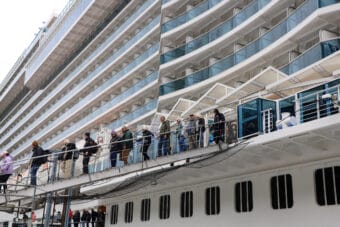
A cruise ship arrives in Juneau in July 2024. (Clarise Larson/KTOO)
Since April, the city has received three letters threatening lawsuits if voters pass the proposition.
In a letter sent to the city attorney’s office in June, Royal Caribbean Cruises called the proposition unlawful under state and federal law. Allen Marine Tours said it violated federal maritime law and citizens’ constitutional right to travel. And, a law firm that represents the privately owned A.J. Dock also voiced legal concerns.
“We could have multiple lawsuits that come in that get joined together because it’s the same issue. We could have the dock owners. We could have businesses who are having their businesses impacted. We’ve got the two private docks, and then we’ve got the cruise lines themselves,” Wright said.
If voters pass the proposition, it becomes law. That means it’s the city’s responsibility to defend against lawsuits — using taxpayer dollars.
This wouldn’t be the first time the city has been sued over conflicts with cruise lines. The industry previously sued Juneau over how it spends the money earned from passenger fees.
That three-year legal fight was settled in 2019. Juneau agreed to pay Cruise Lines International Association Alaska $1.5 million to cover legal fees, and both parties agreed to settle future disputes outside of court.
Juneau’s law department is closely watching a legal battle over limiting cruise ships in Bar Harbor, Maine. That’s where a ballot initiative to limit cruise passengers passed in 2022. A local business group tried unsuccessfully to sue the town and is in the process of appealing the ruling.
Wright said if Ship Free Saturdays passes in Juneau, there could be injunctions filed over the proposition.
“An injunction means to stop something. So we would say, ‘Okay, guys, you’re not allowed here on Saturdays’ and the cruise ships would ask the court to stop us from enforcing that until the court makes a final decision about whether this is legal or not,” she said.
The business group in Bar Harbor tried to do that but failed. Wright said it’s hard to know how things will play out in Juneau if it comes to that.
Voters have until Tuesday, Oct. 1 to make their choice. The final results of the by-mail election won’t be certified until Oct. 15.
The road entrance to Kenai Fjords National Park is marked by a sign, seen on Aug. 27, 2022. The National Park Service has released its annual report on the economic impact of park visitation. Alaska is among the states that reaps the most economic benefit from visitors to its national parks, according to the report. (Photo by Yereth Rosen/Alaska Beacon)
Tourism to national parks in Alaska has rebounded from pre-pandemic levels after three years of lower numbers, according to a report released by the National Park Service.
In all, 3.3 million visitors came to Alaska’s national park sites in 2023, and they spent about $1.5 billion in the local regions, according to the Park Service’s annual visitor spending effects report.
There were 21,300 park-related jobs in Alaska generating $839 million in labor income in 2023, the report said. Alaska’s national park units generated $2.3 billion in economic value to the state, the report said.
The statistics were compiled by the National Park Service, with assistance from the U.S. Geological Survey.
The totals for job numbers, labor income and economic output to the Alaska economy were higher than in 2019, the year prior to the outbreak of the COVID-19 pandemic, according to the report. Total visitor spending in 2023 was about equal to that in 2019, according to the report.
“Solitude, wilderness and deep human connection await in Alaska’s national parks, and I’m proud to see how the parks are benefitting surrounding communities,” Sarah Creachbaum, Alaska regional director for the National Park Service, said in a statement.
Alaska has 23 national park units and is one of the states that reaps the most economic value from its national parks, preserves, monuments and historic sites, according to the report. Alaska ranks fourth among all U.S. states in national park-related visitor spending, jobs, labor income and economic output, according to the report.
The COVID-19 pandemic hit Alaska park visitation particularly hard, however.
Analysis by the Alaska Department of Labor and Workforce Development’s research division found that visitation to Alaska’s eight main national parks fell by 86% from 2019 to 2020, compared to a national decline of 28% for total park visits.
Denali National Park and Preserve, for example, got only 54,850 visits in 2020, less than a tenth of what was recorded in each of the five preceding years, according to the park. Denali is one of the state’s top tourist destinations.
In 2023, visitor totals at Denali were back up to nearly 500,000, according to the Park Service. That was despite a new impediment to travel: the closure at the midpoint of the only road through the park. The 92-mile road has been closed at its midpoint since late summer of 2021 because of an ongoing landslide triggered by thaw. That section of road is expected to remain closed until 2026 as crews build a new bridge at the site.
A different hazard has limited visitation at another popular Alaska national park unit. Severe flooding from storms in the fall of 2022 destroyed bridges and wreaked other damage on the Alaska portion of the 33-mile Chilkoot Trail, part of the Klondike Gold Rush National Historical Park.
The Alaska side of that historic trail has been closed beyond the first four miles, though the Canadian portion of the trail, which lies north of the Chilkoot Pass, remains open.
Indications are that this year’s visitation numbers will be high as well, despite the hindrances at Denali and Klondike Gold Rush. A large percentage of visitors to national parks in Alaska arrive by cruise ship, and cruise passenger numbers this year were expected to break the record set in 2023, according to industry reports.
Summer tourists in Sitka, seen in the documentary “Cruise Boom.” (Courtesy ArtChange, Inc.)
Sitka-based filmmaker Ellen Frankenstein’s latest documentary, “Cruise Boom,” premieres nationwide Saturday on PBS.
The national debut culminates years of work on the part of Frankenstein and her co-director Atman Mehta, who explored both the potential benefits and downsides of cruise tourism’s explosive growth in Sitka.
Frankenstein and Mehta began filming “Cruise Boom” in 2021, as Sitka transitioned from the 2020 pandemic summer of zero cruise passengers. The Southeast Alaska town began a startling rebound to nearly 600,000 passengers in 2023 – roughly three times more than a typical summer prior to the pandemic.
“Cruise Boom,” however, is not a scathing indictment of the industry. Frankenstein wants the audience to think broadly about what’s unfolding, as communities react to the surging numbers.
“It is a really complex issue we try to cover in a very impressionistic film, because tourism, as we know, is super complex,” Frankenstein said. “Everybody loves to travel. We all love experiencing new places. The economic side is so amazing, because we have new food trucks in town, new businesses and all these good things. But globally, you can’t miss it in the news that over-tourism, or the saturation of tourism, is affecting places. And there’s pushback from Barcelona to Bali, there’s an upcoming vote in Juneau about ship-free Saturdays. So it’s just this interesting conversation that is not just pertinent to Sitka. So when people respond to this film elsewhere, they’re seeing it kind of as a case study.”
Frankenstein and Mehta intend the film to stimulate conversation. In fact, there are several scenes in the movie that are just conversation – Sitkans discussing how to confront, and possibly manage, the rapid growth.
No one is blind to the obvious benefits, as new businesses emerge downtown, and the municipal budget swells with increased sales tax revenues. But there are hazards, too.
In an excerpt from the film, four anonymous Sitkans discuss the future of their city:
“I’m either a fifth or sixth-generation Sitkan, and in order for myself, my family, friends, to continue to be able to live here, there has to be an economic means for us to work and make money.”
“I don’t want us to be a destination. I value our community, because we’re a community. You know, the pulp mill sustained the community for years, but had excesses in how much it logged and how fast it logged in the environment. Cruise ships is a similar thing.”
“If we’re going to help shape tourism, we really have to be active and engaged stakeholders. That means talking to the cruise ship lines. It means asking the hard questions.”
“The story is unfolding right now. So we can’t tell the ending because it’s happening right now.”
Frankenstein and Mehta shot the film over a couple of years, so Frankenstein describes it now as history, although Sitka is far from settled into the new volume of passengers. They released rough cuts early in the process, and have shown the final film several times, most recently for a group of graduate environmental-policy students from Johns Hopkins University.
Frankenstein says the screening prompted an intense conversation about solutions.
“When there’s something like this that happened to Sitka in another place, who is responsible to help manage it and see how it all works out?” asked Frankenstein. “And we had this discussion: Is it the responsibility of the city and the government? Is it citizens? Is it tourists? Do we expect tourists to be more responsible in the way they travel?”
For Alaskans who live in tourism destinations, “Cruise Boom” is a kind of mirror. The film is set in Sitka, but the same questions are being asked in many of the state’s other coastal communities.
“We’ve also had community screenings in places like Skagway and Cordova and Homer in the state, and Juneau, and it’s been great,” Frankenstein said. “People have this discussion about their relationship to tourism and what they value in their communities?”
“Cruise Boom” will be available to stream on the PBS website or app beginning Saturday. The film will air on KTOO 360TV at 7 p.m. Sunday, then be broadcast on the PBS television network nationwide – including Alaska’s PBS stations – starting Tuesday. To learn about other ways to view the film, visit the Artchange, Inc. website.
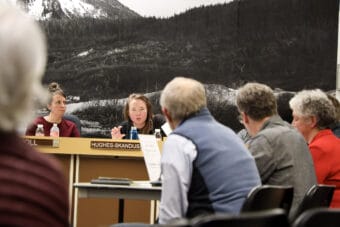
Karla Hart speaks to a crowd at a forum in support of the Ship-Free Saturdays ballot proposition downtown on Wednesday, Sept. 4, 2024. (Clarise Larson/KTOO)
Advocates for a proposition set to appear on Juneau’s local ballot this fall say they want one day a week during the summer cruise season when there are no ships in port.
And the proposition would do just that — if they can convince enough Juneau voters to pass it.
Steve Krall is a Juneau resident who attended a forum at Gold Town Theatre Wednesday evening where supporters of the proposition were invited to share why they will be voting yes.
“What would we do if we had Saturdays? We’d actually live our lives like we used to, like we hoped to,” he said. “I used to be able to launch a kayak downtown. I have a sailboat, I could sail it in the harbor. I could actually maybe walk downtown and not wonder if I’m going to get hit by a car.”
In front of a crowd of about 30 people, Krall and about a dozen other speakers shared their reasons for supporting the proposition, like overcrowding and environmental impacts.
Karla Hart was an emcee at the event. She’s a longtime activist against tourism growth in Juneau and has been at the forefront of getting the proposition, called Ship-Free Saturdays, on the ballot.
“Ship-Free Saturdays would give us a relief,” she said. “Every week we will have one day of a pause. We can breathe, we can do things in our homes without helicopter noise. We can go out in the community and not be diluted by all the people that are here that are not from here.”
If passed by voters, the proposition would ban all cruise ships that carry 250 or more passengers from visiting Juneau on Saturdays and on the Fourth of July. Throughout this spring, supporters gathered over 2,300 signatures in favor of it, enough to get it on the ballot.
The forum on Wednesday follows another forum hosted just last week where representatives of a group against the proposition shared why they think it’s bad for Juneau and the local economy.
The group, called Protect Juneau’s Future, is largely made up of local business owners who work directly with the tourism industry. In 2021, the group’s campaigning helped squash another ballot initiative effort — also led by Hart — seeking to limit cruise ships in Juneau.
McHugh Pierre is an executive member of the group and president and CEO of Goldbelt Incorporated, a local Alaska Native corporation that has invested millions in tourism.
“This effort by a few of our neighbors — a very small group — to say they don’t want people here, is very damaging to us,” he said. “So this group, Protect Juneau’s Future, is specifically making sure this ballot initiative fails and that we continue to welcome business in our community.”
And, legal pressure is mounting against the initiative — some local businesses and cruise ship companies have threatened to sue the city if voters approve it.
Ballots for Juneau’s by-mail election will be mailed to residents on Sept.12. Election Day is Oct. 1.
A panel of members of the Protect Juneau’s Future advocacy group speak to the Greater Juneau Chamber of Commerce on Thursday, Aug. 29, 2024. (Clarise Larson/KTOO)
An advocacy group is telling Juneau residents to vote no on a proposition set to appear on the local ballot this fall. It’s about whether large cruise ships should be banned on Saturdays starting next year.
The Greater Juneau Chamber of Commerce hosted a forum Thursday featuring a panel of executive members of the group Protect Juneau’s Future sharing why they believe the proposition is bad for the local economy.
McHugh Pierre is the president and CEO of Goldbelt Incorporated, a local Alaska Native corporation. The company owns popular tourist attractions like the Goldbelt Tram downtown and has invested millions into a gondola project at Eaglecrest Ski Area.
“I don’t want to be told when to do things and when not to do things, because when does it stop and start? Is it just visitors on Saturdays? Is it truck drivers on Tuesdays? Is it cultural storytellers on Wednesdays?” he said. “I don’t like any of it. It’s bad, and we just need to vote against it.”
Protect Juneau’s Future has been actively campaigning against the initiative from the get-go. They have orange signs hanging around town and ads on social media that discourage people from voting for it.
Pierre and other members of the group, like Holly Johnson with Wings Airways & Taku Glacier Lodge, said their businesses relyon tourism.
Johnson said even just taking away one day out of the week would be a major financial blow for her. And, it could get the city into hot water legally.
“This is not about Saturdays. It will never be good enough. All days of the week would never be good enough for the people that are really pushing this,” she said. “But they tacked on to something that was really emotional.”
Karla Hart is one of the activists who led the effort. In an interview in July, she said the number of signatures shows how much people in Juneau want to limit the growth of tourism.
“I think it says that Juneau really seriously wants some hard stops on cruise industry impacts in their lives and that they haven’t received that from the city Assembly. And that they don’t think that those hard stops are coming unless citizens take action,” Hart said.
Local election ballots will be mailed to residents on Sept. 12. The last day to vote in Juneau’s by-mail election is Oct. 1.
Close
Update notification options
Subscribe to notifications
Subscribe
Get notifications about news related to the topics you care about. You can unsubscribe anytime.