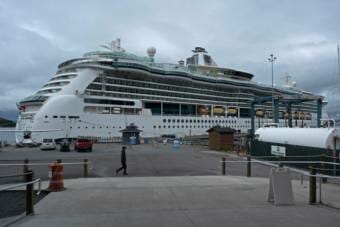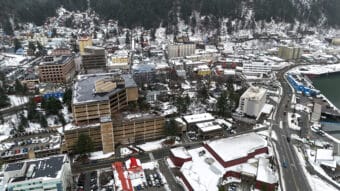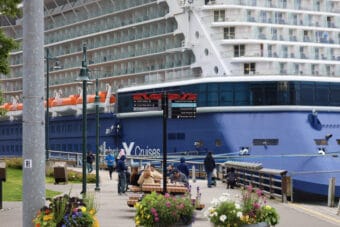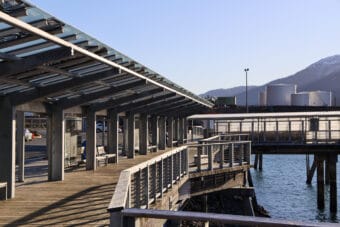
Cruise ship tourists walk the docks in downtown Juneau in July, 2024. (Clarise Larson/KTOO)
Downtown Juneau during the summer cruise ship season is busy. And it’s not just the streets and sidewalks that get congested — so does the internet connection.
A new partnership between a cruise ship company and a local Alaska Native corporation aims to change that. On Thursday, the Royal Caribbean Group and Goldbelt Incorporated announced its launch of a pilot program to improve internet in the downtown area during the cruise season.
In total, they plan to install 10 Starlink receivers at local businesses across downtown. According to McHugh Pierre, Goldbelt’s president and CEO, the first receiver is already live.
“As a person who lives in the downtown Douglas area, my internet was slow, and I know a lot of businesses and residents who had the same situation,” he said. “So, trying to figure out a way to add new capacity to the community was critical.”
The connection is free and open to the public, meaning locals and tourists can use it. In a statement, Preston Carnahan, an executive with the Royal Caribbean Group, said the program aimed to “enhance the travel experience for residents and cruise guests alike.”
This comes as Juneau faces a question on its local ballot this fall about the growth in cruise ship tourism. It asks voters whether large cruise ships should be banned on Saturdays starting next year.
Pierre is on the executive committee of a group called Protect Juneau’s Future, which is actively advocating against the initiative.
“We have a collaborative tourism environment because everybody can work together,” he said. “This is just another example of how tourism works to support our community and how businesses lean forward to make Juneau the best place to live, work and play.”
The City and Borough of Juneau isn’t directly involved in the pilot program, according to Alix Pierce, the city’s visitor industry director. But it has tried to tackle the seasonal problems with internet connectivity. In 2018, it added Wi-Fi to Marine Park, which lasts from 7 a.m. to 9 p.m. during the tourist season. Fees paid by cruise ship passengers help pay for it, and it’s provided by local company SnowCloud Services.
Pierce said the city will continue to look for ways to ease the connectivity connection in future seasons.
Pierre with Goldbelt said more receivers are being installed in the coming weeks. The pilot program will last at least through this season and the 2025 season.
A cruise ship departs Juneau in July, 2023. (Clarise Larson/KTOO)
In June, an inspector with the Alaska Department of Environmental Conservation was on board a cruise ship at port in Ketchikan when he noticed something strange on the starboard side of the vessel — a cloudy discharge that left a shimmery film on the surface of the water.
The inspector’s report called it an “apparent pollution incident” from the ship’s exhaust gas cleaning system, also known as the scrubber.
“We find violations very frequently on scrubbers,” said the department’s Cruise Ship Program Manager Ben Eisenstein.
Scrubbers are technology that uses water to flush out harmful chemicals, especially sulfur, from a ship’s exhaust. Eisenstein says the use of scrubbers on cruise ships has skyrocketed in recent years, because in 2020 regulators with the International Martime Organization implemented new rules requiring ships to burn cleaner low-sulfur fuel, except for vessels with an exhaust gas cleaning technology.
“When that came into effect, a lot of these vessels, instead of choosing to be compliant with that fuel, you know, were spending all this money on this technology to keep them to burn that dirty fuel,” Eisenstein said. “Because it’s kind of a newer technology, that’s how it’s kind of snuck through the cracks.”
Most cruise ships that visit Alaska today have scrubbers, and the majority are open-loop systems that mix seawater with exhaust gas, filter it, then dump the remaining wastewater overboard. The state’s rules for cruise ship wastewater discharge date back to a permit from 2013, and most pertain to gray and blackwater. They don’t include any rules about scrubbers.
Now, more than three dozen entities — including Pacific Environment, the Ocean Conservancy and the nonprofit Friends of the Earth — have called on the Biden Administration and the U.S. Environmental Protection Agency to ban the use of scrubbers at the national level.
Marcie Keever is the director of Friends of the Earth’s Oceans and Vessels program. While scrubbers may prevent harmful pollutants from escaping into the air, Keever said those chemicals just end up in the ocean instead.
“That water pulls all those dirty petroleum pollutants out of the smokestack and converts it into wastewater — into water pollution,” she said.
Though the Alaska Department of Environmental Conservation still monitors cruise ships, the independent Ocean Rangers inspection program ended in 2019. And Keever said scrubber pollution today goes largely unnoticed by the public and unchecked by regulators.
“Many of the discharges happen beyond the horizon, and so I think that’s just in general a problem with enforcing against the shipping industry and the cruise industry,” Keever said. “We just have no eyes on the behavior, and the federal agency that’s tasked with enforcing it isn’t doing it.”
The state of Alaska lost much of its authority to crack down on scrubber pollution through an act of Congress known as the Vessel Incidental Discharge Act, passed in 2018. That act also requires the EPA to update national standards for scrubber discharge. Keever said the federal agency has been slow to do so.
In an email to KTOO, an EPA spokesperson declined to comment except to say the agency is in the process of finalizing those updates.
Eisenstein said federal authorities rarely step in, despite many state reports of scrubber pollution. When cruise ship companies are punished, he said the fines are too low. For instance, the EPA found that ships with Carnival Corporation made hundreds of scrubber discharges in Alaska waters that violated Clean Water Act standards back in 2016. In the end, the company was fined a civil penalty of just $14,500.
“Which is just not enough,” Eisenstein said. “It’s not enough to change that behavior. It’s not enough to balance out the gain that they’re getting by being non compliant.”
Cruise Lines International Association Alaska, a trade group representing the cruise industry, did not respond to KTOO requests for comment.
Right now, a medium sized cruise ship can discharge between 6 and 8 million gallons of scrubber wastewater a day.
That water is acidic, and it can contain heavy metals and other toxic chemicals from fossil fuels, including carcinogens.
Research on the effects of these toxins are relatively limited, but one study found that scrubber wastewater negatively affects sea urchin reproduction at concentrations as low as 0.0001%.
Aaron Brakel is the Clean Water Campaigns Manager for the Southeast Alaska Conservation Council. He worries Alaska’s marine life can’t handle more pollution threats.
“Our oceans are at so much risk already, with ocean warming, ocean acidification,” he said. “And so really the right thing to do now is stop discharging this stuff. Stop using the dirty fuel.”
Nations like Sweden and Denmark have already banned scrubbers, and California requires vessels sailing of their coast to use cleaner-burning low sulfur marine distillate fuels. Brakel says he hopes Alaska will follow suit.
Correction: A previous version of this story misspelled Aaron Brakel’s last name.
James Houck gives a tour of downtown Juneau on his pedicab on Aug. 19, 2024. (Photo by Yvonne Krumrey/KTOO).
This is Tongass Voices, a series from KTOO sharing weekly perspectives from the homelands of the Áak’w Kwáan and beyond.
James Houck has shuttled tourists around town on his bike for seven years as the owner of Juneau Pedicab. It’s his retirement job, he says, and he loves running a tourism company that doesn’t emit carbon or use fossil fuels.
Listen:
This transcript has been lightly edited for clarity.
James Houck: My name’s James P. Houck. I’m a retired Coast Guardsman who lives in his favorite place on Earth. I run a human-powered tourism business. We call them pedicabs, and we take passengers from the docks and the hotels around town, and we bring them into Juneau and show them the best of the best. That’s pretty easy to do in such a wonderful place.
The great thing about being retired and having a pension is, while you’re busier than you’ve ever been in your life, you get to choose how you spend all those hours.
I think it’s important for them to know that we are doing our level best to accommodate the number of people who want to come and visit, and that if we are saying that we’re at capacity, we are at capacity. This is a town that does not boast. It’s a town that does not hyperbolize. And we can feel it.
And I don’t really think people have a feel for what their impact is when they pull in here, and I think the city of Juneau is doing a good job of trying to mitigate some of that. You know, we’re looking at electrifying these two docks so that the ships don’t run their generators all day long while they’re sitting here.
Well, it’s a giant game of dodgem, and we smile and we laugh and we sing and we never raise our voices at people. And so far, knock on wood, we have not impacted anyone. We haven’t run over anyone’s toes. We haven’t run into anything. And in eight years, that’s a phenomenal record.
But in large crowds, how we get through is we ring our little bell and we sing songs like “Joy to the world, all the boys and girls.” When the people hear that kind of discord, they’re like, ‘What the heck? How could a person sing that badly and be so loud?’ And they get out of the way in a hurry.
And then when I find a spot in the crowd where it looks like I can get away with it, I pull over and I show off our rain chimes. So the rain is captured in the bowl and funneled into the tube, and about every quarter inch of real rain fills the tube all the way to the top. It gets top heavy, leans down to dump its water and then rings a gong on the rebound. This one is C sharp, the longest ones are F sharp, and the shortest ones are A sharp, forming the chord F sharp major.
James Houck has owned and run Juneau Pedicab wince 2017. August 19, 2024. (Photo by Yvonne Krumrey/KTOO).
Now back in 2017, the first day I operated, it probably rained an inch and a half, and I was cruising down this dock, and one of them went off. And I’d never seen them before. No one had told me about them. I nearly jumped off my pedicab into the weeds.
I looked in the mirror and said, ‘James, you worked from the time you were 12 until you were 18, roofing houses, and then you never worked again until you were 44, because the Coast Guard treated you so well. Why would you pick a job where you had to work?’ And the next day, I put in an application with Kris McClure to run one of his pedicabs, and he called me up and he said, ‘Is this a joke?’ I said, ‘What’s funny about it?’ He says, ‘I have never heard of anyone with a master’s degree from Princeton wanting to run a pedicab.’ I said, ‘Well, I want to run a pedicab, and I will be out there every day if you give me a job.’ That’s when he told me he married a woman that didn’t like Juneau and he needed to get out. Three weeks later, I wrote him a check, and I had to figure it out from there.
I thought that I was going to be running short run taxi services, and my customers would say, ‘Hey, what’s this?’ I’d say, ‘Well, I can tell you about that, but I’d have to charge you for the time.’ They’d say, ‘Okay, do it. Tell me about it.’ So that’s how I got in the business of turning this into a tour company.
So now, instead of running from the Franklin dock as fast as I can to get to the Red Dog Saloon, I ride two or 300 feet and I stop and I tell a story. I ride another two or 300 feet and I stop and I tell a story. I still burn over 4000 calories a day, and can eat whatever the heck I want, but I figured out a way to do it without a battery, without a motor, and be able to do it — I hope — until I’m in my 60s and 70s. So we’ll see.
Haze smiles as he waits to pull a sled at the Norris Glacier dog sledding camp on Wednesday, Aug. 14, 2024. (Clarise Larson/KTOO)
Dog sledding is an iconic piece of Alaska’s history. From its roots in Alaska Native culture to the Klondike Gold Rush to the Iditarod, it has withstood the test of time.
Now, it’s taken on a new form to help it survive: excursions for Juneau’s ever-booming cruise ship tourism industry.
Taking off in a helicopter from Douglas Island, the green rainforest that engulfs downtown quickly turned to white as the cruise ships in the Gastineau Channel fell out of view.
Soon, the passengers were flying over the Juneau Icefield. Home to over a thousand glaciers, it stretches across 15,000 square miles of mountain terrain between the capital and British Columbia. Looking down from above, all you can see is the blue of glaciers weaving through the dark mountains and white patches of snow.
But, there was something else out there, too. As the helicopter moved closer, it looked like a bunch of ants in the snow. Closer still, and the ants started to look kind of fluffy.
But then, the barking came into earshot — it’s the Norris Glacier dog sledding camp.
The Norris Glacier dog sledding camp comes into view on Wednesday, Aug. 14, 2024. (Clarise Larson/KTOO)
Each year from late April through mid-August, nearly 200 dogs from all over the U.S. live on the glacier. It’s located 3,100 feet above sea level. The camp has existed for more than 20 years, and everything there is flown up and down by helicopter — including the dogs.
Josi Thyr is the camp’s manager and a professional musher. She owns 27 of the dogs at the camp. For most of the year, she’s based in Fairbanks.
“I feel like for Alaska, it’s kind of what the cowboy is for the American West,” she said. “The difference is we still are doing this.”
Last year, she finished her first-ever Iditarod, the iconic 1,000-mile trek from Anchorage to Nome. Now, her team is training for her second.
“These dogs are athletes, and so we want to keep them moving,” she said. “The shape that they’re in after coming off the glacier, I think makes a big difference in how they perform in the wintertime.”
Right now, she’s building her team and figuring out which pups have what it takes to go the distance.
A group of dogs pull a sled at the Norris Glacier dog sledding camp on Wednesday, Aug. 14, 2024. (Clarise Larson/KTOO)
Thyr’s husband, JJ Shelley, selected 10 dogs — with names like Fifa and Seabiscuit – and hooked their harnesses up to a multi-person sled. As they got lined up, some dogs were borderline screaming in anticipation, while others jumped up and down.
Riding down the trail on the back of the sled, Shelley said training in cold places like the icefield is crucial to keeping the dogs in shape during the hot summer months.
Seabiscuit smiles as he gets pet at the Norris Glacier dog sledding camp on Wednesday, Aug. 14, 2024. (Clarise Larson/KTOO)
He said it also serves as a way for mushers to maintain a steady income during the summer via the tours they give to people who visit the camp. In recent years, mushing has become increasingly expensive.
“People ask us the big question of ‘These guys are running over 100 miles a day, what are they eating?’ The answer is, my wallet. They eat maybe about $30,000 worth of food every year,” he said, laughing.
Even in April of this year, race organizers for the Iditarod said financial woes like growing inflation, loss of sponsors and declining revenue threaten the race’s future. That’s why Shelley says more and more mushers are turning to tourism.
“The mushing community in general is very reliant on tourism for I mean, that’s how we make our money,” he said. “We rely on it for dog food money and all that stuff and race entry fees and everything — this is how we make our living.”
A group of dogs pull a sled at the Norris Glacier dog sledding camp on Wednesday, Aug. 14, 2024. (Clarise Larson/KTOO)
Dog mushing tours on the icefield run between $600 to $700 per person online. But for people like Cindy Spencer, it’s worth every penny. She traveled to Alaska from Colorado to celebrate her 60th birthday.
“It was actually on my list to go to Alaska, that was on my ‘live list.’ And so I asked my girlfriends if they would be up for it, and they’re like, ‘Heck, yeah,’” she said. “We kind of chose things that we all wanted to do, and dog sledding was one of them.”
On a typical day during the heart of tourism season, about 150 people are flown up to take a tour. Jack White is the tour manager for NorthStar Helicopters, the company that flies people up to the camp.
“We rely on cruise ships for 90% of our business, so they’re a huge part of it,” he said.
A group of tourist take pictures at the Norris Glacier dog sledding camp on Wednesday, Aug. 14, 2024. (Clarise Larson/KTOO)
White said many of the people who do the trip call it an experience they’ll never forget. It’s also a way to get people out of downtown Juneau during the congested summer months.
But for the dogs, it’s just another day in the office. Their office just happens to be up in the mountains, on a giant hunk of ice.
Traffic in downtown Sitka on a busy cruise ship day in June. (Jeb Sharp/KCAW)
Sitka’s summer tourism season is in full swing with numbers expected to be close to last year’s record-breaking 585,000 cruise visitors. On a handful of days the number of visitors will exceed Sitka’s own population of about 8,000.
On a busy day in June, the scale of the phenomenon was on full display. Lincoln Street was closed, people streamed up and down the steps of St. Michael’s Cathedral, buses rumbled in and out of the parking lot at Harrigan Centennial Hall.
In front of the library, Daina Bauman of Minneapolis tied a bag of salmon onto the back of her rented e-bike in preparation for the ride back out to the Sitka Sound Cruise Terminal. She was feeling good about her family’s decision to book e-bikes online before arriving in Sitka.
“I just think it’s awesome we didn’t have to sit on the bus and wait in line,” Bauman said. “They said, ‘Go early because there’s going to be another cruise ship with some 4,000 people showing up.’ We got in and out, we’ll just zip back and we’re done.”
Bauman was traveling with her daughter Lexi and mother Rita Skurupijs.
“Thank heavens for the bike path,” Skurupijs said, as she contemplated the six-mile ride back out to the Sitka Sound Cruise Terminal in an unprotected bike lane. “But of course when the big buses pass it’s a little nervy.”
A couple blocks away Sitka resident Rachel Jones was leaving Highliner Coffee, shepherding three kids on regular bikes.
“I’m certainly not opposed to the tourism industry at all, but it definitely does impact how we structure our day when the cruise ships are in town,” Jones said.
She and her family live downtown near Crescent Harbor. When it’s quiet the kids can ride around by themselves, but on heavy cruise ship days she accompanies them. It’s a lot to navigate: scooters, pedestrians, buses, stop lights.
“The number of things your brain needs to juggle feels much more like trying to ride bikes in a city,” Jones said.
Jones sees tourism as a major economic engine, noting that she herself benefits as the owner of an Airbnb unit. She likes the fact that cruise ship visitors show up in the morning and leave in the afternoon, making Sitka feel very livable the rest of the time.
Not everyone is so optimistic. Klaudia Leccese grew up in Sitka and has fond memories of waterskiing around cruise ships and learning to drive a skiff in their wake. But what’s happening now is a different scale, with more crowds, buses, e-bikes, noise, pollution. Leccese is president of the advocacy group Small Town Soul, which wants to cap the number of cruise ship visitors at 300,000 a year. That’s about half what Sitka will experience this year.
“Everyone in the Small Town Soul group supports cruise tourism,” Leccese said. “We just feel like there needs to be a limit.”
So far the group has tried three times, unsuccessfully, to get a limit before Sitka voters. From Leccese’s house you get a sense of what she’s trying to protect. The window of her living room looks out on Sitka Sound and Mt. Edgecumbe. She treasures everything about the landscape.
Klaudia Leccese of Small Town Soul at her home on Cascade Creek Road. (Jeb Sharp/KCAW)
“The quietness, the wildness, I’ve been raised subsistence hunting and fishing and gathering so there’s something for every season,” Leccese said. “I really treasure being alone in bays and on trails.”
Leccese can feel the pressure on those quiet places these days, whether she’s stuck in traffic or out running on the Cross Trail or fishing along the coast. There are more people and vehicles and boats wherever she goes.
Out at the Sitka Sound Cruise Terminal there’s no denying the hubbub. On a busy day the facility is alive with ships, visitors, vehicles, retail, food. The enticing aroma of roast nuts greets you as you enter. Chris McGraw is the owner and general manager and the main force behind the explosion in cruise ship numbers in Sitka. After the city voted down a public deep water dock his family business built a private one.
“It’s been a work in progress since 2011,” McGraw said. “The more ships we’ve gotten, you learn to adjust, learn things you need to add, learn to expand.”
A lot of McGraw’s challenge is logistics: moving people smoothly around town.
“Wednesday we had 6,200 people here,” McGraw said. “How do you deal with 6,200 people that come in at 8 o’clock and leave at 5 o’clock and get them to do what they want for the day. How do you do that without impacting the average local who wants to drive to work and go to lunch and come home. And how do you minimize that impact?”
A visitor relaxes at the Sitka Sound Cruise Terminal. (Jeb Sharp/KCAW)
McGraw sat on Sitka’s tourism task force so he’s familiar with the problems people cite. He’s working on various fixes: dispersing visitors, a cleaner bus fleet, a berthing policy of no more than one large ship and one medium ship on any one day. But he doesn’t want strict limits on visitor numbers.
“I’m opposed to any hard caps,” McGraw said.
McGraw’s interest is obvious but he argues the economic benefits go far beyond his own business. You can see that in the startups across the street from the terminal where the Sitka Tribe of Alaska houses an economic development center. There’s office space, a commercial kitchen, a bike-and-hike business, scuba diving, e-bike rentals, jet ski rentals, a four-wheeling venture, a warehouse for merchants at the cruise ship terminal.
“This is a hustling, bustling little place,” Sitka Tribe of Alaska Economic Development Director Camille Ferguson said.
Ferguson’s assessment is that Sitka is still gearing up to handle the influx of visitors.
“There’s a lot of tired people out there,” Ferguson said. “A lot of people putting in long hours and trying to keep up. That’s kind of what I feel. And I know that I’m not the only one that feels that way. We are super busy and we look forward to the days when we can have a day off.”
Amy Ainslee, director of planning and community development for the City and Borough of Sitka, sees this moment as the transition between reacting to tourism and managing tourism.
“I think about what does Sitka look like for the next couple years, and what does tourism look in Sitka for the next five to 10 years,” Ainslee said. “Because we’re in some ways kind of at this tipping point.”
The Sitka Assembly is now working on the recommendations of its tourism task force. That includes figuring out to regulate e-bikes and what areas or activities require special permits and how permits and locations should be doled out for Sitka’s burgeoning food truck scene. Another big action item is to negotiate a memorandum of understanding with the cruise industry over visitor numbers.
“I think there’s been a lot of earnest effort to hear from the community and to try to find the balance point that works for everybody,” Ainslee said. “But I don’t think it’s ever going to feel that way because it’s a really polarized issue.”
As the search for that balance point continues, Sitkans like Rachel Jones are adjusting to the new normal.
“You know I think you just have to adapt,” Jones said. “It’s going to be happening for a while. I got to town right when the discussion about whether the town should put in a deep water dock was happening and I understand why that didn’t happen, but if you don’t do it in a way that’s got public control then you don’t have public control. I think it’s just an ongoing conversation.”
This rendering depicts Huna Totem Corp.’s proposed new downtown development project. (City and Borough of Juneau)
Plans to construct a fifth cruise ship dock in downtown Juneau crossed a major hurdle Monday night. That’s when the Juneau Assembly sided with a state ruling that the project could legally move forward, despite health and safety concerns brought forth by a local activist.
But, Assembly member Christine Woll explained that the Assembly’s vote to accept the ruling doesn’t mean the project has the Assembly’s full stamp of approval.
“Please do not interpret our decision tonight as a policy decision around the Huna Totem dock,” she said. “This decision tonight is simply about whether we are legally allowed to.”
The proposed floating steel dock would be located along the Gastineau Channel next to the U.S. Coast Guard station. The project is proposed by Huna Totem Corp, an Alaska Native village corporation.
Along with the dock, Huna Totem has also proposed underground bus and car parking at the site, retail space and a welcome center. They’ve named the project Aak’w Landing.
This rendering depicts Huna Totem Corp.’s proposed new cruise ship dock downtown. (City and Borough of Juneau)
Juneau resident Karla Hart filed the appeal challenging the Juneau planning commission’s permitting of the dock last summer. She’s a longtime activist who has been at the forefront of several recent attempts to slow down the growth of cruise ship tourism in Juneau.
“I don’t know what I expected when I originally filed it I just felt as if we didn’t have a fair public process in the very beginning and I think we need one,” she said.
The main arguments in her appeal were that building the cruise ship dock would endanger public health and safety and that it did not abide by the city’s existing plan for the downtown waterfront.
But the hearing officer with the State Office of Administrative Hearings ruled that the permitting of the proposed dock will not “materially endanger public health and safety” and that it generally conforms with the waterfront plan.
After the meeting on Monday, Hart said she won’t challenge the ruling, but she will continue to follow the project’s next steps as it goes through the Assembly.
“I think that it’s good that now we move on with the real community discussion on whether we have a dock or not,” she said.
The dock and waterfront development plan still has a long way to go before breaking ground. The Assembly needs to approve a lease of the city-owned tidelands before Huna Totem can build it.
Huna Totem’s president and CEO Russell Dick said he is excited for that process to begin.
“As far as the appeal that was filed this was the appropriate decision by the Assembly. I think the administrative law judge got it right and we’re ready to move on to the next step,” he said.
The Assembly is expected to take up that issue in the coming months.
Close
Update notification options
Subscribe to notifications
Subscribe
Get notifications about news related to the topics you care about. You can unsubscribe anytime.