Tourism

On fourth try, Sitka cruise limit ballot prop goes out for signatures

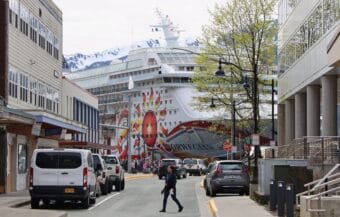
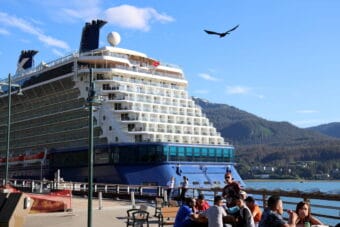
The Serenade of the Seas in Sitka on July 21, 2021, the first port call of the curtailed 2021 cruise season. (Tash Kimmell/KCAW)

After three previous failed attempts, a fourth application to put a cruise limit question before Sitka voters has passed the city’s initial legal review.

Organizers now have a few months to collect 613 signatures in support of their ballot proposition. If they get enough signatures, it could go before the voters in a special election next spring.

The advocacy group Small Town SOUL wants to limit cruise traffic in Sitka, following several years of growth in the industry that’s more than doubled the community’s pre-pandemic cruise traffic numbers.

The proposed ballot initiative would limit cruise traffic in Sitka to 4,500 cruise passengers per day, and 300,000 annually. It would establish a permitting process for cruise ships that the city would oversee, and would fine cruise ships if they dock without a permit or exceed the number of scheduled passengers. The new initiative also removes language requiring a Sitka port facility permit and considers “passengers” ashore instead of persons, meaning cruise ship crew members would not count toward the cap.

It’s the first time a cruise limit ballot question has advanced this far in the process. The last three petition applications were denied by the city’s legal department because they were deemed unenforceable, and included confusing or misleading provisions.

Anchorage law firm Jermain, Dunnagan & Owens prepared the legal opinion on the proposal. In their letter, they note that opponents have called into question a number of legal concerns around the initiative. But the bar is very high for proving a ballot initiative is unconstitutional before it has been enacted.

While they say the ordinance invites “a variety of possible constitutional challenges,” none are clear-cut enough to warrant the city’s rejection of the application at this stage in the process. The clerk can only reject an application if the law leaves “no room for argument about its unconstitutionality.” In their recommendation that the city approve the application, they write, “At this point, any legal challenges to the proposed initiative are best addressed by a court.”

Organizers now have to collect signatures amounting to one-third of the number of votes in the last regular municipal election. In a statement, Larry Edwards, one of SOUL’s organizers wrote, “Sitka’s home rule charter allows ninety days for us to get the signatures. But we aim to get them in weeks, not months, toward having the special election in early spring.”

Once they’ve collected signatures, the petition will be submitted to the city clerk’s office for a signature review. If enough signatures are collected for a special election, one must be held between 40 to 90 days later. If the ballot proposition is approved by the voters, it would go into effect in 2026.

Report: Southeast Alaska is projected to lose nearly a fifth of its population by 2050

Downtown Juneau on Wednesday, Dec. 4, 2024. (Clarise Larson/KTOO)

Millions of visitors flock to Southeast Alaska tourism hubs like Juneau, Ketchikan and Sitka every summer. But, when the cruise ship season comes to a close, it gets pretty quiet. 

Each town has a relatively small year-round population compared to the number of people who visit them. But, soon those populations are projected to get much smaller. 

According to a recent report by the Alaska Department of Labor and Workforce Development, Southeast Alaska’s overall population is projected to drop by about 17% by 2050 — or roughly 12,000 people. That’s about the populations of Sitka and Wrangell combined.

Compare that to Alaska’s overall population, which is projected to drop by 2%.

Brian Holst, the executive director of the Juneau Economic Development Council, said without more people moving to the region, Southeast Alaska can’t sustain its population. And, it could have adverse impacts on the region’s workforce and economy. 

“People are choosing to live elsewhere, we think in large part, because for all the attractiveness of Juneau, for too many families the price of a home and the cost of being here is just too much of a challenge,” he said.

The total population of Southeast Alaska is roughly 71,000, with close to half living in the capital city. Southeast Alaska relies on its year-round residents for a lot of things — like the tourism industry, fisheries and state jobs. 

According to the study, the loss in population comes from a mixture of increased outmigration and deaths outnumbering births in the region.

Because while Southeast Alaska’s population grows smaller, it’s also growing older. It’s actually older than most of the state. According to a 2024 report by the Juneau Economic Development Council, the over-60 population in Juneau outnumbers the under-20 population.

Fewer people in the region equals a smaller workforce, less young people going to schools and fewer people to care for the aging population. 

The Juneau School District has already been grappling with declining enrollment for decades. There are just simply fewer students to fill the schools than there were a few decades ago.

“When you have inadequate transportation in Southeast Alaska and inadequate school funding, you really eliminate two of the biggest incentives for young people to stay in Alaska,” said Juneau School Board member Emil Mackey.

At the start of the school year, Juneau’s high schools and middle schools consolidated. It was a decision made by the board in part to address the dwindling number of students. Mackey said if the younger population continues to decline, elementary school closures could be next. 

“No matter how many kids we have, we have the same infrastructure costs  — it costs the same to paint a building if there’s one student or 300 students in it,” he said. “I would believe, yes, future closures would have to be necessary.”

More people simply need to move here, Holst said. That’s hard to do as Juneau isn’t building housing fast enough to meet its changing demographics, and the cost of living and rent continues to rise. 

“It comes down to the cost of living,” he said. “While you can have a job, does it pay enough to be able to afford Juneau’s high cost of living, and more specifically, housing, or housing costs? Our housing costs continue to be very high. For young people in particular, it’s really hard to make ends meet here in Juneau.”

But, Holst said these are just projections and there’s still time to reverse course. The projections are based on the last several years of population trends. 

“I see the glass half full here. I think we have challenges ahead of us, but there are things that we can do to make our community a little bit more affordable,” he said. 

Holst said that includes things like building more affordable housing and supporting child care, which the City and Borough of Juneau has been prioritizing. On a positive note, according to the state’s study, Southeast Alaska’s communities’ wages rose the most in the state in 2023. 

Got an idea for a marine passenger fee project in Juneau? The city wants to hear it.

Tourists enjoy the seawalk in downtown Juneau on Wednesday, July 24, 2024. (Clarise Larson/KTOO)

Do you have a great idea for a project that would make tourism in Juneau run a little smoother or make its impact less noticeable? The City and Borough of Juneau wants to hear it.

Juneau residents and businesses can now submit proposals for how the city should spend marine passenger fees for next year. The proposal period runs through Jan. 2. 

“I think it’s important that the community feels invested in the use of these funds,” said Alix Pierce, the city’s visitor industry director. “That we’re able to not just sit in a room and come up with a budget and what the city thinks that we need, but that we’re also going out to the community and asking the community for ideas and suggestions.”

Every cruise season the city collects a $5 fee from each passenger that comes off a cruise ship and into Juneau. Those fees can go toward funding tourism projects that benefit visitors and locals. In the past, these fees have funded things like upgrades to downtown public restrooms and improvements at Marine Park. The city expects it to total around $22 million.

Because of a lawsuit the cruise industry filed against the city about how it spends the money it collects, the projects can’t just be for anything or anywhere around town

The lawsuit was settled in 2019. It puts limits on how the city can use the funds and some projects require approval by the tourism industry. 

Most of the projects chosen in the past have been downtown near the waterfront area, where the impacts of tourism are felt the most. But other parts of town can still get projects funded, like near the Mendenhall Glacier, as long as they focus on tourism.

Residents have a few ways they can submit their suggestions. This year the city opened up a new webform where people can submit proposals. Pierce said it gives people a better idea about what projects fit the criteria. 

“Hopefully that just educates people, provides them with a little bit more context around the fees,” she said. “I think the more that people understand the money and how it can be spent, the better proposals will get.”

People can also submit proposals on the city’s marine passenger fee webpage or by emailing Pierce directly at alexandra.pierce@juneau.gov.


City to negotiate land swap to extend Juneau’s waterfront seawalk farther south

The downtown seawalk on Thursday, Nov. 21, 2024. (Clarise Larson/KTOO)

A plan to extend Juneau’s downtown waterfront walking path, also known as the seawalk, crossed a major hurdle earlier this week.

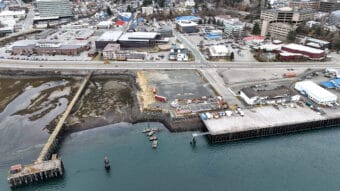
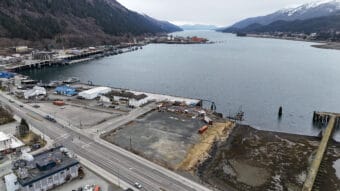
The city has long planned to develop a continuous, mile-and-a-half-long path from the Douglas Bridge to the AJ Dock. That’s the cruise ship dock farthest from downtown. The city has developed the seawalk in sections over the years, and this new section will extend a quarter mile south towards Thane. 

Alix Pierce, the city’s visitor industry director, presented on the project in May. She said it will make Juneau more welcoming — and accessible – for tourists. 

“We would need to get further along in the design process to have a more accurate estimate, but we can assume it’s a $20 to $25 million project,” she said. 

But, the project can’t move forward unless the city can negotiate a land swap deal with the private owners of the Franklin Dock — where the seawalk currently ends.

The city would essentially swap a small piece of city-owned land near the Franklin Dock, called the National Guard Dock, in exchange for a land easement and a tidelands lease. On Monday, the Juneau Assembly voted to let the city manager start those negotiations. 

Right now, the AJ dock is isolated from the rest of the ships. Tourists coming off ships there have to shuttle into town or walk roughly 10 minutes through an industrial area to get there. The extension will allow them to walk directly to Juneau along the waterfront. But a lot of residents use the seawalk too — whether that’s walking their dogs or simply sitting on a bench to look out at the channel.  

Karla Hart, a longtime activist against the growth of tourism in Juneau, said those locals should have more say in how this project moves forward. She spoke about it at the meeting on Monday.

“There’s no public urgency, and delaying this will not impair existing use and scale of the cruise industry. Rushing it will have unknown consequences,” she said.

She asked the Assembly to table the negotiations to gather more input. 

The city already has close to $6 million set aside for the project from marine passenger fees. The Assembly will need to determine how to pay for the rest, but passenger fees will likely pay for most of it.

The Assembly will still need to give the final stamp of approval on the negotiated land swap before anything can move forward. The city will also have to work out a deal for a land easement with Petro Marine, another landowner in the area, and go through a permitting process. 

Seward, an Alaska tourism hotspot, gets grant for shore-based system to power docked cruise ships

A docked cruise ship, the Regent Seven Seas Explorer, is seen in Seward’s harbor on June 19 from the Race Point on Mount Marathon. The Port of Seward received a Clean Ports Program grant from the Environmental Protection Agency for a shore-based system to power cruise ships when they are docked in town. (Photo by Yereth Rosen/Alaska Beacon)

The Port of Seward, which serves a coastal Kenai Peninsula town that is a tourism hotspot in the summer, has received a $45.7 million grant to develop a system to cut air pollution from visiting cruise ships.

The grant, from the Environmental Protection Agency’s Clean Ports Program, is for shore-based power and battery storage systems to be used by the cruise ships that sail in and out of Seward. Those systems will allow cruise ships to switch to electric power from the emissions-spewing diesel fuel they burn while making port calls.

The systems are planned as part of a redeveloped cruise facility expected to be operating in 2026. The new facility is designed to have a floating pier to replace the current fixed dock, accommodating more and bigger ships.

The port project is led by The Seward Company, a public-private developer with the Alaska Railroad, Royal Caribbean Group and Turnagain Marine as partners.

The EPA Clean Ports grant will help Seward meet its environmental goals, the city’s mayor said in a statement.

“The Port of Seward’s shore power project will place Seward among the forefront of sustainable ports in North America. By reducing reliance on diesel generators, we are not only cutting emissions but also enhancing the resilience of our local electric grid,” Mayor Sue McClure said in the statement.

Seward is the smallest community among those with ports that received the 55 EPA Clean Ports Program grants announced last week.

Most of the grant-receiving ports are in major population centers. The three biggest grants went to the Port of Los Angeles, the Port of Virginia in Norfolk and the Port of New York and New Jersey. The Port of Alaska in Anchorage, the state’s largest city, was another grant recipient, getting $1.9 million for an emissions inventory and clean-energy transition study.

Seward, in contrast, has only about 2,500 full-time residents within city limits and a roughly similar number in areas just outside of the city boundaries, said Kat Sorensen, the city manager.

But in summer, Seward’s numbers swell. Seasonal workers bring the population to about 7,500 to 10,000, Sorensen said, and tourists add several thousands more each day, she said.

Cruise travel has grown in Seward, just as it has grown in the state in general, Sorensen said.

Alaska’s cruise business has hit all-time highs, bouncing back from the halt caused by the COVID-19 pandemic. In 2023, a record 1.65 million cruise passengers visited the state, and this year’s totals could wind up being even higher, according to industry reports.

While most cruise passengers’ travel in Alaska is in Southeast Alaska, Seward — in the state’s Southcentral region — got about 190,000 cruise passengers last year, according to industry experts. Between April and October of this year, there were 104 scheduled cruise ship stops in Seward, according to the Cruise Lines International Association.

Sorensen said the cruise companies need to keep their ships powered when making port calls in Seward.

“A fishing boat can come in for a week and just shut off. But the cruise ships can’t,” she said.

Along with building onshore power and battery storage systems, the plan includes a workforce-development program focused on the Seward-based Alaska Vocational Technical Center, she said.

“I think it’s just a win-win-win,” she said.

Alaska’s capital city, Juneau, was the first to develop a shore-based power system for cruise ships. While Seward is on track to be the second Alaska cruise destination to develop such a system, shore-based power is now available for cruise ships in several major ports along the U.S. West Coast and around the world.

First all-female crew operates White Pass train

Lindsay Breen, White Pass & Yukon Route Railway’s first female engineer, gives a tour of her train cab on Oct 15, 2024. (Munson/KHNS)

The White Pass & Yukon Route Railway has operated out of Skagway for over 124 years. It regularly travels between Skagway and the Yukon, a scenic trip that is one of Skagway’s top attractions.

But one day in mid-October was special. That day an all-female crew drove a train full of tourists up the mountain, creating history.

On Oct. 15, approximately 600 chilly sightseers climbed aboard the White Pass train for a brief international ride through the Yukon.

Both the brakeman and the conductor who helped them aboard were female. Also on duty was Lindsay Breen, White Pass’ first woman engineer.

“I was the second female brakeman, second female conductor,” Breen said before departing from Skagway’s Ore Dock. “I was the only one who stayed long enough to get trained as an engineer.”

Breen has worked for White Pass for 12 years. She fell into her profession almost accidentally.

“I am one of those people that came up for one summer, way back in 2001,” she said.  “And here I am, 23 years later, married, kid, all the things. I just fell in love with Skagway and this community. Never thought that this is where I would end up. It wasn’t like a dream of mine – I didn’t play with train cars as a little kid or anything like that.”

Breen started as a train agent, then a dock representative, then she transferred to coach cleaning. Eventually she worked her way up to brakeman, conductor, then engineer.

A White Pass train is run by three crew members. The engineer operates the train. The conductor is in charge of the entire train, helps load and unload passengers and decides when to leave. A brakeman is the assistant to the conductor.

Breen described trains as “big, loud and obnoxious.” She said that blowing the piercing train whistle isn’t just for fun.

“I really sometimes don’t enjoy doing it, especially when you’re yard crew at 5 a.m. and bringing trains down and everyone’s still in bed,” she said. “But they’re actually part of our rules book. And so it is a federal requirement of what your whistle means. So, when we’re going across crossings, that’s when you hear what we call long and short. So, long, long, short. Long is coming through a crossing. Two shorts is you’re going ahead. Three is backing up.”

Breen’s days can sometimes be very long – 12-hour shifts with three trips up the mountain. But she said she loves it.

“I didn’t realize how much I would actually like the engineering job,” Breen said. “It’s a really cool job to have. And I just strive to make it as good as I can every day. Every run.”

Breen is incredibly proud of the two women on her team, and all the women she works with.

“It felt, can I say bad ass? That’s kind of how it felt,” she said. “It was really neat that it was finally happening. It took long enough.”

Eliza Myers was the conductor. In her early 20s, she already knows that she wants to be an engineer after an experience that happened in 2022.

“One of the trainmen, who’s actually a friend now, had me come up into the cab of the locomotive,” she said. “I sat in the seat, and I was like, ‘whoa. This is really cool.’ And they took a photo of me. And I was looking back at that photo the other day, because one day I will become an engineer. And I think that just really sparked my interest. That just being in it, and seeing the whole operation. Because I didn’t really think about it beforehand. I wasn’t like a little kid watching Thomas the Engine.”

Myers started out at White Pass at the ticket office and as a dock representative. She became a brakeman in 2023. There is no non-gendered term for the position. Myers said that’s okay with her.

As conductor, she is responsible for the safety and timeliness of the train, which sometimes means politely redirecting intoxicated train ticket holders back to their ship.

Myers said she loves the formal aspect and exactness of train etiquette. For example, the suit uniform and the protocol of radio communication.

“When you are talking to someone and they tell you something, you can say ‘roger,’” she said. “You don’t really say ‘copy that,’ because copy that technically means that you have specifically written it down and copied what they said.”

Myers said that she sometimes gets sexist comments from visitors, but has received only support from her employers.

“So, I’ve never felt from my co-workers or from management specifically that like, ‘Oh, I’m a girl, like, I can’t do this job.’ Or you can’t be hired because you’re a woman. I never felt that way with this company, which I really appreciated. It feels very empowering to be accepted,” Myers said.

White Pass currently employs five female train crew out of a total of 29. Two of those are engineers.

Site notifications
Update notification options
Subscribe to notifications